Podcast Producer Resume Examples: the lines they read
Produce a Podcast Producer Resume That Amplifies Your Career
By Mustafa Tarabya, founder of CVBooster · Published · Updated
Build a compelling podcast producer resume with audio production skills, audience growth metrics, and content development expertise that media companies seek.
Sample resumes for a podcast producer
The same podcast producer content laid out in three CVBooster templates, so you can see what the finished document looks like before you write a word.
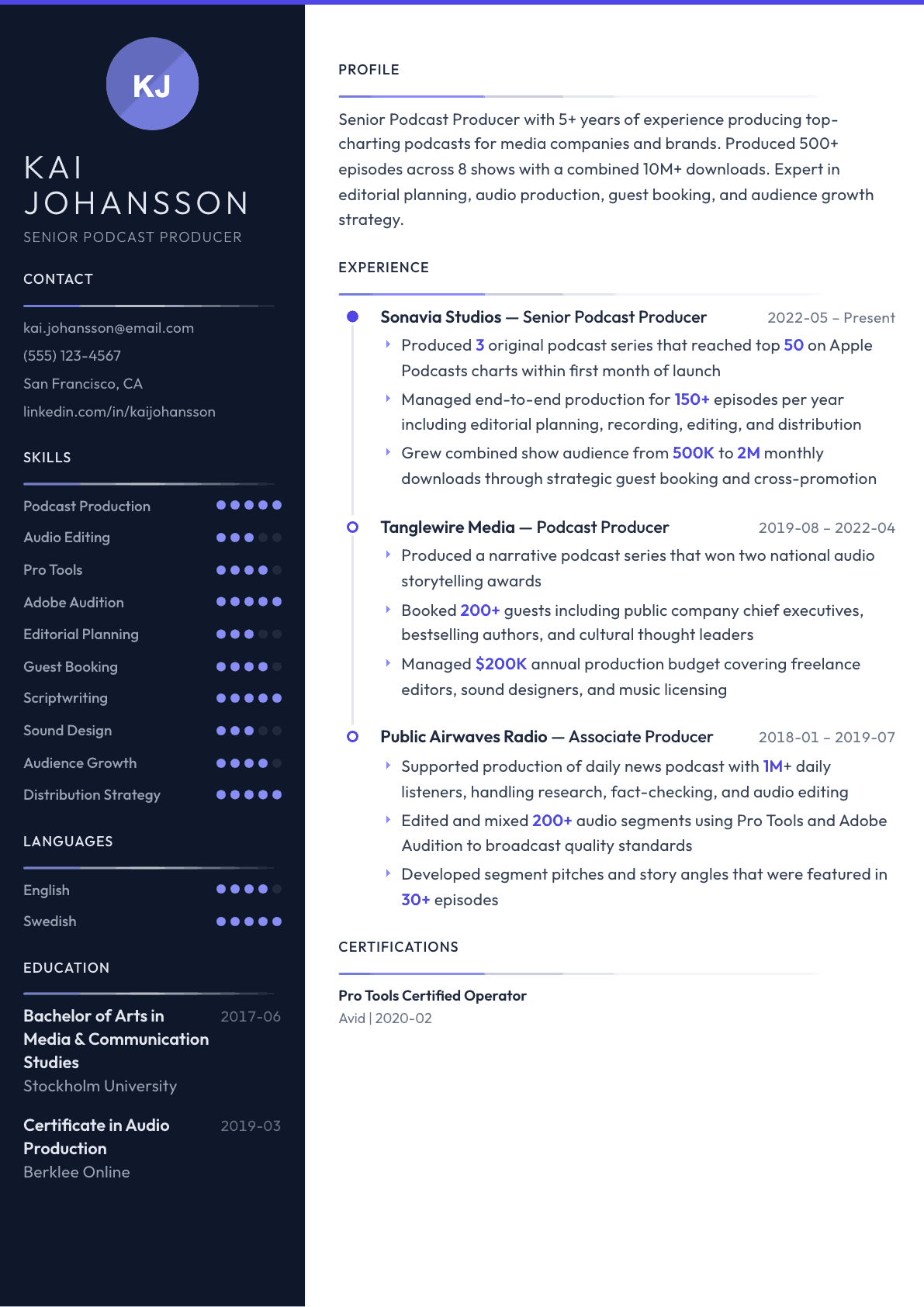
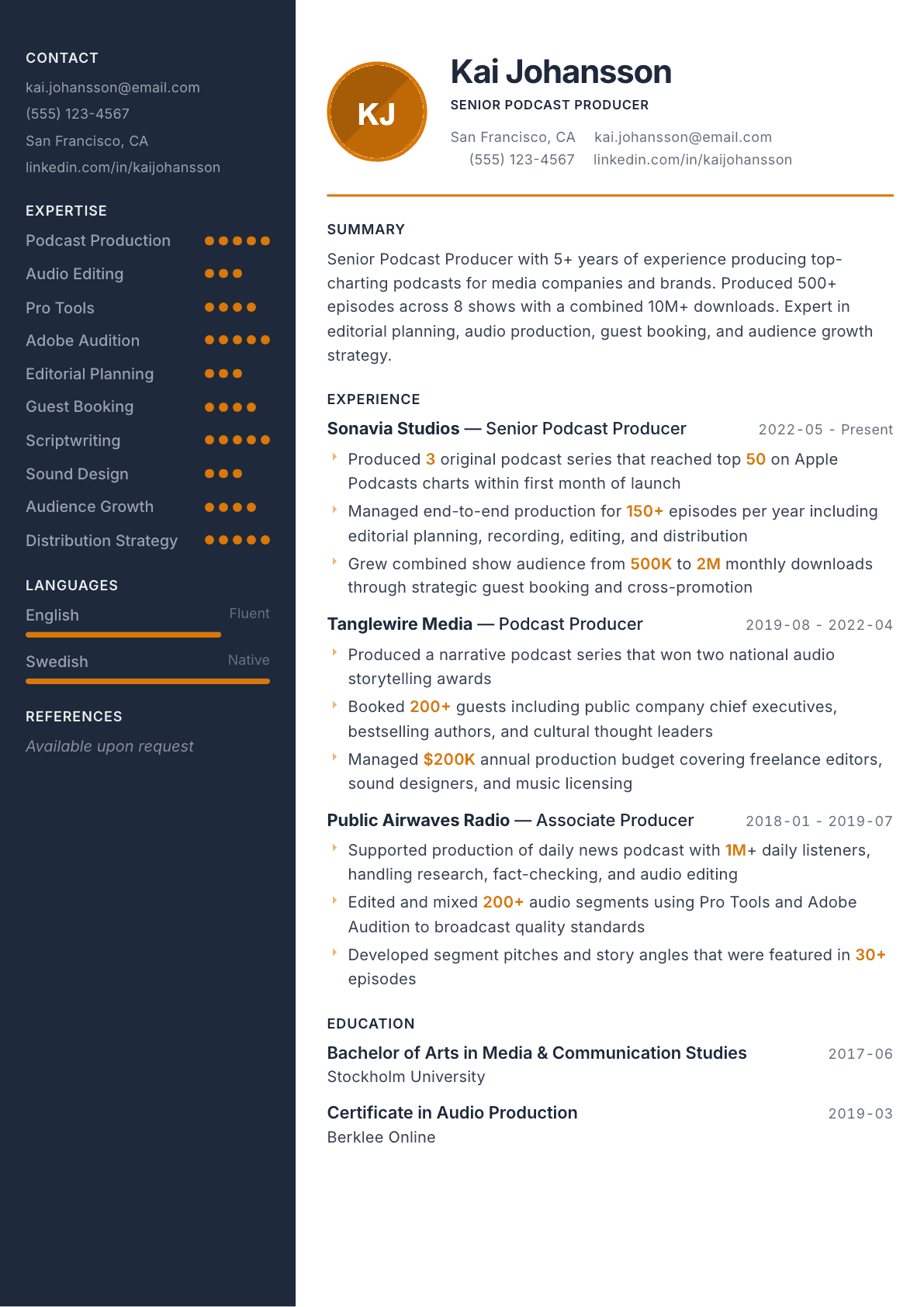
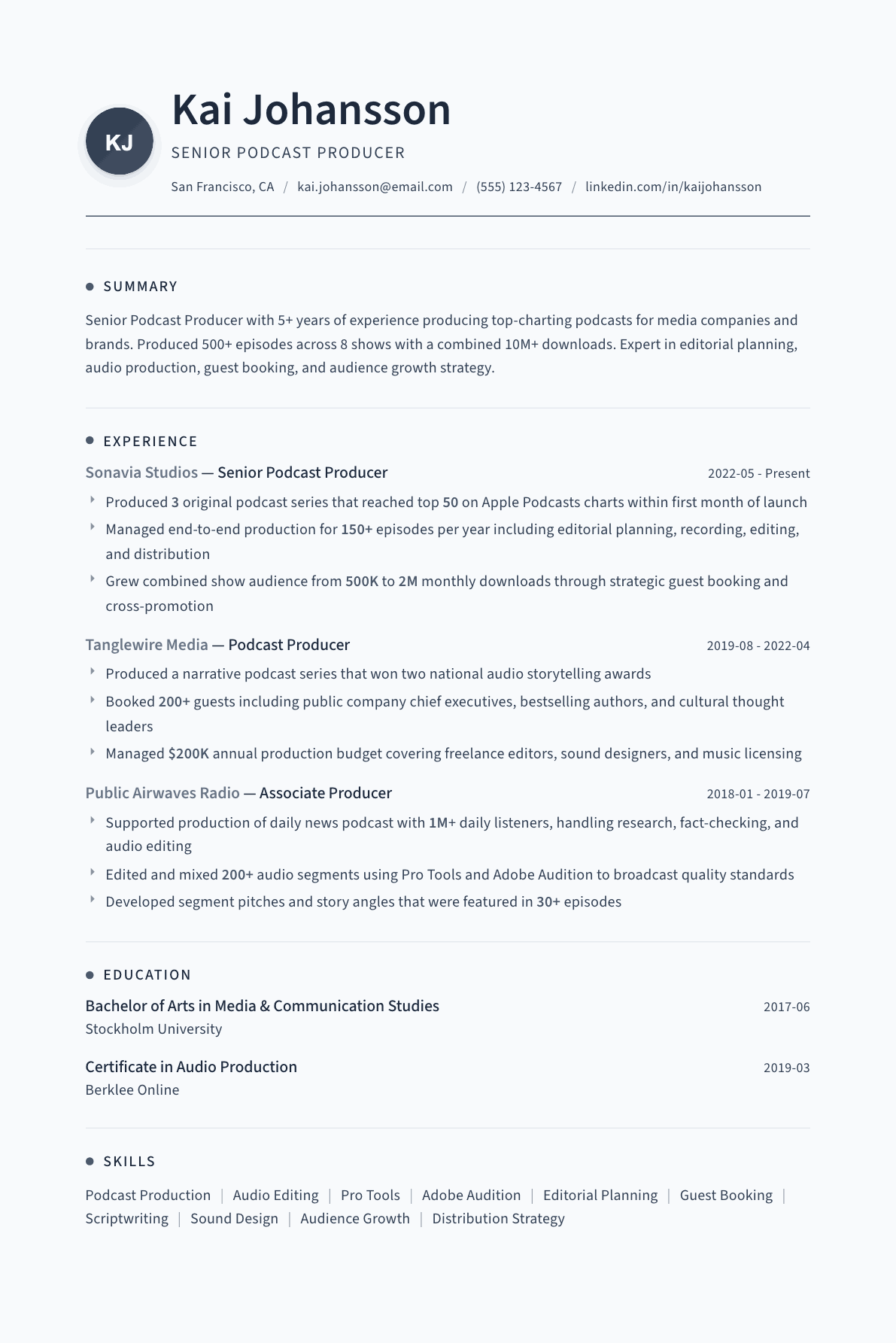
Example Podcast Producer summary
Podcast Producer with 5 years making top-charting shows for audio studios and brands. Produced 500+ episodes across 8 shows with 10M+ combined downloads and took one slate from 500K to 2M monthly downloads. Strong on narrative editorial, guest booking and Pro Tools post-production.
Skills to list on a Podcast Producer resume
- Podcast Production
- Audio Editing
- Pro Tools
- Adobe Audition
- Descript
- Editorial Planning
- Scriptwriting
- Guest Booking
- Sound Design
- Audience Growth
- Distribution
- Monetization
- Narrative Storytelling
- Remote Recording
What actually gets this resume read
- Lead with audience metrics: total downloads, monthly listeners, chart positions, and growth rates.
- List audio production tools: Pro Tools, Adobe Audition, Logic Pro, Descript, Hindenburg.
- Showcase editorial and storytelling skills -- podcast production is as much about content as it is about audio.
- Highlight guest booking experience and the caliber of guests you have secured.
- Include awards, chart positions, and press coverage to validate your production quality.
- Mention monetization experience: sponsorship management, ad insertion, premium content strategy.
How to write a podcast producer resume
Podcast producer covers at least three jobs that share a title. Some producers are editorial: they find the story, book the guest, write the script and run the interview. Some are technical: they cut tape, mix, master to broadcast loudness targets and deliver the file. Some are operational: they run the schedule, the budget, the sponsors and the publishing calendar. A resume that does not say which one you are, or which combination, is the reason most applications go nowhere.
The person hiring is usually an executive producer or a show lead who has a slot to fill on a specific format. They read for format fit first. A daily news podcast, a narrative documentary series, a weekly interview show and a branded podcast for a company all demand different instincts, different turnaround times and different tools.
This guide covers how to structure a producer resume around shows rather than duties, how to present audience figures honestly, three summaries by career stage, before and after bullets, and the questions producers ask when their best work is a sound and not a sentence.
Format: shows as the unit, one page, a link to tape
Reverse chronological by employer, but inside each employer list the shows. A producer who worked at one network for four years across three formats has a much stronger story when the shows are named and typed than when the years are simply stated.
Put a link to selected work in the header and make sure it opens to something curated: three or four clips with a line each on your role, not a full feed. Producers are hired on tape, and a hiring producer who has to hunt through 200 episodes to find your work will not.
- Header: name, city, email, portfolio or reel link, and one line naming your format specialty.
- Per show: title, format, cadence, your role, and the length of the run.
- State explicitly whether you cut your own audio or handed it to an engineer.
Summary: format, cadence, and the part of the job you own
Two or three lines. Name the formats you have made, the cadence you can sustain, and your center of gravity: editorial, technical, or production management. Cadence is a real screening criterion, because producing a daily show is a different skill from producing an eight part series and few people are strong at both.
If you have a genre, say it. Narrative journalism, business interviews, true crime, sports, branded content for companies. Show leads hire for a voice they already have in their head.
Experience: pitch, book, record, cut, publish
Walk each show through the pipeline you owned. Pitching and research: where the stories came from, how you built a guest pipeline, how far ahead you kept the board. Booking: the caliber and volume of guests, and how you handled preinterviews. Recording: studio, remote, field, and the setups you can run without a technician. Editing: the tools, the turnaround, and whether you did the story edit, the audio edit or both.
Name the technical facts a hiring producer cares about. Which digital audio workstation you cut in, whether you mix to a loudness target and can deliver a mastered file, whether you work with multitrack remote recording, how you handle noisy field audio, and whether you write the show notes, chapter markers and transcripts that go out with the episode.
Include the unglamorous operational work, because it is what breaks shows. Run of show documents, release calendars, rights and clearances for music, contributor contracts, ad slot management with dynamic insertion, and the handoff to the publishing platform. A producer who keeps a weekly show on schedule for two years is a rarer hire than one who made a beautiful single episode.
If you have done branded or corporate podcast work, treat it as its own line of experience with the client relationship named. It is a different sale and a different edit, and employers in that part of the market screen for it directly.
Audience numbers: precise, sourced, and modest
Give downloads with a window attached, because a download figure without one means nothing. Downloads in the first thirty days per episode is the standard the industry actually uses, so use it. Where you know the measurement source, name it.
Chart positions and awards are worth listing when they are real and specific: the category, the territory and the period. Avoid rounded claims of millions with no source, because everyone in this field knows how easily those are inflated, and an inflated number is the fastest way to lose an experienced hiring producer.
Skills: editorial and technical, kept separate
Split the skills block in two. Editorial: story structure, scripting, interviewing, guest research, fact checking, narration direction. Technical: the workstation, noise reduction, mixing and mastering, remote recording platforms, and the publishing and analytics tools.
Keeping them apart lets a technical show lead and an editorial show lead each find what they came for in one glance, and it stops you looking like a generalist who is average at everything.
Podcast Producer resume summary examples
Associate producer
Associate podcast producer with two years on a weekly business interview show. Book and preinterview guests, write the host prep document and cut a 45 minute episode in Descript and Adobe Audition on a two day turnaround. Journalism degree and student radio background.
Five years in
Podcast producer with five years across a daily news show and two limited narrative series. Own story pitching, scripting and the story edit, cut in Pro Tools and mix to broadcast loudness. Kept a daily show on schedule for 18 months with no missed publish, averaging 60 thousand downloads in the first month.
Senior or supervising producer
Supervising podcast producer with nine years in narrative audio, running two shows and a team of four producers plus freelance engineers. Own format development, budgets, contributor contracts and the release calendar, and led a six part documentary series that charted in its category.
Work experience bullets: before and after
Before: Produced a weekly podcast.
After: Produced a weekly 40 minute interview show for two years, owning guest booking, host prep, the story edit and final mix, and published on schedule for 96 consecutive episodes.
Format, length, cadence and an unbroken run tell a show lead you can be trusted with a slot.
Before: Edited audio for episodes.
After: Cut and mixed episodes in Pro Tools, mastered to a loudness target of minus 16 LUFS for stereo delivery, and rescued unusable field audio with iZotope RX on three location shoots.
Naming the workstation, the delivery target and a specific repair proves technical depth rather than familiarity.
Before: Booked guests for the show.
After: Built and maintained a rolling guest pipeline eight weeks deep, booking and preinterviewing roughly 50 guests a year including three sitting chief executives.
Pipeline depth is the metric bookers are actually judged on, and it shows planning rather than scrambling.
Before: Grew the audience.
After: Grew average first month downloads from 12 thousand to 47 thousand over four quarters by restructuring the cold open, adding a feed swap with two partner shows and publishing full transcripts.
The tactics make the growth credible, and a first month window makes the download figure comparable.
Before: Worked on a narrative series.
After: Story produced a six part narrative series: reported two of the episodes, structured the arc across the run, directed narration sessions and supervised the score and sound design with the composer.
Specific credits within the series show exactly what you contributed to a collaborative project.
Hard skills
- Story structure and scripting
- Guest research and booking
- Interviewing and preinterviews
- Pro Tools
- Adobe Audition
- Descript
- Hindenburg
- iZotope RX noise repair
- Mixing and mastering to loudness targets
- Remote multitrack recording
- Field recording
- Sound design and music clearance
- Publishing and hosting platforms
- Podcast analytics
Soft skills
- Directing hosts and narrators
- Working to a fixed publish date
- Editorial judgment
- Coordinating freelancers
- Handling sensitive interviews
Mistakes that cost podcast producer candidates the interview
- Not saying which shows you worked on, which makes every claim in the resume unverifiable.
- Linking to a full episode feed instead of three curated clips with your role stated on each.
- Quoting total downloads with no time window, which experienced producers read as inflation.
- Blurring the story edit and the audio edit, when hiring producers screen for exactly one of them.
- Leaving out cadence, so a daily show lead cannot tell whether you can hold a daily turnaround.
- Skipping the operational work: calendars, clearances, contracts and ad slots keep shows alive.
Podcast Producer resume questions
What should a podcast producer put in a portfolio?
Three or four clips of two to four minutes, each with one line naming the show, the format and exactly what you did on it. Include one piece of tape that shows a story edit and one that shows technical work, so both kinds of hiring producer find what they need.
How do I report download numbers honestly?
Use average downloads in the first thirty days per episode and say so, because that is the comparable industry window. Where the figure came from your hosting platform, name the platform. Avoid rounded totals across all time, which tell a reader nothing about the show now.
Do I need to be able to edit audio to be a podcast producer?
For most jobs outside large networks, yes. Smaller teams expect the producer to cut, mix and deliver the file. If your strength is editorial, say so plainly and list the workstation you are competent in rather than claiming a mixing depth you do not have.
How do I move from radio into podcasting?
Lead with the transferable craft: story structure, interviewing, tight turnaround and working to a clock. Then add the podcast specific pieces employers check for, which are remote multitrack recording, the publishing workflow, transcripts and the audience analytics that radio never asked you to read.
Should I list branded podcast work on my resume?
Yes, as its own clearly labeled experience. Branded and corporate audio is a large part of the market with its own hiring managers, and naming the client, the format and the client relationship you managed makes you the obvious candidate for those roles.