Marriage and Family Therapist Resume Examples: free score
Marriage and Family Therapist Resume With Systemic Practice Examples
By Mustafa Tarabya, founder of CVBooster · Published · Updated
Marriage and family therapist resume example with couples therapy bullets, systemic model keywords, and a guide to writing each section for MFT roles.
Sample resumes for a marriage and family therapist
The same marriage and family therapist content laid out in three CVBooster templates, so you can see what the finished document looks like before you write a word.
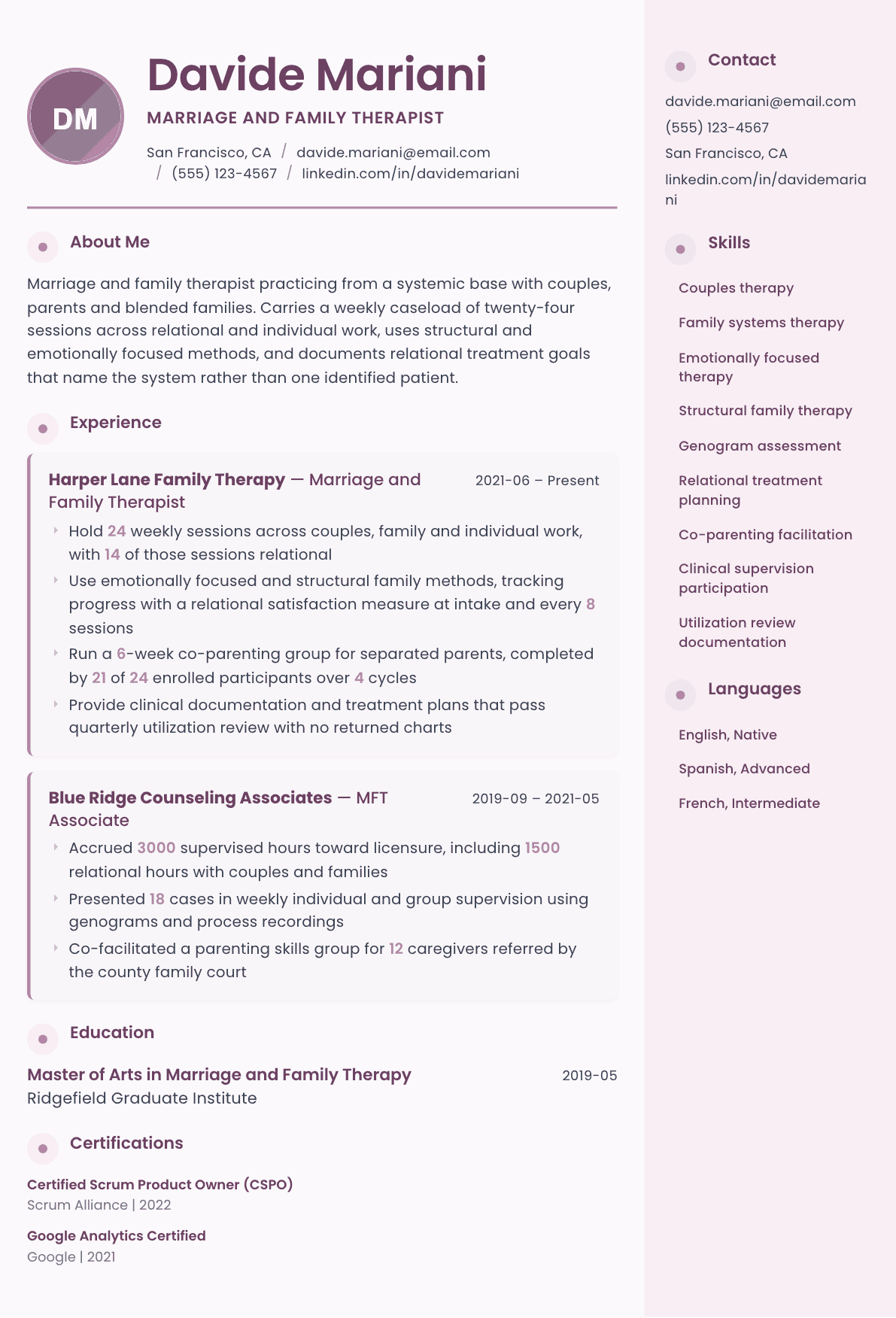
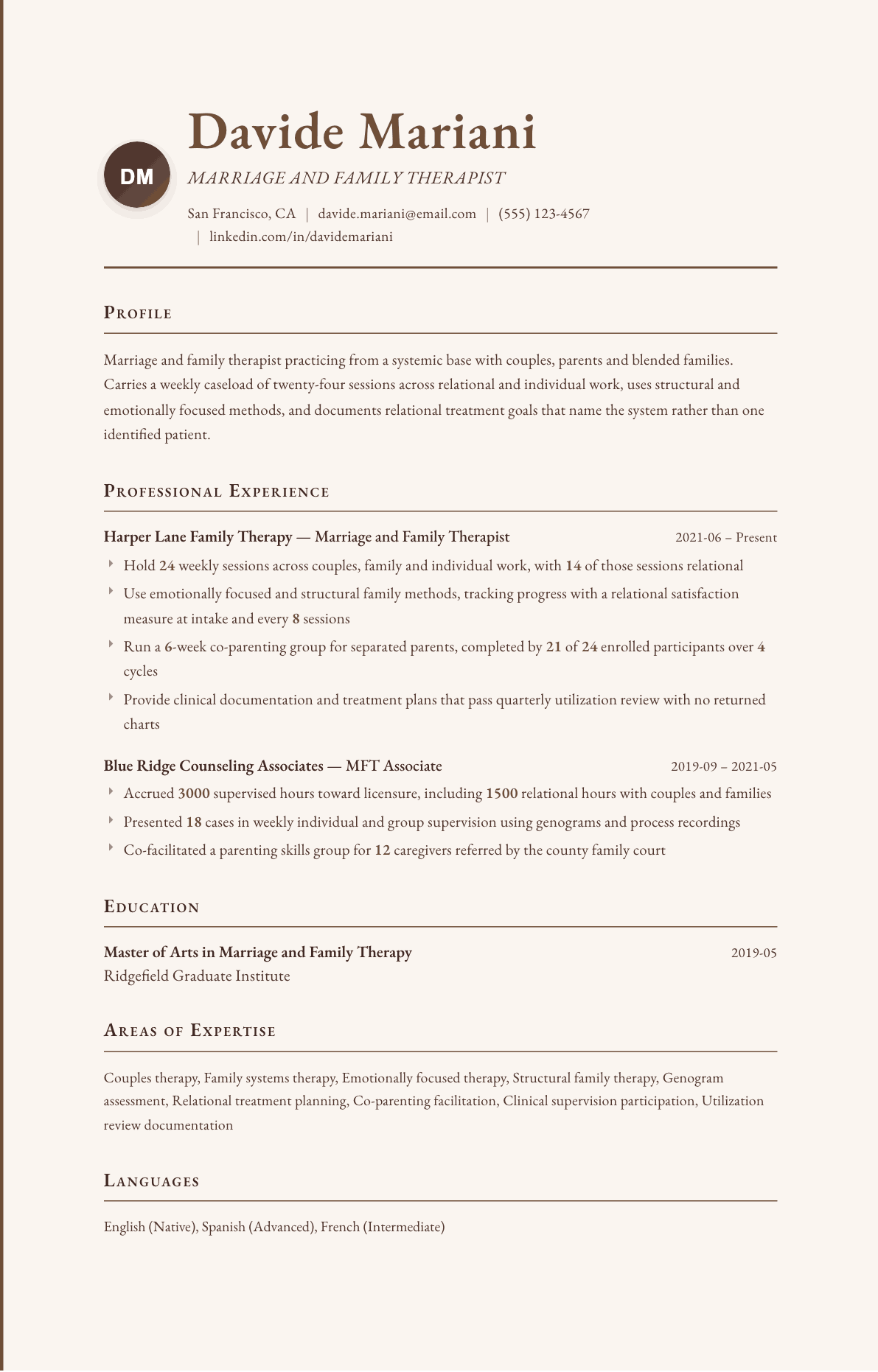
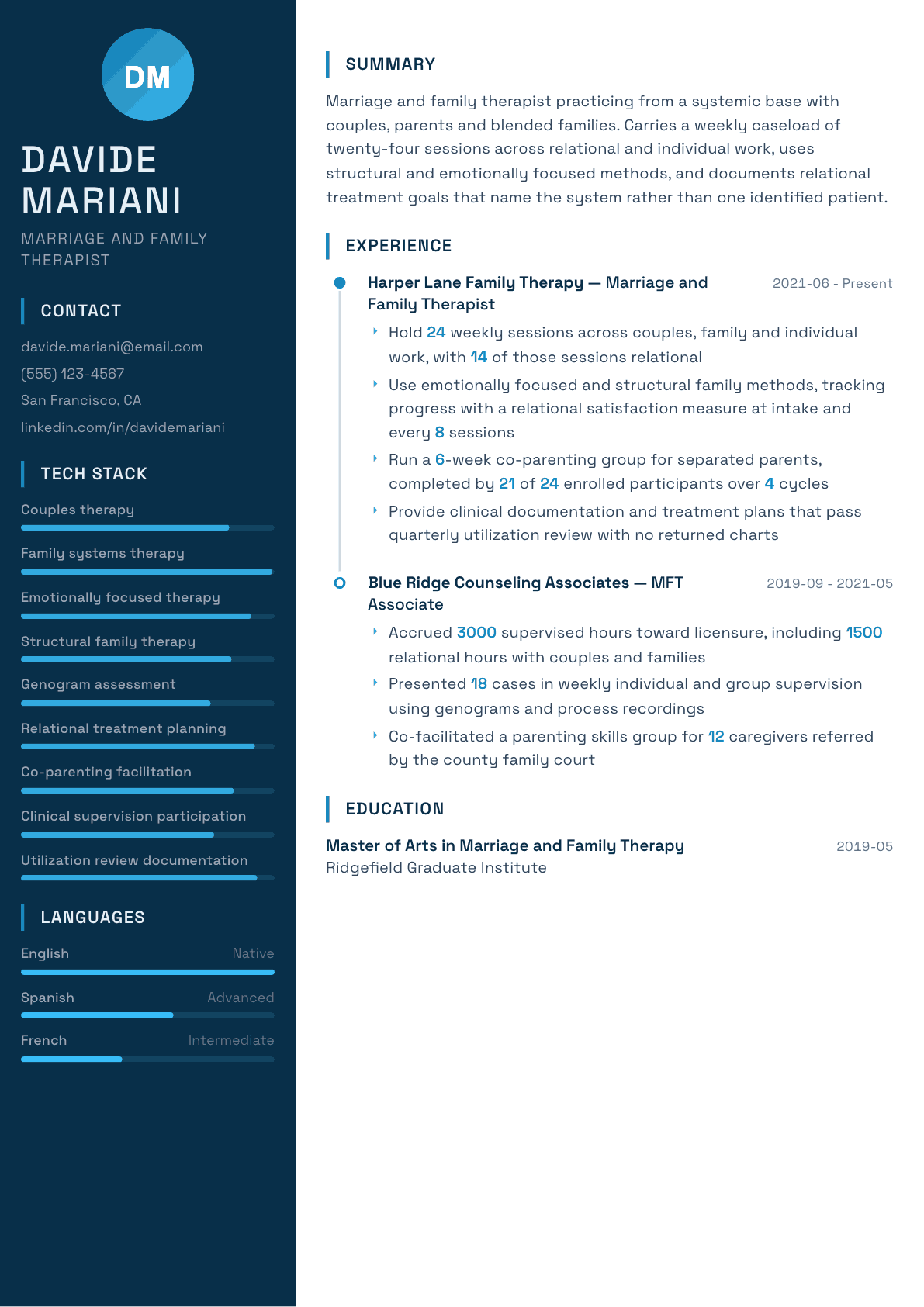
Example Marriage and Family Therapist summary
Marriage and family therapist with five years of systemic practice serving couples, parents and blended families. Carries twenty-four weekly sessions with the majority relational, works from emotionally focused and structural models, and measures relational satisfaction at intake and every eight sessions. Writes relational treatment goals that clear utilization review without returned charts.
Skills to list on a Marriage and Family Therapist resume
- Couples therapy
- Family systems therapy
- Emotionally focused therapy
- Structural family therapy
- Narrative therapy
- Genogram and relational assessment
- Relational treatment planning
- Co-parenting and divorce adjustment work
- Play-based family sessions
- Suicide and domestic violence risk screening
- Clinical documentation
- Utilization review compliance
- Group facilitation
- Supervision and case presentation
What actually gets this resume read
- Separate relational hours from individual hours, because MFT boards and clinical directors count them differently.
- Name the systemic models you actually practice, such as emotionally focused, structural, Bowenian or narrative therapy.
- Write treatment goals in relational language on the resume, since that is how an MFT supervisor spots real training.
- Include supervision history with the format and frequency if you are pre-licensed or recently licensed.
- Mention specialty populations such as blended families, co-parenting after separation, or premarital work.
- State your license or associate registration and the state, because reciprocity questions come up in the first call.
How to write a marriage and family therapist resume
A marriage and family therapist resume has to prove something no other clinical resume does: that you think in systems rather than individuals. A clinical director who trained as an MFT reads for it immediately. She looks at how you count your hours, how you phrase your treatment goals, and whether the couples and family work is at the center of the file or hiding underneath a pile of individual sessions.
The second thing she checks is relational hours, because licensure boards count them separately and a group practice building a couples caseload needs someone who has actually sat with two people in conflict for a full hour. Many applicants report a total hour count and leave the relational share invisible, which forces the reader to assume the worst.
This guide walks the sections in the order an MFT supervisor reads them, gives three summaries from associate to supervisor, before-and-after bullets that show how systemic work is usually undersold, and answers the questions therapists ask when they move between agency work, group practice and independent practice.
Format: credential block, then hours, then practice
Reverse chronological, one page while you are an associate and two once you hold a license with several settings behind you. The credential block sits directly under the header: license or associate registration, state, number where issued, and supervisor name and credential while you are pre-license. Boards and credentialing staff both start there.
Underneath the credential block, put a short hours line for anyone not yet fully licensed: total supervised hours, relational hours, and supervision format. It is the single most useful piece of information on a pre-license MFT resume and it belongs above the experience section rather than buried in it.
- Header: name with credential, city and state, phone, email, license or registration status.
- Order: credentials, supervised hours, clinical experience, training in systemic models, education, skills.
- Name your systemic models by their real names rather than describing them generically.
Summary: systemic identity in three lines
Say who you work with and how you think about them. Couples in distress, blended families after remarriage, parents and adolescents locked in a conflict cycle, or separated parents learning to co-parent are all recognizable specialties, and naming yours is more persuasive than describing a general family practice.
Then name the models. Emotionally focused therapy, structural family therapy, Bowen family systems, narrative therapy and solution-focused work are distinct traditions with distinct training paths, and a supervisor can tell instantly whether you have actually practiced one. Close with your weekly session load and how much of it is relational.
Experience: relational hours, session structure, the system in the room
Open each job with the setting and the session profile. An agency post might be twenty-four sessions weekly with fourteen of them relational, while a school-linked family program might be fewer sessions with more coordination. Give both numbers, because a group practice owner is calculating whether you can fill a couples schedule.
Then show systemic practice concretely. Who is in the room, how you handle a member who refuses to attend, how you use enactments or genograms, how you manage a session where one partner uses the hour to make a case against the other. These are craft questions and the answers are what separate trained systemic therapists from individual therapists who occasionally see couples.
Include measurement. A relational satisfaction measure at intake and at intervals, individual symptom screens for members who need them, and progress reviewed against goals written in relational language. Agencies and payers both ask for it, and few MFT resumes show it.
Treatment planning and documentation in relational language
The tell of a genuine MFT file is the way goals are written. An individual goal names a symptom in one person. A relational goal names an interaction pattern between people: the pursue and withdraw cycle, the coalition across a generation, the conflict that escalates whenever a stepparent sets a limit. Put one example of that phrasing on the resume, since it does more than any adjective could.
Then documentation compliance. Identify who is the client of record, how you handle consent and confidentiality when several family members attend, and whether your charts have cleared utilization review. Multi-member confidentiality is a live risk area and a therapist who addresses it plainly reads as experienced.
- Goals written as interaction patterns rather than individual symptom lists.
- Consent, no-secrets policy and release handling across multiple attending members.
- Utilization review outcomes and any returned chart history.
Specialties, supervision and keywords
Specialty work fills a practice. Co-parenting after separation, premarital preparation, infidelity recovery, family work around an adolescent with an eating disorder or substance use, blended family formation, and family sessions in a medical context are all niches a practice owner can market. Name yours and say how many cases or cycles you have carried.
The keyword layer for these postings is specific: marriage and family therapy, couples therapy, family systems, emotionally focused therapy, structural family therapy, genogram, relational treatment plan, co-parenting, premarital counseling, supervised relational hours. Use the ones you own, once in the skills block and once inside a job. If you hold or are pursuing a supervisor designation, say so, because supervision capacity is scarce in most agencies.
Marriage and Family Therapist resume summary examples
Associate accruing hours
Marriage and family therapy graduate with 900 supervised hours including 400 relational hours with couples and families. Trained in structural family therapy and emotionally focused methods, uses genograms in assessment, and presented 12 cases in weekly individual and group supervision.
Licensed with a couples caseload
Licensed marriage and family therapist holding 24 weekly sessions with 14 of them relational, working with couples, blended families and separated parents. Uses emotionally focused and structural methods, measures relational satisfaction at intake and every 8 sessions, and runs a 6-week co-parenting group.
Supervisor and practice lead
Marriage and family therapist supervising 6 associates in a group practice while carrying 16 weekly sessions, most of them couples. Runs a live supervision group, built the intake protocol that routes relational referrals correctly, and reduced first appointment wait from 4 weeks to 10 days.
Work experience bullets: before and after
Before: Provided therapy to couples and families.
After: Held 24 weekly sessions with 14 of them relational, working with couples, blended families and parents in conflict with adolescent children.
Splitting relational sessions from the total is the number MFT supervisors and licensing boards both count.
Before: Used family systems approaches in my work.
After: Practiced from emotionally focused and structural family models, using enactments in session and genograms at assessment to map the pattern across two generations.
Named models plus a named technique prove training that a general reference to systems work never does.
Before: Wrote treatment plans for the families I saw.
After: Wrote relational treatment goals describing interaction patterns rather than individual symptoms, reviewed them with every attending member, and cleared quarterly utilization review with no returned charts.
Goal phrasing is the clearest evidence of systemic training, and the review result proves it satisfies payers.
Before: Ran a group for separated parents.
After: Designed and facilitated a 6-week co-parenting group for separated parents referred by family court, completed by 21 of 24 enrolled participants across 4 cycles.
Referral source, cycle count and completion rate turn a group into a program with measurable reach.
Before: Completed my supervision requirements.
After: Accrued 3000 supervised hours including 1500 relational hours, presenting 18 cases across weekly individual and group supervision using process recordings and session video.
Separating relational hours and naming the supervision method shows exactly how the training was earned.
Hard skills
- Couples therapy
- Family systems therapy
- Emotionally focused therapy
- Structural family therapy
- Narrative and solution-focused methods
- Genogram and relational assessment
- Relational treatment planning
- Co-parenting and separation adjustment work
- Multi-member consent and confidentiality practice
- Domestic violence and risk screening in couples work
- Relational outcome measurement
- Clinical documentation and utilization review
Soft skills
- Balancing alliance with two people at once
- Interrupting a cycle without taking sides
- Tolerating conflict in the room
- Reflective use of supervision
- Managing a family member who attends unwillingly
Certifications worth listing
- AAMFT Approved Supervisor (American Association for Marriage and Family Therapy)
- Certified Emotionally Focused Therapist (International Centre for Excellence in Emotionally Focused Therapy)
- National Certified Counselor (NCC) (National Board for Certified Counselors)
Mistakes that cost marriage and family therapist candidates the interview
- Reporting one total hour figure so a reader cannot see how much of the work was actually relational.
- Describing a systemic approach in general terms without naming a model you have trained and practiced in.
- Writing treatment goals as individual symptom lists, which signals individual training in a systemic post.
- Leaving multi-member confidentiality unaddressed when it is the risk area supervisors probe in interviews.
- Filling the resume with individual therapy sessions when the position was posted to build a couples caseload.
- Omitting screening for domestic violence in couples work, which reads as a serious gap to any experienced supervisor.
Marriage and Family Therapist resume questions
How should I report relational hours toward MFT licensure?
Report total supervised hours and relational hours as separate figures, then add the supervision format and your supervisor credential. Boards count relational hours specifically, and a group practice hiring you before full licensure needs to know how many you still have to accrue.
Can I apply for MFT positions if most of my experience is individual therapy?
Yes, but reorganize the file so every family and couples case you have carried appears first, and name your systemic training explicitly. Then be honest about the balance. Supervisors are more willing to develop a therapist who states the gap than one who obscures it.
What models should I name on an MFT resume?
Only the ones you have trained in and used with real cases. Emotionally focused therapy, structural family therapy, Bowen family systems, narrative and solution-focused approaches are all recognizable. Naming five you have merely read about is the fastest way to lose credibility in the first interview question.
How do I handle confidentiality when writing about family cases?
Keep everything at the level of patterns and volumes rather than stories. Say how many couples or families you carried, what the presenting patterns were in general terms, and what methods you used. Never include a case narrative detailed enough for anyone to recognize.
What makes an MFT resume attractive to a private group practice?
Caseload capacity, a couples specialty that fills a schedule, insurance panels you are already credentialed with, and comfort documenting independently. Add any niche referral relationship you hold, such as family court or a fertility clinic, because a practice owner reads that as a stream of referrals arriving with you.
Related resume examples
- Social Worker Resume example
- Case Manager Resume example
- Psychotherapist Resume example
- Licensed Clinical Social Worker Resume example
- Counselor Resume example
- Licensed Professional Counselor Resume example