Power BI Developer Resume Examples: the lines they read
Craft a Power BI Developer Resume That Shows Model Quality
By Mustafa Tarabya, founder of CVBooster · Published · Updated
Power BI developer resume examples, DAX and data modeling keywords, plus a writing guide covering semantic models, gateways and report performance work.
Sample resumes for a power bi developer
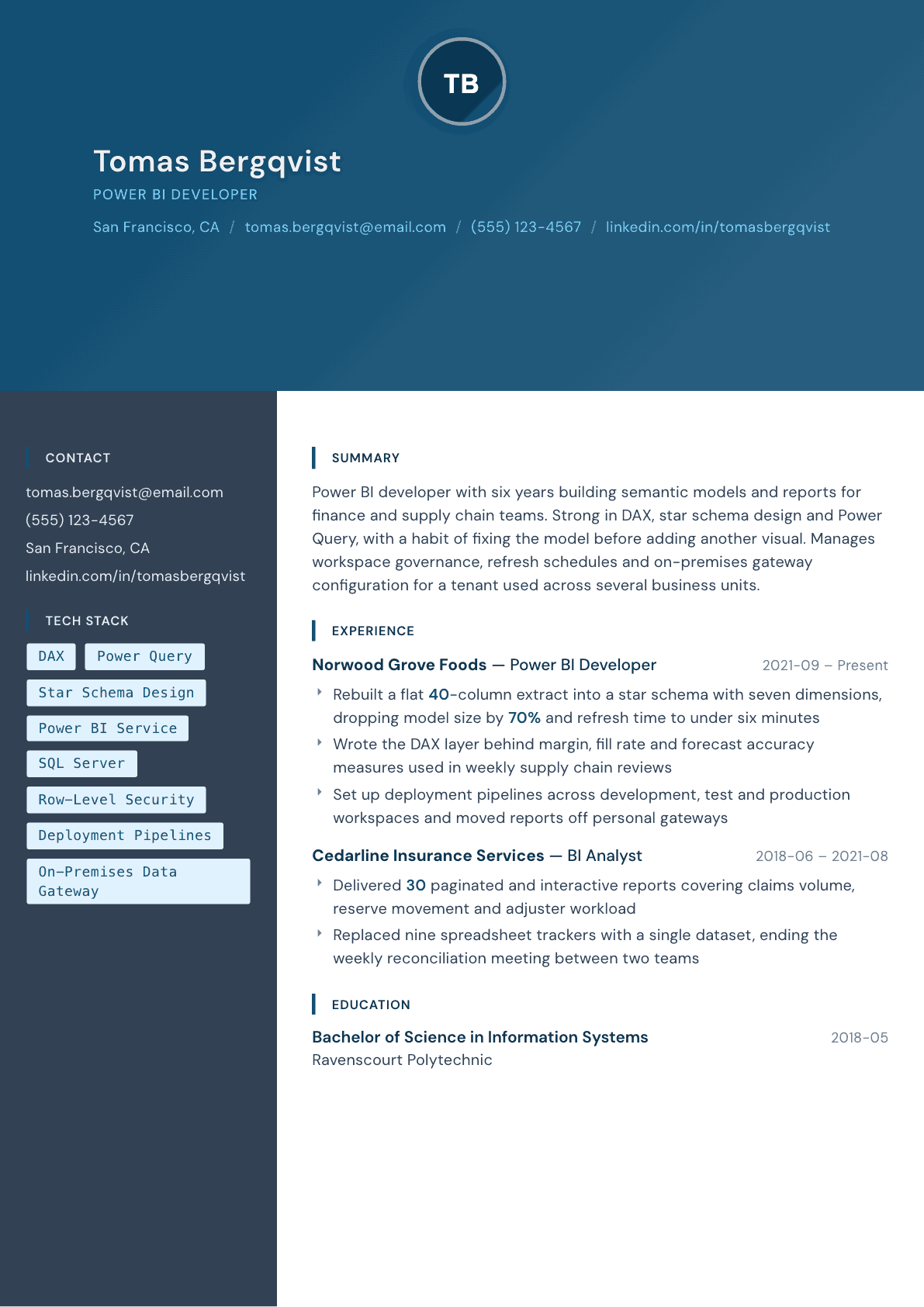
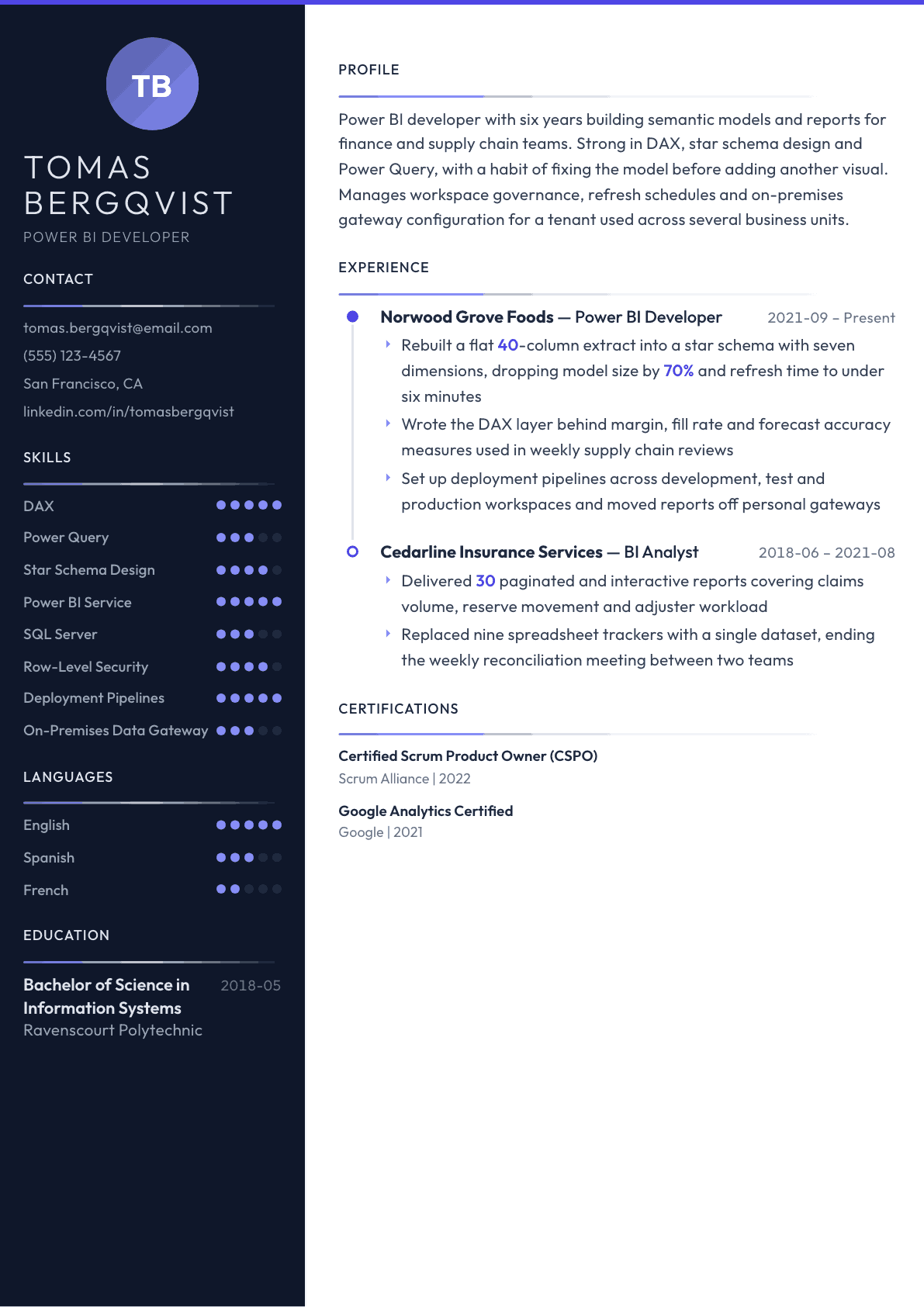
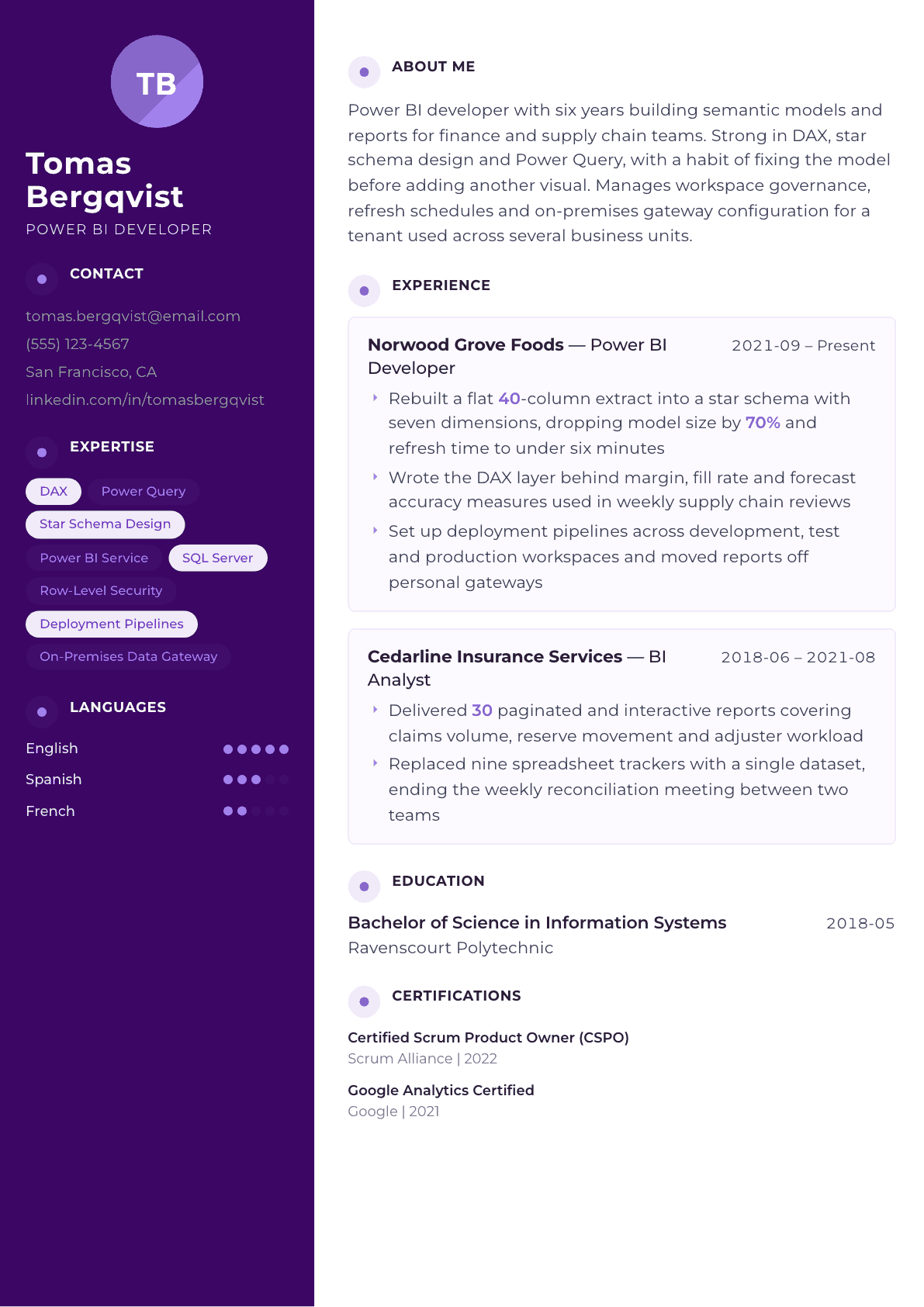
The same power bi developer content laid out in three CVBooster templates, so you can see what the finished document looks like before you write a word.
Example Power BI Developer summary
Power BI developer with six years turning slow spreadsheet reporting into governed semantic models. Designs star schemas, writes the DAX measure layer, and tunes refresh and query performance with Tabular Editor and DAX Studio. Owns workspace roles, deployment pipelines and gateway configuration for a tenant serving finance and supply chain users across several business units.
Skills to list on a Power BI Developer resume
- DAX
- Power Query
- M Language
- Star Schema Design
- Semantic Modeling
- Power BI Service
- Row-Level Security
- Deployment Pipelines
- On-Premises Data Gateway
- SQL Server
- Azure Data Factory
- Microsoft Fabric
- Paginated Reports
- Tabular Editor
- DAX Studio
- Report Performance Tuning
What actually gets this resume read
- Lead with the data model, not the visuals: star schema design and DAX are what a hiring manager screens for.
- Say which sources you pull from, such as SQL Server, Dataverse, SAP or flat files, and how the refresh runs.
- Give report performance numbers: model size, refresh duration, or the page load time you brought down.
- Show governance work like workspace roles, deployment pipelines, row-level security and gateway ownership.
- Name the business function each report served, because finance reporting and manufacturing reporting hire differently.
- Keep a short section for the wider Microsoft data stack you touch, such as Fabric, Synapse or Azure Data Factory.
How to write a power bi developer resume
Hiring managers for Power BI roles have all inherited the same mess at least once: a workbook someone published from a laptop, forty columns wide, refreshing on a personal gateway, with measures copied between six reports. So the resume that wins is the one that proves you build models, not screenshots.
That means the top of your resume should carry the modeling vocabulary: star schema, fact and dimension tables, relationships, DAX measure layer, incremental refresh, row level security. Visual design still matters, but nobody hires a developer for choosing a chart type. They hire for the layer underneath that keeps the chart honest and fast.
This guide sets out the section order, how to describe a semantic model without listing every visual, three example summaries by career stage, before and after bullets that a data manager would react to, and the questions candidates ask when they move from analyst work into a developer title.
Format: one page early, two pages once you own a tenant
Reverse chronological with a technical skills block near the top. A Power BI developer resume should be readable by a data engineering lead and by a finance director, so keep the language concrete and skip decorative graphics. A resume for a visualization role does not need to be a visualization.
Put a short environment line under each employer: the source systems, the tenant setup, the number of workspaces or models you owned, and the audience size. That single line does more work than three bullets of tool names.
- Header: name, title, city, phone, email, and a portfolio link only if the reports shown use public data.
- Order: summary, technical skills, experience, certifications, education.
- Environment line per role: sources, workspaces owned, model count, report consumers.
Summary: modeling depth first, then the business area
Say what you build and for whom. A developer who models supply chain data for planners is a different hire from one who builds finance consolidation reporting, and the domain often decides the shortlist. Then name the modeling and performance work you are strongest in.
Avoid the phrase data driven decisions. Every candidate writes it and it carries no information. Replace it with the thing you actually changed: a refresh window, a close cycle, a manual report that stopped being produced.
Experience: model, DAX, performance, governance
Model bullets should describe the shape you built and why. Moving a wide flat extract into a star schema with named dimensions, adding a proper date table, and setting relationship cardinality deliberately is the work that makes everything else possible. Give the resulting model size and refresh time, because those two numbers are the fastest proof a reader can verify in an interview.
DAX bullets should name the measures by business meaning rather than by function. Built the margin, fill rate and forecast accuracy measure set used in the weekly planning review tells a manager the measures are trusted. Wrote complex DAX does not.
Governance bullets are what separate a developer from a report author. Workspace roles, deployment pipelines across development, test and production, row level security tied to a security group, gateway ownership, and dataset certification all belong here. Many teams hire specifically because nobody currently owns those.
- Model: schema shape, dimension count, model size, refresh duration and refresh method.
- DAX: the measure families you own and where their numbers are used.
- Performance: what was slow, what you changed, and the tool you diagnosed it with.
- Governance: workspace structure, pipelines, row level security, gateway and certification.
- Sources: the systems you extract from and how the data lands before the model reads it.
Skills: the Microsoft data stack around the report
List DAX, Power Query and the M language separately, since they are genuinely different skills and postings ask for them by name. Add the source side: SQL, the warehouse or lakehouse platform, and any pipeline tool you use to land data. Include Tabular Editor and the performance analyzer tooling because they signal that you tune models rather than rebuild them.
If you work in the newer unified analytics platform, say which items you use: lakehouse, warehouse, pipelines, semantic models. Vague platform name dropping is easy to test and easy to fail.
Keywords a data hiring manager searches for
Postings repeat a small vocabulary: semantic model, star schema, DAX, Power Query, incremental refresh, row level security, deployment pipeline, gateway, paginated report, dataset certification, and the source systems. Use each one where it is true and attach it to something you did.
One caution on portfolios. A link to a report full of a former employer data is a red flag rather than a credential. Rebuild the sample on public data before you link it.
Power BI Developer resume summary examples
Analyst moving into development
Reporting analyst moving into Power BI development with two years building datasets for a finance team. Comfortable in Power Query and writing measure logic in DAX, and recently rebuilt a 30-column extract into a small star schema that cut refresh from 18 minutes to 4. Certified in Power BI data analysis.
Six years, model owner
Power BI developer with six years owning semantic models for supply chain and finance. Designs star schemas, writes the measure layer behind margin and fill rate reporting, and tunes refresh with Tabular Editor and query diagnostics. Manages deployment pipelines and row level security across a tenant used by several business units.
Analytics lead
Analytics lead with eleven years across Power BI and the wider Microsoft data stack. Sets modeling standards, reviews every certified dataset before release, and mentors four developers. Recent program consolidated 60 overlapping reports into nine certified models with documented owners and a published refresh calendar.
Work experience bullets: before and after
Before: Created dashboards and reports in Power BI.
After: Built nine certified semantic models feeding 40 reports for supply chain and finance, each with a documented owner, refresh window and support contact.
Certified models with owners and refresh windows describe a platform, while dashboards and reports describes output anyone can produce.
Before: Improved report performance.
After: Rebuilt a flat 40-column extract into a star schema with seven dimensions, dropping model size by 70% and full refresh from 24 minutes to under 6.
Naming the schema change and giving both before and after numbers proves the improvement came from modeling, not from hiding visuals.
Before: Wrote DAX measures for business users.
After: Wrote the margin, fill rate and forecast accuracy measure set used in the weekly supply chain review, with a shared date table and consistent time intelligence.
The business meaning and the shared date table show the measures are governed rather than pasted per report.
Before: Handled data refresh and gateways.
After: Moved 30 datasets off personal gateways onto a clustered on-premises gateway, added incremental refresh on the two largest fact tables, and published a refresh calendar.
The migration, the refresh technique and the published calendar make reliability visible instead of assumed.
Before: Set up security for reports.
After: Implemented row level security tied to directory security groups across four models, and tested each role with the security preview before every release.
Linking security to groups and naming the test step turns a checkbox into a repeatable release practice.
Hard skills
- DAX measure design
- Power Query and M
- Star schema and dimensional modeling
- Incremental refresh configuration
- Row level security
- Deployment pipelines
- On-premises data gateway administration
- Tabular Editor
- Query diagnostics and performance tuning
- SQL and source extraction
- Paginated report authoring
- Workspace and dataset governance
Soft skills
- Requirement translation with business users
- Data storytelling in review meetings
- Documentation of model logic
- Pushing back on report sprawl
- Stakeholder training
- Prioritizing a report request queue
Certifications worth listing
- Microsoft Certified: Power BI Data Analyst Associate (Microsoft)
- Microsoft Certified: Fabric Analytics Engineer Associate (Microsoft)
- Microsoft Certified: Azure Data Fundamentals (Microsoft)
- Microsoft Certified: Azure Data Engineer Associate (Microsoft)
Mistakes that cost power bi developer candidates the interview
- Listing visuals and chart types instead of the model underneath, which reads as report authoring rather than development.
- Giving no refresh times or model sizes, leaving a reader unable to judge whether you have worked at any real scale.
- Claiming the whole Microsoft data stack when your work stopped at the report layer.
- Linking a portfolio built on a former employer data, which raises a confidentiality question instead of demonstrating skill.
- Ignoring governance entirely, when workspace structure and security are often the reason the role is open.
- Filling the skills block with generic analytics phrases that crowd out the exact terms a recruiter searches.
Power BI Developer resume questions
Should a Power BI developer resume include a portfolio link?
Only if the reports run on public or synthetic data and load quickly. A clean sample model with visible measure logic helps; a slow report built on former employer data hurts you twice, on confidentiality and on performance.
How much SQL should I claim as a Power BI developer?
Claim what you can write under interview pressure: joins, aggregation, window functions and a view. Most teams expect the developer to shape the source query rather than pull a wide table and fix it inside Power Query.
Is the Power BI data analyst certification worth listing?
Yes, especially for candidates without a developer title yet. It clears automated filters and confirms modeling vocabulary. Once you have several years of model ownership, your experience section carries more weight than the credential.
How do I describe work done in the newer Fabric workloads?
Name the specific items you used, such as lakehouse tables, warehouse queries, data pipelines or direct lake semantic models. Generic platform mentions invite a technical question you cannot answer, while item level detail proves hands-on use.
What if my reports were built for a small company with little data?
Lead with modeling discipline instead of volume: the schema you chose, the date table, security setup and the manual reporting you eliminated. Small data done properly interviews better than large data handled as one flat extract.
Related resume examples
- Data Analyst Resume example
- Data Engineer Resume example
- Business Intelligence Analyst Resume example
- Analytics Engineer Resume example
- SQL Developer Resume example
- C# Developer Resume example