Database Administrator Resume Examples: read this first
A Database Administrator Resume That Proves the Restore Works
By Mustafa Tarabya, founder of CVBooster · Published · Updated
Database administrator and database engineer resume samples, with the environment line, tuning and recovery bullets, keywords and a full writing guide.
Sample resumes for a database administrator
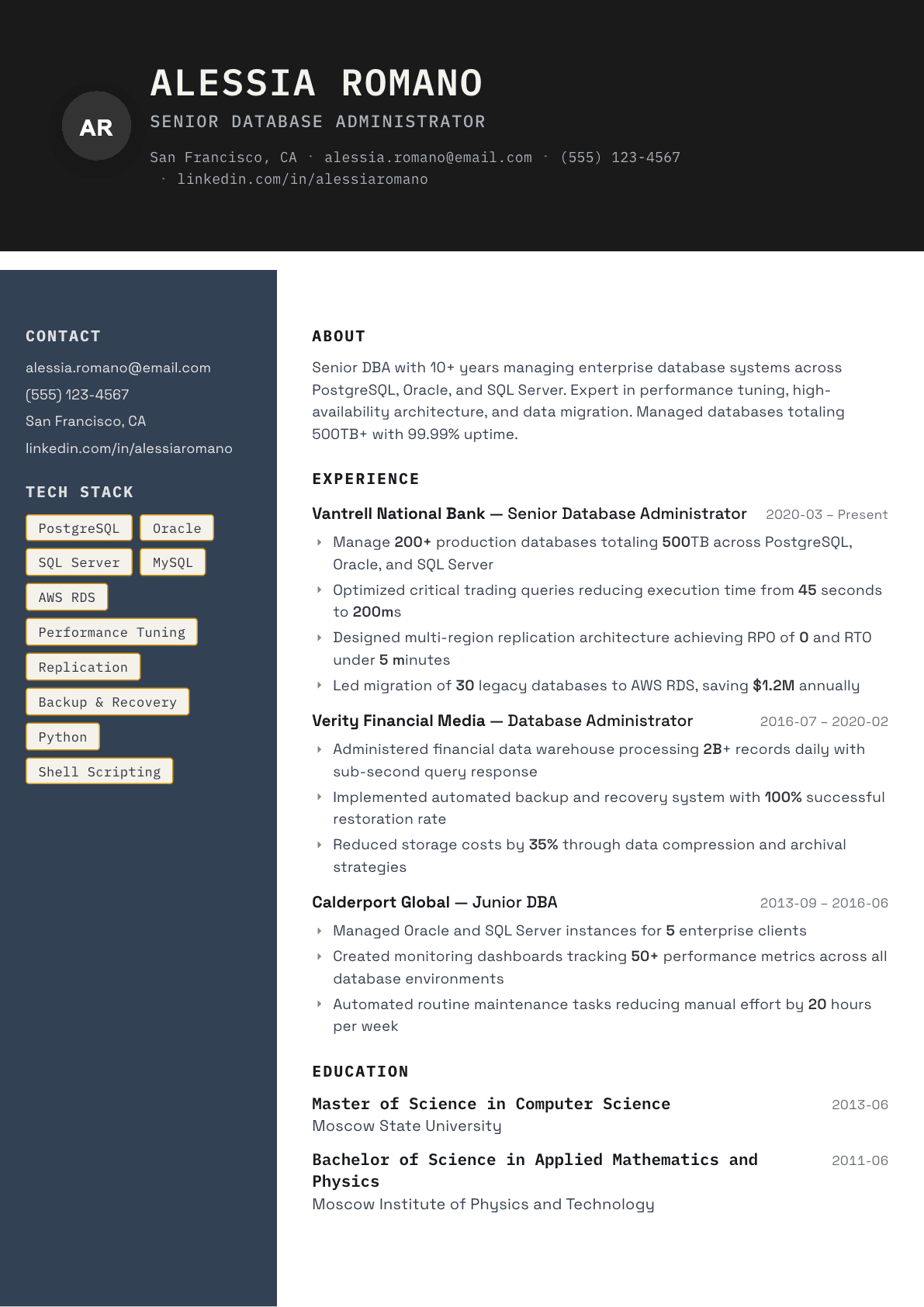
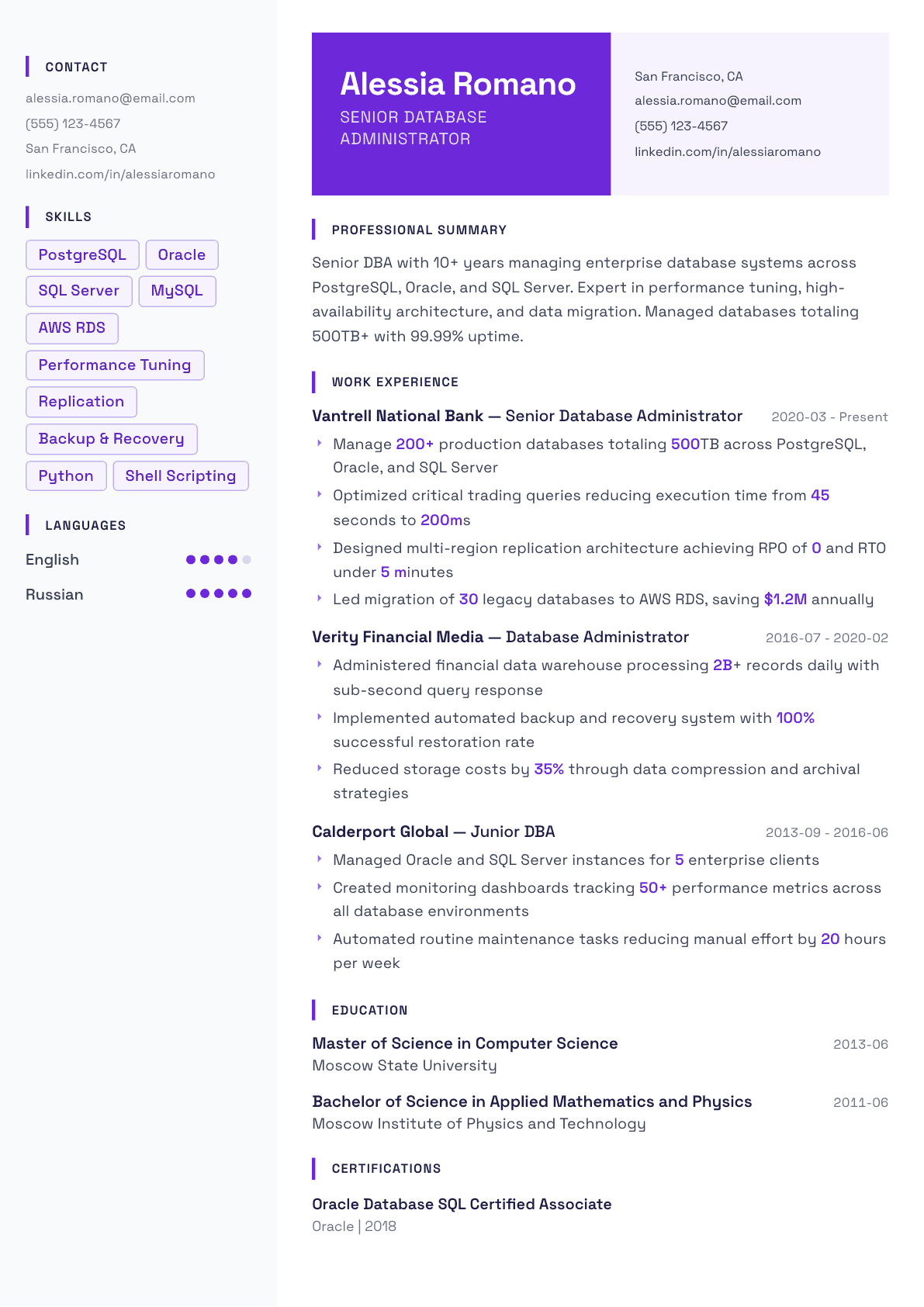
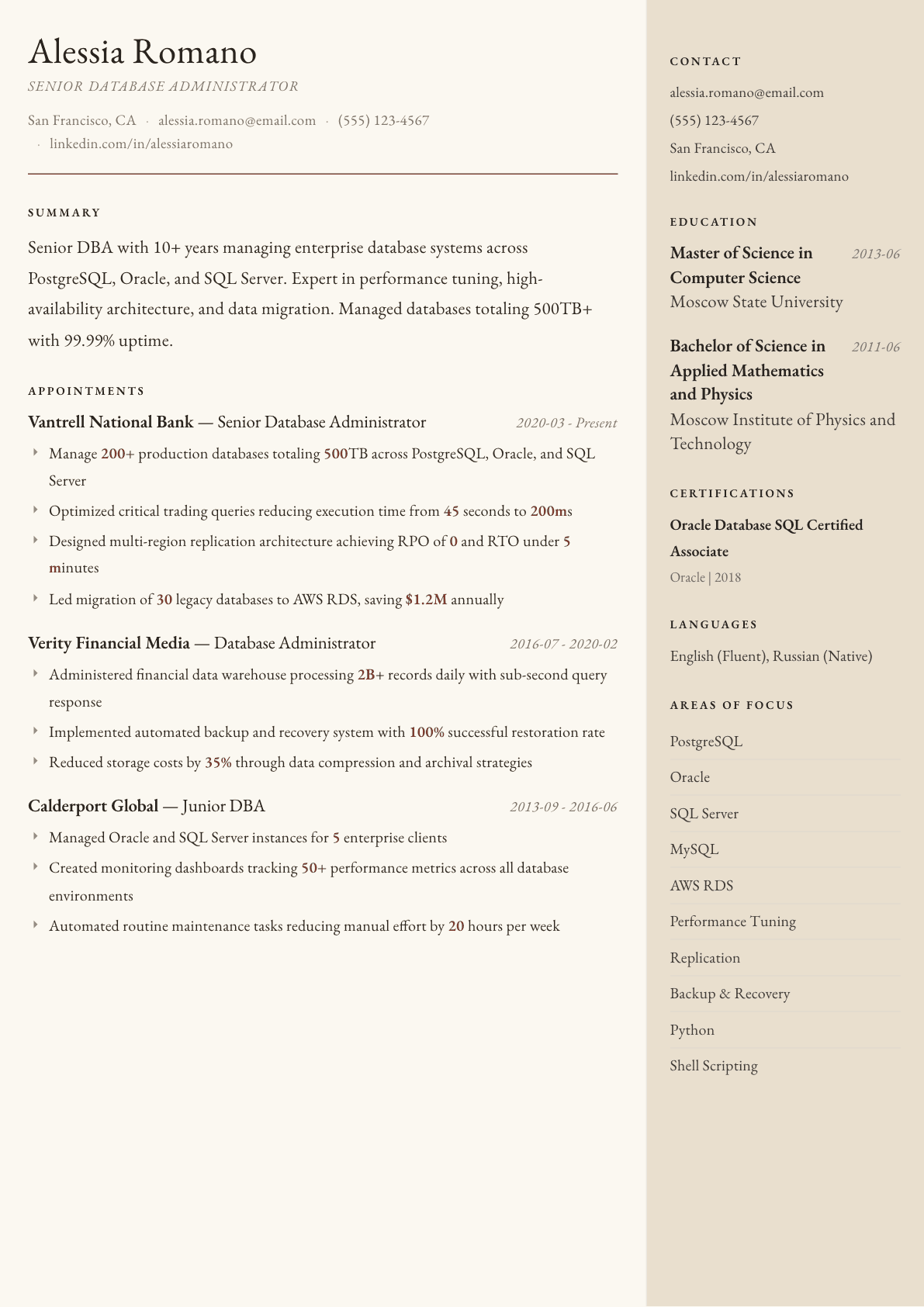
The same database administrator content laid out in three CVBooster templates, so you can see what the finished document looks like before you write a word.
Example Database Administrator summary
Oracle certified DBA, 10 years, holding 200 production databases and 500TB across PostgreSQL, Oracle and SQL Server at 99.99% availability. Tuned a critical trading query from 45 seconds to 200 milliseconds, designed multi-region replication with zero data loss, and moved 30 legacy databases to AWS RDS for $1.2M a year.
Skills to list on a Database Administrator resume
- PostgreSQL
- Oracle
- SQL Server
- MySQL
- MongoDB
- AWS RDS
- Performance Tuning
- Replication
- Backup & Recovery
- Data Migration
- Python
- Shell Scripting
- Monitoring
- High Availability
What actually gets this resume read
- List all database platforms you manage with version numbers.
- Quantify database size, transaction volumes, and uptime metrics.
- Highlight performance tuning achievements with before/after metrics.
- Include disaster recovery and backup experience.
- Show cloud database migration expertise.
How to write a database administrator resume
A database administrator resume is evaluated on trust. The person hiring is handing over the systems that cannot be re-created from a repository, and the question behind every line of the page is whether you have restored a production database under pressure and had the restore work. Everything else, the tuning, the automation, the migrations, sits on top of that one proof.
Because of that, this is one of the few technical resumes where platform and version numbers matter as much as the achievements. A senior administrator on Oracle Real Application Clusters and one on managed PostgreSQL in a cloud provider have different daily lives, different failure modes and different interviews. Naming the platform, the edition and the high-availability topology tells a manager immediately which conversation to have with you.
This guide covers each section as a database manager reads it, with three summaries at recognizable levels, before-and-after bullets that put numbers behind tuning claims, and the questions administrators ask as their estates move into managed cloud services.
Format: two pages is fine, environment details under every job
Reverse chronological, single column. Two pages is normal because the role accumulates platforms. The unusual requirement here is an environment line under each job title giving the engines and versions, the number of instances, the largest database size, and the availability target you were held to.
Recruiters filter on engine names, so write PostgreSQL, Microsoft SQL Server, Oracle Database, MySQL and MongoDB in full at least once rather than only in abbreviations.
- Header: name, title, location, email, and the certifications in short form.
- Order: summary, platforms and versions, experience, automation and scripting, certifications, education.
- Under each job: engines and versions, instance count, largest database, availability target, on-call arrangement.
Summary: engines, estate size, and the availability you have held
Three lines. Name your primary engine and the secondary one, the size of the estate in instances and total data, the high-availability topology you have run, and the recovery objectives the business set. A database administrator who states the recovery time and recovery point objectives they designed to is speaking the language the interview will use.
If you have moved estates into managed cloud services, say it here. Migration from self-managed instances to a managed platform is the dominant project type in this field and hiring managers search for candidates who have already done one.
Backup and recovery: write it as if the reader will only read this section
Give it real space, because most resumes reduce it to the phrase backup and recovery and lose the strongest evidence available. Describe the strategy: full, differential and log backups on their schedule, retention, offsite or cross-region copies, and whether backups are encrypted.
Then describe testing. Restores you have actually performed, how often you test them, the largest restore you have completed and how long it took, and any point-in-time recovery you have run against a real incident. One bullet about a recovery you executed under pressure outweighs a paragraph about a backup policy that exists on paper.
Performance tuning: before and after, with the method in between
Tuning claims are worthless without numbers on both sides. Give the symptom, what you found, what you changed and the measured result. A missing index found through a wait statistics review, a query rewritten to avoid a scan, a statistics or parameter sniffing issue, a badly chosen fill factor, a vacuum and autovacuum configuration that could not keep up with the write rate.
Name the diagnostic path. Execution plans, wait events, the automatic workload repository on Oracle, dynamic management views on SQL Server, the statistics collector and slow query log on PostgreSQL and MySQL. A manager can tell within one bullet whether you tune by evidence or by guesswork.
Automation, upgrades and the modern part of the job
The role has shifted from console work to code, so show the code. Scripts for provisioning, patching and health checks, schema changes managed through a migration tool and code review, monitoring with defined thresholds and alert routing, and infrastructure as code for cloud database resources.
Upgrades and patching deserve a bullet. Major version upgrades with a rollback plan, quarterly patch cycles across an estate, and end-of-support migrations are the work that keeps a database team credible with security and audit teams, and they are frequently the reason the position is open.
Database engineer resume sample: when the posting says engineer
A database engineer resume uses the same structure as a database administrator resume, with the weight moved from running the estate to building it. Postings with the engineer title usually ask for schema and data model design, query and stored procedure work alongside application teams, infrastructure as code for database resources, and automation of what an administrator once did by hand. Use the posting title in your header, keep the environment line under each job, and put design and automation bullets first.
The sample below is for a database engineer at a software company applying to a larger platform team. The person and companies are invented; copy the order and replace every figure with one you can defend.
- Header and summary: Marcus Feld, Database Engineer. Five years on PostgreSQL and MySQL, designing schemas and owning the database layer for a subscription platform. Builds database infrastructure with Terraform, runs schema changes through code review, and leads performance work with the application teams.
- Database Engineer, a subscription software company, three years. Environment: PostgreSQL 15 on a managed cloud service, 40 instances, largest database 6 TB.
- Designed the partitioning scheme for the event tables, cutting the largest query times for the reporting service and making old partitions cheap to archive.
- Moved every schema change into a migration tool with review and automated checks, ending manual changes in production.
- Wrote Terraform modules for database provisioning, replicas and parameter groups, used by four product teams.
- Earlier: Database Administrator, a regional logistics firm, two years, SQL Server backups, restores and patching.
Database Administrator resume summary examples
Junior administrator
Junior database administrator with 2 years supporting a 40-instance SQL Server estate. Runs the backup verification and restore testing schedule, resolved a recurring blocking issue by adding two covering indexes, and holds the Azure Database Administrator Associate certification.
Five years in
Database administrator with 5 years across PostgreSQL and SQL Server, running 120 instances and a largest database of 8 TB. Owns streaming replication and failover testing, meets a 15-minute recovery point objective, and automated patching across the estate with Ansible.
Lead or principal administrator
Lead database administrator with 12 years on Oracle and PostgreSQL. Runs a 300-instance estate with Data Guard and streaming replication, led the migration of 90 databases to managed cloud services with under 30 minutes of cutover downtime each, and mentors 4 administrators.
Work experience bullets: before and after
Before: Managed database backups and recovery procedures.
After: Ran the backup strategy for 120 instances: nightly full backups, log backups copied to a second region every 15 minutes, encrypted retention for 35 days, and a monthly randomized restore test that proved the recovery point objective on real data.
A tested restore schedule is the evidence a manager needs; a policy statement alone proves nothing.
Before: Improved database performance through tuning.
After: Traced a nightly reporting stall to a missing composite index and stale statistics using wait event analysis, added the index and a targeted statistics job, and brought the batch window from 5 hours to 70 minutes.
The diagnostic method plus a before and after figure shows evidence-based tuning rather than trial and error.
Before: Set up high availability for our databases.
After: Built a three-node PostgreSQL cluster with synchronous replication to the local standby and asynchronous to a second region, with automated failover and a documented quarterly failover drill the application team takes part in.
Naming the replication modes and the rehearsed drill proves the topology works when it is needed.
Before: Migrated databases to the cloud.
After: Migrated 90 SQL Server databases to managed instances using log replay for the initial seed and a final cutover under 30 minutes each, with a rollback path kept live for 7 days after every wave.
Method, downtime and rollback are the three things a change advisory board asks about in every migration.
Before: Handled database security and user permissions.
After: Replaced 200 individually granted logins with role-based access, enabled transparent data encryption on the regulated schemas, and added an auditing policy that closed the privileged access finding from the annual review.
A named audit finding closed turns routine permission work into a demonstrable compliance outcome.
Hard skills
- PostgreSQL administration
- Microsoft SQL Server administration
- Oracle Database administration
- MySQL and MariaDB
- Backup, restore and point-in-time recovery
- Replication and failover clustering
- Query and index tuning
- Execution plan analysis
- Managed cloud database services
- Schema migration tooling
- Monitoring and alerting
- Shell and Python scripting
- Capacity and storage planning
- Database security and encryption
Soft skills
- Calm during outages
- Change control discipline
- Explaining risk to application teams
- Clear runbook writing
- Refusing an unsafe deployment politely
- On-call reliability
Certifications worth listing
- Oracle Database Administrator Certified Professional (Oracle)
- Microsoft Certified: Azure Database Administrator Associate (Microsoft)
- AWS Certified Database Specialty (Amazon Web Services)
- MongoDB Associate Database Administrator (MongoDB)
- EDB PostgreSQL Associate Certification (EDB)
Mistakes that cost database administrator candidates the interview
- Writing backup and recovery as a two-word skill with no evidence of a restore ever being tested.
- Leaving out engine versions, when upgrade and end-of-support work is often the reason the role exists.
- Claiming tuning wins without a before figure, which makes every improvement unverifiable.
- Listing every engine you have ever logged into. Managers ask a deep question about the first one named.
- Omitting estate size, so a reader cannot separate a single application database from a shared enterprise platform.
- Ignoring automation, which reads as a console-only administrator in a field that now expects code.
- Skipping on-call and incident work, which is where the trust in this role is earned.
Database Administrator resume questions
Is the database administrator role disappearing because of managed cloud services?
The provisioning and patching work shrinks, but performance, data modeling, cost, security and recovery design do not. Position yourself around those, and show at least one migration to a managed service so the page reads as current rather than legacy.
Should I list database sizes and instance counts?
Yes. They are the fastest way for a manager to calibrate your experience level. Give the instance count, the largest single database and the total estate size, and keep the figures ones you can defend if the interview probes them.
How do I show performance tuning experience convincingly?
Use a symptom, diagnosis, change and measured result structure for each tuning bullet. Name the diagnostic tool you used, because that is what distinguishes an administrator who investigates from one who adds indexes hoping something improves.
Do I need to know more than one database engine?
One engine at real depth beats three at surface level, and most postings name a primary engine. Adding a second becomes valuable when it is a common pair in your industry, such as a legacy commercial engine alongside an open-source one being migrated to.
What is the difference between a database engineer resume and a DBA resume?
The structure is the same; the emphasis differs. A database engineer resume leads with schema design, data modeling, automation and infrastructure as code, written as projects you built. A database administrator resume leads with availability, backup and recovery, tuning and estate size. Mirror the title and the first three requirements of the posting.
Related resume examples
- Data Engineer Resume example
- Big Data Engineer Resume example
- Systems Architect Resume example
- SQL Developer Resume example
- ETL Developer Resume example
- Infrastructure Engineer Resume example