SQL Developer Resume Examples: free ATS score and gap list
Write a SQL Developer Resume That Proves Query and Schema Skill
By Mustafa Tarabya, founder of CVBooster · Published · Updated
SQL developer resume examples, database keywords and a writing guide covering stored procedures, indexing, query tuning and reporting data pipelines.
Sample resumes for a sql developer
The same sql developer content laid out in three CVBooster templates, so you can see what the finished document looks like before you write a word.
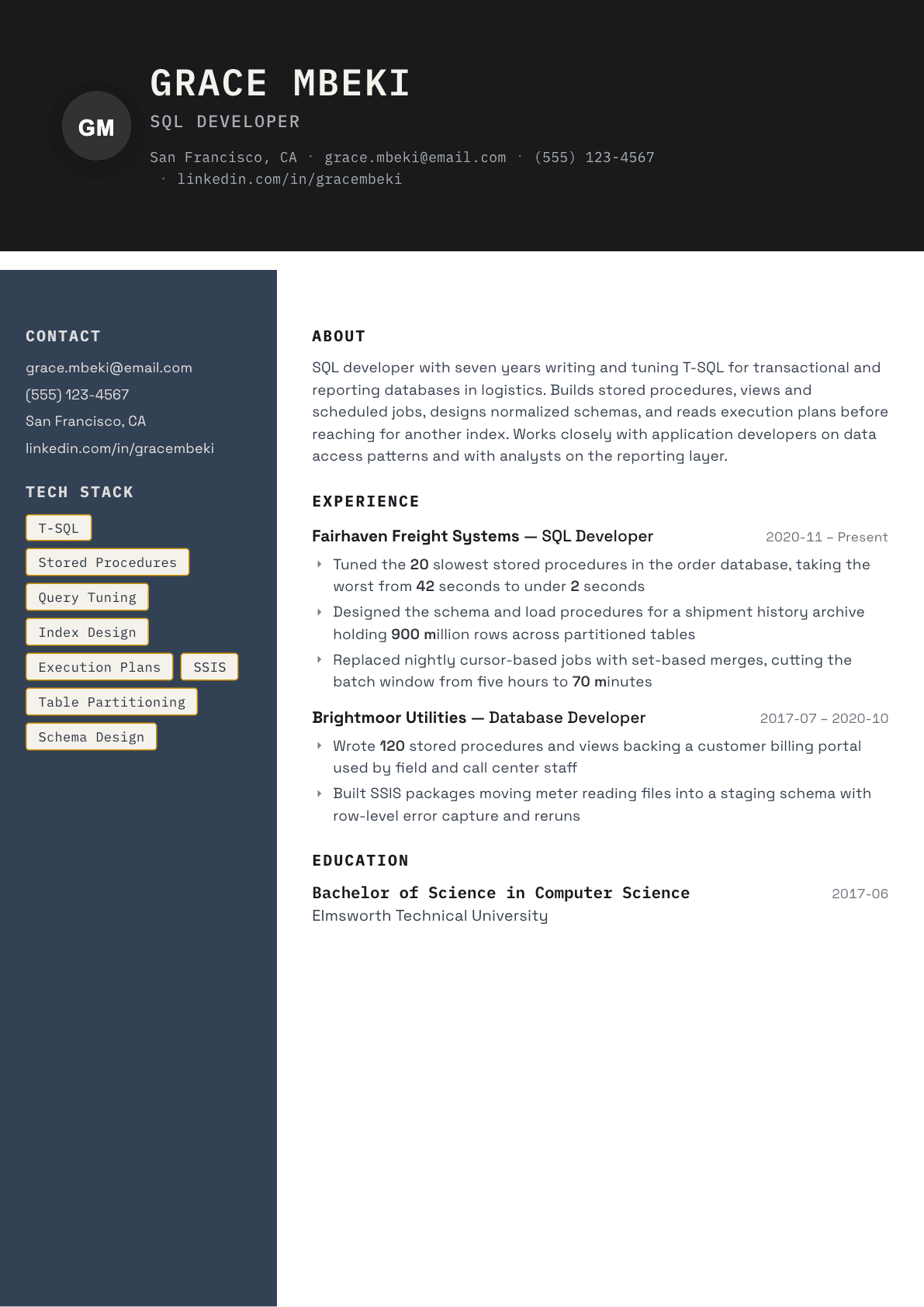
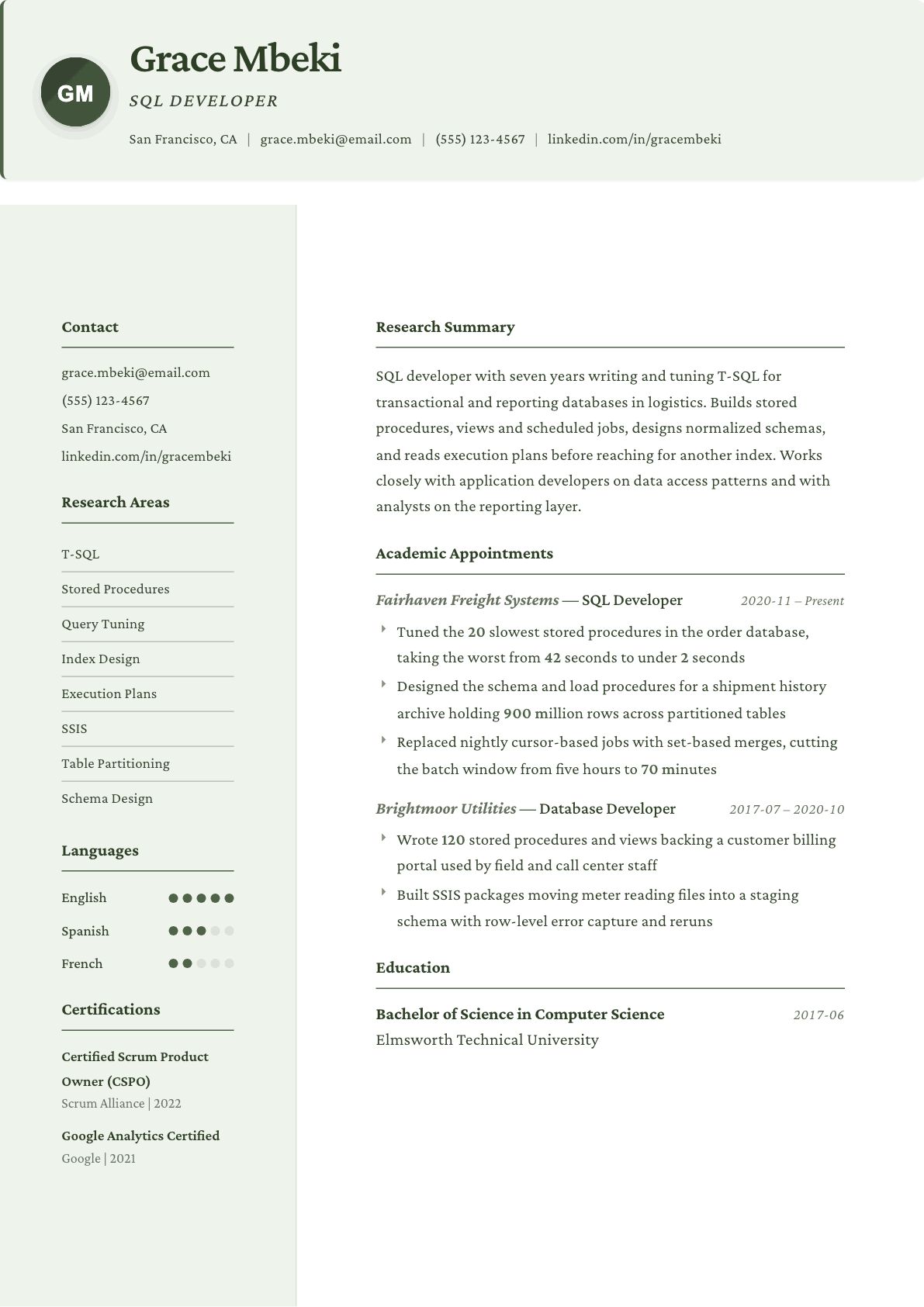
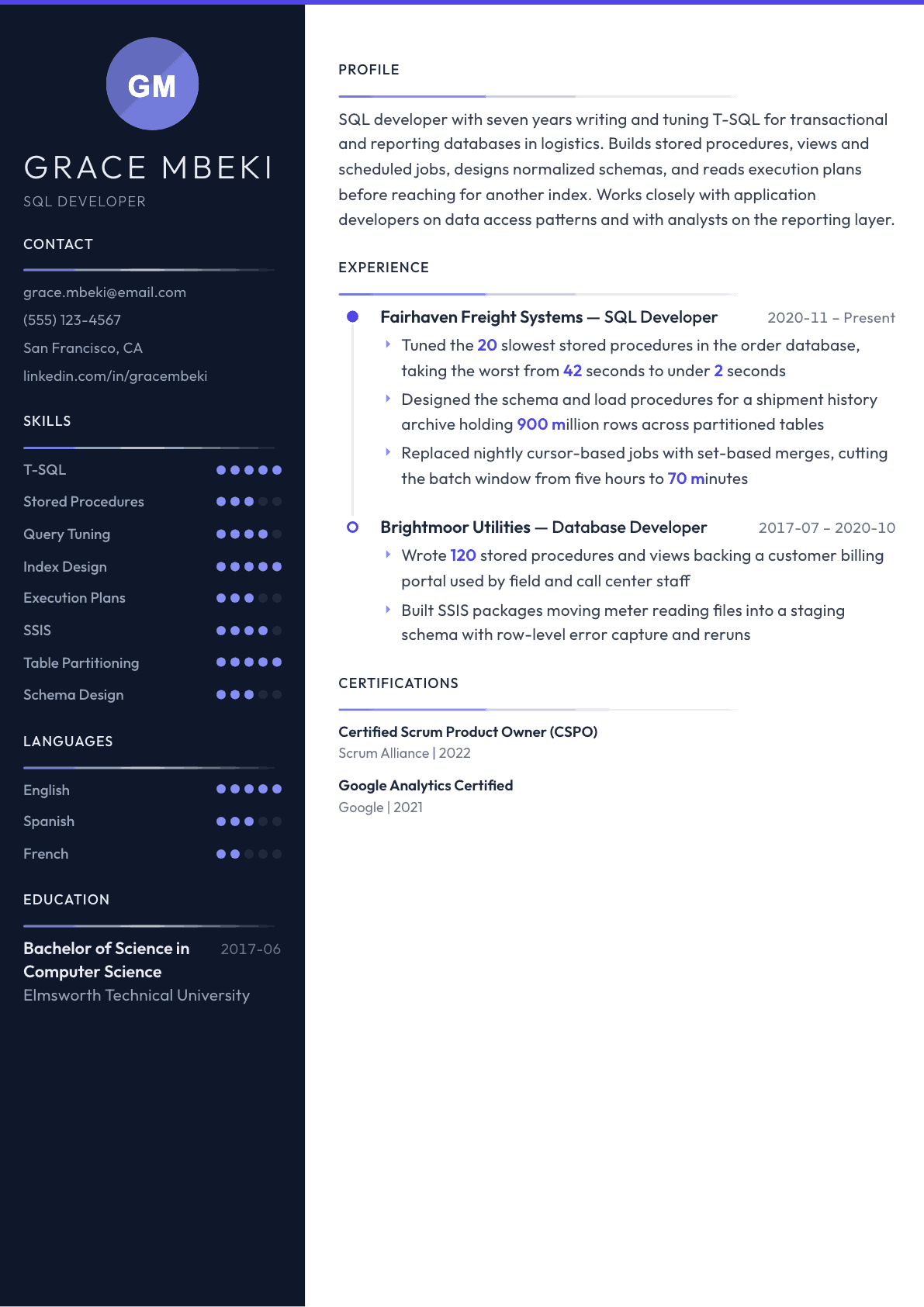
Example SQL Developer summary
SQL developer with seven years on high-volume transactional and reporting databases in logistics and utilities. Writes and tunes T-SQL, designs normalized schemas, partitions large history tables, and rewrites cursor logic into set-based operations. Reads execution plans first and adds indexes second. Seeking a role where database performance is owned by a developer rather than left to the application layer.
Skills to list on a SQL Developer resume
- T-SQL
- PL/pgSQL
- Stored Procedures
- Views and Functions
- Query Optimization
- Index Design
- Execution Plan Analysis
- Schema Design
- Normalization
- Table Partitioning
- SSIS
- SQL Server Agent
- PostgreSQL
- Database Migrations
- Data Modeling
- ETL Development
What actually gets this resume read
- Name the database engines by version family, because a SQL Server shop and a PostgreSQL shop screen differently.
- Show query tuning with before and after timings, the index or rewrite you used, and the table size involved.
- Describe the data volumes you work with in rows and table counts so a lead can judge the scale.
- Separate application database work from reporting and warehouse work, since teams hire for one or the other.
- List the tooling around your SQL: source control for database projects, migration scripts and job scheduling.
- Mention how you handle deployments and rollback, because production change discipline is a real screening question.
How to write a sql developer resume
The person screening a SQL developer resume is usually a data lead who already knows which queries in her system are slow. She is reading for evidence that you can find the cause, not just add an index and hope. That evidence lives in three places: the engines you have worked on, the volumes you have handled, and whether you talk about execution plans at all.
The title also hides two different jobs. One is application database work: schemas, stored procedures, constraints, and the data access patterns behind a running product. The other is reporting and warehouse work: loads, transformations, staging layers and history tables. Teams hire for one of them, so a resume that blurs the two reads as unfocused.
What follows is the structure that keeps both readers happy, how to write a tuning bullet that survives a whiteboard question, three summaries by level, before and after examples, and the questions SQL developers ask when they move between engines or between application and analytics work.
Format: engines and volumes visible in the first ten lines
Reverse chronological, one page under six years and two pages after. Directly under the summary put a technical block that names the database engines, the languages, the tooling and the platforms. A reader should be able to answer whether you are a match on engine within seconds.
Under each employer, add an environment line: the engine, roughly how large the main tables are, the transaction or batch profile, and whether you worked on the transactional side, the reporting side, or both. That line prevents the most common misread of a SQL resume.
- Header: name, title, city, phone, email, and a code repository link if you keep database projects there.
- Order: summary, technical skills, experience, certifications, education, projects.
- Environment line per role: engine and version family, data volume, workload type, team shape.
Summary: dialect, domain, and the kind of problem you solve
Three lines naming the dialect you write daily, the domain you know, and your strongest pattern of work: performance tuning, schema design, batch processing or reporting layers. Domain matters because billing, logistics and clinical data each carry rules that take months to learn.
Skip the phrase strong SQL skills. Everyone applying writes it. Replace it with the sharpest true statement you have, such as taking a batch window from five hours to seventy minutes by moving cursor logic to set based operations.
Experience: tuning, schema, batch, and production discipline
Tuning bullets need four elements: what was slow, how slow, what you changed, and the result. Naming the change is what makes it credible. An index on a covering column set, a rewritten correlated subquery, statistics maintenance, a partition switch or a plan guide all sound different to a reader who has done the work.
Schema bullets should describe intent. Normalizing a wide table into three related ones, adding the right constraints, choosing a clustered key that matches the access pattern, or partitioning a history table so archive queries stop scanning live data are decisions, not chores.
Batch and load bullets should give the window and the failure behavior. A nightly job that finishes in the window is only half the story; a reader wants to know what happens when a row in the middle of the file fails validation, whether you capture the row, and whether the job is safe to rerun.
Production discipline is the quiet differentiator. Say how database changes reach production: migration scripts in source control, a review step, a deployment tool, and what your rollback looks like. Many candidates never mention it and every senior interviewer asks.
Skills: dialect, tooling, and the layer above
Separate the language from the platform. T-SQL and PL/pgSQL are not interchangeable on a resume, and a hiring team on one engine reads the other as a training cost. List the tooling you use for diagnosis and deployment, because that is what distinguishes a developer from someone who writes queries in a client window.
Add the layer above the database if you touch it: the application framework calling your procedures, the orchestration tool running your loads, or the reporting tool reading your views. It shows you understand where your output goes.
Keywords that appear in nearly every posting
Recurring terms include stored procedures, views, functions, triggers, indexing, execution plan, query optimization, normalization, partitioning, ETL, data modeling, and the engine name. Use each one attached to real work rather than in a list on its own.
One warning about buzz terms. Listing a warehouse platform you have queried twice invites a design question. If your exposure is light, put it under a familiarity heading rather than beside your core dialect.
SQL Developer resume summary examples
Two years in
SQL developer with two years writing T-SQL for a billing application, covering stored procedures, views and scheduled jobs. Comfortable reading execution plans, adding covering indexes and testing changes against a restored copy of production. Studying for the Azure database administrator credential and moving toward larger schema work.
Seven years, transactional and reporting
SQL developer with seven years on high-volume logistics databases. Tunes procedures against tables in the hundreds of millions of rows, designs normalized schemas with partitioned history, and rewrote a nightly cursor batch into set based merges that cut the window from five hours to 70 minutes.
Lead database developer
Lead database developer with twelve years across SQL Server and PostgreSQL. Owns schema standards, reviews every migration before release, and mentors three developers. Introduced source controlled database projects and a staged deployment path that ended manual production script edits at a utilities client.
Work experience bullets: before and after
Before: Optimized slow queries in the database.
After: Tuned the 20 slowest stored procedures in the order database, taking the worst from 42 seconds to under 2 by rewriting a correlated subquery and adding two covering indexes.
Naming the technique alongside the timing proves the improvement came from analysis rather than trial and error.
Before: Wrote stored procedures and views.
After: Wrote 120 stored procedures and views behind a customer billing portal, with consistent error handling, transaction boundaries and parameter validation across the set.
The count plus the standards applied shows the code is maintainable, which is what a lead is actually assessing.
Before: Worked with large tables.
After: Designed a partitioned shipment history archive holding 900 million rows, with a monthly partition switch that keeps archive queries off the live transaction tables.
A concrete volume and the partitioning mechanism turn a vague scale claim into a design decision a reader can question.
Before: Built ETL jobs to load data.
After: Built load packages moving meter reading files into a staging schema with row level error capture, so a bad file quarantines its own rows and the job stays rerunnable.
Failure behavior is the part interviewers probe, and stating it separates a working pipeline from a fragile one.
Before: Replaced old batch jobs.
After: Replaced nightly cursor based jobs with set based merge statements and batched commits, cutting the batch window from five hours to 70 minutes without changing downstream contracts.
The technique, the result and the note about downstream contracts show the change was safe as well as fast.
Hard skills
- T-SQL
- PL/pgSQL
- Stored procedures and functions
- Query optimization
- Execution plan analysis
- Index and statistics design
- Normalization and schema design
- Table partitioning
- Set based batch processing
- ETL package development
- Database migrations in source control
- Job scheduling and monitoring
Soft skills
- Explaining query cost to application developers
- Change discipline under production pressure
- Requirement clarification with analysts
- Code review of database changes
- Incident calm
- Documentation of data contracts
Certifications worth listing
- Microsoft Certified: Azure Database Administrator Associate (Microsoft)
- Oracle Database SQL Certified Associate (Oracle)
- Microsoft Certified: Azure Data Engineer Associate (Microsoft)
- Microsoft Certified: Azure Data Fundamentals (Microsoft)
Mistakes that cost sql developer candidates the interview
- Writing optimized queries with no timing, technique or table size, which a technical reader treats as an empty claim.
- Mixing application database work and reporting work in one blur, so neither hiring team recognizes their own job.
- Leaving the engine and version family off, forcing a recruiter to guess whether you are a match.
- Listing every database product you have ever opened, which invites a design question you cannot answer.
- Ignoring deployment and rollback, when production change discipline is a standard senior screening question.
- Describing volumes only as large, when a row count would settle the question in one line.
SQL Developer resume questions
How do I show query tuning skill without breaking confidentiality?
Describe the pattern rather than the business data: table size, the slow operation, the change you made and the timing before and after. Generic table names are fine, and the technique is what the interviewer is testing.
Is a SQL developer the same as a database administrator?
No. Developers own schemas, procedures and data access code; administrators own backups, high availability, patching and capacity. Say which side you work on, and list the other only as supporting exposure if you cover it occasionally.
Do I need a certification to be taken seriously as a SQL developer?
Experience carries more weight, but a platform credential helps career changers and candidates switching engines. It signals you have covered the whole surface rather than only the parts your last employer used.
How do I move from SQL developer to data engineering work?
Emphasize the pipeline half of your history: staging layers, incremental loads, error handling and orchestration. Then add one modern platform you genuinely used, and describe a load you built there rather than the platform name alone.
Should I put personal database projects on the resume?
Yes when your work history is short, and only if the project has real scale or an interesting design decision. A schema with a documented access pattern and a tuning writeup gives an interviewer something to ask about.
Related resume examples
- Database Administrator Resume example
- Data Engineer Resume example
- ETL Developer Resume example
- Analytics Engineer Resume example
- Business Intelligence Analyst Resume example
- Power BI Developer Resume example