PPC Specialist Resume Examples: the lines they read
Write a PPC Specialist Resume That Proves You Manage Spend Well
By Mustafa Tarabya, founder of CVBooster · Published · Updated
A PPC specialist resume example with budget, efficiency and testing bullets, plus platform keywords and a section by section writing guide.
Sample resumes for a ppc specialist
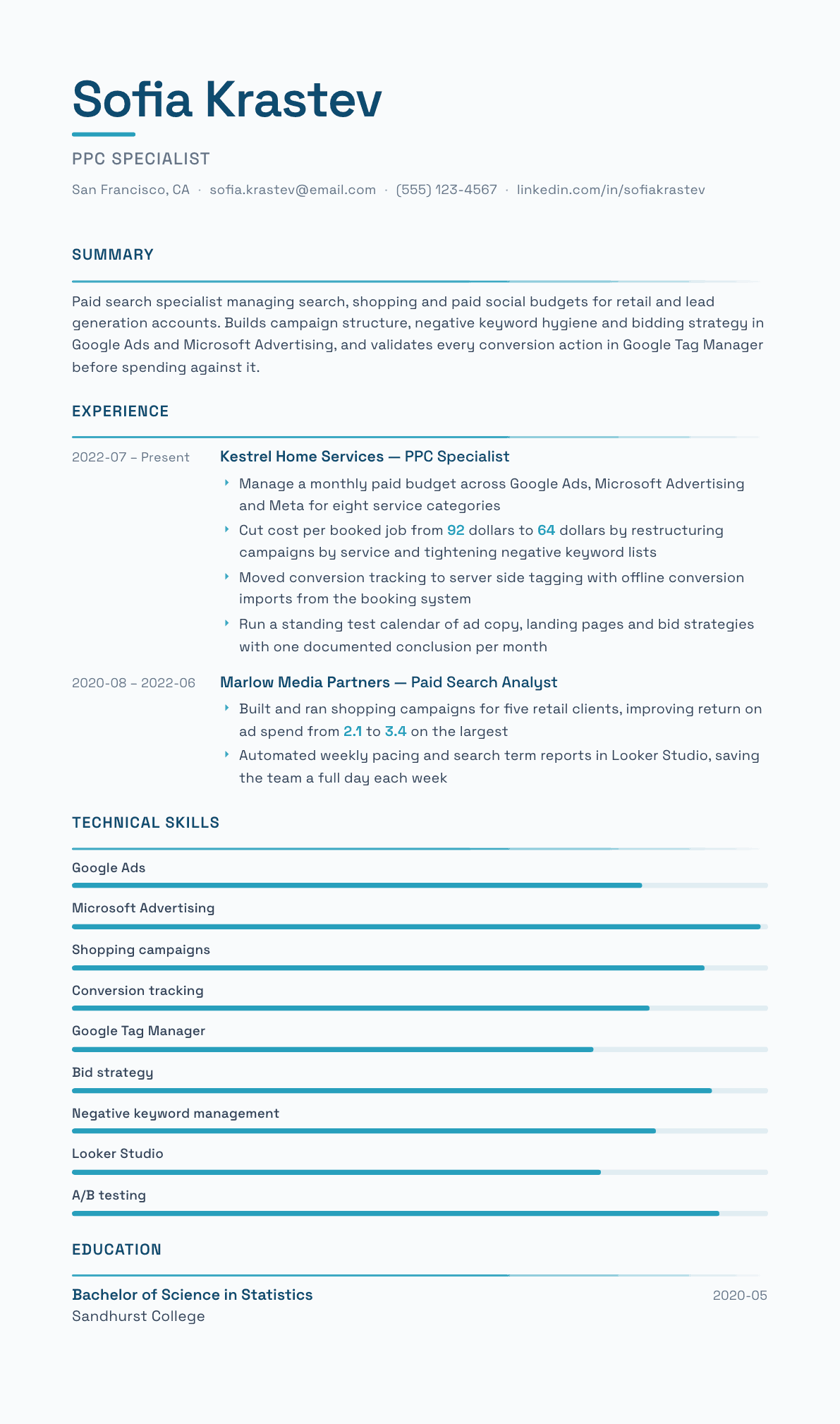
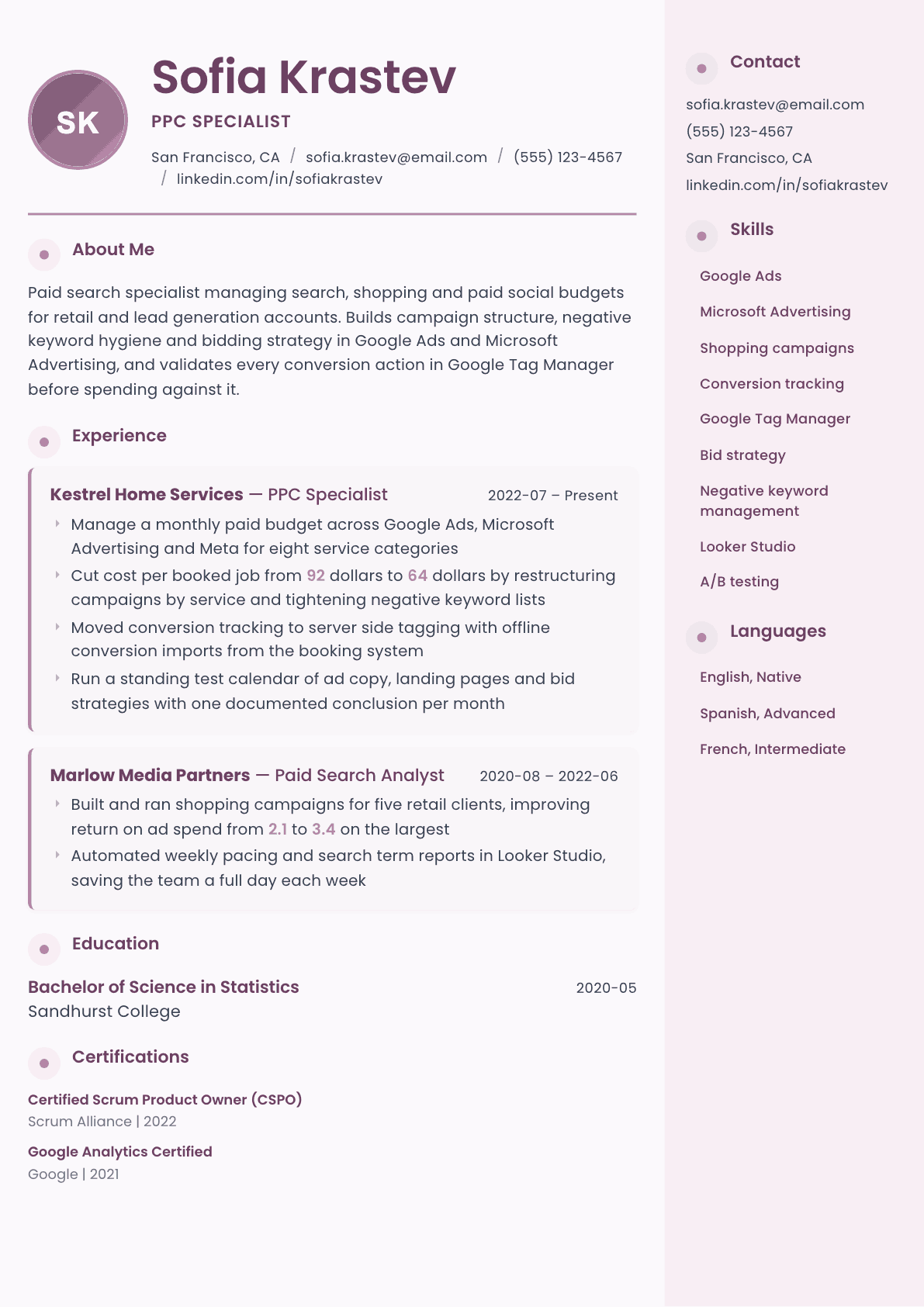
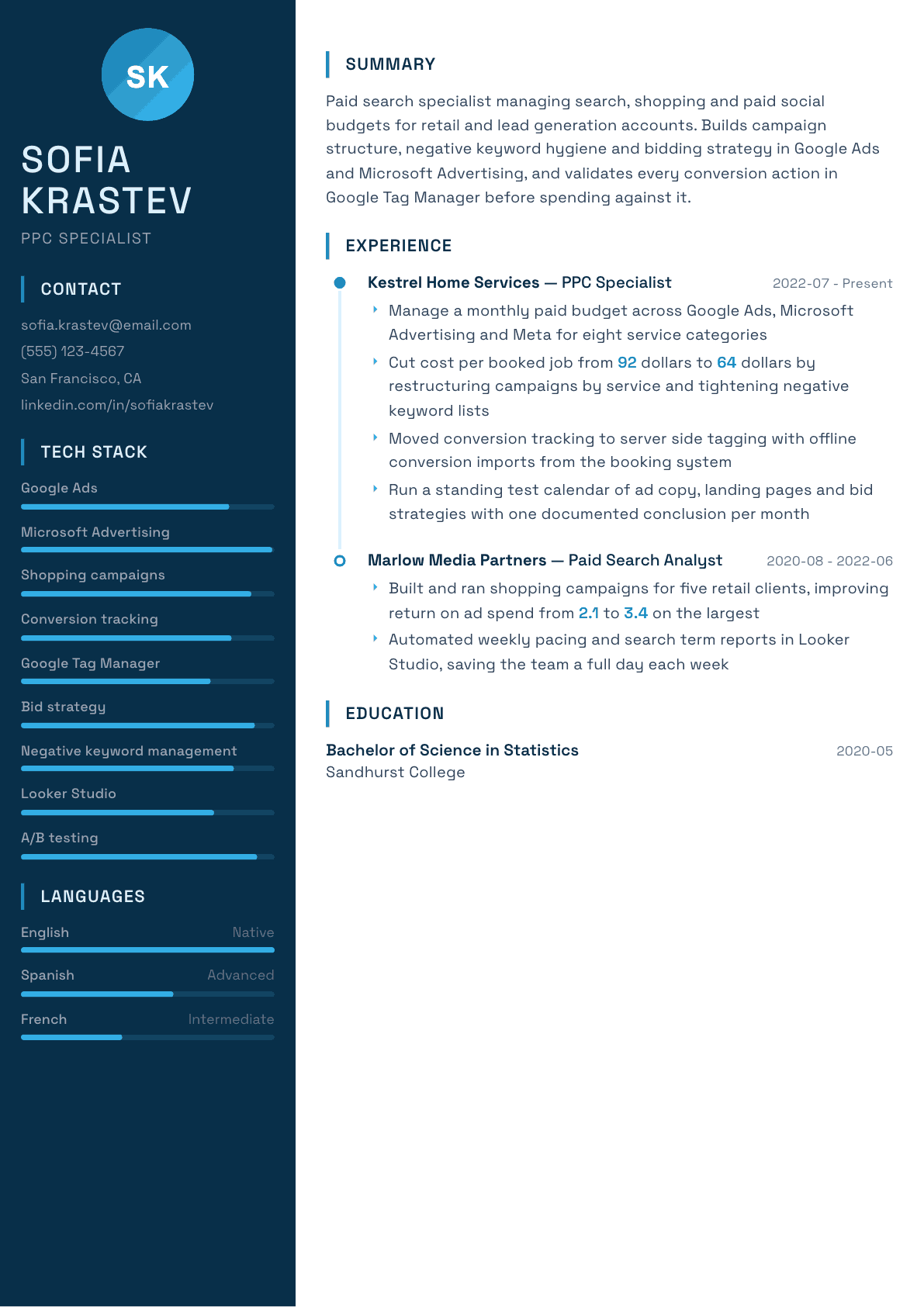
The same ppc specialist content laid out in three CVBooster templates, so you can see what the finished document looks like before you write a word.
Example PPC Specialist summary
Paid search specialist with five years managing search, shopping and paid social budgets across retail and lead generation accounts. Builds campaign structure, bidding strategy and negative keyword hygiene in Google Ads and Microsoft Advertising, and validates conversion tracking before spending against it. Cut cost per booked job by nearly a third through restructuring, and runs a standing test calendar with one documented conclusion each month.
Skills to list on a PPC Specialist resume
- Paid search
- Google Ads
- Microsoft Advertising
- Shopping campaigns
- Performance Max
- Paid social
- Bid strategy
- Negative keyword management
- Conversion tracking
- Google Tag Manager
- Landing page testing
- Budget pacing
- Looker Studio
- Return on ad spend analysis
- Audience targeting
What actually gets this resume read
- Give the monthly budget you manage as a range, because spend level is the first thing a paid media lead screens for.
- Lead with efficiency metrics such as cost per acquisition or return on ad spend rather than impressions and clicks.
- Show account structure work: campaign segmentation, negative keyword hygiene, feed quality and audience layering.
- Prove you own measurement, including conversion actions, tag manager setup and offline conversion imports where relevant.
- Describe your testing rhythm and one conclusion you acted on, because untested spend management reads as button clicking.
- List the platforms separately, since Google Ads, Microsoft Advertising, Meta and Amazon each appear as distinct requirements.
How to write a ppc specialist resume
A PPC specialist is trusted with money every single day, so the resume is read as a risk assessment. The paid media lead reviewing it wants to know the spend level you have handled, whether the conversions you optimized toward were tracked correctly, and whether you can explain a bad month without blaming the algorithm. Everything else on the page is secondary to those three.
The field has also changed in a way many resumes have not caught up with. Automated bidding and broad campaign types have moved the work away from manual bid adjustments and toward feeding the machine well: clean conversion data, sensible account structure, exclusion and negative lists, creative volume and offer testing. A resume built entirely on manual optimization tactics reads as out of date even when the candidate is not.
This guide covers the layout that gets a PPC resume past the screen, how to write budget and efficiency bullets that hold up, three summaries by level, before and after rewrites, and the questions people ask when they move between agency and in house paid media work.
Format: one page, spend and platforms in the top third
One page, single column, reverse chronological. Directly under the summary, add a block listing the platforms you buy on, the account types you have run, and the monthly or annual budget range you have managed. That block answers the first three screening questions before the reader reaches your first job.
Keep formatting plain. Paid media hiring runs through applicant tracking systems that index platform names, campaign types and metric abbreviations, and a two column design regularly loses exactly those tokens.
- Header: name, title, city and state, phone, email, professional profile link.
- Sections: summary, platforms and budget scope, experience, tools, education, certifications.
- State whether the accounts were ecommerce, lead generation, subscription or app install.
Summary: spend level, account type, and one efficiency number
Three lines. Years buying, the platforms, the budget scale, the account type, and one efficiency result stated as a before and after. Cost per acquisition, cost per qualified lead or return on ad spend all work. Impressions and click through rate do not belong in a summary.
Add a measurement clause. Saying that you validate conversion actions before spending against them signals discipline immediately, and it is the habit paid media leads most often find missing in candidates who otherwise interview well.
Experience: structure, measurement, testing, pacing
Account structure deserves its own bullet in every role. How you segment campaigns, whether by service, margin, geography or intent, how you keep search term and negative lists clean, how you handle feed quality for shopping, and what you exclude. Structure is what makes automated bidding work, and it is the clearest evidence of craft.
Measurement is the second bullet. Conversion actions defined and validated, tag manager work, server side tagging, offline conversion imports from a booking or customer system, and the reconciliation you do between the ad platform numbers and the business system. Ad platforms overstate conversions, and a candidate who says so and handles it is ahead of most.
Then testing and pacing. A standing test calendar with one documented conclusion per period reads far better than a vague claim of continuous optimization. Pacing, budget reallocation between platforms mid month, and how you handle a campaign that is spending without converting all show operational control.
- Give before and after efficiency figures rather than a single end state number.
- Name campaign types explicitly, since postings often require experience with specific ones.
- Include a bullet on what you turned off, because knowing when to stop spending is a screened trait.
The landing page and offer half of the job
Most paid performance problems are not in the account. They are in the offer, the form length, the page load, the phone answering or the lead follow up speed. A specialist who has diagnosed and fixed those, or pushed another team to, is worth considerably more than one who only manages the auction.
Write at least one bullet that crosses the click: a landing page test, a form change, a call tracking implementation, a lead routing fix. Say what the metric did afterward and who you worked with to get it done.
Certifications, tools and posting keywords
Platform certifications are expected in this role because they are free and directly relevant. The Google Ads search, shopping, display and measurement certifications, the Microsoft Advertising certification and the Meta media buying credential are all recognized. List the issuer with each and keep them current.
Keywords that recur in postings: paid search, shopping campaigns, bid strategy, negative keywords, conversion tracking, tag management, budget pacing, cost per acquisition, return on ad spend, audience targeting and feed management. Each should appear once in a block and once inside a bullet.
PPC Specialist resume summary examples
Two years buying
Paid search analyst with two years running shopping and search campaigns for five retail clients at an agency. Improved return on ad spend from 2.1 to 3.4 on the largest account through feed cleanup and campaign segmentation, and automated the weekly pacing and search term reports the team used.
Five years, in house
PPC specialist managing search, shopping and paid social budgets across eight service categories for a home services company. Cut cost per booked job from 92 dollars to 64 dollars through restructuring and negative keyword work, and moved conversion tracking to server side tagging with offline imports from the booking system.
Senior paid media
Senior paid media specialist running multi platform acquisition for a subscription business, including search, shopping, paid social and retail media. Owns the test calendar, the measurement stack and monthly pacing against a contribution margin target, and mentors two analysts on account structure and reporting.
Work experience bullets: before and after
Before: Managed pay per click campaigns across multiple platforms.
After: Managed a monthly paid budget across Google Ads, Microsoft Advertising and Meta for eight home service categories, with weekly pacing reviews and mid month reallocation between platforms.
Platform list, account breadth and the pacing routine show operational control rather than account access.
Before: Reduced cost per lead for the business.
After: Cut cost per booked job from 92 dollars to 64 dollars by restructuring campaigns from one catch all to eight service specific units and rebuilding negative keyword lists from twelve months of search terms.
A before and after figure with the structural cause behind it makes the improvement yours rather than seasonal.
Before: Set up conversion tracking.
After: Moved conversion tracking to server side tagging and imported offline booked jobs from the scheduling system, so bidding optimized toward completed work instead of form fills that never answered the phone.
Naming the mechanism and what it changed about bidding proves measurement understanding, not just setup.
Before: Ran A/B tests on ads and landing pages.
After: Ran a standing monthly test calendar across ad copy, landing pages and bid strategies with one documented conclusion per cycle, including two tests that ended a format the team had assumed was working.
A documented cadence with negative results included reads as genuine experimentation rather than tinkering.
Before: Built reports for clients each week.
After: Automated weekly pacing and search term reporting for five retail accounts in Looker Studio, replacing a manual spreadsheet process that had consumed a full day of analyst time every week.
Framing reporting as time recovered gives the work a business value that a report count never does.
Hard skills
- Paid search account management
- Google Ads
- Microsoft Advertising
- Shopping and feed management
- Performance Max campaigns
- Bid strategy selection
- Negative keyword management
- Conversion tracking and tag management
- Offline conversion imports
- Budget pacing
- Landing page testing
- Looker Studio reporting
Soft skills
- Discipline with other people's money
- Honest reporting of a bad month
- Clear explanation of auction mechanics
- Testing patience
- Working with sales on lead quality
Certifications worth listing
- Google Ads Search Certification (Google Skillshop)
- Google Ads Shopping Certification (Google Skillshop)
- Google Ads Measurement Certification (Google Skillshop)
- Microsoft Advertising Certified Professional (Microsoft)
- Meta Certified Media Buying Professional (Meta)
Mistakes that cost ppc specialist candidates the interview
- Omitting the budget scale, which is the single fastest way to be filtered out of a paid media screen.
- Reporting click through rate and impressions instead of cost per acquisition or return on ad spend.
- Writing only manual optimization tactics, which reads as out of step with how modern campaign types run.
- Skipping measurement entirely, so the reader cannot tell whether your conversion numbers were trustworthy.
- Claiming an efficiency gain with no structural change behind it, which invites the seasonality question.
- Ignoring the landing page and lead follow up side, where most paid performance problems actually live.
- Letting platform certifications expire when they are free and hiring teams check for them.
PPC Specialist resume questions
How much budget should I say I managed on a PPC resume?
Give a range or a monthly figure rather than an exact annual total, and say it plainly. Spend level is the primary screening filter for paid media roles, and leaving it out usually gets the resume passed over rather than investigated.
Are Google Ads certifications worth it for a PPC specialist?
Yes, because they are free, verifiable and quick, so their absence is noticed even though their presence proves little. Hold the search and measurement ones at minimum, add shopping if you run retail accounts, and keep them current.
How do I show PPC skill when automation runs the bidding now?
Write about the inputs you control: account structure, conversion definitions and validation, audience and exclusion lists, feed quality, creative volume, budget allocation and offer testing. Those are the levers that decide whether automated bidding performs.
What if my accounts had a bad quarter?
Include it with the diagnosis. A candidate who can describe a downturn, name whether it was market, tracking, offer or competitive, and explain what changed afterward is more credible than one whose every account only improved.
How do I move from agency PPC into an in house role?
Convert client deliverables into commercial outcomes and name the industries and spend levels. Then add a bullet showing work beyond the account, such as a landing page test or a lead routing fix, because in house teams expect you to own the whole path to revenue.