Ruby Developer Resume Examples: the lines they read
Craft a Ruby Developer Resume That Shines Like a Gem
By Mustafa Tarabya, founder of CVBooster · Published · Updated
Build a standout Ruby developer resume showcasing Rails expertise, TDD practices, and scalable web application experience with recruiter-tested templates.
Sample resumes for a ruby developer
The same ruby developer content laid out in three CVBooster templates, so you can see what the finished document looks like before you write a word.
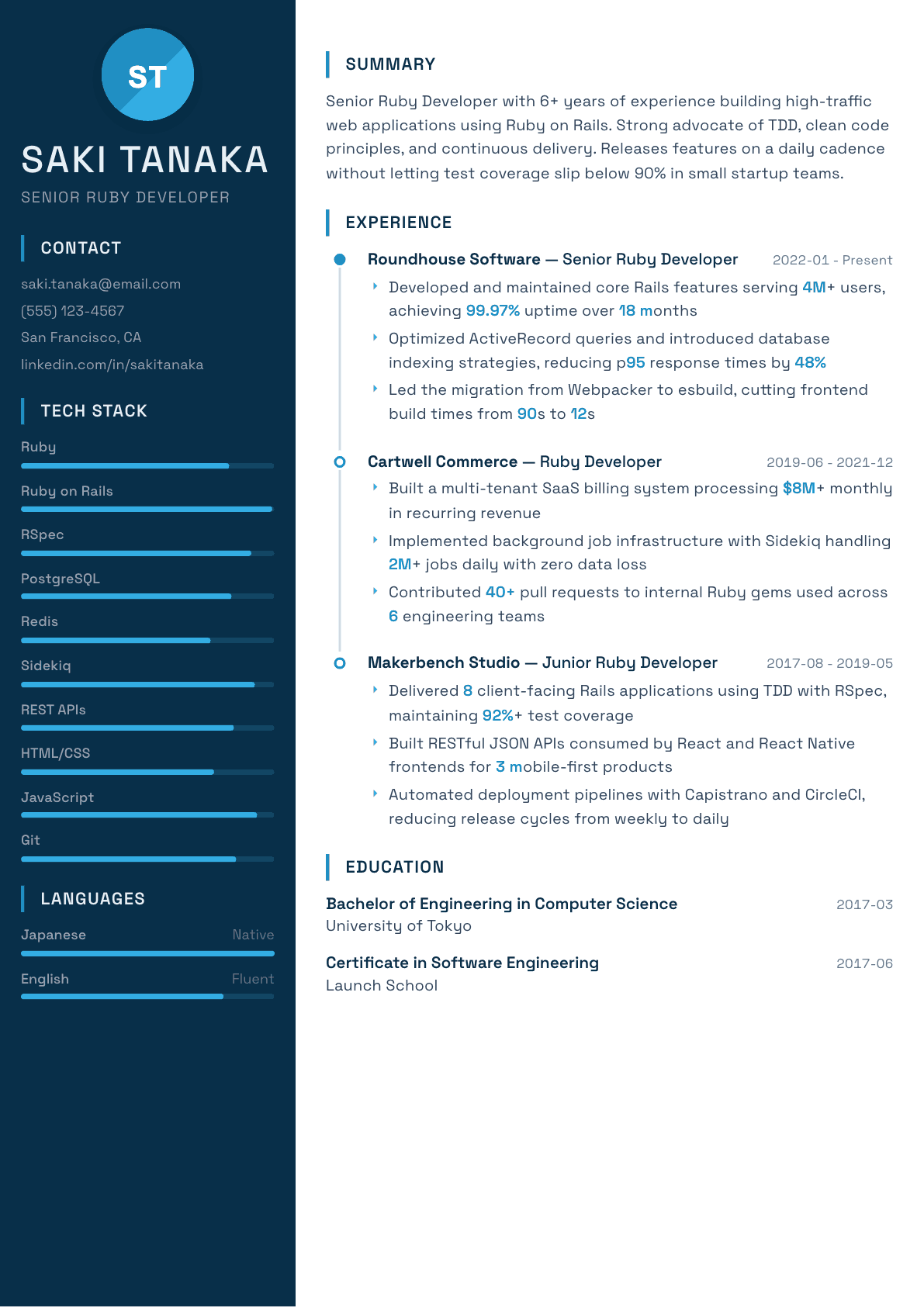
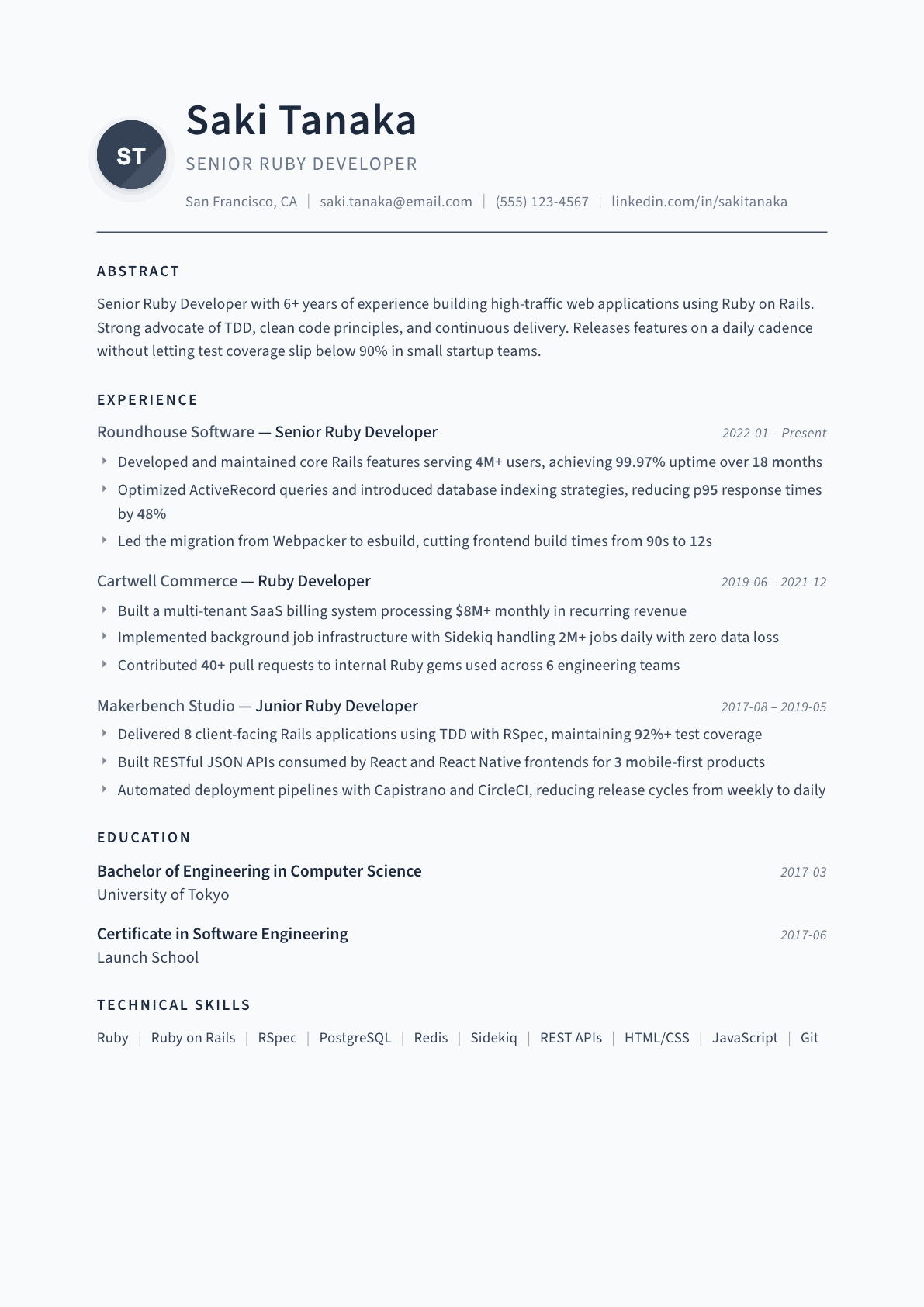
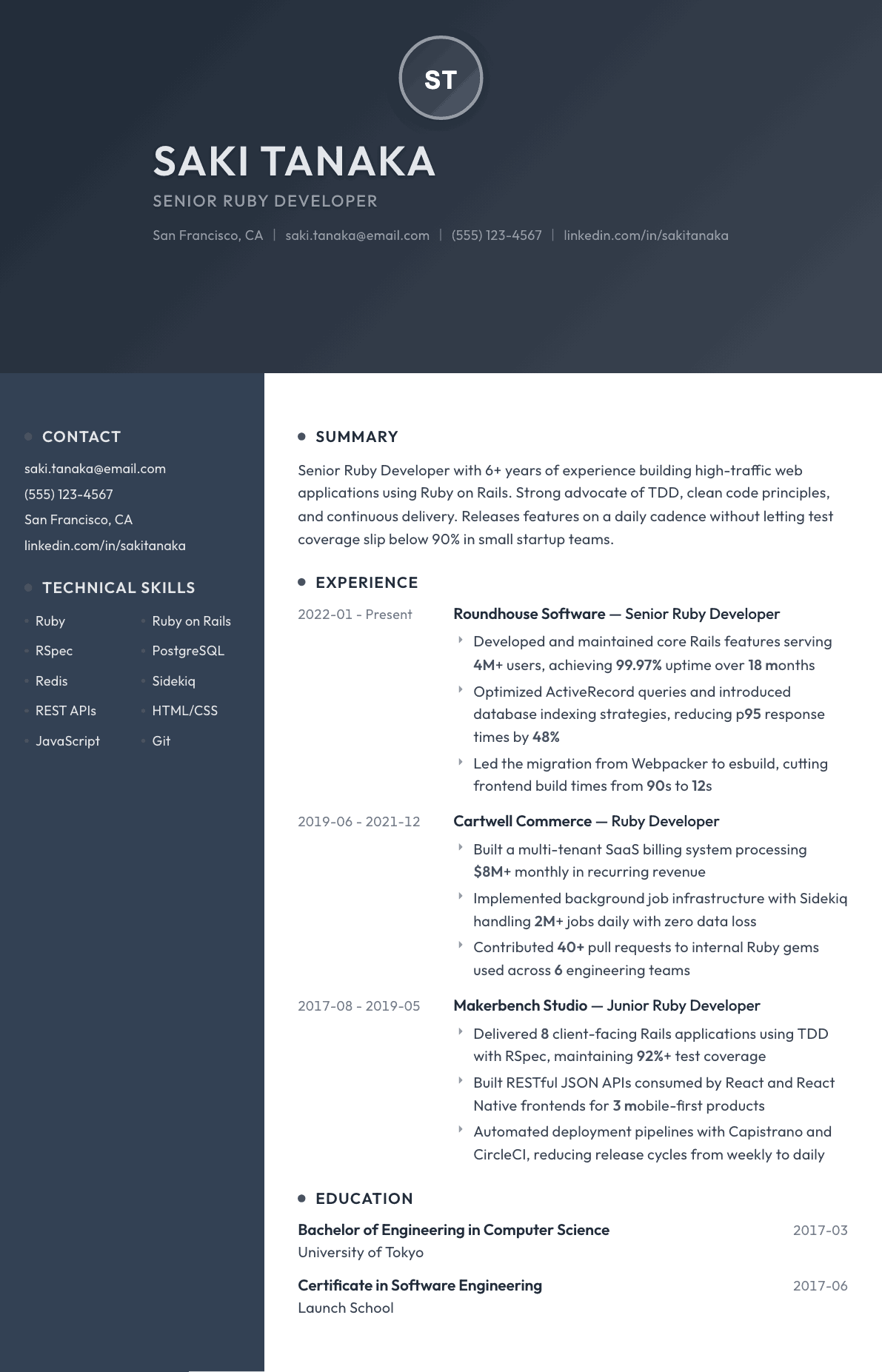
Example Ruby Developer summary
Ruby Developer with 6 years of experience delivering high-traffic Rails applications in startup and enterprise environments. Expert in TDD with RSpec, background processing with Sidekiq, and PostgreSQL optimization. Delivered features serving millions of users while holding uptime above 99.9%.
Skills to list on a Ruby Developer resume
- Ruby
- Ruby on Rails
- RSpec
- PostgreSQL
- Redis
- Sidekiq
- REST APIs
- JavaScript
- HTML/CSS
- Hotwire/Turbo
- Capistrano
- Docker
What actually gets this resume read
- Emphasize Ruby on Rails version experience and gem ecosystem familiarity such as Devise, Sidekiq, and Pundit.
- Highlight TDD/BDD practices with RSpec, Minitest, or Capybara to show code quality commitment.
- Quantify application scale: concurrent users, request throughput, and uptime percentages.
- Mention experience with Hotwire, Turbo, and Stimulus if you have worked with modern Rails stacks.
- Include background job processing experience with Sidekiq, Resque, or DelayedJob.
How to write a ruby developer resume
Ruby hiring is concentrated. Most openings are Rails openings, most Rails openings are at companies with a large existing application, and the people reading your resume have usually maintained that application for years. They are not looking for someone who has heard of Rails. They are looking for someone who can open a 200k line codebase with a fat model layer and a slow test suite and make it better without breaking checkout.
That shapes what earns attention. Test discipline matters more here than in almost any other language community, because Rails culture assumes it. Database and ActiveRecord fluency matters because that is where Rails applications get slow. Background job design matters because everything that cannot happen in the request cycle ends up in Sidekiq. And familiarity with the modern Rails direction, meaning Hotwire, Turbo and Stimulus rather than a bolted-on frontend framework, tells a team whether you have been paying attention.
This guide covers how to write the stack line a Rails lead scans for, how to describe performance work in ActiveRecord terms, how to present a monolith you helped keep healthy, and the questions Ruby developers ask when their resume is not producing interviews.
Format: Rails version, application age, and test suite
Reverse-chronological, one page under six years. Under the summary give the stack line: Ruby and Rails versions, database, background job system, cache, frontend approach, and test framework with suite size and runtime. Rails teams care about all seven and can read your working reality from them in seconds.
Mention the age and size of the application you worked on. Working in a nine year old monolith with a slow suite is a credential in this community, not something to hide, because that is what most of the available jobs actually look like.
- Header: name, title, city, email, and a repository profile if you have gems or real open source commits.
- Order: summary, stack line, experience, skills grouped by layer, open source, education.
- Say which testing framework you live in, RSpec or Minitest, since teams have strong preferences.
- Name the deployment target: containers, a managed platform, Kamal, or classic Capistrano.
Summary: scale, the part of the app you owned, and your test posture
Three lines. Years with Ruby and Rails, the traffic or transaction scale of the largest application you worked on, and the domain you owned inside it: billing, onboarding, search, admin, the public API, or the background processing layer. Owning a domain in a monolith is a more meaningful claim than a list of features.
Then your testing posture, stated concretely. Whether you write tests first, what the suite coverage and runtime were, and whether you improved either. Saying you value quality means nothing; saying you cut the suite from 40 minutes to 9 and kept coverage means everything.
Experience: ActiveRecord, jobs, and the seams in a monolith
The most convincing Ruby bullets are about the database. N plus one queries you removed with includes or preload, indexes added after reading the query plan, counter caches, batch processing with find_each on large tables, a slow migration executed without locking a busy table, and a report query moved off the primary. Name how you found the problem: Bullet, rack-mini-profiler, the Rails log, New Relic, Skylight or a slow query log.
Then the asynchronous layer. Sidekiq queues and concurrency, job idempotency, retry and dead set handling, scheduling, and what happens when a queue backs up. Payment, email and export flows all live here, and a candidate who can describe a job that must never run twice is describing real production experience.
Then the architecture work inside the monolith. Extracting service objects or query objects out of fat models, introducing a domain namespace or a Rails engine, replacing callbacks that fired across concerns, and adding a public interface between two parts of the app. Rails teams value people who can create seams without proposing a rewrite.
Modern Rails: show that you kept current
Name where you sit on the frontend question, because it is the biggest live debate in Rails work. Hotwire with Turbo Frames, Turbo Streams and Stimulus, an ImportMap or a bundler such as esbuild, ViewComponent for reusable markup, or a separate JavaScript application talking to a Rails API. Each answer suits different teams, and stating yours helps you match rather than hurts you.
Add the operational modernization if you did it: an upgrade across major Rails versions with deprecation cleanup, a move off Webpacker, adopting Zeitwerk autoloading, adding Rubocop and a style baseline, or introducing type checking with Sorbet or RBS. Upgrade work is undervalued by candidates and highly valued by teams carrying an aging application.
- Rails and Ruby upgrade experience, with the versions and the strategy you used.
- Frontend approach: Hotwire and Stimulus, ViewComponent, or an API-only backend.
- Gem ecosystem you rely on: Devise or authentication you rolled, Pundit for authorization, Sidekiq, Kaminari, Searchkick.
- Code quality tooling: Rubocop, Brakeman for security scanning, SimpleCov, Bullet.
Skills and open source: depth over breadth
Group into language and framework, data, background processing, frontend, testing and infrastructure. Do not pad with every gem you have installed. A Rails lead reads a long gem list as noise and a short list of gems you can discuss trade-offs on as signal.
Open source carries unusual weight in this community because so much of the stack is community maintained. A merged pull request to a gem the team uses, a small gem you maintain, or a documented issue reproduction is worth more than three certificates. Give the project name and what your contribution did.
Ruby Developer resume summary examples
Junior Ruby developer
Junior Ruby developer with a year on a Rails application for an events platform, writing RSpec tests and Hotwire views. Built the ticket transfer flow end to end and reduced a slow admin page from 12 queries per row to two using preloading. Bootcamp graduate with a maintained side project.
Four years in
Ruby developer with four years on a Rails monolith serving 4M users, owning the billing domain. Rebuilt subscription proration behind service objects with 340 RSpec examples, moved invoice generation into idempotent Sidekiq jobs, and cut p95 response time on the account pages by 48%.
Senior Rails engineer
Senior Rails engineer with nine years across startups and a large marketplace. Led two major Rails version upgrades with no customer downtime, introduced ViewComponent and Hotwire to replace an aging JavaScript layer, and mentors four developers on ActiveRecord performance and test design.
Work experience bullets: before and after
Before: Optimized database queries in the Rails application.
After: Found N plus one queries on the dashboard with Bullet, added preloading and a counter cache, and dropped the page from 640 queries to 11 and the p95 from 3.1s to 340ms.
The detection tool, the specific ActiveRecord techniques and the query count make it a diagnosis a Rails developer recognizes.
Before: Wrote background jobs with Sidekiq.
After: Moved invoice generation into idempotent Sidekiq jobs with a dedicated queue, exponential backoff and a dead set alert, processing 2M jobs a day with no duplicate charges after the migration.
Idempotency, queue design and the failure handling are what distinguish production job work from calling perform_async.
Before: Improved the test suite.
After: Cut the RSpec suite from 41 minutes to 9 by replacing factory-heavy setup with build_stubbed, parallelizing across four processes and removing 200 redundant controller specs, while keeping line coverage above 90%.
The specific techniques and the runtime change speak directly to a pain every Rails team feels.
Before: Upgraded Rails to a newer version.
After: Led the upgrade from Rails 5.2 to 7.0 across three minor steps, converting to Zeitwerk autoloading, clearing 400 deprecation warnings and replacing Webpacker with esbuild, with each step released behind a dual boot setup.
The staged path and the named migrations show a controlled upgrade rather than a version number change.
Before: Refactored legacy code in the monolith.
After: Extracted the pricing logic out of a 900 line model into service and query objects behind a single public interface, with characterization specs written first, so two teams could change pricing rules without touching the order model.
Creating a seam and protecting it with tests is the exact senior behavior a monolith maintainer is hiring for.
Hard skills
- Ruby
- Ruby on Rails
- ActiveRecord and query optimization
- PostgreSQL
- RSpec and Minitest
- Sidekiq and background job design
- Redis
- Hotwire (Turbo and Stimulus)
- ViewComponent
- REST and JSON API design
- Rubocop and Brakeman
- Docker and continuous deployment
- Rails engine and service object patterns
- Rails version upgrades
Soft skills
- Code review with an eye for readability
- Refactoring without proposing a rewrite
- Pairing and mentoring
- Estimating on unfamiliar legacy code
- Communicating trade-offs to product owners
Certifications worth listing
- Ruby Association Certified Ruby Programmer Silver (Ruby Association)
- Ruby Association Certified Ruby Programmer Gold (Ruby Association)
Mistakes that cost ruby developer candidates the interview
- Leaving out the Rails version, which makes a lead assume the oldest one that fits your dates.
- Describing features delivered with no database detail, when ActiveRecord performance is where Rails applications actually struggle.
- Listing twenty gems as skills instead of the handful you can argue trade-offs about.
- Treating monolith maintenance as low status work, when most Rails jobs on the market are exactly that.
- Never mentioning tests, which in this community reads as a gap rather than an omission.
- Saying you know Hotwire without naming a single Turbo Frame or Stream you have actually built.
Ruby Developer resume questions
Is Ruby on Rails still worth specializing in?
Openings are fewer than for JavaScript or Python, but they are concentrated at companies with mature revenue-generating applications, and the competition per opening is often lower. Specialists who can handle upgrades, performance and monolith architecture stay in demand precisely because those applications keep running.
RSpec or Minitest on my resume?
List the one you actually work in and mention the other if you have used it. RSpec dominates commercial Rails work, while Minitest is common in teams that follow the framework defaults closely. Either is fine, but silence about testing is the version that costs you interviews.
How do I show Ruby experience without a production Rails job?
Build and deploy one real application with a database, background jobs, authentication and a test suite, then write about it the way you would write about work: the modeling decisions, a performance problem you found, and the tests. Add a merged pull request to a gem the community uses, which is achievable and carries real weight here.
Should I include the size of the codebase I worked on?
Yes. Line count, model count, suite size and suite runtime give a Rails lead an accurate picture of the complexity you are used to. Someone who has kept a large old application healthy is more attractive to most hiring teams than someone who has only worked in fresh projects.
Do Ruby certifications matter to employers?
Very little. Rails hiring runs on code you can discuss, open source contributions and a technical conversation about ActiveRecord and testing. A certification does no harm, but a maintained project and one solid performance story will move you further in every interview loop.
Related resume examples
- Full-Stack Developer Resume example
- Backend Developer Resume example
- Software Engineer Resume example
- PHP Developer Resume example
- Node.js Developer Resume example
- .NET Developer Resume example