Power Systems Engineer Resume Examples: read this first
Build a Power Systems Engineer Resume Around Studies and Standards
By Mustafa Tarabya, founder of CVBooster · Published · Updated
Power systems engineer resume example with load flow and protection keywords, sample study bullets and a full section by section guide.
Sample resumes for a power systems engineer
The same power systems engineer content laid out in three CVBooster templates, so you can see what the finished document looks like before you write a word.
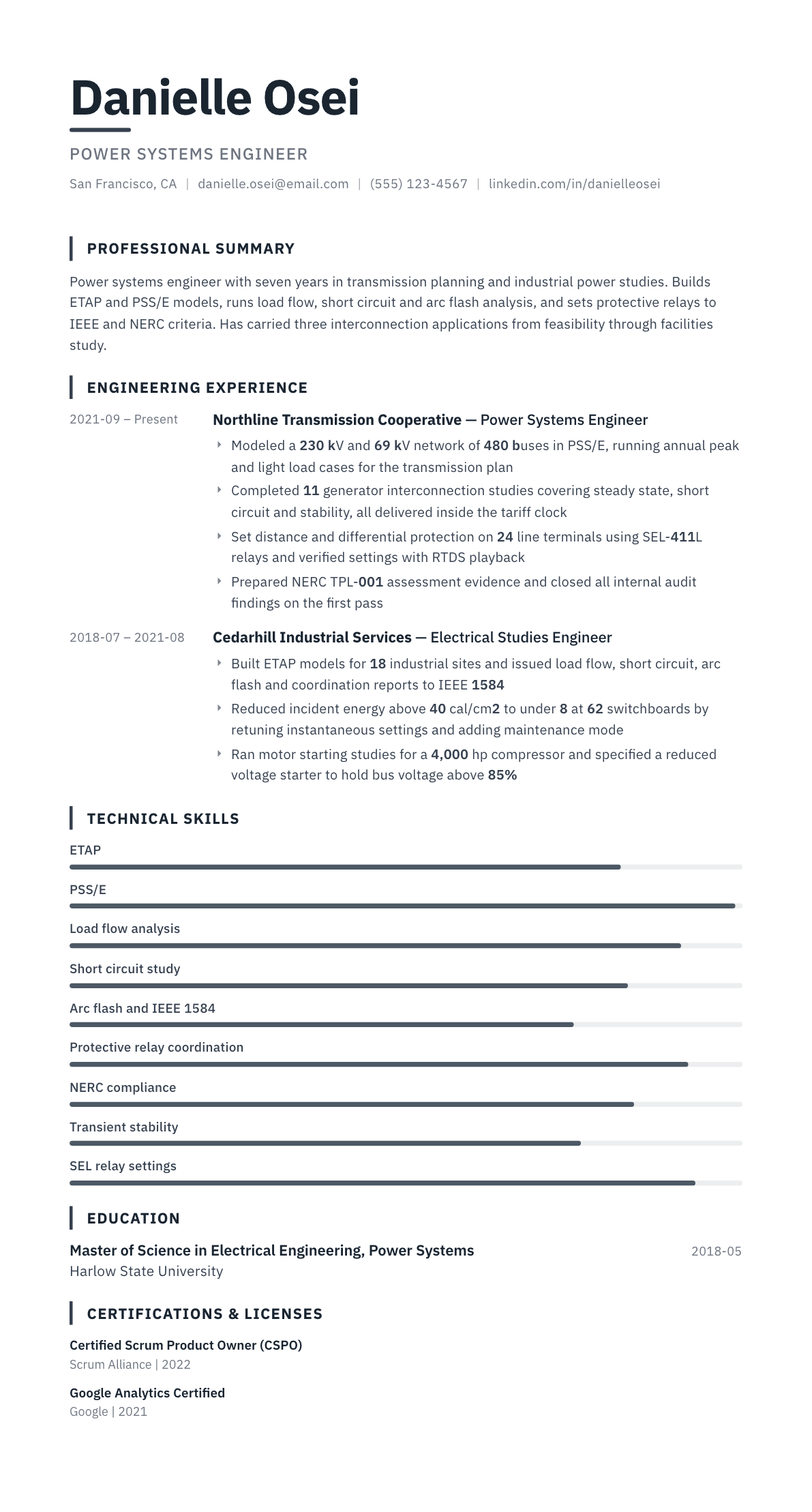
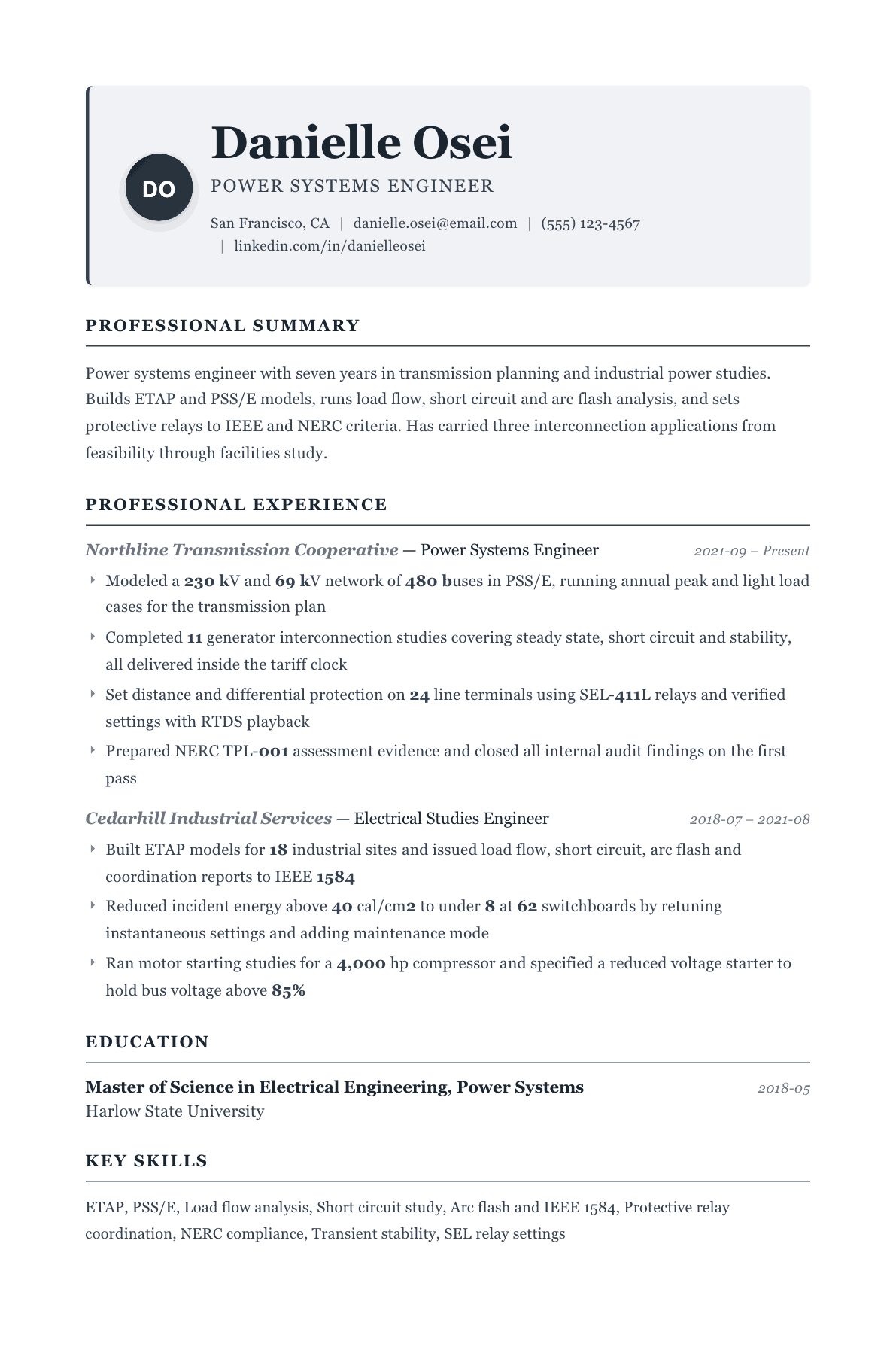
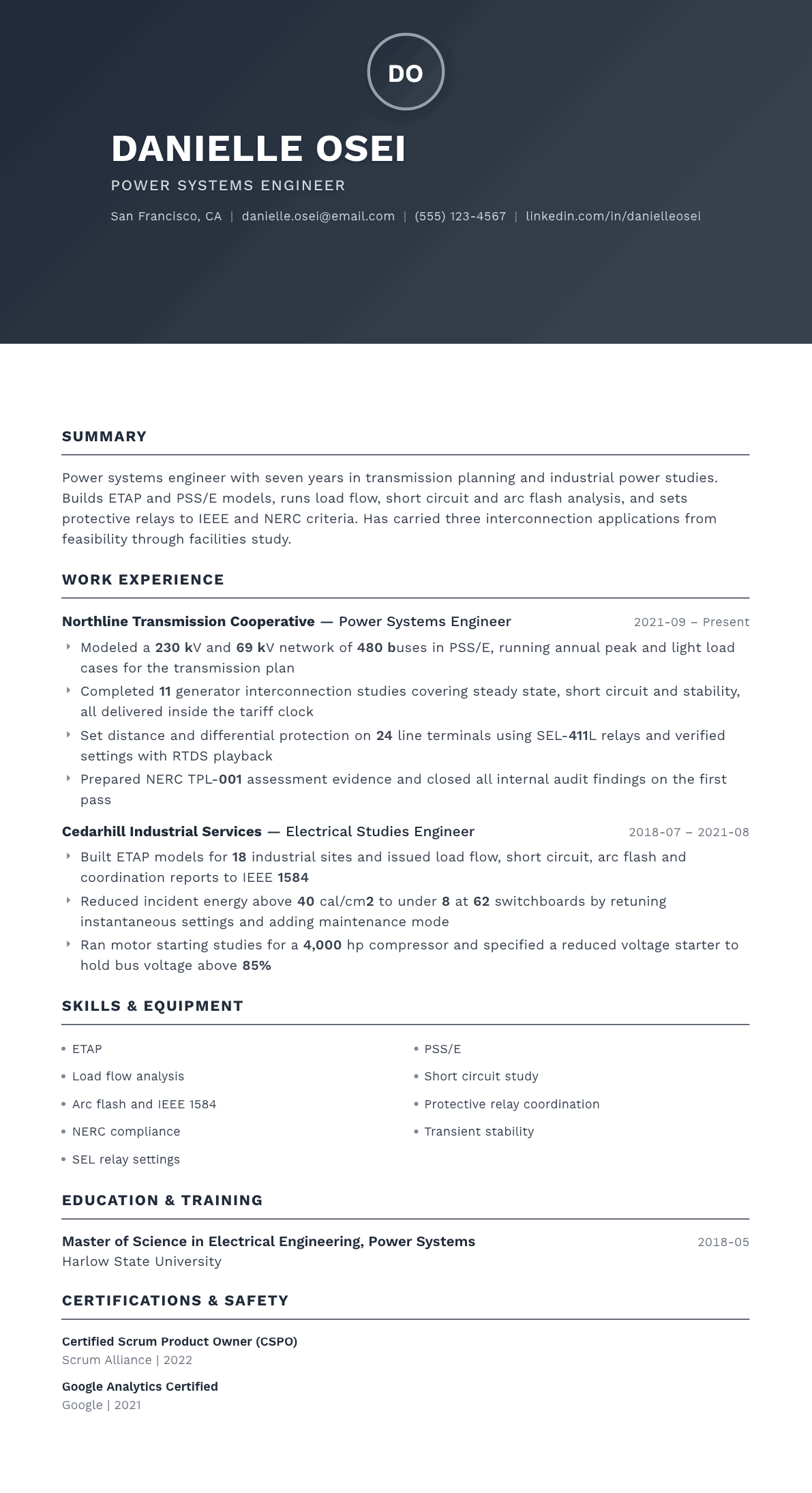
Example Power Systems Engineer summary
Power systems engineer with seven years of transmission planning and industrial study work at voltages from 480 volts to 230 kilovolts. Builds and validates ETAP and PSS/E models, delivers arc flash and coordination reports to IEEE 1584, and sets microprocessor line protection. Carries interconnection studies through the full tariff sequence and prepares NERC assessment evidence. Targeting a senior planning role with a transmission owner.
Skills to list on a Power Systems Engineer resume
- Load flow analysis
- Short circuit analysis
- Arc flash study
- Protective relay coordination
- Transient stability
- Harmonic analysis
- ETAP
- PSS/E
- CYME
- SEL relays
- NERC standards
- Interconnection studies
- Grounding design
- Motor starting studies
- Power quality
- Substation design support
What actually gets this resume read
- Lead with the studies you have signed: load flow, short circuit, arc flash, coordination, stability and harmonic analysis are the screening list.
- State the voltage levels you have worked at, because distribution, subtransmission and extra high voltage are treated as separate careers.
- Name the software versions and the model sizes, since bus counts tell a manager whether you handled a plant or a control area.
- Put your professional engineer license status in the header, as many utility postings will not advance a candidate without it.
- Reference the specific standards you applied, such as IEEE 1584, IEEE 242 or the NERC reliability standard family relevant to the job.
- Separate consulting study work from utility planning work, because hiring managers on each side read the other as unproven.
How to write a power systems engineer resume
A power systems engineer is hired on the strength of the studies they can sign. The person reading your resume wants to know which analyses you have run yourself, at which voltage levels, in which software, and whether anyone downstream depended on the answer. Everything else on the page is context around that one question.
This discipline splits into camps that do not read each other work generously. Utility planning, protection and control, industrial power studies, renewable interconnection and substation design all carry the same job title and expect different evidence. A resume that stays vague about which camp you belong to gets filed under none of them.
The sections below cover the layout, what to put in each block, three summary examples across career stages, five rewritten bullets, and the questions power engineers ask most when the resume is not getting calls.
Format: license status first, studies second
Reverse chronological order, two pages is normal for this field because study lists and project lists take room. Put professional engineer license status in the header line with the state, since a large share of utility and consulting postings will not move a candidate forward without it or a clear path to it.
Directly under the summary, add a studies and analysis block. It is the fastest way to answer the screening question, and it keeps your job bullets free to describe scope and outcomes rather than repeating a list of study types in every entry.
- Header: name, PE status and state, city, phone, email.
- Section order: summary, analysis capability, software, experience, education, certifications.
- Per job: voltage levels, network size in buses or facilities, and your specific deliverable.
Summary: voltage levels, network scale, and what you deliver
Open with years and the environment: transmission owner, distribution utility, industrial end user, consulting firm or independent power producer. Then give the voltage range you have worked across, because the gap between a 480 volt motor control center and a 345 kilovolt line is a career, not a detail.
Finish with the deliverable a manager cares about. Signed and stamped study reports, approved relay settings files, completed interconnection studies and compliance evidence are all concrete. The phrase strong analytical skills is not.
Experience: the study, the model, the decision it drove
Every study bullet should carry three things: the analysis type, the model scale, and what changed because of it. An arc flash study that produced a report is routine. An arc flash study that moved sixty two switchboards out of the highest incident energy category through relay retuning and a maintenance switch is a result an engineering manager can repeat to a client.
For protection work, name the relay families and the schemes. Distance, line current differential, transformer differential, breaker failure and directional overcurrent are all different competencies, and the reader is checking which ones you have set and tested rather than only reviewed.
For planning work, describe the case set. Annual peak, light load, contingency screening and stability runs each imply different tooling and different discipline. Add the compliance context if your assessments feed a reliability standard, because that changes the documentation burden and reviewers know it.
Software and modeling: version, model size, and what you built
Say whether you built the model or inherited it. Constructing a network model from single line diagrams, nameplate data and cable schedules is far harder than running cases on a model someone else validated, and hiring managers ask this in the first interview anyway.
Name the tools precisely: ETAP, PSS/E, PSCAD, CYME, SKM PowerTools, DIgSILENT PowerFactory, ASPEN OneLiner and Aspen Distribution each appear as literal search strings in postings. Add any scripting you use to batch cases, because engineers who automate contingency runs are scarce.
Standards, compliance and the paperwork trail
List the standards you have applied by number where you can do so accurately. Incident energy calculations, protective device coordination, grounding design and equipment ratings all trace back to published documents, and citing them tells the reader your reports would survive review.
If you have worked under a mandatory reliability standard regime, describe the evidence work rather than only the analysis. Audit preparation, data retention and documented assumptions are a real part of the job and many candidates leave them out entirely.
- Analysis standards: incident energy calculation, device coordination, grounding, equipment duty ratings.
- Compliance: assessment documentation, audit evidence packages, assumption logs, model data submittals.
- Deliverables: stamped reports, settings files, single line updates, interconnection study responses.
Power Systems Engineer resume summary examples
New graduate
Electrical engineering graduate specializing in power systems, with coursework in protection and machine dynamics and a capstone modeling a 12-bus distribution feeder in ETAP. Passed the Fundamentals of Engineering exam. Seeking an entry power systems role supporting short circuit and coordination studies.
Five years in
Power systems engineer with 5 years of industrial study work from 480 V to 138 kV. Builds ETAP models from field data and issues load flow, short circuit, arc flash and coordination reports. Recently reduced incident energy at 60 plus switchboards through settings changes.
Lead planning engineer
Licensed power systems engineer with 12 years in transmission planning, leading interconnection and reliability assessments on a 230 kV network of 480 buses. Runs steady state, short circuit and stability studies in PSS/E, sets line protection, and prepares audit-ready compliance evidence.
Work experience bullets: before and after
Before: Performed power system studies for clients.
After: Built ETAP models for 18 industrial sites from single line drawings and cable schedules, then issued load flow, short circuit, arc flash and coordination reports under a licensed reviewer.
Naming model construction, site count and the four study types shows breadth that the word studies hides.
Before: Reduced arc flash hazards at customer facilities.
After: Lowered incident energy from above 40 cal per square centimeter to under 8 at 62 switchboards by retuning instantaneous settings and adding a maintenance mode switch.
The before and after energy levels and the actual technique prove the engineering rather than the intention.
Before: Set protective relays on transmission lines.
After: Calculated and issued distance and line current differential settings for 24 terminals on microprocessor relays, then verified each scheme with real time digital simulator playback before energization.
Scheme types, terminal count and the verification method demonstrate ownership through to field acceptance.
Before: Supported generator interconnection requests.
After: Completed 11 generator interconnection studies covering steady state thermal and voltage screening, short circuit duty and transient stability, delivering every report inside the tariff timeline.
Study count, scope breakdown and on-time delivery answer the three questions an interconnection manager asks.
Before: Handled compliance work for reliability standards.
After: Prepared transmission planning assessment evidence including case archives, assumption logs and contingency definitions, and closed every internal audit finding on the first review cycle.
Listing the evidence artifacts shows you understand that compliance is documentation, not just analysis.
Hard skills
- Load flow and contingency analysis
- Short circuit and fault duty studies
- Arc flash and incident energy calculation
- Protective device coordination
- Transient and dynamic stability
- Harmonic and power quality analysis
- Grounding and step and touch potential
- Motor starting studies
- ETAP and SKM PowerTools
- PSS/E and PowerFactory
- PSCAD electromagnetic transients
- Microprocessor relay settings
- Interconnection study process
- Reliability standard compliance evidence
Soft skills
- Assumption documentation
- Client report writing
- Peer review discipline
- Field data gathering
- Deadline management under tariff clocks
- Explaining results to non-engineers
Certifications worth listing
- Professional Engineer (PE), Electrical and Computer (NCEES member state licensing boards)
- Fundamentals of Engineering (FE), Electrical and Computer (NCEES)
- System Operator Certification (North American Electric Reliability Corporation)
Mistakes that cost power systems engineer candidates the interview
- Omitting voltage levels, which forces the reader to guess whether your career sits in a plant or on a transmission network.
- Claiming a long software list without saying which models you built yourself and which you only ran cases on.
- Describing study output as a report delivered rather than as a decision the client or utility made because of it.
- Hiding professional engineer license status at the bottom when it is the first screening filter for many postings.
- Treating protection work as one skill instead of naming the specific schemes and relay families you have set.
- Leaving compliance documentation off the resume when the target employer lives under mandatory reliability standards.
Power Systems Engineer resume questions
How important is the PE license on a power systems resume?
It is often the difference between a screen and a rejection, especially for consulting and utility roles where reports are stamped. If you are not yet licensed, state that you passed the fundamentals exam and give the year you become eligible to sit for the principles exam.
Should I list individual studies or summarize them?
Summarize by type and volume in a capability block near the top, then use job bullets for the two or three studies with the most interesting outcomes. A reader wants the range quickly and the depth selectively, not a numbered list of every project file.
How do I move from industrial studies into utility planning?
Highlight the analysis that transfers directly, which is short circuit, coordination and load flow, then show any exposure to network scale models, contingency screening or interconnection work. Coursework or a self-built transmission case in PSS/E is worth listing if your paid work has not covered it.
Do I need to explain the software versions I used?
Naming the exact package matters more than the version, since hiring teams search on the tool name. Mention versions only when a major release changed the workflow, such as moving to a newer dynamics engine, and keep it to a short parenthetical.
What belongs in a power systems skills section?
Analysis types, software packages, relay families and the standards you have applied. Keep general engineering traits out of it. The skills block exists so a recruiter searching for arc flash or line differential finds a literal match on the first screen of your resume.
Related resume examples
- Electrical Engineer Resume example
- Solar Energy Engineer Resume example
- Electrical Design Engineer Resume example
- Controls Engineer Resume example
- Electrical Power Engineer Resume example
- Fire Protection Engineer Resume example