HVAC Engineer Resume Examples: free ATS score and gap list
Write an HVAC Engineer Resume That Shows Real Building Loads
By Mustafa Tarabya, founder of CVBooster · Published · Updated
HVAC engineer resume example covering load calculations, equipment selection, code references, keywords and a full writing guide.
Sample resumes for a hvac engineer
The same hvac engineer content laid out in three CVBooster templates, so you can see what the finished document looks like before you write a word.
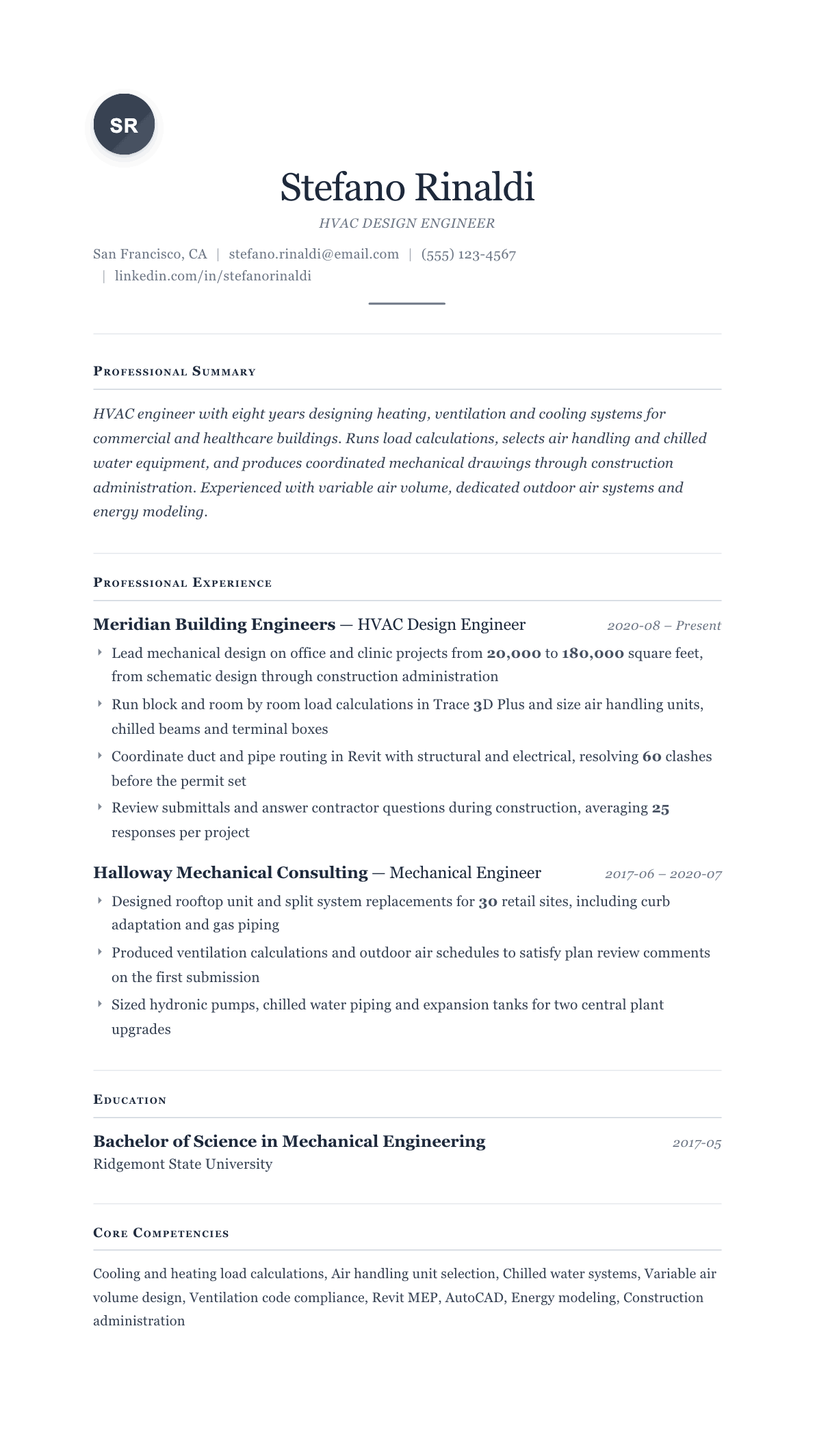
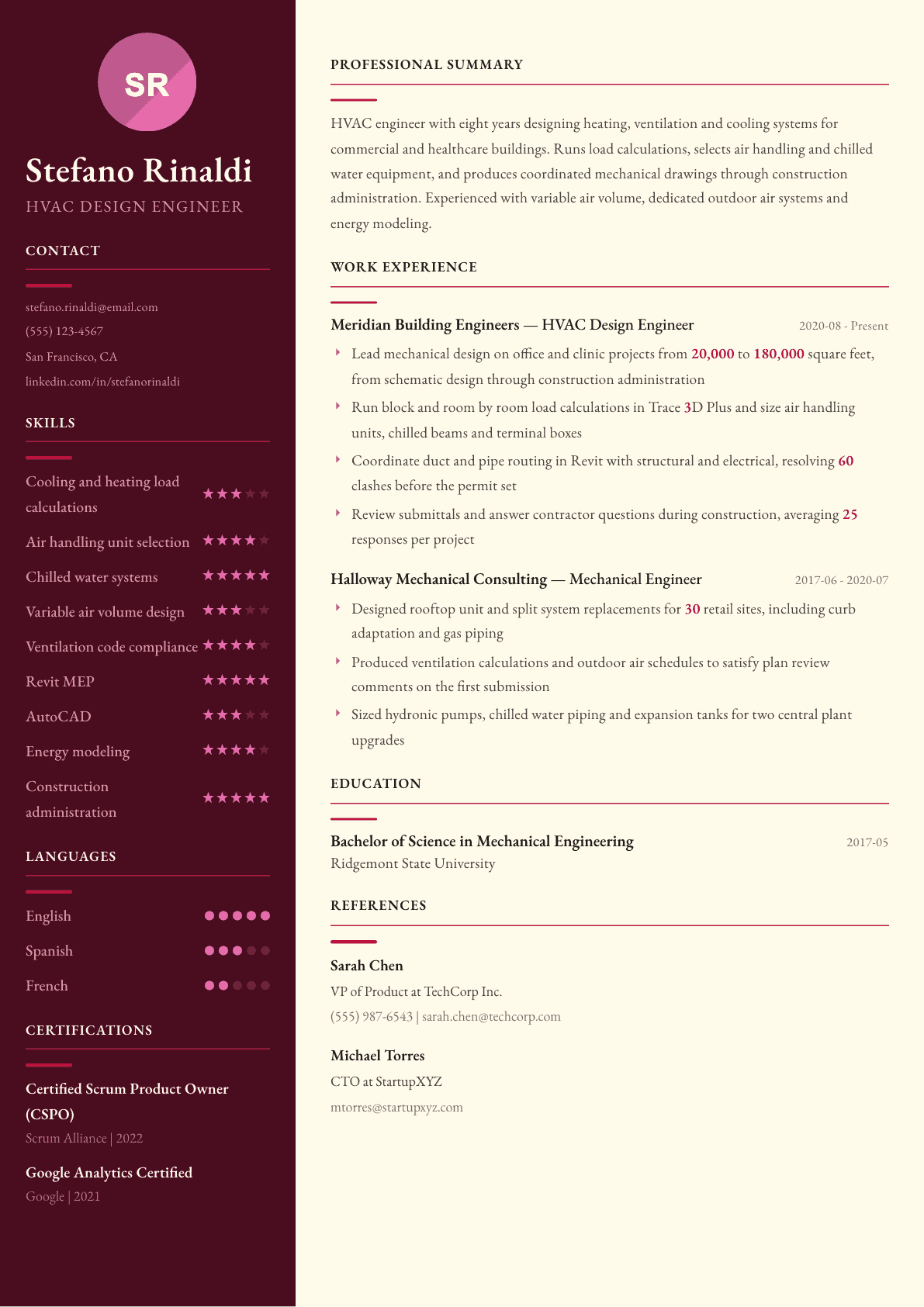
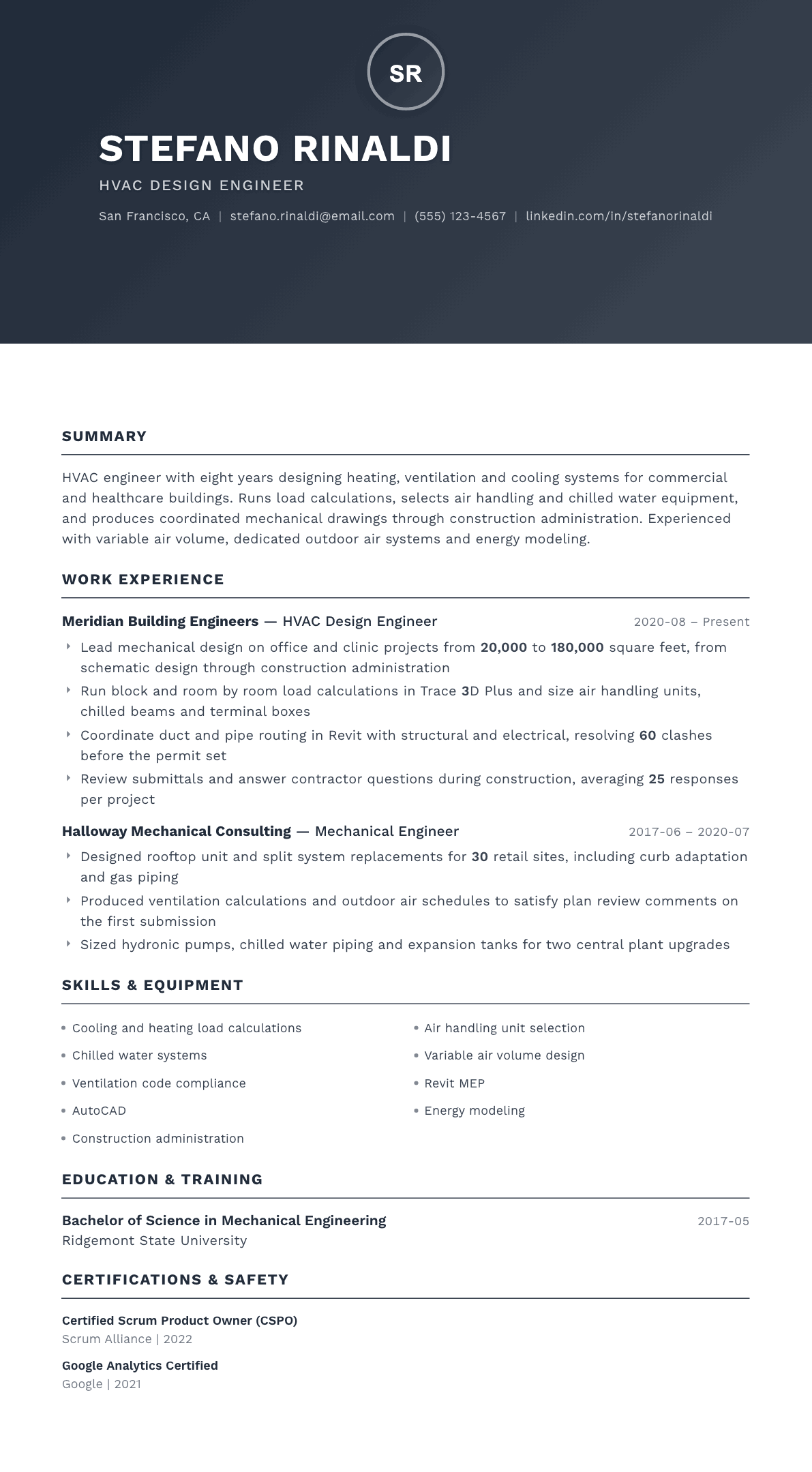
Example HVAC Engineer summary
HVAC engineer with eight years designing mechanical systems for commercial, clinical and retail buildings. Performs room by room load calculations, selects air handling and chilled water equipment, and delivers coordinated Revit models through permit and construction administration. Comfortable defending a ventilation calculation in plan review and answering contractor questions on site during startup.
Skills to list on a HVAC Engineer resume
- Heating and cooling load calculations
- Air handling unit selection
- Chilled water plant design
- Boiler and hydronic design
- Variable air volume systems
- Dedicated outdoor air systems
- Duct design and static pressure
- Ventilation code compliance
- Revit MEP
- AutoCAD MEP
- Trane Trace and Carrier HAP
- Energy modeling
- Commissioning support
- Construction administration
- Specification writing
- Refrigerant piping design
What actually gets this resume read
- Name the building types you have designed for, because a hospital project and a warehouse project need different reviewers.
- Give project size in square feet and say which design phases you personally carried.
- List the load calculation and energy modeling software by name, since firms hire on that toolset.
- Show code and standard familiarity by naming the ventilation and energy standards you design against.
- Include construction administration work: submittals, requests for information and site observation visits.
- State your engineering license status clearly, including the states where you hold it or are pursuing it.
How to write a hvac engineer resume
The person hiring an HVAC engineer at a consulting firm is staffing projects, and she reads your resume as a staffing question: which building types can I put you on, at which phase, and how much redlining will your drawings need before they leave the office. A resume that answers those three things gets a call. One that lists mechanical systems in the abstract does not.
The other half of the market is the owner side, plants, hospitals, universities and data centers, where the same title means operating and upgrading systems rather than drawing new ones. The two versions of the job share vocabulary but reward different evidence, so decide which one you are applying to before you write a line.
This guide covers the section order design firms expect, how to present load calculations and equipment selection so a principal believes them, and the license and code details that decide whether your file moves forward.
Format: a project list is the spine of the resume
Design firms think in projects, so give them one. Under each employer, list representative projects with the building type, the area in square feet, the systems you designed and the phases you carried. A reviewer can staff you from that list in under a minute, which is exactly the outcome you want.
Two pages is normal for an HVAC engineer past five years, because the project list is the value. Keep it single column and text based. Put license status, states and the discipline in the header so it is visible before anything else.
- Header: name, credentials, city, phone, email, license states and status.
- Sections: summary, licenses, technical skills and software, experience with project lists, education.
- Owner-side candidates replace the project list with plant and system inventories.
Summary: building types, system types, phases carried
Three lines that answer the staffing question. Name the sectors you have designed for, healthcare, laboratory, education, office, industrial, data center, the system families you know well, and how far into construction you have carried a job. Carrying design through construction administration is a real differentiator, because many engineers have only ever produced a permit set.
Avoid the phrase mechanical systems on its own. Every HVAC engineer designs mechanical systems. Say chilled water plants, dedicated outdoor air with energy recovery, laboratory exhaust and pressurization, or whatever you actually own.
Calculations and equipment: show the work, not the software
A hiring principal wants to know whether you can defend a number. Say what you calculate and in what tool: block and room by room cooling and heating loads, ventilation rates, duct sizing and static pressure, pump head, pipe sizing, and energy models when you run them. Naming the load software matters, but naming the calculation matters more.
Equipment selection deserves its own line. Air handling units, rooftop units, chillers, boilers, terminal boxes, fan coils, energy recovery wheels, humidifiers and exhaust fans are all selections someone had to make and stand behind. Say which ones you selected and scheduled.
Ventilation and energy standards are the arena where an HVAC engineer either sounds credible or does not. Name the standards you design against and describe a plan review comment you closed, rather than claiming general code knowledge.
Coordination and construction: the part firms complain about
Firms lose money on coordination, so evidence that you can run a model without leaving clashes for the field is valuable. Say what you model in, how you coordinate with structural, electrical and plumbing, and how you handle ceiling space conflicts before the permit set goes out.
Then cover construction administration: submittal and shop drawing review, responses to contractor questions, site observation visits, punch lists and commissioning support. An engineer who has stood in a mechanical room during startup writes better drawings, and every principal knows it.
Owner-side and retrofit work, if that is your track
If you work for a building owner rather than a consultant, restructure around the portfolio. Give the number of buildings, the total area, the plant equipment you are responsible for, and the control system you operate through. Then show project work: chiller replacements, boiler plant upgrades, air handling unit rebuilds, controls migrations and retro-commissioning studies.
Energy work belongs here as well. Utility rebate applications, measurement and verification, and setpoint or scheduling changes that cut consumption are exactly what an owner reads for, and they translate poorly into consulting language, so write them plainly.
HVAC Engineer resume summary examples
New graduate
Mechanical engineering graduate with an internship at a building systems consultancy, where I produced load calculations for two office renovations and drafted duct layouts in Revit. Fundamentals of Engineering exam passed. Seeking an HVAC design role with mentorship toward professional licensure.
Six years in
HVAC engineer with six years designing variable air volume and dedicated outdoor air systems for office and clinic projects from schematic design through construction administration. Runs room by room loads, selects air handling and terminal equipment, and closes plan review comments on first resubmission.
Project engineer, licensed
Licensed professional engineer with twelve years leading mechanical design on healthcare and laboratory projects up to 200K square feet. Owns central plant design, pressurization strategy and specification writing, mentors three junior engineers, and runs construction administration through commissioning and turnover.
Work experience bullets: before and after
Before: Designed HVAC systems for commercial buildings.
After: Led mechanical design on office and clinic projects from 20K to 180K square feet, carrying each from schematic design through construction administration.
Building types, size range and phases let a principal decide instantly which projects you can be staffed on.
Before: Performed load calculations.
After: Ran block and room by room heating and cooling loads for 30 zone types, then sized air handling units, terminal boxes and chilled water coils from the results.
Linking the calculation to the equipment it justified shows the full design chain rather than a software task.
Before: Used Revit for drawings.
After: Modeled duct, pipe and equipment in Revit and cleared 60 clashes with structural and electrical before the permit set was issued.
Clash resolution before issue is the coordination outcome firms actually pay for.
Before: Reviewed contractor submittals.
After: Reviewed equipment submittals and answered roughly 25 contractor questions per project, and attended startup for two central plants.
Volume and site presence prove real construction administration rather than a line borrowed from a job description.
Before: Helped with energy efficiency.
After: Modeled two envelope and system alternatives against the baseline and recommended energy recovery on the outdoor air unit, which the owner funded through a utility rebate.
A named alternative, a recommendation and an owner decision beat a general claim of efficiency work.
Hard skills
- Heating and cooling load calculations
- Ventilation rate calculations
- Duct design and static pressure
- Hydronic and chilled water piping design
- Air handling unit selection
- Chiller and boiler plant design
- Variable air volume system design
- Dedicated outdoor air systems
- Energy modeling
- Revit MEP
- AutoCAD MEP
- Specification writing
- Commissioning support
- Construction administration
Soft skills
- Client communication
- Design review defense
- Multidiscipline coordination
- Field problem solving
- Deadline management
- Mentoring junior staff
Certifications worth listing
- Professional Engineer (PE), Mechanical (State board of professional engineers)
- Fundamentals of Engineering (FE) (National Council of Examiners for Engineering and Surveying)
- LEED Accredited Professional, Building Design and Construction (US Green Building Council)
- Certified Energy Manager (CEM) (Association of Energy Engineers)
- Certified Commissioning Authority (CxA) (AABC Commissioning Group)
Mistakes that cost hvac engineer candidates the interview
- Writing about mechanical systems generally instead of naming the building types, the plant equipment and the phases you carried.
- Leaving license status and states out of the header, which forces a recruiter to ask before she can even screen you.
- Listing software as the achievement, so a principal cannot tell whether you sized anything or only drew it.
- Omitting construction administration, which is the experience that separates a drafter from an HVAC engineer.
- Claiming code knowledge without one example of a review comment you resolved or a calculation you defended.
- Mixing owner-side operations language into a consulting application, so neither audience recognizes their own job.
- Burying the project list at the end of the resume where a staffing manager will never find it.
HVAC Engineer resume questions
Do I need a professional engineer license to work as an HVAC engineer?
Not to start, but consulting careers stall without it because drawings must be sealed. Most firms expect the fundamentals exam early and the professional exam after four years of qualifying experience, so state where you are in that path.
Should I list every project I have worked on?
No. Pick eight to twelve that show range across building type, size and system family, and give each one a single dense line. A complete list of forty small tenant fit-outs makes the resume harder to staff from, not easier.
How do I move from an HVAC technician role into engineering design?
Lead with the systems knowledge field work gave you, then prove the design side: load calculations you have run, drawings you have produced, and the degree or coursework behind them. Field diagnosis experience is a genuine advantage once the design credential is visible.
What software should an HVAC engineer put on a resume?
The load and energy tools you have actually run, the drafting platform your drawings were produced in, and any selection software from major manufacturers. List the version family only if a posting asks, and never list a tool you cannot discuss.
How do I show design experience if I have only done small projects?
Depth beats size. A small clinic where you sized every duct, selected the equipment, wrote the schedules and answered contractor questions demonstrates more than a large project where you drew one floor of ductwork under close supervision.
Related resume examples
- Mechanical Engineer Resume example
- HVAC Technician Resume example
- Building Engineer Resume example
- Facilities Engineer Resume example
- Electrical Design Engineer Resume example
- Fire Protection Engineer Resume example