RF Engineer Resume Examples: free ATS score and gap list
Craft an RF Engineer Resume That Shows Measured Performance
By Mustafa Tarabya, founder of CVBooster · Published · Updated
RF engineer resume example covering antenna design, link budgets and lab measurement, plus keywords and a detailed writing guide.
Sample resumes for a rf engineer
The same rf engineer content laid out in three CVBooster templates, so you can see what the finished document looks like before you write a word.
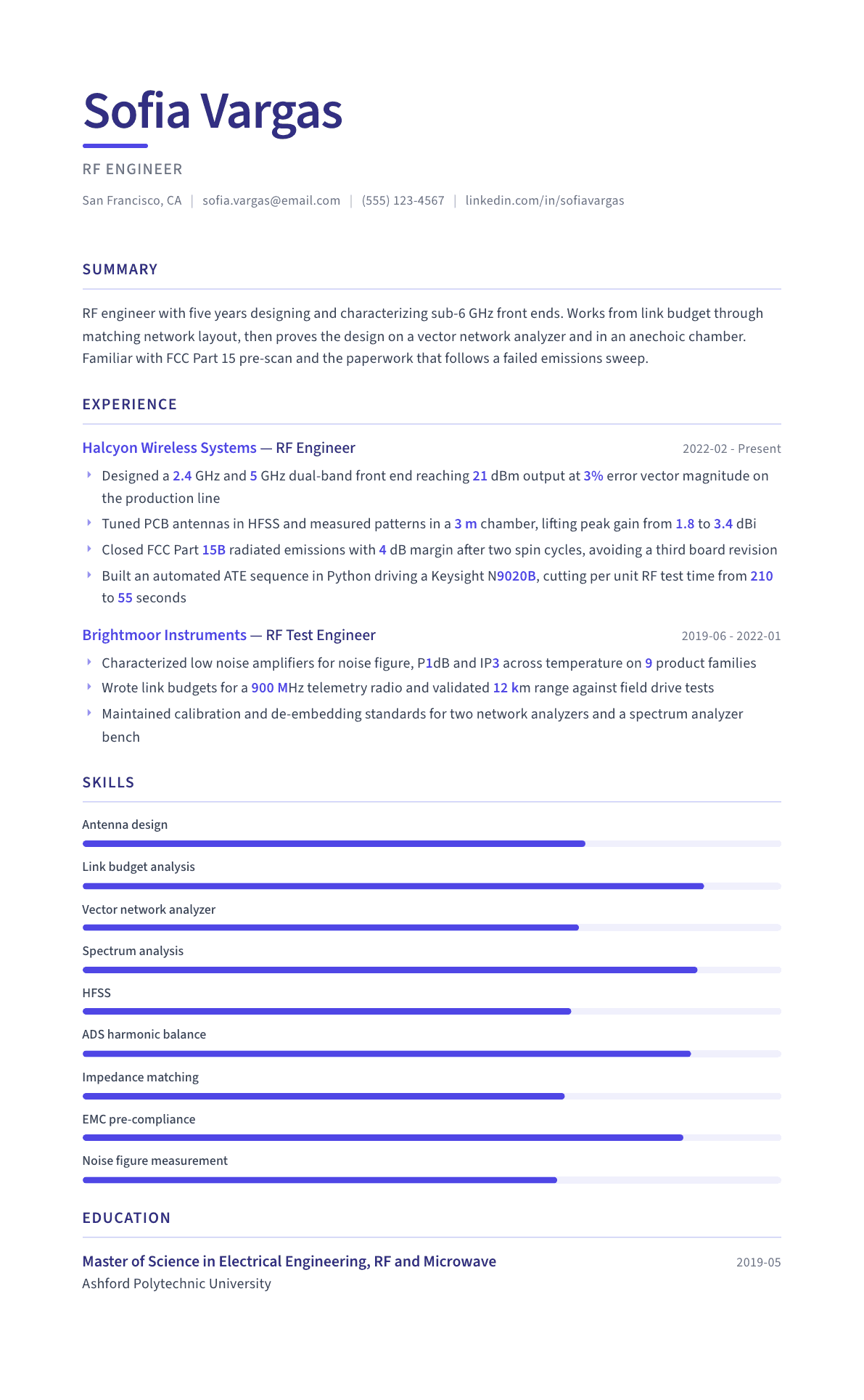
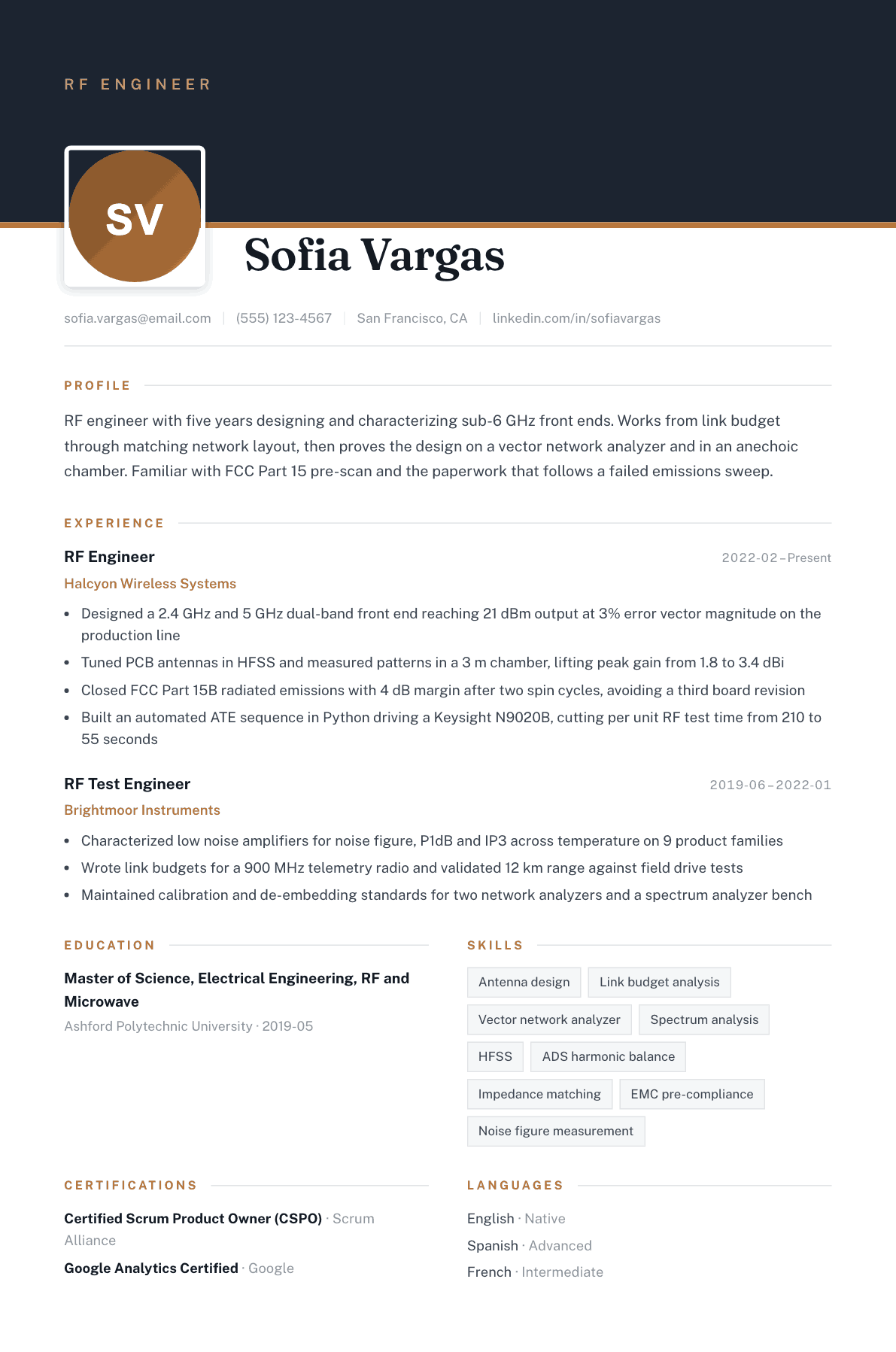
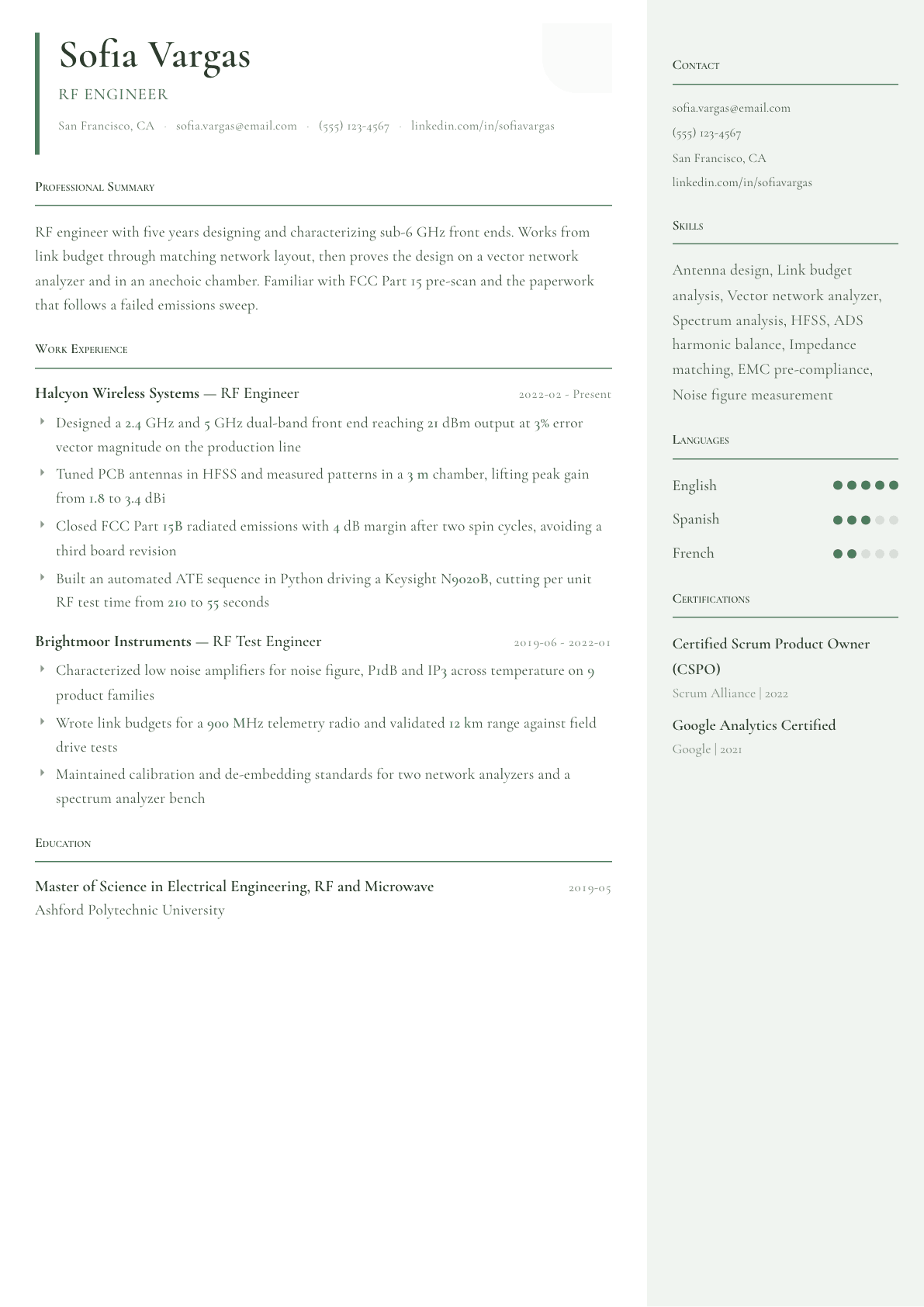
Example RF Engineer summary
RF engineer with five years taking sub-6 GHz radios from link budget to volume production. Designs matching networks and PCB antennas in HFSS, validates them on a vector network analyzer and in an anechoic chamber, and closes radiated emissions testing with margin. Automates production RF test in Python against Keysight instruments. Looking for a senior role owning front end architecture on connected products.
Skills to list on a RF Engineer resume
- Antenna design
- Impedance matching
- Link budget analysis
- S-parameter measurement
- Vector network analyzer
- Spectrum analyzer
- HFSS
- CST Studio Suite
- Keysight ADS
- Noise figure and IP3
- EMC pre-compliance
- FCC Part 15
- RF PCB layout
- Anechoic chamber testing
- Python test automation
- Filter and duplexer design
What actually gets this resume read
- Give the frequency bands you have worked in, because a sub-6 GHz career and a millimeter wave career hire through different doors.
- Pair every design claim with the measurement that proved it, since RF managers trust bench numbers more than simulation output.
- Name the instruments and the calibration method, as de-embedding and fixture design are what separate real lab time from coursework.
- Say whether you owned regulatory submissions, because FCC, CE and equivalent filings are a large part of many RF roles.
- List simulation tools with the solver you used, since HFSS, CST and ADS harmonic balance signal different design responsibilities.
- Include board level work if you have it: RF layout, stackup choice and via stitching are frequently the real bottleneck.
How to write a rf engineer resume
RF engineering resumes are read by people who have been burned by candidates who can simulate but cannot measure. The hiring manager scans for frequency bands, for named instruments, for calibration and de-embedding practice, and for evidence that a design you drew was built, characterized and passed regulatory testing. Simulation results without bench numbers read as coursework.
The second thing that reader checks is scope. There is a large difference between an RF systems engineer writing link budgets, a component designer laying out matching networks and amplifiers, an antenna engineer working in a chamber, and a test engineer automating production measurement. Most careers touch several. The resume should show which one you would be hired to do tomorrow.
This guide covers formatting, section by section content, three example summaries, five before and after bullets, and the questions RF engineers ask when their applications stall.
Format: bands and instruments visible on the first screen
Use a single column reverse chronological layout, one page under six years. Directly beneath the summary put a compact technical block with three lines: frequency ranges worked, simulation tools, and measurement equipment. A hiring manager can qualify you from those three lines alone, which is exactly what you want.
Keep any project or publication list at the end. It is useful supporting material for research heavy roles, but a product company reads experience first and will not hunt for it.
- Header: name, RF specialization, location, phone, email, portfolio or publication link if genuinely relevant.
- Technical block: bands, simulation tools, instruments, regulatory frameworks.
- Section order: summary, technical block, experience, education, certifications, projects.
Summary: band, layer, and proof
State the frequency range and the layer you work at. Sub-6 GHz radio front ends, millimeter wave phased arrays, high frequency communications and satellite payloads all sit under the same RF title and rarely swap candidates. Naming the band immediately removes you from the wrong piles and puts you at the top of the right one.
Then attach one measured outcome. Output power at a given error vector magnitude, a noise figure achieved across temperature, an antenna gain improvement, or a regulatory pass with margin all work. A number that came off an instrument is the most persuasive sentence an RF resume can carry.
Experience: design, measurement, and the spin that was avoided
Write each design bullet as a pair: what you designed, and what the bench said afterward. A matching network described without its return loss or an amplifier without its compression point leaves the reader unable to judge whether the work was good.
Regulatory work deserves specific treatment. Say whether you ran pre-compliance sweeps yourself, whether you attended the accredited lab session, and what you changed when something failed. Board respins are expensive and an engineer who has avoided one by catching a spurious emission early is telling a story every hardware manager understands.
If you have automated production test, describe the instrument stack and the time saved per unit. RF test time is a direct manufacturing cost, and this is one of the few RF bullets that a non-RF manager can also value.
Measurement discipline: the section most candidates skip
Name the calibration methods you use and the fixtures you built. Short open load thru calibration, thru reflect line standards, de-embedding of test fixtures, probe station work and over the air chamber measurement are all separate competencies, and stating them proves you have owned a bench rather than borrowed one.
Add the environmental dimension where it applies. Characterizing across temperature, voltage and process corners is what turns a working prototype into a product, and few candidates mention it.
- Network analysis: calibration kits, de-embedding, fixture design, time domain gating.
- Signal analysis: error vector magnitude, adjacent channel power, phase noise, spurious search.
- Antenna: pattern and gain measurement, efficiency, near field to far field, chamber setup.
Keywords that get an RF resume surfaced
Recruiters searching for RF talent use literal strings: the band, the modulation standard, the instrument manufacturer, the simulator, and the regulatory part number. Mirror the exact phrasing of the posting once in the technical block and once inside an experience bullet where it is demonstrated rather than merely claimed.
Avoid stacking acronyms into an unreadable block. A human opens the file within seconds of the search hit, and a wall of abbreviations tells that human nothing about what you can be trusted to design.
RF Engineer resume summary examples
New graduate
RF and microwave graduate with thesis work on a 3.5 GHz patch antenna array simulated in HFSS and measured in a university chamber. Hands-on with vector network analyzer calibration and spectrum analysis. Seeking an entry RF design or RF test role in wireless product development.
Five years in
RF engineer with 5 years designing sub-6 GHz front ends, taking dual-band radios from link budget to volume production. Reached 21 dBm output at 3% error vector magnitude and closed radiated emissions testing with 4 dB margin. Automates production RF test in Python.
Principal RF engineer
Principal RF engineer with 13 years across cellular and satellite terminals, owning front end architecture, filter and duplexer selection, and regulatory strategy across three regions. Leads chamber characterization, mentors 5 engineers, and has carried 20 plus products through certification.
Work experience bullets: before and after
Before: Designed RF circuits for wireless products.
After: Designed a dual-band 2.4 and 5 GHz front end including matching networks and harmonic filtering, reaching 21 dBm output at 3% error vector magnitude on the production line.
The band, the blocks designed and the measured linearity turn a claim into a verifiable result.
Before: Worked on antenna tuning.
After: Tuned PCB antennas in HFSS against measured impedance, then verified patterns in a 3 meter chamber and lifted peak gain from 1.8 to 3.4 dBi across the operating band.
Pairing simulation with chamber measurement is what separates antenna work from antenna interest.
Before: Helped the product pass emissions testing.
After: Ran pre-compliance radiated sweeps, traced a spurious emission to a clock harmonic coupling into the antenna feed, and closed FCC Part 15B with 4 dB margin after a single board revision.
Naming the failure mechanism and the margin proves diagnostic ability rather than attendance at a test lab.
Before: Automated RF testing in the factory.
After: Built an automated production test sequence in Python driving a signal analyzer and switch matrix, cutting per unit RF test time from 210 seconds to 55 and logging results to a central database.
Test time is a manufacturing cost, so the before and after seconds make the work legible to management.
Before: Characterized amplifiers in the lab.
After: Characterized low noise amplifiers for noise figure, input referred third order intercept and compression across temperature for 9 product families, feeding the results into updated link budgets.
Listing the specific parameters and the downstream use shows the measurements had a purpose.
Hard skills
- Antenna design and tuning
- Impedance matching networks
- Link budget analysis
- S-parameter measurement and de-embedding
- Vector network analyzer operation
- Signal and spectrum analysis
- Noise figure and intercept point measurement
- HFSS and CST electromagnetic simulation
- Harmonic balance simulation
- RF PCB layout and stackup
- Filter and duplexer selection
- EMC pre-compliance testing
- Anechoic chamber measurement
- Python test automation
Soft skills
- Bench troubleshooting patience
- Working with layout designers
- Explaining margin to program managers
- Test lab coordination
- Documentation of measurement conditions
Certifications worth listing
- General Radiotelephone Operator License (Federal Communications Commission)
- Certified EMC Engineer (iNARTE, Exemplar Global)
- Certified LabVIEW Associate Developer (National Instruments)
Mistakes that cost rf engineer candidates the interview
- Presenting simulation plots as achievements with no measured result anywhere on the resume.
- Omitting the frequency bands, which makes it impossible for a manager to place you in the right team.
- Listing instruments you have watched someone else operate rather than the bench you personally owned.
- Ignoring regulatory work entirely when most product RF roles carry certification responsibility.
- Burying production test automation at the bottom when it is often the fastest path to a hiring yes.
- Filling the skills block with acronyms and leaving no sentence that shows engineering judgment.
RF Engineer resume questions
How much simulation detail belongs on an RF resume?
Enough to show the solver and the problem class, then move to measurement. Say that you modeled a structure in a named tool and what the bench confirmed. Reviewers assume simulation skill is common and measurement skill is rare, so weight the page accordingly.
Should I include publications and conference papers?
Include them for research, defense and academic-adjacent roles, and keep them to a short list at the end for product companies. Two or three relevant papers signal depth. A full bibliography on a consumer hardware application reads as a mismatch of intent.
How do I show RF experience without access to expensive equipment?
Describe what you built and how you verified it with what you had. Vector network analyzer time at a university, a software defined radio project with documented spectrum captures, or an antenna measured on a turntable all count if you report real numbers and honest limitations.
Is a portfolio or personal project section worth it for RF?
It helps early in a career. One well documented board with schematic decisions, measured return loss and a lesson learned proves more than three unfinished ideas. Link to a single page rather than a repository the reviewer has to explore alone.
How do I pivot from RF test into RF design?
Lead with the design adjacent work you already do: fixture design, de-embedding, correlation between bench and simulation, and any circuit changes you proposed. Then show a design project end to end, even a personal one, so the reader has evidence rather than an aspiration.
Related resume examples
- Electrical Engineer Resume example
- Firmware Engineer Resume example
- Electronics Engineer Resume example
- Hardware Engineer Resume example
- Test Engineer Resume example
- Battery Engineer Resume example