Emergency Management Specialist Resume Examples: free
Write an Emergency Management Specialist Resume That Lands Interviews
By Mustafa Tarabya, founder of CVBooster · Published · Updated
Emergency management specialist resume example with EOC, ICS, exercise design and continuity keywords, plus a guide to writing activations and plans.
Sample resumes for a emergency management specialist
The same emergency management specialist content laid out in three CVBooster templates, so you can see what the finished document looks like before you write a word.
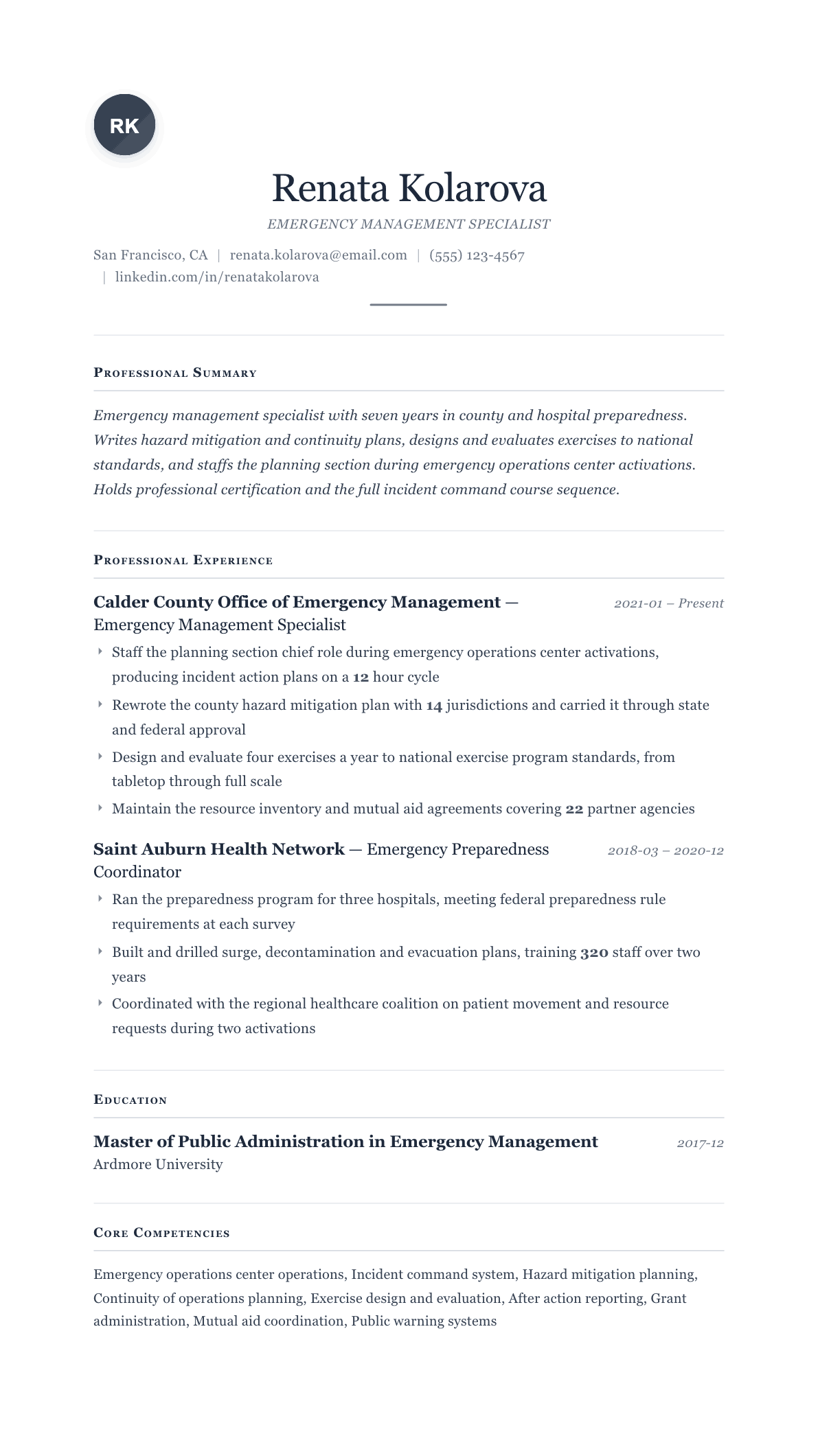
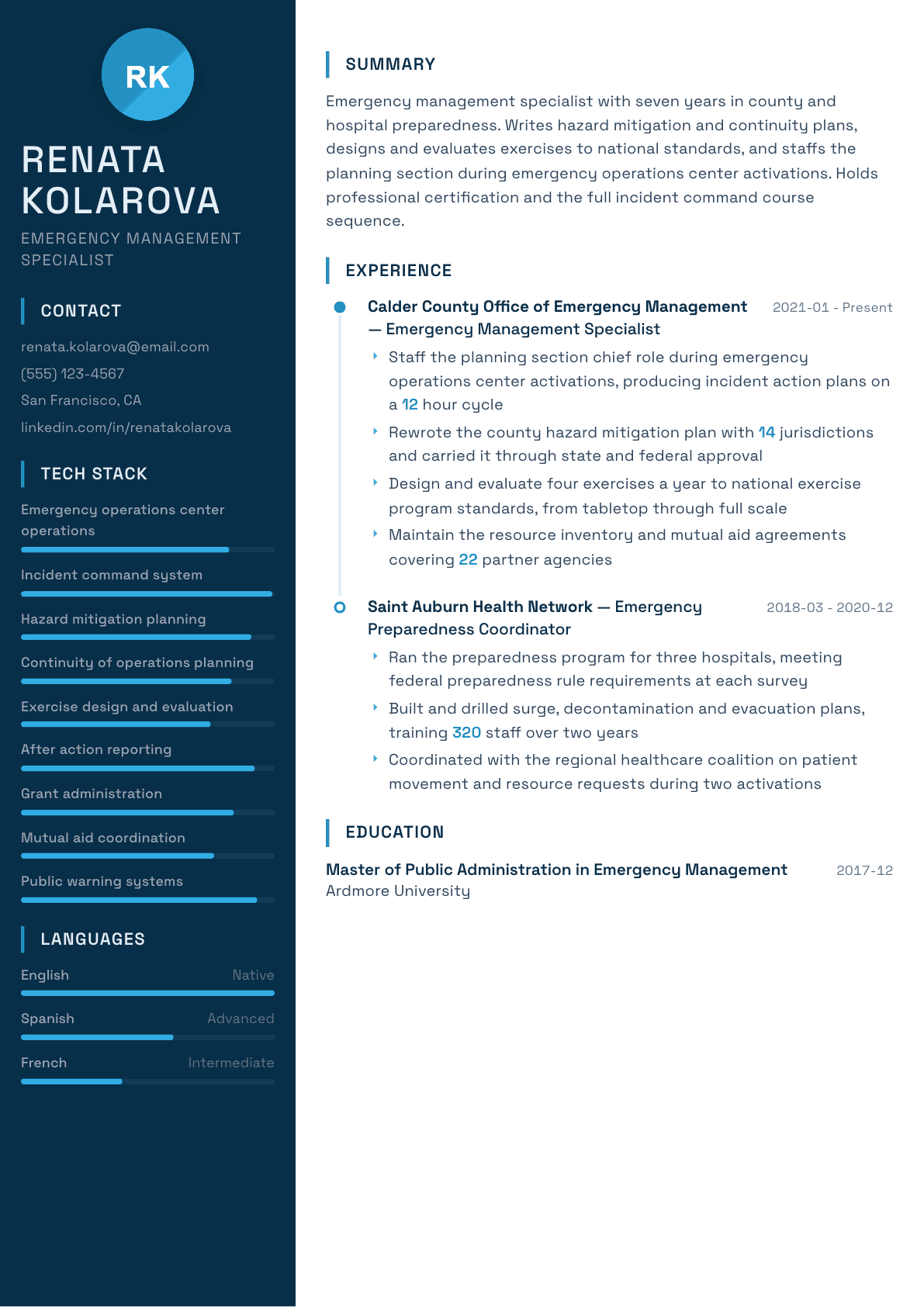
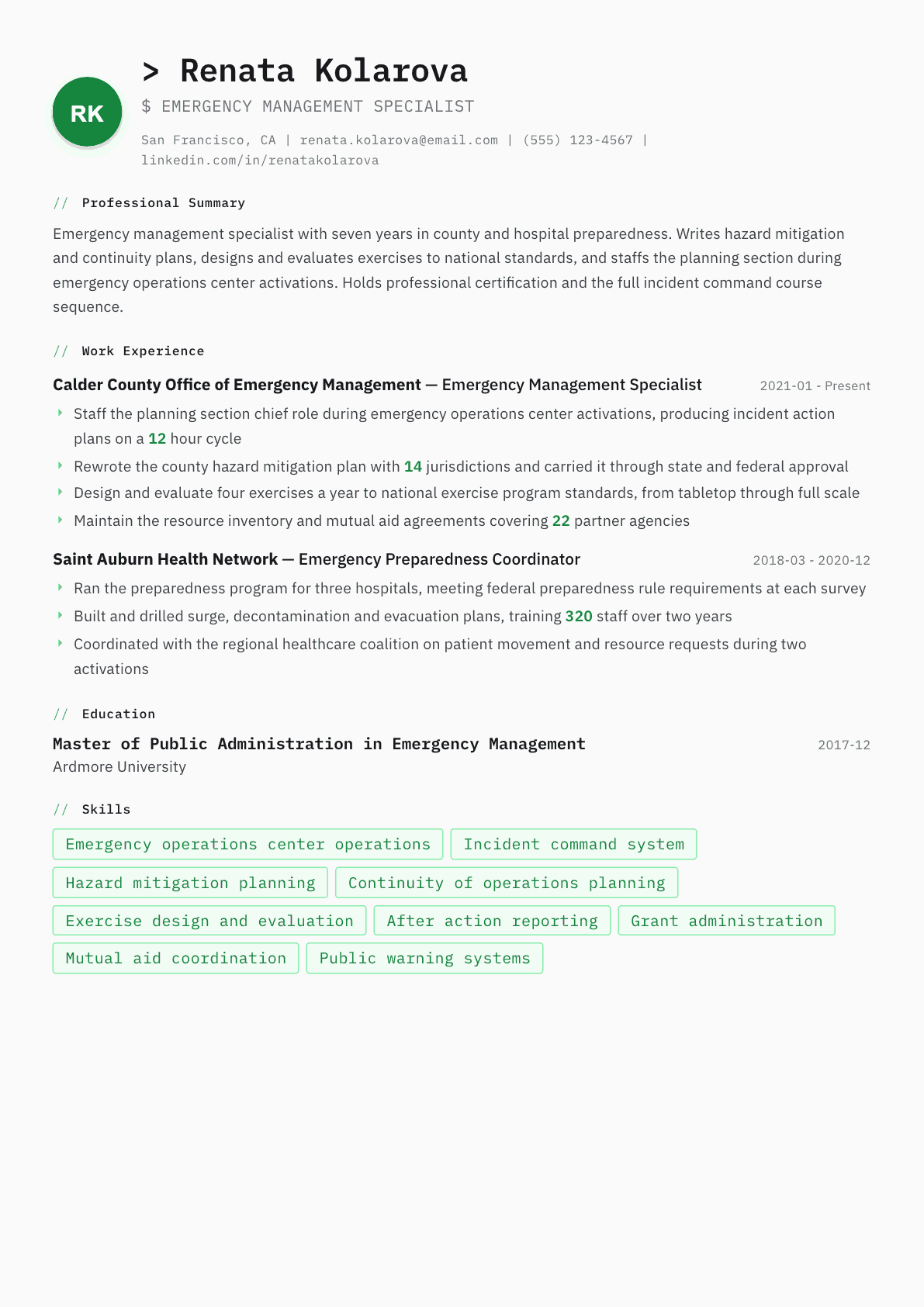
Example Emergency Management Specialist summary
Emergency management specialist with seven years across county and healthcare preparedness, staffing the planning section during emergency operations center activations and producing incident action plans on a 12 hour cycle. Rewrote a multi jurisdiction hazard mitigation plan through federal approval, designs and evaluates exercises to national standards, and maintains mutual aid agreements across more than twenty partner agencies.
Skills to list on a Emergency Management Specialist resume
- Emergency operations center staffing
- Incident command system sections
- Incident action plan development
- Hazard identification and risk assessment
- Hazard mitigation planning
- Continuity of operations planning
- Exercise design and control
- After action report and improvement planning
- Preparedness grant administration
- Mutual aid and resource typing
- Mass notification systems
- Damage assessment
- Interagency coordination
- Public information support
What actually gets this resume read
- List your incident command courses by number and say which section you have actually staffed in a live activation.
- Count activations, not years, because a specialist who has worked ten real events reads differently from one who has not.
- Name every plan you wrote or revised by type: mitigation, continuity, evacuation, debris, mass care or recovery.
- Describe exercises by level, from tabletop to full scale, and say whether you designed, controlled or evaluated them.
- Put grant work on the page with the program name, since preparedness offices are funded through those cycles.
- Name the software you use for planning, resource tracking and notification, because agencies buy specific platforms.
How to write a emergency management specialist resume
Emergency management is a planning profession that occasionally becomes an operations profession at three in the morning. The director reading your application needs proof of both halves. She wants someone who can write a hazard mitigation plan that survives state and federal review, and who can also walk into an emergency operations center during a flood and produce an incident action plan on a twelve hour cycle without being told how.
Most applicants show only the planning half, because that is what a normal week looks like. The result is a resume full of documents and courses with no evidence the person has ever worked a live activation. Others do the reverse and describe deployments with no mention of the plans, grants and exercises that fill the other fifty weeks of the year.
This guide covers what belongs in each section of an emergency management resume, how to write activations and exercises so a director can weigh them, summaries for a coordinator moving up, a working specialist and a program lead, before and after bullets, and the questions people ask when they move between county, hospital and private sector preparedness.
Format: two pages, courses in a block, activations counted
Reverse chronological across two pages. Public sector postings often come with a supplemental questionnaire, but the resume still carries the argument, so do not let it become a course transcript with job titles attached.
Training is genuinely load bearing in this field, so give it a block rather than a footnote. List the incident command sequence by course number, the professional development series if you completed it, and any position specific training such as planning section chief or public information officer. Then keep it factual: a course is training, not experience, and a director can tell the difference instantly.
- Header block for this field: name, city and state, phone, email, professional certification status, and a short line of clearances if held.
- Order that works: summary, certifications and training, experience, plans and exercises produced, education.
- Each job names the jurisdiction or organization type, the population or facility count served, and the hazards you plan against.
- A separate line count for activations worked, with the position filled in each one.
Summary: jurisdiction, section experience, activation count
Three lines. Name the type of program you have run, the population or facilities it covers, the sections of the command structure you have actually staffed, and the number of activations you have worked. That last number is the single most useful thing on the page because it separates people who plan for events from people who have run them.
If you are certified, put the abbreviation in the summary. If you are working toward it, say so with the stage you are at. Directors track that credential because it signals a person who has documented her own experience against a standard, which is exactly the discipline the job requires.
Experience: plans written, exercises run, activations worked
Organize each job around three products. Plans: name the type, the jurisdictions or departments involved, and where it went for approval. A hazard mitigation plan carried through state and federal review is a different achievement from a departmental annex updated in place, and both deserve to be described precisely.
Exercises: give the level, from a discussion based tabletop through a drill, a functional exercise and a full scale event, and your role in each. Designer, controller, evaluator and player are separate jobs, and applicants routinely claim the first while having done the last. Add the improvement plan outcome, because an exercise with no tracked corrective action is theater.
Activations: name the hazard, the duration in operational periods, the position you filled and one concrete product you owned. A specialist who staffed the planning section through a five day flood and produced the action plan each cycle is describing something a director can rely on. A specialist who says she supported operations during severe weather is describing nothing.
Grants, resources and the administrative half nobody writes about
Preparedness programs are funded through grant cycles, and the person who can manage an application, a spend plan and a closeout is worth a great deal to a director. Name the funding program, the scope of what it bought, and whether you handled the reporting. Do not put award amounts on the page, because they read as budget rather than skill and they date quickly.
Resource management is the other quiet half. Resource typing, inventory maintenance, mutual aid agreements and credentialing are the systems that make a request work at two in the morning. An applicant who has kept an inventory current across twenty partner agencies has done a harder job than the phrase suggests, and should say how many agencies and how often it was verified.
- Plans by type: mitigation, emergency operations, continuity, evacuation, mass care, debris, recovery and hazard specific annexes.
- Exercises by level with your role and whether an improvement plan followed.
- Activations with hazard, operational periods and the command position you held.
- Grant program name, the scope funded and your reporting responsibility.
- Resource inventory and mutual aid agreements with the number of partner agencies covered.
Software, standards and the words a posting scans for
Name the platforms. Incident management software, mass notification systems, geographic information tools used for damage assessment, and the exercise documentation format you write in. Agencies buy these on multi year contracts and a specialist who already works in the same platform starts producing in week one.
Postings recycle a tight vocabulary drawn from national doctrine: preparedness, mitigation, response, recovery, incident command system, emergency support functions, continuity of operations, after action report, improvement plan, damage assessment, whole community. Mirror the exact phrases once in the skills area and once inside a bullet where the work is visible.
Emergency Management Specialist resume summary examples
Moving up from a coordinator role
Emergency management coordinator with two years supporting a city program, maintaining the notification system and the resource inventory. Completed the incident command sequence through the intermediate course, staffed two activations in the planning section as a unit member, and drafted three departmental annexes.
Five years in a county program
Emergency management specialist with five years in a county office serving eleven jurisdictions. Has worked nine activations across flood, winter storm and hazardous materials events, staffs the planning section, designs four exercises a year to national standards, and administers two preparedness grant cycles.
Program lead
Emergency management program lead with ten years across county and healthcare preparedness. Rewrote a multi jurisdiction hazard mitigation plan through federal approval, serves as planning section chief during activations, controls full scale exercises, and maintains mutual aid agreements with more than twenty partner agencies.
Work experience bullets: before and after
Before: Assisted with emergency operations center activities during emergencies.
After: Staffed the planning section chief position through a five day flood activation, producing an incident action plan each twelve hour operational period and briefing the policy group twice daily.
The position, the duration and the product prove you ran a section instead of standing in the room.
Before: Updated emergency plans for the county.
After: Rewrote the county hazard mitigation plan with 14 participating jurisdictions, ran the public comment process and carried the document through state and federal approval.
Plan type, participant count and the approval path show a project delivered rather than a file edited.
Before: Ran training exercises for staff.
After: Designed and evaluated four exercises a year from tabletop through full scale, wrote the after action report for each and tracked 31 corrective actions to closure.
Exercise levels, a design role and closed corrective actions separate real exercise work from a meeting with scenarios.
Before: Worked on preparedness grants.
After: Administered two preparedness grant cycles including the application narrative, the spend plan for interoperable radios and generators, quarterly reporting and closeout.
Naming the funded scope and the reporting duties shows you can hold the funding half of the program together.
Before: Maintained relationships with partner agencies.
After: Maintained mutual aid agreements and a typed resource inventory covering 22 partner agencies, verifying contact and capability data twice a year before hurricane season.
Agency count and a verification cadence turn a soft claim into a system a director can inherit.
Hard skills
- Emergency operations center staffing
- Incident command system section roles
- Incident action plan development
- Hazard identification and risk assessment
- Hazard mitigation planning
- Continuity of operations planning
- Exercise design, control and evaluation
- After action reporting and improvement planning
- Preparedness grant administration
- Mutual aid agreements and resource typing
- Mass notification system administration
- Damage assessment methods
- Interagency and multi jurisdiction coordination
- Public information support during incidents
Soft skills
- Holding a planning cycle when the incident keeps changing
- Getting agreement from agencies with no obligation to agree
- Writing plainly enough that a volunteer can follow the plan
- Working long operational periods without dropping the documentation
- Telling a policy group something it does not want to hear
Certifications worth listing
- Certified Emergency Manager (CEM) (International Association of Emergency Managers)
- Associate Emergency Manager (AEM) (International Association of Emergency Managers)
- ICS-400 Advanced Incident Command System (FEMA Emergency Management Institute)
Mistakes that cost emergency management specialist candidates the interview
- Letting the resume become a course list, so a director sees training records where she needed activation experience.
- Saying you supported an activation without naming the position you held or the product you produced each cycle.
- Describing exercises without their level or your role, which hides the difference between designing one and attending one.
- Leaving plan work vague instead of naming the plan type, the participating jurisdictions and where it went for approval.
- Ignoring grants and resource management, the administrative work that keeps a preparedness program funded and ready.
- Skipping the software platforms, when a specialist who already knows the incident management system saves months of onboarding.
Emergency Management Specialist resume questions
How do I show activation experience if my county rarely activates?
Count everything honestly: partial activations, monitoring postures, planned event operations and regional deployments to help neighboring jurisdictions. Then lean on exercise work, since a full scale exercise where you filled a command position is the closest legitimate substitute a director will accept.
Which certification matters most in emergency management?
The professional emergency manager credential from the international association is the recognized standard, with an associate level for people still building experience. Beyond it, the advanced incident command courses and position specific training carry the most weight with hiring directors.
How is a hospital preparedness resume different from a county one?
Healthcare preparedness is written around federal preparedness rule requirements, surge, decontamination, evacuation and coalition coordination. County work is written around multi jurisdiction planning, mitigation and public warning. Reorder the experience and the plan list toward whichever one you are applying to.
Should I include military deployments and disaster response volunteering?
Yes, when you describe them in incident command terms. A deployment where you ran logistics for a base camp, or a volunteer role staffing a shelter for a week, both demonstrate operational experience that pure office planners lack. Name the position and the operational period.
How do I move from public sector emergency management to private business continuity?
Lead with continuity planning, business impact analysis, exercise design and vendor or supply disruption work, then translate jurisdiction language into site and function language. Private employers care about downtime and recovery targets more than they care about mutual aid.
Related resume examples
- Emergency Management Director Resume example
- Emergency Management Coordinator Resume example
- Firefighter Resume example
- Safety Officer Resume example
- Military Resume example
- Fire Captain Resume example