Fire Captain Resume Examples: free ATS score and gap list
Write a Fire Captain Resume for the Promotional Process
By Mustafa Tarabya, founder of CVBooster · Published · Updated
Fire captain resume example covering company command, training records and keywords for promotional boards and lateral officer hiring.
Sample resumes for a fire captain
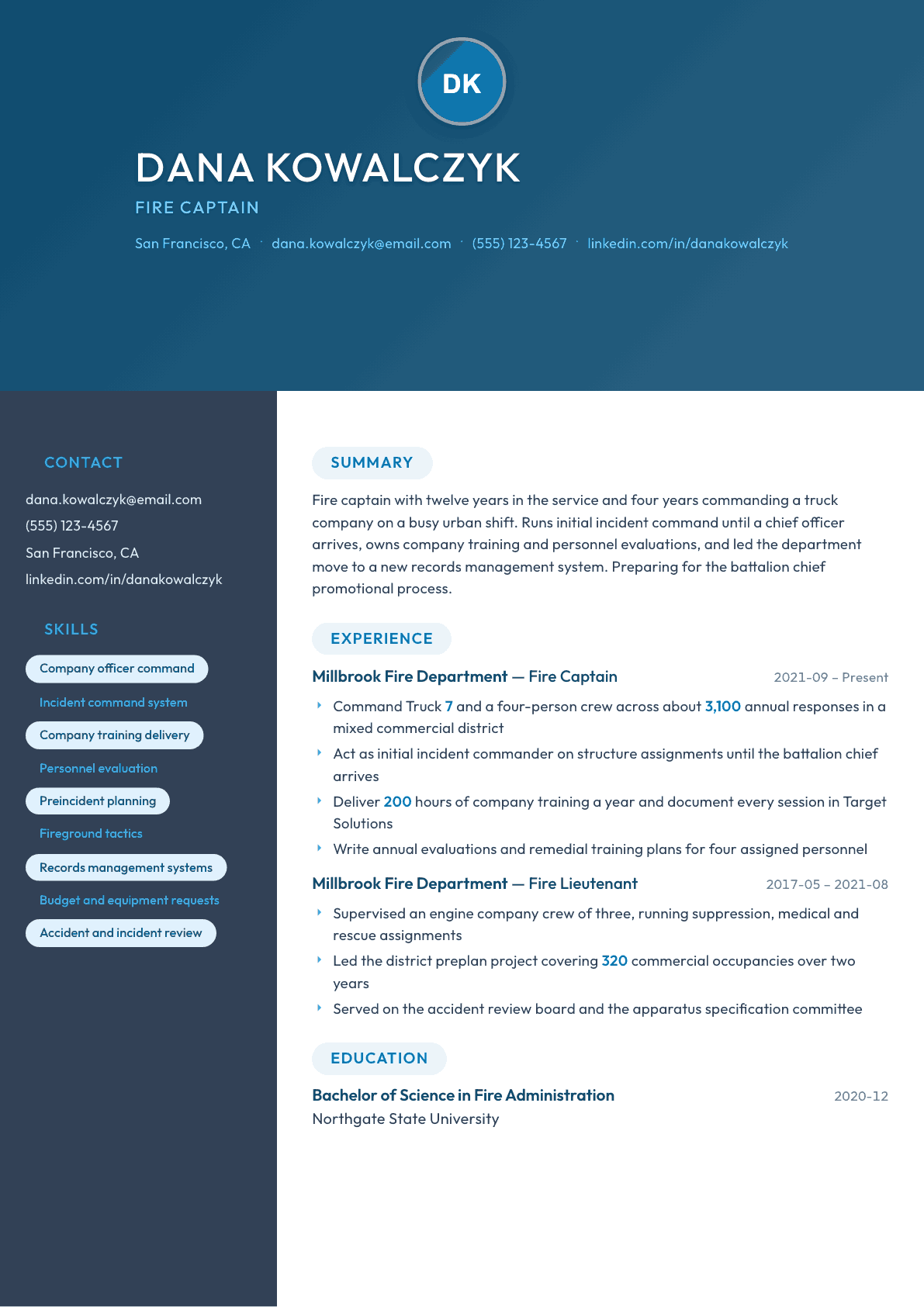
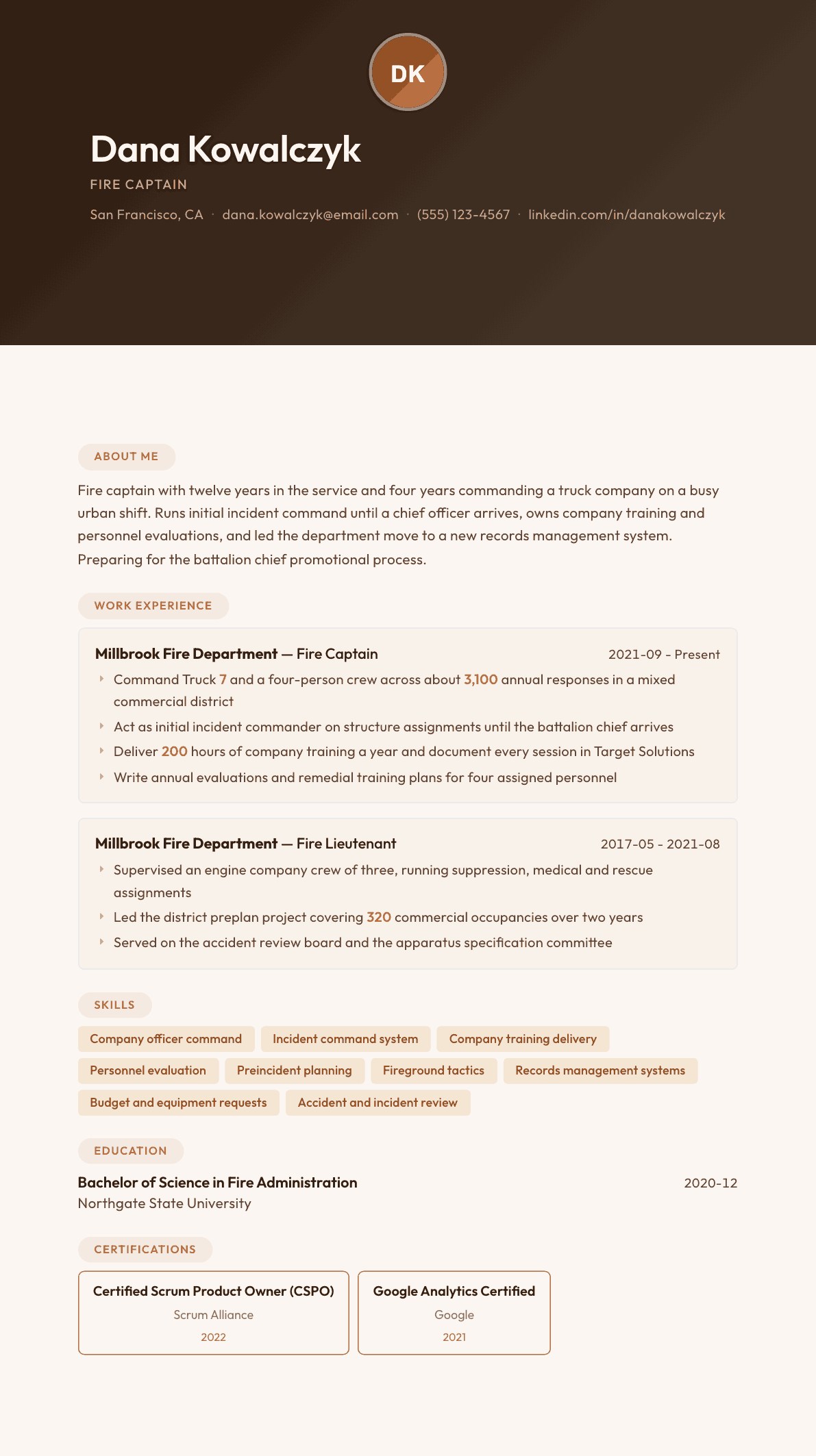
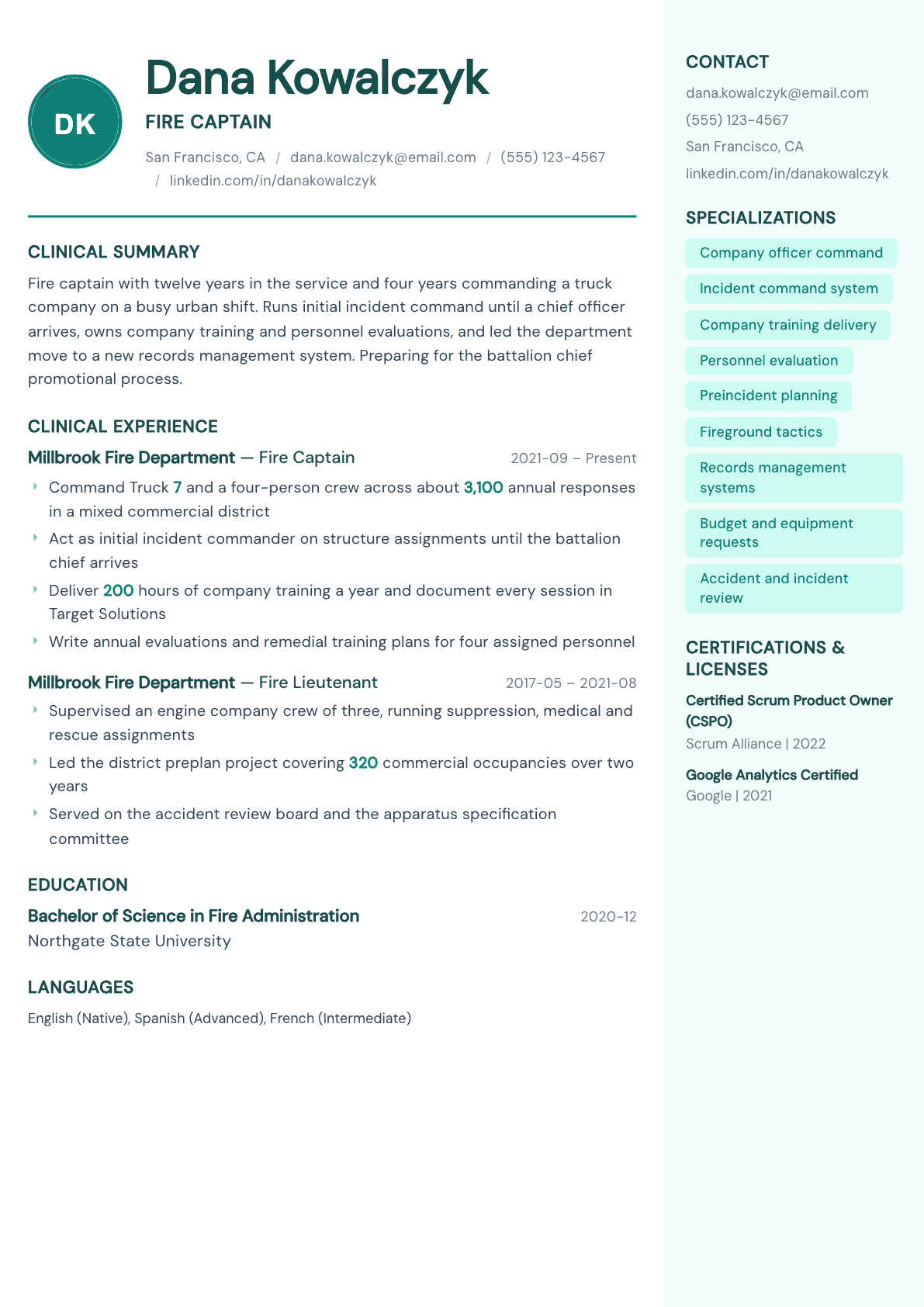
The same fire captain content laid out in three CVBooster templates, so you can see what the finished document looks like before you write a word.
Example Fire Captain summary
Fire captain with twelve years of service and four years commanding a truck company through about 3,100 annual responses in a mixed commercial district. Holds initial incident command on structure assignments, delivers 200 hours of company training a year, and writes evaluations and remedial plans for four assigned personnel. Led the department move to a new records management system. Preparing for the battalion chief promotional process.
Skills to list on a Fire Captain resume
- Company officer leadership
- Incident command and size-up
- Fireground strategy and tactics
- Crew accountability
- Company training program delivery
- Personnel evaluation and coaching
- Preincident planning
- Standard operating guideline development
- Records management systems
- Apparatus specification
- Budget requests and equipment justification
- Accident and near miss review
- Mutual aid coordination
- Public education and community risk reduction
What actually gets this resume read
- Lead with company command: the apparatus you run, the crew size, and the annual response count for your district.
- Show how often you have held initial incident command and what type of incidents you commanded before relief.
- Document training hours you delivered and the system you recorded them in, since promotional boards audit that.
- List every officer credential with the issuing board, because lateral hiring depends on credential reciprocity.
- Name the committees, projects and budget items you owned outside the shift, which is what separates captains.
- Include personnel work honestly: evaluations written, remedial plans built, and grievances or discipline handled.
How to write a fire captain resume
A fire captain resume is written for one of two readers. Inside your own department it supports a promotional process where an assessment center, a written exam and a panel already have your service record, so the document exists to frame your command experience and your work off the shift. Outside it, applying laterally or for a chief officer position, it has to carry the whole case to people who have never watched you work a fire.
Both readers want the same evidence and rarely get it. How often you have held command before a chief arrived, what you did with your company between calls, how you handle a firefighter who is failing, and what you have built that outlasted your assignment. Command time and personnel work are the two areas where captain resumes are thinnest, and they are exactly what promotional panels score.
This guide covers the format a promotional file expects, how to describe company command and incident command honestly, how to present training and personnel work, and the questions captains ask when they are preparing for a battalion chief process.
Format: command scope in the heading, department work in its own section
Two pages is normal for an officer with ten or more years. Under the name goes your current rank and target position, then a short summary, then experience with a scope line under each position, then a department contributions section, then credentials and education.
The department contributions section is what separates a captain resume from a firefighter resume. Committees, projects, program ownership, instructor work and any budget or specification input belong there rather than buried among incident bullets.
- Scope line for a company officer: apparatus commanded, crew size, district type and annual response count.
- Officer credential block: fire officer levels, instructor levels, incident command training, each with the issuing board.
- A command experience line stating how often you have served as initial incident commander and on what incident types.
- Education section carrying degrees and executive fire service programs, with completion dates.
Command experience: the number nobody writes down
Panels want to know how much command you have actually held. Give the count or the frequency: how many times you have been the initial incident commander, on what kinds of incidents, and how long you typically held command before transfer to a chief officer. Almost no captain resume includes this, and it is the strongest thing on the page when it does.
Follow it with the range. Structure assignments, vehicle fires, technical rescue, hazardous materials incidents, multi-company medical incidents and mutual aid responses each demand something different from an incident commander, and the mix says more than a total ever will.
One narrative bullet is worth including: an incident where the decision you made changed the outcome, written factually with the tactic and the result. Panels ask for these in interviews and a captain who has already articulated one arrives prepared.
Training, personnel and the unglamorous half of the job
Give the training hours you delivered annually and the system you documented them in. Departments audit training records, and a captain who can state hours delivered and how they were recorded is describing the compliance side of the job that chief officers spend their time worrying about.
Personnel work needs to be on the page and needs to be honest. Evaluations written, remedial plans built, probationary firefighters mentored through their first year, and any disciplinary or grievance process you handled at company level. This is the work that gets a captain promoted and the work most captains omit.
Where you have improved a person rather than a process, say so specifically. A probationary firefighter who was failing a skill and passed after a structured plan is a better promotional story than any incident bullet.
Programs, projects and the work off the apparatus
Chief officer panels are choosing someone who will run a program, so show that you already have. A preplan project across a district, a records system migration, an apparatus specification committee, a standard operating guideline you drafted, a recruitment effort or a community risk reduction initiative all count.
Attach a size to each. Number of occupancies covered, personnel affected, stations involved, or the period it ran. A project without a scale is indistinguishable from having attended a few meetings.
Include the accident review and safety work if you have done it. Reviewing a near miss and changing a guideline as a result is precisely the judgment a department is testing for at the next rank.
Credentials, education and lateral moves
List fire officer and instructor certifications with the issuing board, because lateral hiring and promotion eligibility both depend on which body accredited them. Add incident command coursework and any executive fire service program with dates.
A degree matters more at the officer level than at the firefighter level, and many departments require one for chief positions. If you are enrolled, state the program and expected completion so a panel can see the trajectory rather than a gap.
For a lateral application, add the context an outside department lacks: your department size, station count, annual responses and staffing model. Without it, a reviewer cannot tell whether your captain rank matches theirs.
Fire Captain resume summary examples
Newly promoted company officer
Fire lieutenant with eight years of service and one year supervising an engine company crew of three across suppression, medical and rescue assignments. Holds Fire Officer I and Fire Instructor I. Led the district preplan project covering 320 commercial occupancies and serves on the accident review board.
Captain, four years in the seat
Fire captain with twelve years of service and four years commanding a truck company through about 3,100 annual responses in a mixed commercial district. Holds initial incident command on structure assignments, delivers 200 hours of company training a year, and writes evaluations and remedial plans for four assigned personnel.
Senior captain testing for chief
Senior fire captain with nineteen years of service, nine as a company officer across engine, truck and rescue assignments in a department of six stations. Owns the department training records system, chairs the safety committee, and instructs recruit academy classes. Completing a bachelor degree in fire administration.
Work experience bullets: before and after
Before: Supervised a company of firefighters on emergency responses.
After: Command Truck 7 and a four-person crew across about 3,100 annual responses in a mixed commercial district, covering suppression, technical rescue and multi-company medical incidents.
Apparatus, crew size, annual volume and district type let a panel compare your seat directly against their own.
Before: Acted as incident commander at various incidents.
After: Served as initial incident commander on more than 60 structure and rescue assignments, holding command through size-up, assignment and accountability until the battalion chief arrived.
A command count with the specific functions held is the evidence a promotional panel is actually looking for.
Before: Provided training to company personnel throughout the year.
After: Delivered 200 hours of company training a year and documented every session in the department records system, closing each quarter with the shift fully current.
Hours, documentation and a compliance outcome describe the training program a chief officer will hold you accountable for.
Before: Completed annual evaluations for assigned personnel.
After: Wrote annual evaluations for four assigned personnel and built a remedial training plan that brought a probationary firefighter through a failed skill assessment to a pass within one cycle.
The remedial outcome shows supervision that develops people rather than paperwork completed on schedule.
Before: Helped implement a new records system for the department.
After: Led the move to a new records management system across six stations, writing the entry standards and training 90 personnel before the changeover date.
Stations affected, headcount trained and the artifact produced turn participation into project ownership.
Hard skills
- Company officer command
- Incident command and size-up
- Fireground strategy and tactics
- Crew accountability systems
- Company training program delivery
- Personnel evaluation and remedial planning
- Preincident planning
- Standard operating guideline development
- Records management system administration
- Apparatus specification input
- Accident and near miss review
- Mutual aid coordination
Soft skills
- Giving an order that will not be questioned on the fireground
- Coaching a firefighter who used to be your peer
- Keeping a crew together across a long shift cycle
- Delivering bad news up the chain without softening it
- Holding a safety standard when the shortcut is tempting
Certifications worth listing
- Fire Officer I and II (National Board on Fire Service Professional Qualifications)
- Fire Instructor I (International Fire Service Accreditation Congress)
- Incident Command System ICS-300 (FEMA Emergency Management Institute)
- Fire Inspector I (International Code Council)
Mistakes that cost fire captain candidates the interview
- Writing a firefighter resume with a captain title on it, full of incident bullets and empty of supervision.
- Leaving out how often you have held initial command, which is the first thing a promotional panel wants.
- Omitting personnel work because evaluations and remedial plans feel like paperwork rather than achievement.
- Listing committees without the size, duration or outcome that would make them read as project ownership.
- Applying laterally without giving department size, station count and annual responses for context.
- Naming officer certifications without the issuing board, which is what eligibility and reciprocity turn on.
Fire Captain resume questions
How is a promotional resume different from a job application?
A promotional file supports a process where your service record is already known, so it frames command experience, program work and education. A lateral or chief officer application must supply all the context an outside reader lacks, including department size and response volume.
How do I show incident command experience credibly?
Give a count or a frequency, the incident types, and what functions you performed while holding command. Then add one narrative bullet describing a decision and its result. Panels are testing judgment, and only a specific example demonstrates it.
Should I include company level discipline on the resume?
Describe the supervisory work in general terms, such as handling company level performance issues and building remedial plans, without naming individuals or specific cases. It shows you take the responsibility seriously while keeping personnel matters confidential.
Is a degree necessary to promote past captain?
Many departments require or strongly prefer one for battalion chief and above, and some accept an executive fire service program as an alternative pathway. Check your own department rules early, since degree requirements have long lead times.
What belongs in a department contributions section?
Committee service, program ownership, instructor work, specification input, recruitment and community risk reduction, each with a size and a period attached. This section is what tells a panel you already do the work of the next rank rather than only the current one.
Related resume examples
- Fire Chief Resume example
- Firefighter Resume example
- Emergency Management Director Resume example
- Security Guard Resume example
- Combat Medic Resume example
- Emergency Management Specialist Resume example