Environmental Health and Safety Manager Resume Examples
Write an EHS Manager Resume That Proves Program Ownership
By Mustafa Tarabya, founder of CVBooster · Published · Updated
Environmental health and safety manager resume example with EHS program, permit, audit and management system keywords, plus a full writing guide.
Sample resumes for a environmental health and safety manager
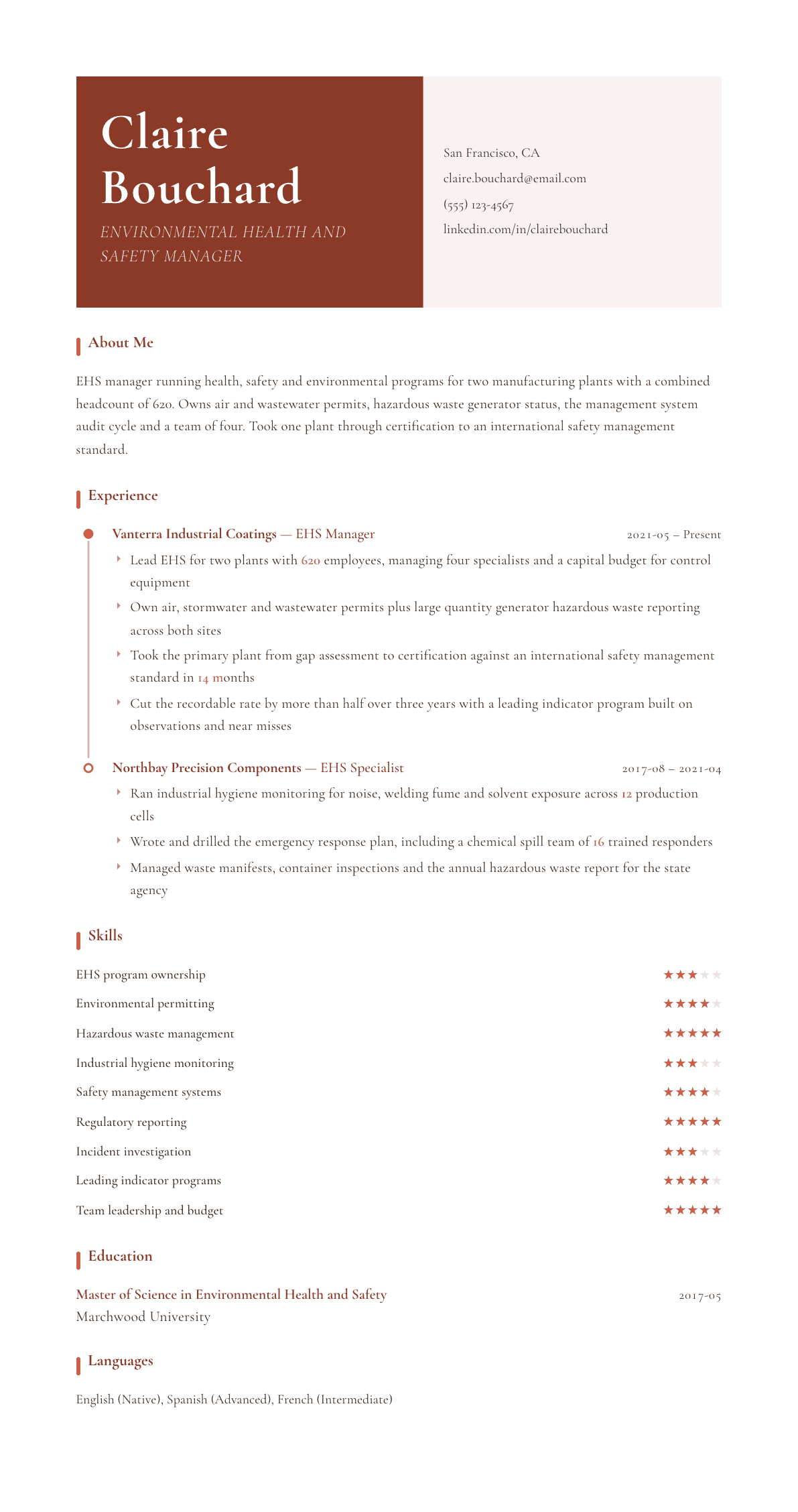
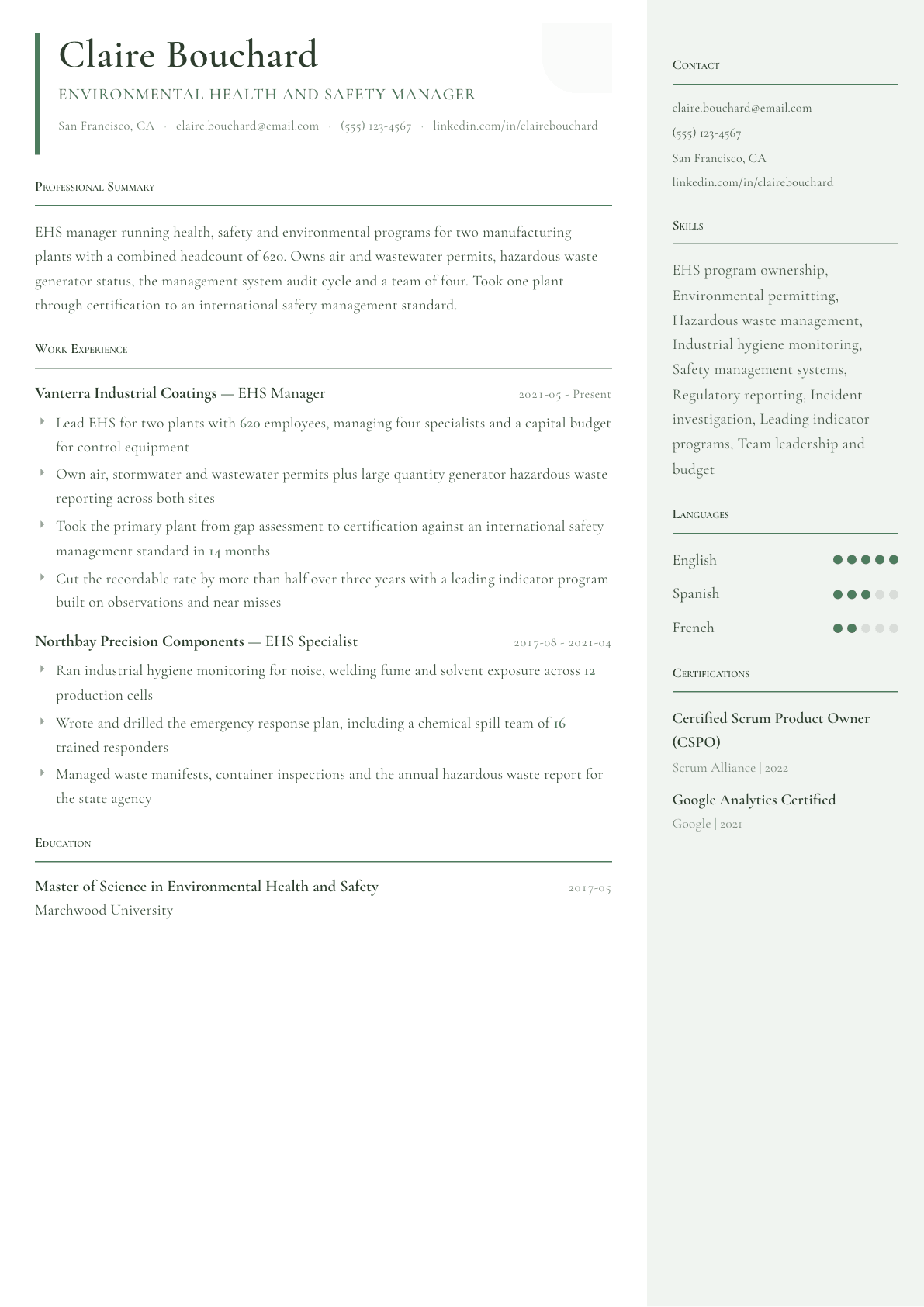
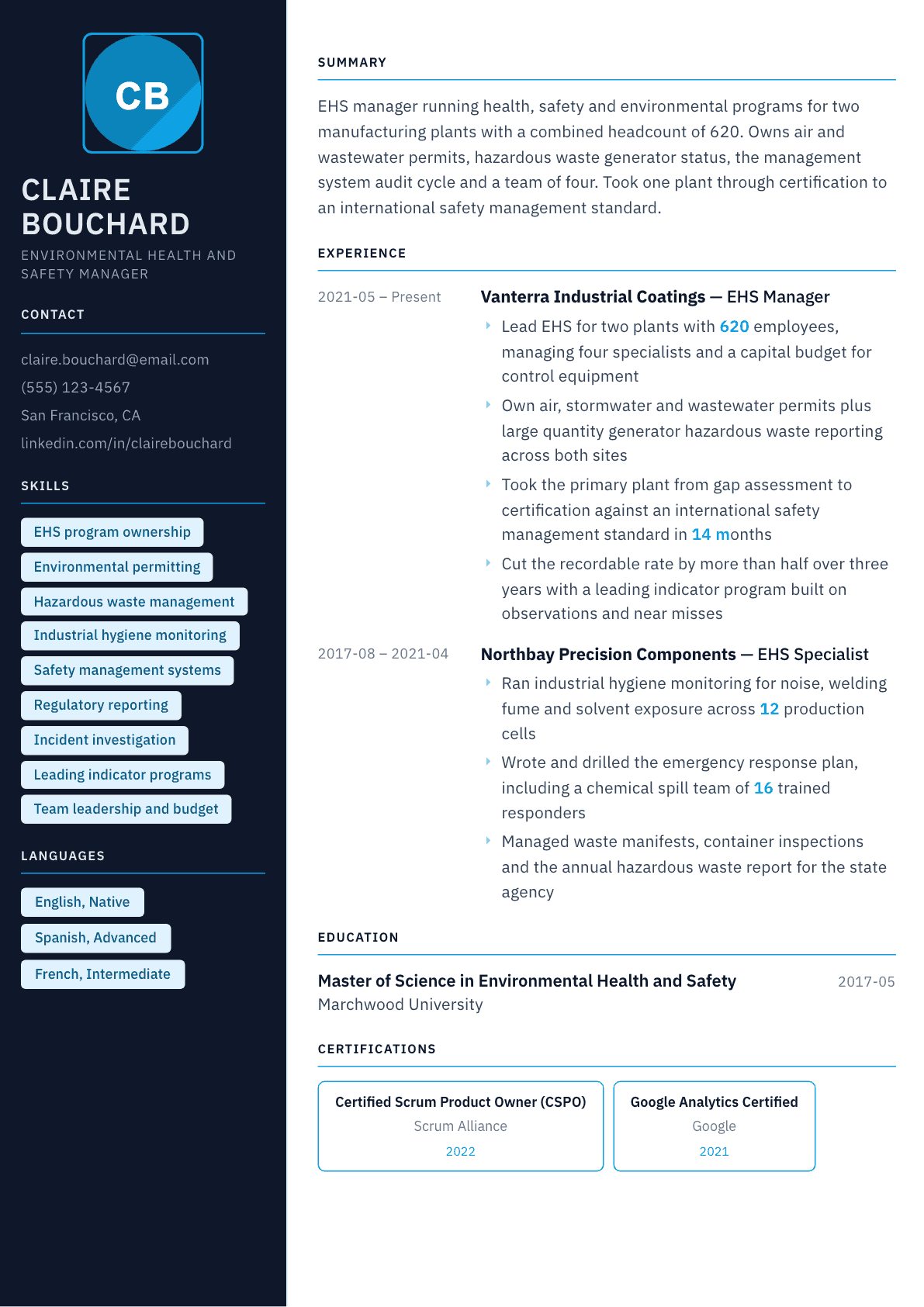
The same environmental health and safety manager content laid out in three CVBooster templates, so you can see what the finished document looks like before you write a word.
Example Environmental Health and Safety Manager summary
Environmental health and safety manager covering two manufacturing plants and 620 employees with a team of four specialists. Owns air, stormwater and wastewater permits along with large quantity generator waste reporting, took the primary plant through certification to an international safety management standard, and halved the recordable rate using an observation and near miss program rather than campaign posters.
Skills to list on a Environmental Health and Safety Manager resume
- EHS management systems
- Air, water and waste permitting
- Hazardous waste generator compliance
- Regulatory reporting and agency inspections
- Industrial hygiene sampling
- Risk assessment and hierarchy of controls
- Incident investigation and root cause
- Leading and lagging indicator programs
- Contractor and vendor safety management
- Emergency response and spill planning
- Process safety fundamentals
- Training program design
- Internal audit and corrective action
- Budget and capital project support
- Team leadership and development
What actually gets this resume read
- State the number of sites, the headcount and the process type, because an EHS manager is hired against a risk profile.
- Separate environmental from safety on the page, since permits, waste and reporting are a different skill from injury prevention.
- Name the management standards you have implemented or maintained and whether you took a site through certification.
- Give leading indicators alongside injury rates, because a manager who only reports lagging numbers looks reactive.
- List your permits by media: air, stormwater, wastewater and waste generator status, with the reporting cycles you own.
- Say how many specialists you manage and what budget you hold, since program ownership is what separates this from a specialist role.
How to write a environmental health and safety manager resume
An environmental health and safety manager is hired against a risk profile, not against a job description. The plant manager or vice president reading your file has a specific set of exposures: a coating line with solvent emissions, a wastewater discharge permit with limits that are tight in summer, a hazardous waste generator status that triggers reporting, and a workforce whose injury numbers are visible to a customer. He is trying to work out whether you have carried that combination before.
The word manager is doing real work in the title, and applicants often ignore it. This role owns permits, budgets, people and an audit cycle. A resume that reads like a strong specialist page, full of inspections and training sessions with no program ownership behind it, gets passed over for someone who wrote about the management system, the agency relationship and the team.
This guide breaks down what an EHS manager resume needs in each section, how to separate the environmental half from the safety half without weakening either, three summaries for different levels of program responsibility, before and after bullets, and the questions specialists ask when they step up to running a program.
Format: two pages, sites and risk profile first
Two pages, reverse chronological, with a short profile block at the top that states the scope you have carried: number of sites, total headcount, process type and the regulatory programs you owned. That block does the work of the first interview question and lets a reader place you against his own operation immediately.
Professional certifications go directly beneath it. In this field the certification set signals the depth a hiring executive cannot verify quickly, particularly a safety certification, an industrial hygiene credential or a hazardous materials management credential. List each with its awarding board rather than the abbreviation alone.
- Scope block: sites managed, combined headcount, process description, and the permits and generator status you held.
- Team and budget line, because program ownership is what separates this title from a specialist role.
- Split experience bullets into environmental compliance and occupational safety so neither disappears into the other.
- Management system experience named by standard, with whether you implemented, certified or maintained it.
Summary: sites, headcount, permits, and the system you built
Four lines at most. Name the number of plants and the combined headcount, the process risk, the permits and waste status you owned, the size of your team, and one program outcome. An executive wants to know within seconds whether you have operated at his scale and under his kind of regulation.
Pick the outcome carefully. Taking a site from a gap assessment through certification to a recognized management standard is a stronger summary line than an injury statistic, because it demonstrates the system building an executive is actually buying. Save the rate movement for the experience section where it can be given a baseline.
Environmental compliance: permits, waste and the agency relationship
Write this half by media, because that is how the regulations arrive. Air permits with their monitoring and record requirements. Stormwater and wastewater discharge permits with sampling schedules and limits. Hazardous waste generator status with manifests, container inspections, accumulation time and the annual report. Chemical inventory reporting and any right to know submissions.
Then describe the agency relationship honestly. Inspections received, findings raised, how they were closed, and whether any enforcement followed. An executive is far more impressed by a manager who walked an inspector through a site and closed two minor findings in writing than by one who claims never to have been inspected at all.
Add the projects that reduce the exposure rather than manage it. A solvent substitution that lowered emissions, a wastewater pretreatment change that brought a parameter back inside limits, a waste stream reclassified after a characterization study. These are the bullets that separate a compliance administrator from an EHS manager.
Occupational safety: the system, the indicators and the people
Describe the safety half as a program with parts: risk assessment against the hierarchy of controls, machine guarding and process changes, permit systems for high hazard work, contractor management, industrial hygiene monitoring, emergency response and training design. Say which parts you built and which you inherited, because an executive assumes everything is inherited unless you tell him otherwise.
Give indicators in both directions. Injury rates as a movement across a stated period, and leading measures such as observations completed, hazard reports raised per employee, corrective action closure time and audit findings closed. The combination is what tells a reader you manage the program between incidents rather than only after them.
Industrial hygiene deserves its own line if you have it. Noise dosimetry, welding fume sampling, solvent exposure monitoring and the controls that followed are technical work that a plant leader cannot evaluate himself, which makes it valuable to state precisely.
Management systems, audits and the team you led
Name the management standards you have worked to and be exact about your role. Implementing a system from a gap assessment through certification is a project with a timeline and a cost. Maintaining a certified system through surveillance audits is a different discipline. Running internal audits across sites is a third. Executives read all three as separate qualifications.
Close with the management content itself: the specialists you supervised, their development, the capital projects you justified for control equipment, and the cross functional work with engineering, maintenance and operations. An EHS manager who cannot show that operations leaders acted on his recommendations has not really managed anything, and that is the quiet test in every interview for this role.
- Permits by media with their reporting cycles and your role in each submission.
- Waste generator status, manifests and the annual report you signed or prepared.
- Agency inspections received with findings and closure, stated plainly.
- Management standard work labeled as implementation, certification or maintenance.
- Team size, development activity and the capital projects you carried through approval.
Environmental Health and Safety Manager resume summary examples
Specialist stepping up
EHS specialist with four years in precision manufacturing, running industrial hygiene monitoring, waste manifests and the emergency response plan for a single plant. Holds a safety certification and has led internal audits against a recognized management standard. Seeking a first manager role with program ownership.
Single plant manager
Environmental health and safety manager for a coatings plant with 310 employees, owning air, stormwater and wastewater permits plus large quantity generator waste reporting. Supervises two specialists, runs the internal audit cycle, and cut the recordable rate by more than half over three years using an observation program.
Multi site manager
EHS manager covering two manufacturing plants with a combined headcount of 620 and a team of four specialists. Took the primary site from gap assessment to certification against an international safety management standard in 14 months and holds a capital budget for emission and noise control equipment.
Work experience bullets: before and after
Before: Responsible for environmental compliance at the facility.
After: Owned air, stormwater and wastewater permits plus large quantity generator hazardous waste reporting across two plants, including sampling schedules, manifests and the annual state submission.
Naming the permits by media and the reporting duties shows exactly which regulatory load you have carried.
Before: Implemented a safety management system.
After: Took the primary plant from gap assessment through documentation, internal audit and certification against an international safety management standard in 14 months.
The project stages and the duration prove implementation rather than a claim of familiarity with the standard.
Before: Reduced injuries at the plants.
After: Cut the recordable rate by more than half over three years by building a leading indicator program on observations and near miss reporting rather than campaign posters.
The mechanism explains the result and signals a manager who works the program between incidents.
Before: Handled inspections from regulators.
After: Hosted four agency inspections across two sites, closed two minor findings in writing within the response window and had no enforcement action taken.
Inspection counts and documented closure are the outcomes an executive can actually verify with a reference.
Before: Monitored employee exposure to hazards.
After: Ran industrial hygiene monitoring for noise, welding fume and solvent exposure across 12 production cells, then justified local exhaust upgrades that brought two cells under the action level.
Sampling scope followed by an engineering control shows the hierarchy of controls applied rather than measured.
Hard skills
- EHS management system implementation
- Air, stormwater and wastewater permitting
- Hazardous waste generator compliance
- Regulatory reporting and agency inspections
- Industrial hygiene sampling and interpretation
- Risk assessment and hierarchy of controls
- Machine guarding and engineering controls
- Incident investigation and root cause analysis
- Leading and lagging indicator programs
- Contractor and vendor safety management
- Emergency response and spill planning
- Internal audit and corrective action systems
- Training program design and delivery
- Capital project justification for controls
Soft skills
- Persuading operations leaders to spend on a control they cannot see failing
- Standing firm during a production push without becoming an obstacle
- Coaching specialists into decisions rather than answering for them
- Explaining a permit limit to people who have never read one
- Being straight with an inspector without volunteering the site into trouble
Certifications worth listing
- Certified Safety Professional (CSP) (Board of Certified Safety Professionals)
- Certified Industrial Hygienist (CIH) (American Board of Industrial Hygiene)
- Certified Hazardous Materials Manager (CHMM) (Institute of Hazardous Materials Management)
Mistakes that cost environmental health and safety manager candidates the interview
- Writing a specialist page for a manager job, with inspections and training but no permits, budget, team or audit cycle.
- Merging the environmental and safety halves so a reader cannot tell whether you have ever held a discharge permit.
- Leaving out the number of sites, the headcount and the process type, which are the facts that define the risk profile.
- Claiming a management standard without saying whether you implemented, certified or merely maintained it.
- Reporting injury rates with no baseline and no mechanism, which reads as inherited luck rather than program work.
- Hiding agency inspection history, when a documented closure record is one of the most reassuring things on the page.
Environmental Health and Safety Manager resume questions
How do I move from EHS specialist to EHS manager?
Take ownership of something whole before you apply: a permit, an audit cycle, a contractor program or a management system project. Then write the resume around those owned items rather than around tasks, and add a professional certification that supports the step up.
Should environmental and safety experience be separated on the resume?
Yes, within each job. Use two short groups of bullets so a reader scanning for permit and waste experience finds it immediately and a reader scanning for injury prevention finds that too. Blending them tends to bury whichever half the employer needed most.
Which certification carries the most weight for this role?
The safety certification board credential is the general standard, the industrial hygiene credential carries more weight where exposure is the main risk, and the hazardous materials credential matters where waste and chemical regulation dominate. Match the credential to the risk profile in the posting.
Do I need manufacturing experience to be hired into a plant?
Not always, but you must translate. A construction or energy background covers permits, contractors and high hazard work well, and the gap is usually machine guarding, ergonomics and process consistency. Name that gap and the plan to close it rather than hoping nobody notices.
How should I write about a site that had a serious incident?
Keep the resume factual and prepare a full account for the interview: what happened, the investigation method, the control you installed and how you verified it held. Executives expect a career in this field to include hard events and distrust anyone who implies otherwise.
Related resume examples
- Safety Engineer Resume example
- Occupational Health and Safety Specialist Resume example
- Environmental Engineer Resume example
- Construction Safety Manager Resume example
- Security Manager Resume example
- Emergency Management Specialist Resume example