Armed Security Guard Resume Examples: what gets the call
Build an Armed Security Guard Resume Around Your Permits
By Mustafa Tarabya, founder of CVBooster · Published · Updated
Armed security guard resume example and guide covering firearms permits, qualification dates, use of force policy and high value post experience.
Sample resumes for a armed security guard
The same armed security guard content laid out in three CVBooster templates, so you can see what the finished document looks like before you write a word.
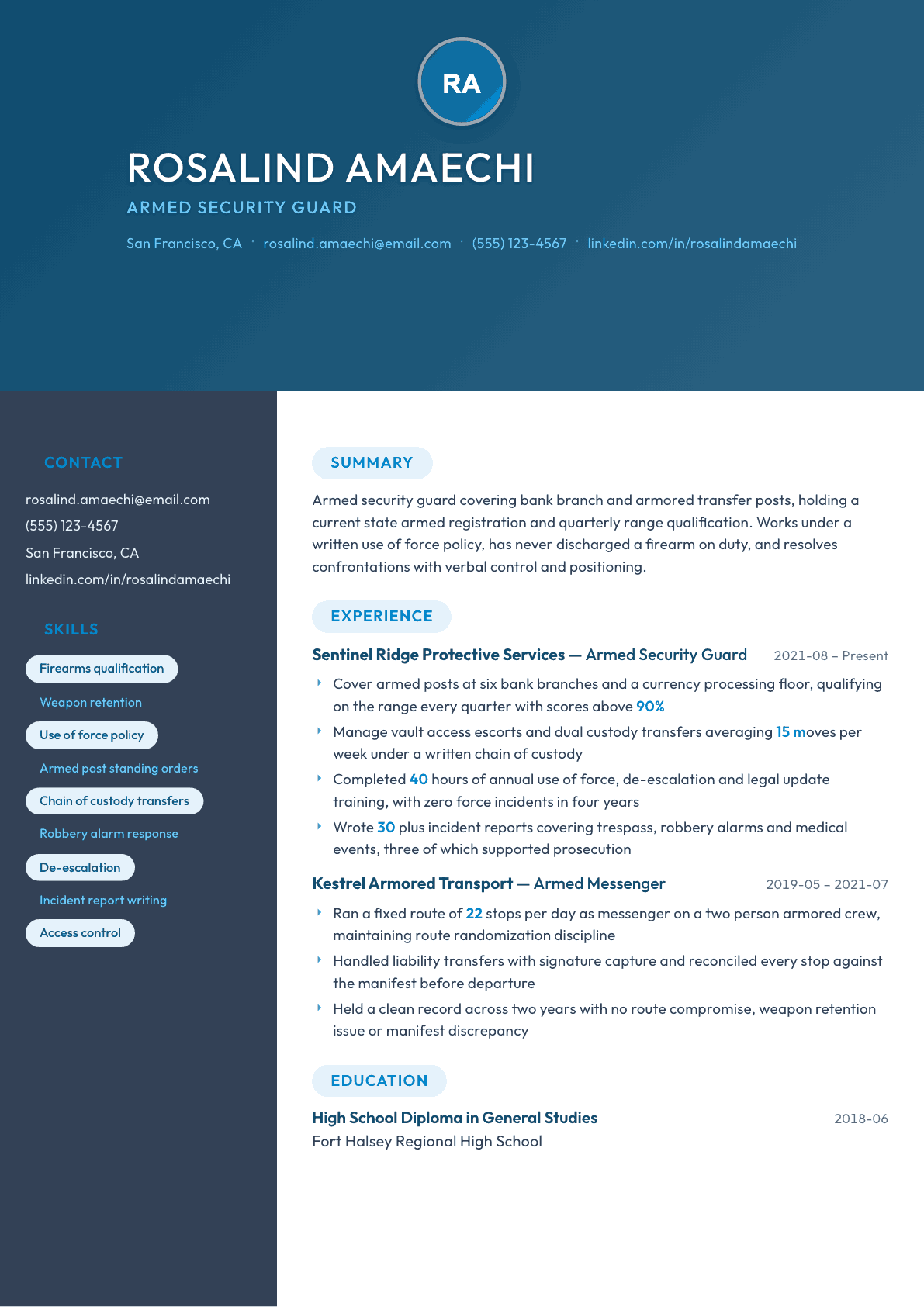
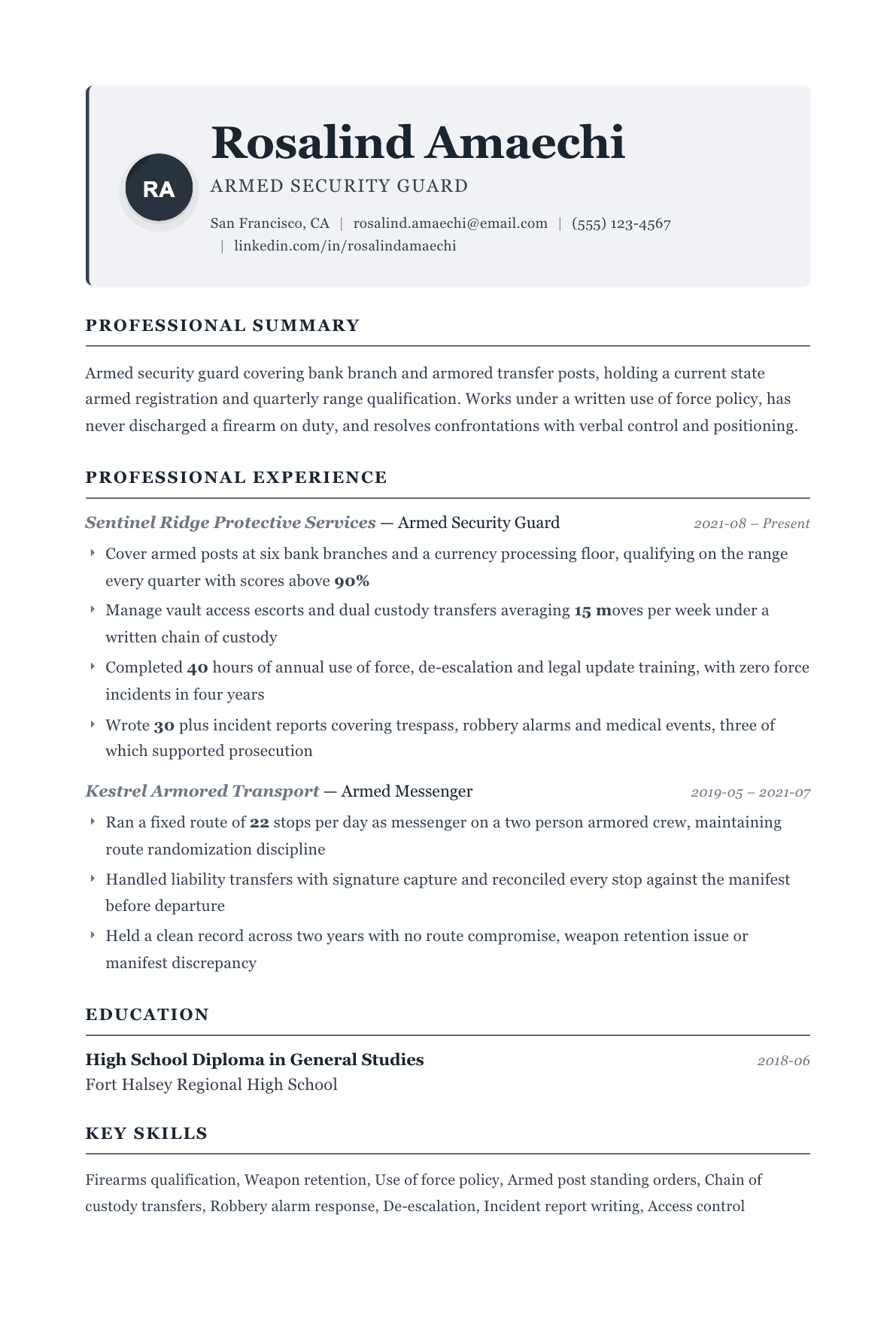
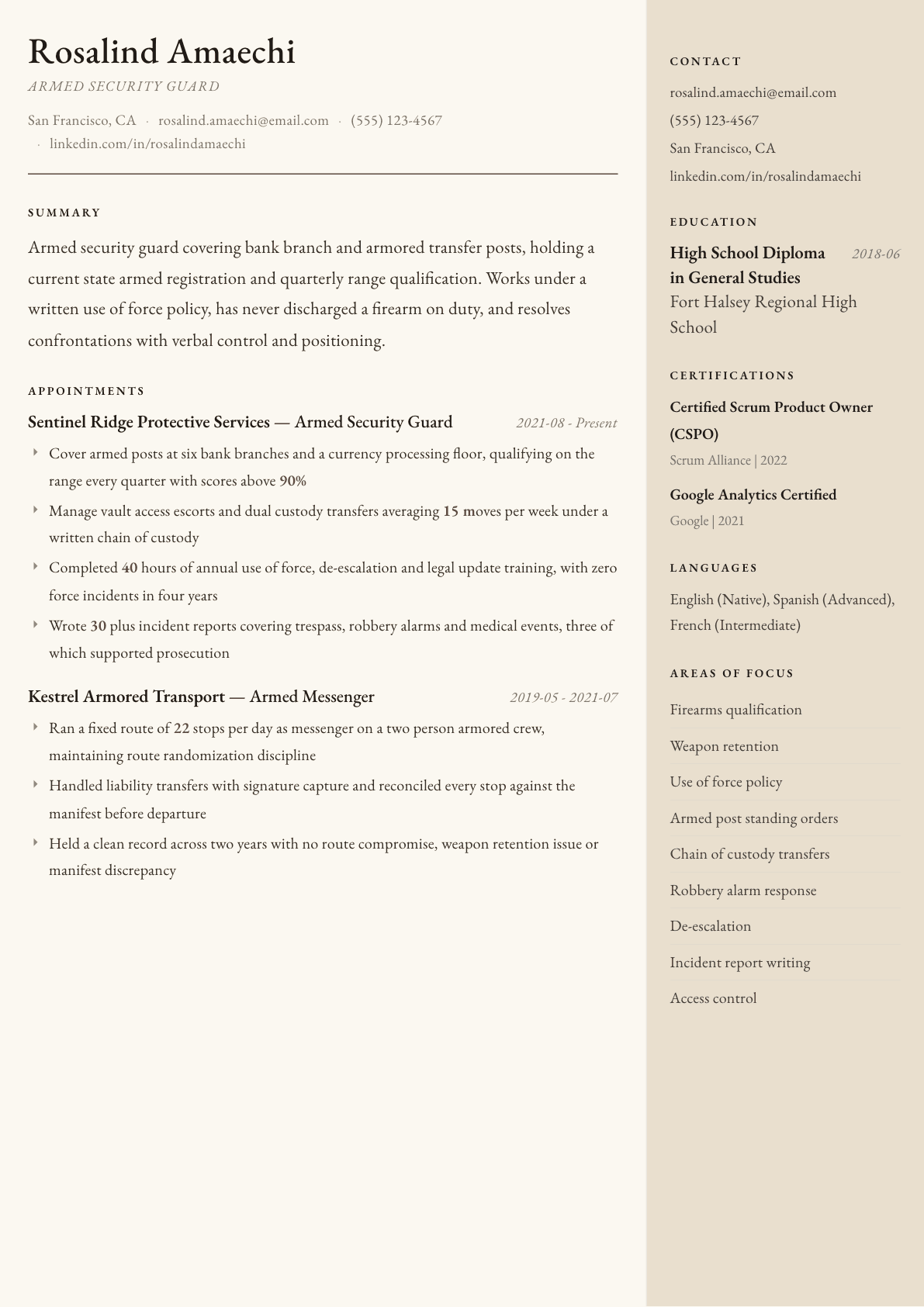
Example Armed Security Guard summary
Armed security guard with six years across bank branch, currency processing and armored transport posts, holding a current state armed registration and quarterly range qualification. Runs dual custody transfers and vault escorts under written chain of custody, completes annual use of force and legal update training, and has closed four years with no force incident and no discharge on duty.
Skills to list on a Armed Security Guard resume
- State armed guard registration
- Quarterly firearms qualification
- Weapon retention technique
- Holster and carry discipline
- Use of force continuum
- Robbery and duress alarm response
- Dual custody cash transfers
- Vault escort procedures
- Route randomization
- Access control and screening
- De-escalation and verbal control
- Incident and use of force reporting
- Handcuffing and restraint policy
- First aid, CPR and AED
- Court testimony preparation
What actually gets this resume read
- Put your armed registration, the issuing state and your last range qualification date at the top of the page.
- Name the weapon platform you qualify on, because a client with a standard sidearm needs a matching qualification.
- State the training hours you complete each year in use of force and legal updates, since insurers ask for that record.
- Say plainly that you have no discharge or force incident on duty if that is true, because clients screen on it hard.
- Describe the post types you have covered, from bank branch to hospital to currency handling, with the risk profile.
- Show weapon retention and holster discipline training, since it separates a serious armed officer from a badge holder.
- Keep de-escalation on the page even on an armed resume, because the best armed officers rarely need the firearm.
How to write a armed security guard resume
Hiring an armed security guard is a liability decision before it is a staffing decision. The person reading your application is thinking about the insurance carrier, the client contract and the day a firearm comes out of the holster. Everything you put on the page is read through that lens, which is why armed resumes have to be built differently from unarmed ones.
The weakest armed applications lead with weapons. They list platforms, ranges, competition scores and tactical courses, and say almost nothing about post duties, documentation or restraint. A director of operations reads that page and sees risk. The strongest applications lead with credentials and clean history, put the firearm in its proper place as one tool among several, and prove that the candidate almost never needs it.
This guide covers how to present permits and qualification currency, how to write armed post experience so a client can approve you, and how to talk about use of force on paper without either boasting or hiding.
Format: permits, qualification date, clean record, then posts
One page, and the first block is compliance. Your armed registration or permit, the issuing state, the expiration, your most recent range qualification date and the weapon platform you qualified on all belong above the fold. An armed officer whose qualification currency has to be chased is a scheduling problem, and the reader knows it.
Immediately after the permit block, state your record. No discharge on duty, no sustained use of force complaint and no weapon retention incident, if all three are true, written as a plain factual line. That single line does more for an armed application than any amount of training history, because it is the fact the client insurer will ask about.
- Permit block: armed registration or permit number status, issuing state, expiration, and any reciprocity you hold.
- Qualification line: platform, qualification cadence, most recent date, and the course of fire used.
- Record line: discharge history, use of force reports filed, and complaint history, stated factually.
- Training line: annual use of force hours, legal update hours, de-escalation and weapon retention refreshers.
- Medical line: first aid, CPR and AED, and any trauma care training that matters at an armed post.
Summary: post type, risk profile, currency, restraint
Your first three lines should name the kinds of armed posts you have covered and their risk profile. Bank branch, currency processing, cannabis retail, jewelry, hospital behavioral health and armored transport are all armed assignments with completely different threat models and completely different client expectations.
End the summary with restraint, not with capability. An armed guard who states that four years of assignments closed with no force incident is making the claim that matters. Capability is assumed once the permit is on the page, so the rare and valuable signal is judgment.
Experience: the post, the assets, the transfers, the escalations
Describe each armed assignment by what was being protected and how exposure was managed. Cash in transit, a vault, a dispensary till, a pharmacy stock or a person are different assets, and the procedures around each are what a client is buying. Give the volume: transfers per week, branches covered, stops per route, hours of armed post coverage.
Procedure detail carries weight here in a way it does not at unarmed posts. Dual custody, chain of custody signatures, manifest reconciliation, route randomization, duress code use, safe room protocols and the sequence for a robbery alarm are all specific, checkable practices. An officer who writes them accurately is showing training that transferred.
Then handle escalation honestly. Write about the confrontations you resolved with position, distance and verbal control, and say what the outcome was. If you have drawn a weapon, an interview is the right place to discuss it, and the resume should show only that your reporting was complete and your supervisor was notified as policy required.
Keep range results proportionate. One line with your qualification score and cadence is enough. Pages about marksmanship read as hobby content to an operations director filling a bank branch post.
Use of force, reporting and the paperwork clients audit
Every armed program runs on documentation. Post orders define when a firearm may be drawn, the use of force policy defines the continuum, and the report is what survives afterward. Say which of those you have worked under, whether you have written a use of force report, and whether your reports have supported a prosecution or an insurance claim.
Annual training hours belong on the page because carriers and clients ask for them by number. Hours in use of force, legal updates, de-escalation, weapon retention and medical response are the record that shows an officer who stays current rather than one who qualified once and coasted.
- Use of force policy you operated under and where your authority ended.
- Reports written, including any that supported prosecution or a claim, without identifying anyone.
- Annual training hours by subject, with the year and the provider type.
- Weapon retention and holster discipline training, including any scenario based work.
- Court appearances or depositions, and how you prepared for them.
Skills and keywords an armed posting screens on
Armed postings repeat a specific vocabulary: armed registration, qualification, use of force continuum, weapon retention, dual custody, duress alarm, robbery response, chain of custody, access control, incident reporting. Match the words exactly, since compliance staff often screen against a checklist before an operations manager sees the page.
Do not let the skills block become a weapons list. Balance it with the post competencies that fill most of an armed shift: screening, patrol, alarm handling, documentation and de-escalation. A block that is half firearms and half everything else describes the job accurately.
Armed Security Guard resume summary examples
Newly armed
Security officer with three years of unarmed post experience, newly holding a state armed registration with a first range qualification completed in 2025. Trained on the use of force continuum, weapon retention and de-escalation, and seeking a fixed armed post at a bank branch or medical campus.
Four years armed
Armed security guard covering six bank branches and a currency processing floor, qualifying quarterly with scores above 90% and managing 15 dual custody transfers a week. Completes 40 hours of annual use of force and legal training, with no force incident and no discharge on duty across four years.
Senior armed officer
Senior armed officer with nine years across armored transport, cannabis retail and hospital behavioral health posts, serving as range liaison for a 30 officer armed roster. Tracks qualification currency for the account, writes armed post orders with the client, and has testified twice in trespass prosecutions.
Work experience bullets: before and after
Before: Worked as an armed guard at bank locations.
After: Covered armed posts at six bank branches and a currency processing floor, holding opening and closing procedures, robbery alarm response and duress code protocol under written armed post orders.
The site count and the three named procedures show a supervised armed program rather than a person with a firearm.
Before: Qualified with my firearm regularly.
After: Qualified on the range every quarter with scores above 90% on the state course of fire, and completed scenario based weapon retention and holster discipline refreshers each year.
Cadence, score, course of fire and retention training answer the currency question an insurer will ask first.
Before: Moved money between locations safely.
After: Ran a fixed route of 22 stops a day as messenger on a two person armored crew, reconciling every liability transfer against the manifest before departure and maintaining route randomization across the schedule.
Stop count, crew configuration, reconciliation and randomization are the controls a transport client actually audits.
Before: Handled confrontations with aggressive individuals.
After: Resolved 14 confrontations with intoxicated or agitated subjects using distance, positioning and verbal control, filing incident reports on each and closing four years with no use of force report.
A count, a method and a clean force record turn a risky claim into evidence of restraint under real pressure.
Before: Wrote reports about incidents at the site.
After: Wrote more than 30 incident reports covering trespass, robbery alarms and medical events, three of which were used as the basis for prosecution after review by the client legal team.
Report count, incident types and downstream legal use prove documentation quality that a claim file will rely on.
Hard skills
- State armed guard registration compliance
- Firearms qualification and currency tracking
- Weapon retention and holster discipline
- Use of force continuum application
- Armed post order compliance
- Robbery and duress alarm response
- Dual custody and chain of custody transfers
- Vault and safe room escort procedures
- Route randomization and manifest reconciliation
- Access control and screening at armed posts
- De-escalation and verbal control
- Incident and use of force report writing
- First aid, CPR, AED and trauma response
- Court testimony preparation
Soft skills
- Choosing distance and position before choosing anything else
- Staying unremarkable at a post where being noticed is the problem
- Accepting that most shifts end with nothing to report
- Reporting a near miss on yourself without being asked
- Keeping the same standard on the last stop of the route as the first
Certifications worth listing
- Certified Protection Officer (CPO) (International Foundation for Protection Officers)
- Security Supervision and Management (International Foundation for Protection Officers)
- Basic Life Support (American Heart Association)
Mistakes that cost armed security guard candidates the interview
- Building the page around weapons and courses of fire instead of around the posts you have actually held.
- Omitting the last qualification date, which is the first compliance detail a scheduler has to verify.
- Failing to state a clean discharge and force record when it is true, which is the strongest line an armed applicant has.
- Listing personal firearms and competition results, which read as hobby content to an operations director.
- Skipping de-escalation entirely on the assumption that an armed post is about force rather than avoidance.
- Leaving out the transfer, vault or alarm procedures that make armed assignments checkable and specific.
- Describing a drawn weapon incident in detail on the page, when documentation quality is what a resume should show.
Armed Security Guard resume questions
How do I move from an unarmed to an armed post?
Get the armed registration your state requires, complete the range qualification, then apply with your unarmed post record intact. Employers want proof that you handled screening, patrol and documentation well before adding a firearm, so keep that history visible rather than replacing it.
Should I list the weapon platform I qualify on?
Yes, in one line, because many clients standardize on a single sidearm and want a matching qualification. Keep it factual: platform, course of fire and date. Anything beyond that starts to read like a gun review rather than a compliance record.
What if I have filed a use of force report?
Do not detail it on the resume. Note that you have written use of force reports as part of your documentation experience, and be prepared to explain the incident, the review outcome and what you would change. Employers respect a straight account far more than a silent gap.
Do armed posts pay attention to customer service experience?
They do at retail, medical and branch locations, where the officer is visible to the public all day. Show that you can hold a friendly front counter presence and still enforce access rules, because a client complaint closes an armed post as quickly as a security failure would.
How much training history should I include?
Give annual hours by subject for the last two or three years and the provider type. That is enough for a carrier or client to verify the program you trained under, and it avoids turning half the page into a course transcript that nobody reads to the end.
Related resume examples
- Security Guard Resume example
- Bodyguard Resume example
- Unarmed Security Guard Resume example
- Executive Protection Agent Resume example
- Security Officer Resume example
- Campus Security Officer Resume example