Combat Medic Resume Examples: free ATS score and gap list
Turn Combat Medic Skills Into a Civilian Healthcare Resume
By Mustafa Tarabya, founder of CVBooster · Published · Updated
Combat medic resume example with patient volume, trauma skills and a keyword list for EMT, paramedic and clinical technician roles.
Sample resumes for a combat medic
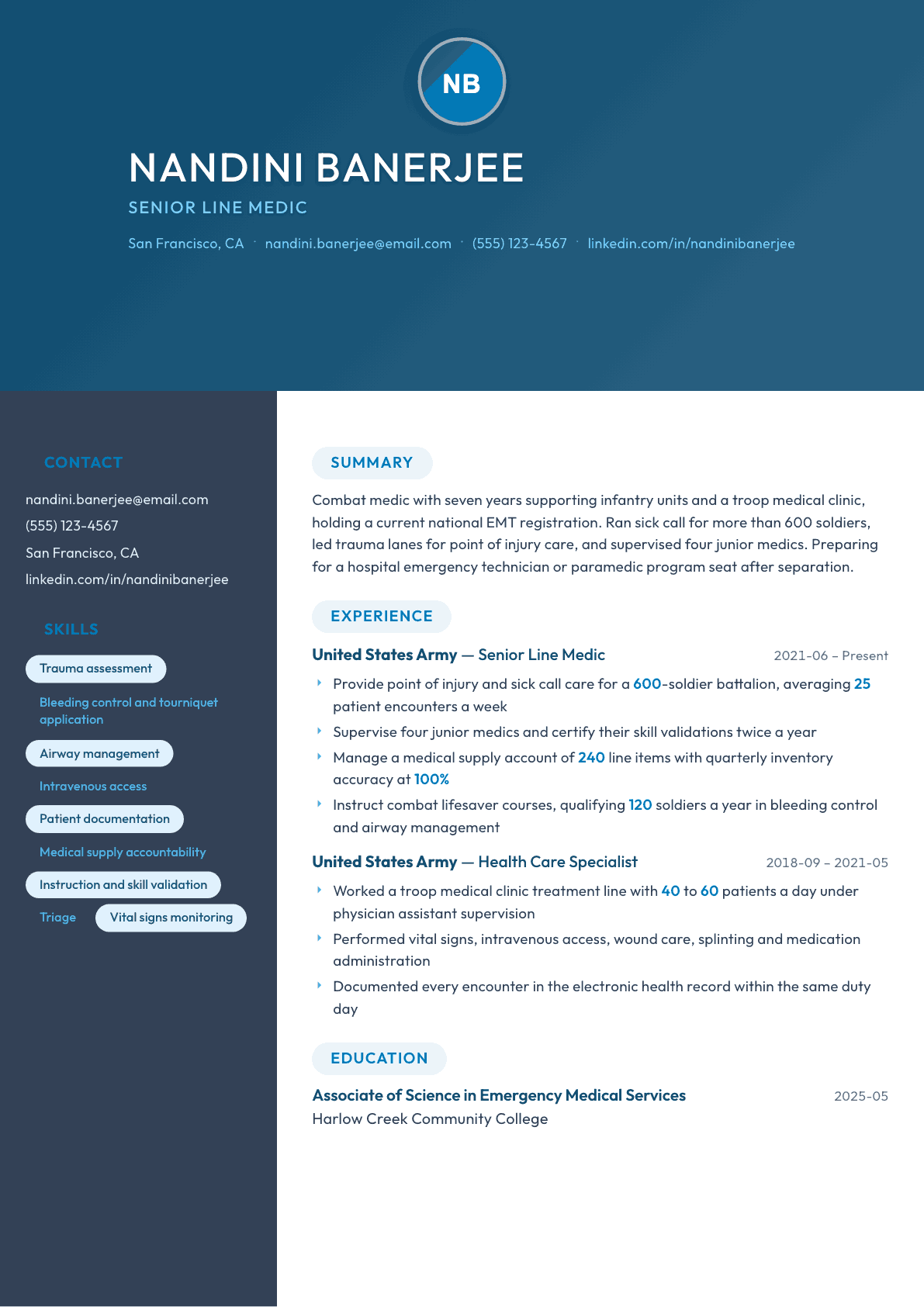
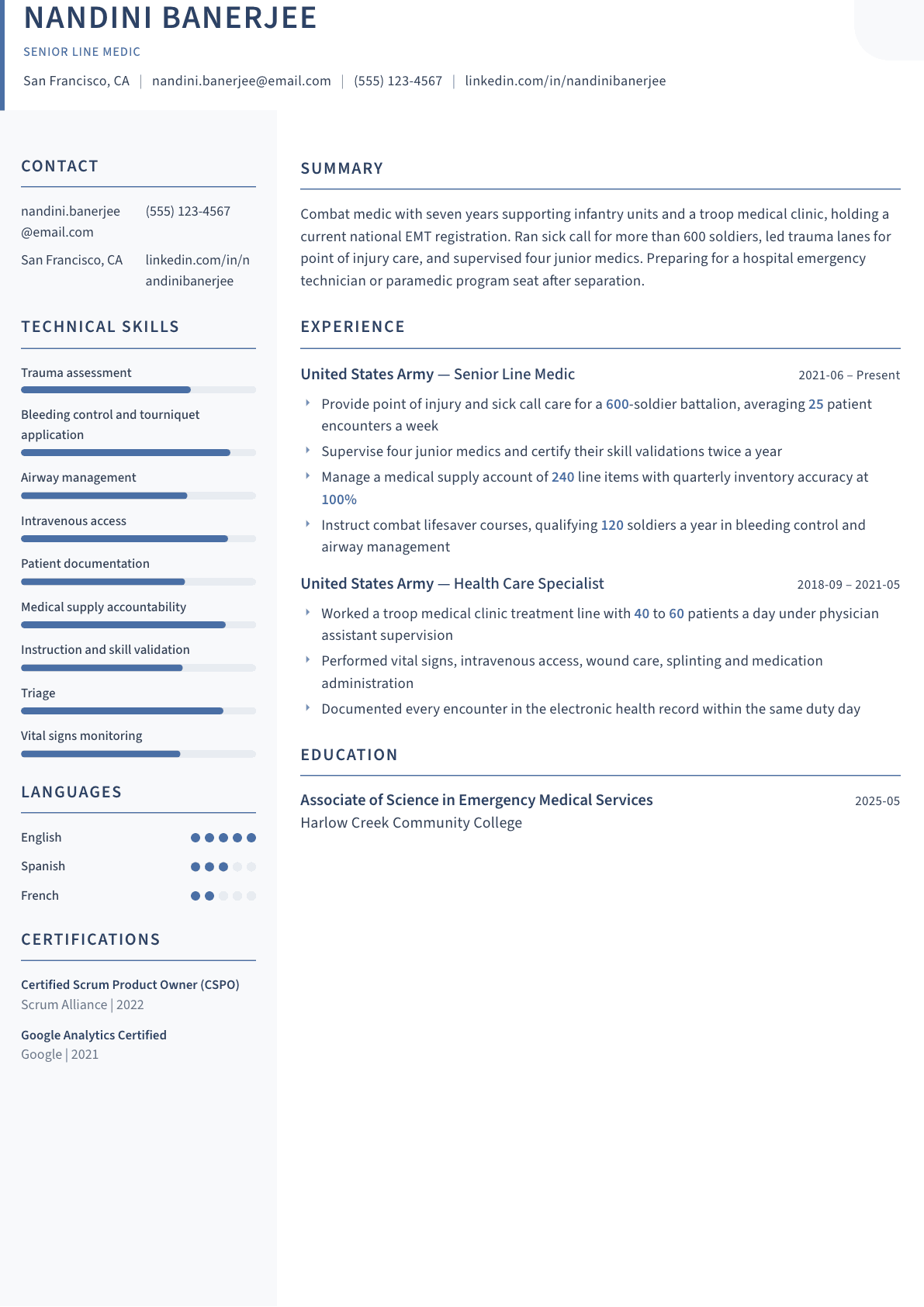
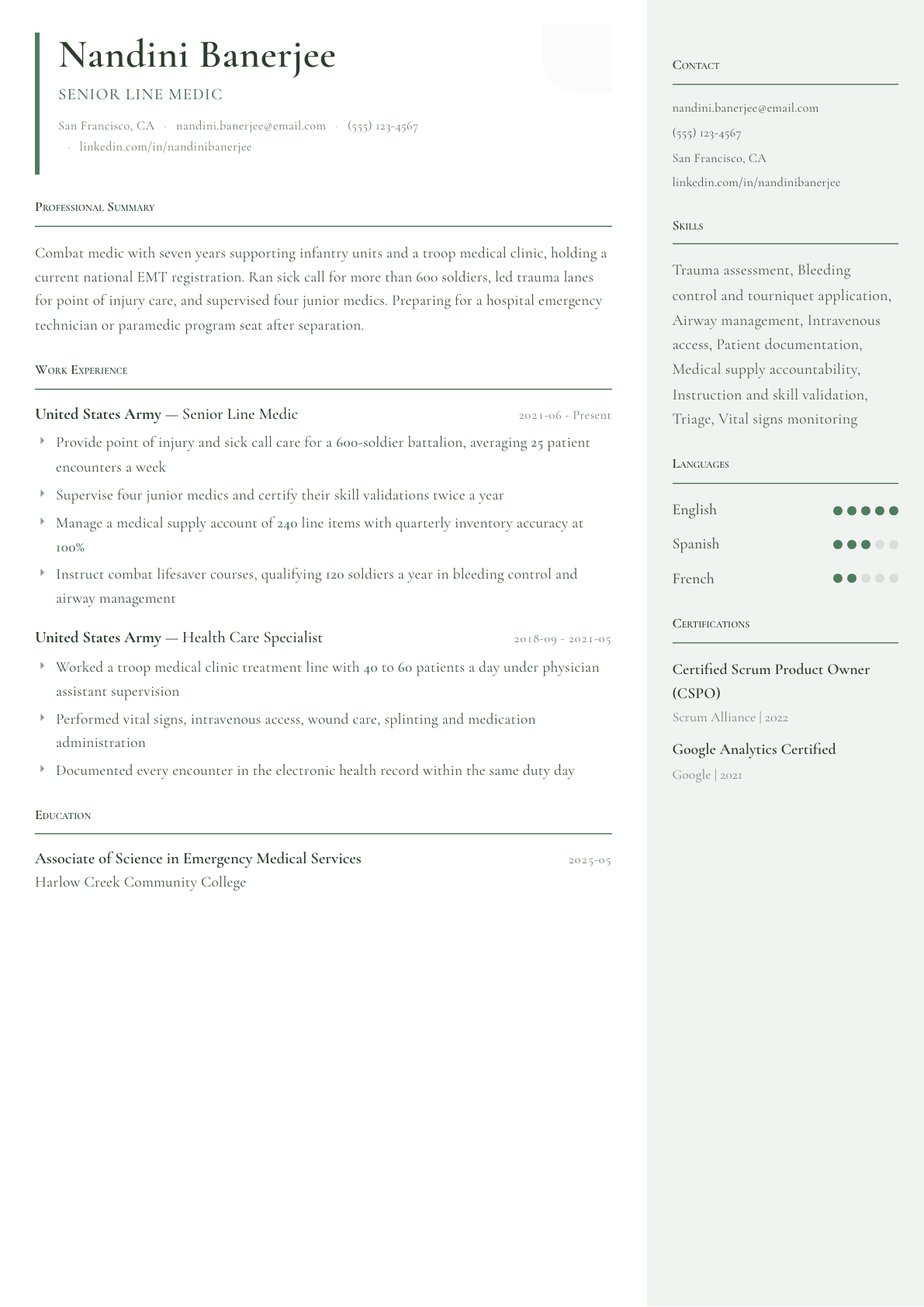
The same combat medic content laid out in three CVBooster templates, so you can see what the finished document looks like before you write a word.
Example Combat Medic summary
Combat medic with seven years supporting a 600-soldier battalion and a troop medical clinic, currently registered as an EMT. Averages 25 patient encounters a week, supervises four junior medics through semiannual skill validation, and teaches combat lifesaver courses to about 120 soldiers a year. Holds a full medical supply account with clean quarterly inventories. Seeking a hospital emergency department technician role while finishing paramedic prerequisites.
Skills to list on a Combat Medic resume
- Emergency medical care
- Trauma assessment and triage
- Bleeding control
- Airway management
- Intravenous and intraosseous access
- Medication administration
- Wound care and splinting
- Patient documentation
- Electronic health records
- Medical supply management
- Skills instruction and validation
- Mass casualty response
- Vital signs monitoring
- Clinic treatment line support
What actually gets this resume read
- Put your national EMT registration and its expiration near the top, because it is the credential a civilian employer verifies.
- Give patient encounters per week or per day, since volume is how clinical hiring managers judge readiness.
- Name the skills by their civilian clinical terms, such as intravenous access rather than the field shorthand.
- List the trauma protocols you worked under and any instructor role you held teaching them to others.
- Show documentation discipline by naming the record system and the timeliness standard you met.
- State the state licensure you are pursuing and its target date so a recruiter can plan around it.
How to write a combat medic resume
A combat medic applying for civilian healthcare work is in an odd position: clinically ahead of most entry level applicants and behind them on paper. The skills are real, the volume is real, and none of it is recognized by a state licensing board unless it has been converted into a civilian credential. The resume has to bridge that gap honestly, because a hiring manager who suspects overstatement will pass.
The bridge is built from three things. A current national registration, stated with its expiration. Patient volume, given as encounters per week or per day. And clinical vocabulary written the way a hospital writes it, so the reader is never asked to translate field shorthand into a clinical skill.
This guide covers the format an emergency department or clinic manager expects, how to describe trauma and sick call work in clinical terms, what to do about scope of practice differences, and the questions medics ask when they are choosing between an emergency technician job and a paramedic program.
Format: credential first, then volume, then the clinical detail
One page. Under the name goes your target title and your national registration status, because that credential is what makes a civilian clinical application viable. Then a summary, a licenses and certifications block, then experience.
Put the certification block above experience while your clinical background is entirely military. Managers check credential currency before they read anything else, and burying it at the bottom of the page invites them to assume you do not hold one.
- Credential block: emergency medical registration with expiration, life support cards with issuers, and any state certification in progress.
- Each position gets a scope line naming the supported population and the average patient encounters per week or per day.
- Give the occupational code once beside the first position and the branch in full as the employer.
- Add a single line for the paramedic or nursing prerequisites you are completing, with the expected date.
Writing the clinical work in clinical language
Every field skill has a hospital name, and the hospital name is what belongs on the page. Bleeding control with tourniquet application, airway management including supraglottic devices, intravenous access, wound care and closure assistance, splinting and immobilization, medication administration under protocol. Written that way, a nurse manager can place your capability instantly.
Say what supervision you worked under, because it defines scope and every clinical reader will want to know. Care delivered under physician assistant supervision on a clinic treatment line is a different qualification from independent point of injury care, and both are worth stating plainly.
Add documentation. A medic who charted every encounter in an electronic health record the same duty day is describing a habit that hospital managers value highly and rarely see in an applicant with no civilian clinical job.
Volume, acuity and the range of what you saw
Volume is the fastest credibility signal available. Give patient encounters per week for a line assignment or per day for a clinic, and add the size of the population you supported. Forty to sixty patients a day on a treatment line tells a manager you can work at pace.
Acuity matters as much as volume. Separate routine sick call from trauma response, and give a sense of the cases without inventing detail: musculoskeletal injuries, heat and cold injuries, respiratory illness, and traumatic injury during training and operations.
If you supported mass casualty exercises or real events, describe your role in triage rather than the event itself. Triage decision making under a defined protocol is exactly the skill an emergency department is buying.
Teaching, supply and the parts that are not bedside care
Most senior medics teach. Combat lifesaver instruction, skill validation for junior medics and refresher training are all instructional work with a headcount and a validation standard attached. Say how many people you qualified and how often you revalidated them.
Medical supply accountability is the other overlooked half of the job. Managing a controlled supply account with quarterly inventories, expiration tracking and refrigeration monitoring maps onto clinic materials management and pharmacy support roles that hire steadily.
Both of these matter more than medics expect, because they show the administrative reliability that clinical managers worry about when hiring from outside the civilian system.
Scope of practice and how to stay honest about it
Never imply a civilian scope you do not hold. If you performed a skill in service that sits above your civilian registration level, describe it as performed under military protocol and name the supervision. Clinical hiring managers respect that framing and distrust anyone who blurs it.
State clearly which state you are seeking licensure in and where you are in the process, including any reciprocity or bridge program you are using. A manager who can see the timeline can plan a start date around it rather than passing on the uncertainty.
Where your skills exceed the entry role you are applying for, say so once in the summary rather than in every bullet. Overqualification stated politely reads as value; repeated, it reads as someone who will leave in six months.
Combat Medic resume summary examples
Junior medic, separating
Health care specialist with three years on a clinic treatment line, seeing 40 to 60 patients a day under physician assistant supervision and performing vital signs, intravenous access, wound care and splinting. Nationally registered emergency medical technician. Seeking an emergency department technician position while completing paramedic prerequisites.
Senior line medic
Combat medic with seven years supporting a 600-soldier battalion and a troop medical clinic, averaging 25 patient encounters a week. Supervises four junior medics through semiannual skill validation, teaches combat lifesaver courses to about 120 soldiers a year, and holds a controlled supply account with clean quarterly inventories.
Senior medic and instructor
Senior medical noncommissioned officer with thirteen years across line medic, clinic and instructor assignments. Ran a treatment platoon of 18 medics, owned the unit medical readiness program for 1,200 personnel, and served as a course instructor. Registered paramedic seeking a clinical education or field supervisor role.
Work experience bullets: before and after
Before: Provided medical care to soldiers in garrison and field environments.
After: Delivered point of injury and sick call care for a 600-soldier battalion, averaging 25 patient encounters a week across trauma, musculoskeletal injury and respiratory illness.
Population size, weekly volume and a case mix give a clinical manager a real picture of pace and range.
Before: Performed emergency medical procedures as trained.
After: Performed bleeding control with tourniquet application, airway management, intravenous access and splinting under written protocol, with physician assistant oversight on the clinic line.
Clinical skill names plus the supervision arrangement make the scope of practice clear instead of leaving it ambiguous.
Before: Kept accurate patient records for all treatments provided.
After: Documented every patient encounter in the electronic health record within the same duty day, keeping the clinic current with no backlog at any monthly review.
Charting timeliness is a habit clinical managers screen for, and the same-day standard is a concrete claim.
Before: Taught first aid classes to unit personnel.
After: Instructed combat lifesaver courses qualifying about 120 soldiers a year in bleeding control and airway management, and revalidated four junior medics on their skill sheets twice a year.
Instruction becomes measurable with a qualification count, the subject matter and a revalidation cadence.
Before: Managed medical supplies and equipment for the unit.
After: Maintained a medical supply account of 240 line items with full quarterly inventory accuracy, tracking expiration dates and refrigerated storage temperatures daily.
Materials management with counts and controls translates straight into clinic supply and pharmacy support work.
Hard skills
- Trauma assessment and triage
- Bleeding control and tourniquet application
- Airway management
- Intravenous and intraosseous access
- Medication administration under protocol
- Wound care and splinting
- Vital signs and patient monitoring
- Electronic health record documentation
- Mass casualty triage
- Medical supply and inventory control
- Skills instruction and validation
- Patient movement and evacuation coordination
Soft skills
- Staying methodical when a patient is deteriorating
- Explaining a plan to a frightened person in plain words
- Handing over a patient cleanly to the next provider
- Knowing the edge of your scope and saying so
- Recovering from a bad outcome and returning to the line
Certifications worth listing
- Emergency Medical Technician (National Registry of Emergency Medical Technicians)
- Basic Life Support Provider (American Heart Association)
- Advanced Cardiovascular Life Support (American Heart Association)
- Pediatric Advanced Life Support (American Heart Association)
Mistakes that cost combat medic candidates the interview
- Leaving national registration status off the top of the page, which is the first thing a clinical manager checks.
- Using field shorthand for procedures that already have accepted clinical names.
- Implying a civilian scope of practice above the credential you actually hold.
- Omitting patient volume, which is the clearest evidence that you can work at hospital pace.
- Ignoring the documentation habit, when charting discipline is a real advantage over other entry applicants.
- Skipping supply accountability and instruction, the two parts of the job that translate into non-bedside openings.
Combat Medic resume questions
Can I work in a hospital straight after separating?
With a current emergency medical registration, emergency department technician and patient care technician roles are realistic immediately. Nursing and paramedic positions require the civilian program and licensure first, so list those as in progress rather than implying you already hold them.
How do I explain skills that exceed my civilian certification?
Describe them as performed under military protocol with named supervision, and keep them in the experience section rather than the skills list. That framing is accurate, it demonstrates capability, and it avoids any suggestion that you would practice beyond your civilian scope.
Is a paramedic program worth it after being a medic?
For most medics moving into emergency services, yes, because it converts existing clinical judgment into a license with a defined scope. Bridge programs exist in many states for those holding national registration, so check for one before enrolling in a full program.
What if most of my time was routine sick call?
Say so and give the volume, because clinic throughput is directly relevant to urgent care, primary care and outpatient work. Chronic complaint management and high patient volume are more transferable to most civilian openings than occasional trauma exposure.
Should the resume mention deployments?
Briefly, one line inside the relevant position, naming the length and your clinical role during it. What matters to a healthcare employer is the sustained responsibility and the case exposure, not the location or the operation name.
Related resume examples
- Paramedic Resume example
- Security Guard Resume example
- Infantry Resume example
- Veteran Resume example
- Military to Civilian Resume example
- Military Resume example