Flutter Developer Resume Examples: the lines they read
Write a Flutter Developer Resume That Proves Cross Platform Depth
By Mustafa Tarabya, founder of CVBooster · Published · Updated
A Flutter developer resume with Dart and state management examples, store release keywords, sample bullets and a section by section guide.
Sample resumes for a flutter developer
The same flutter developer content laid out in three CVBooster templates, so you can see what the finished document looks like before you write a word.
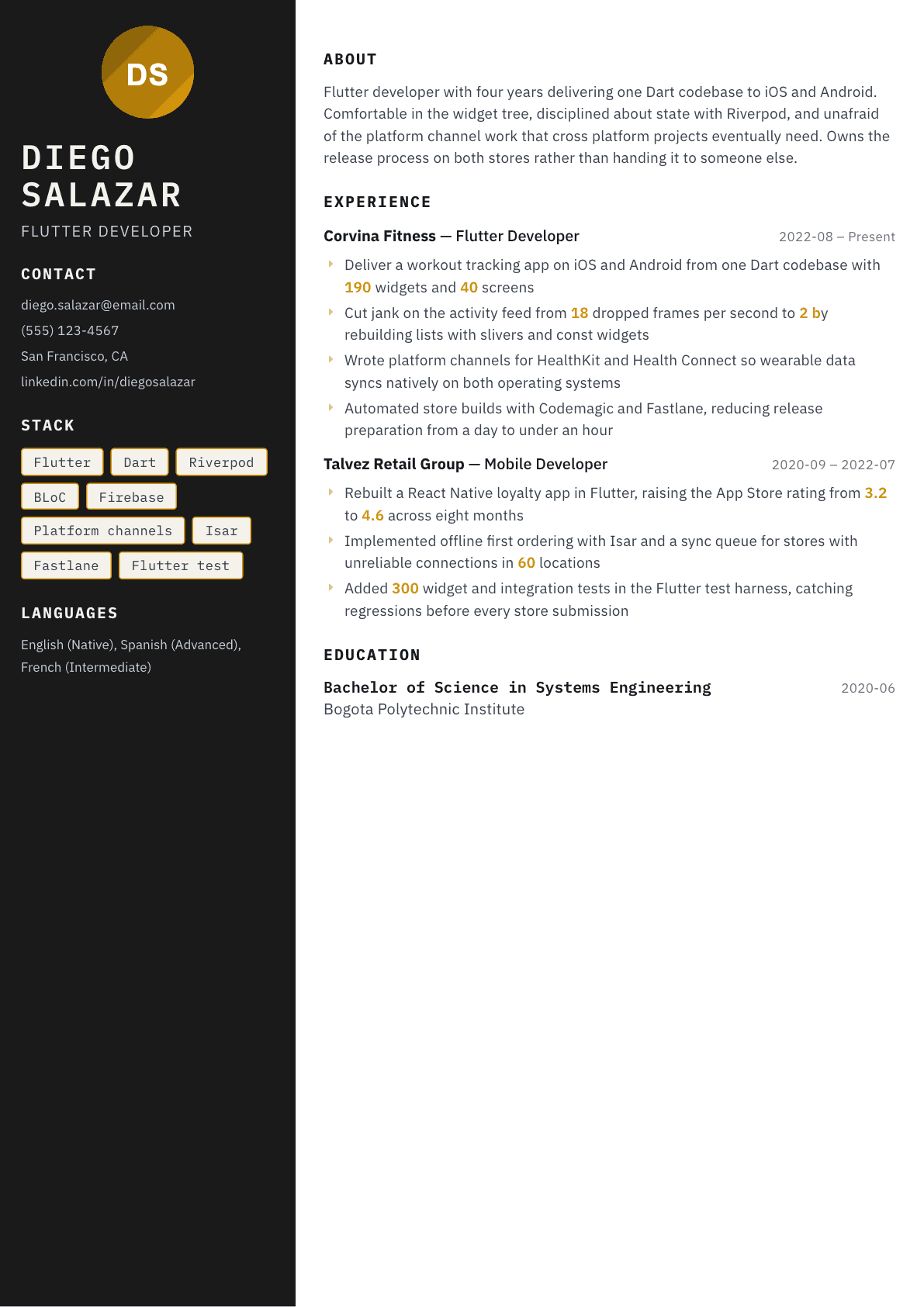
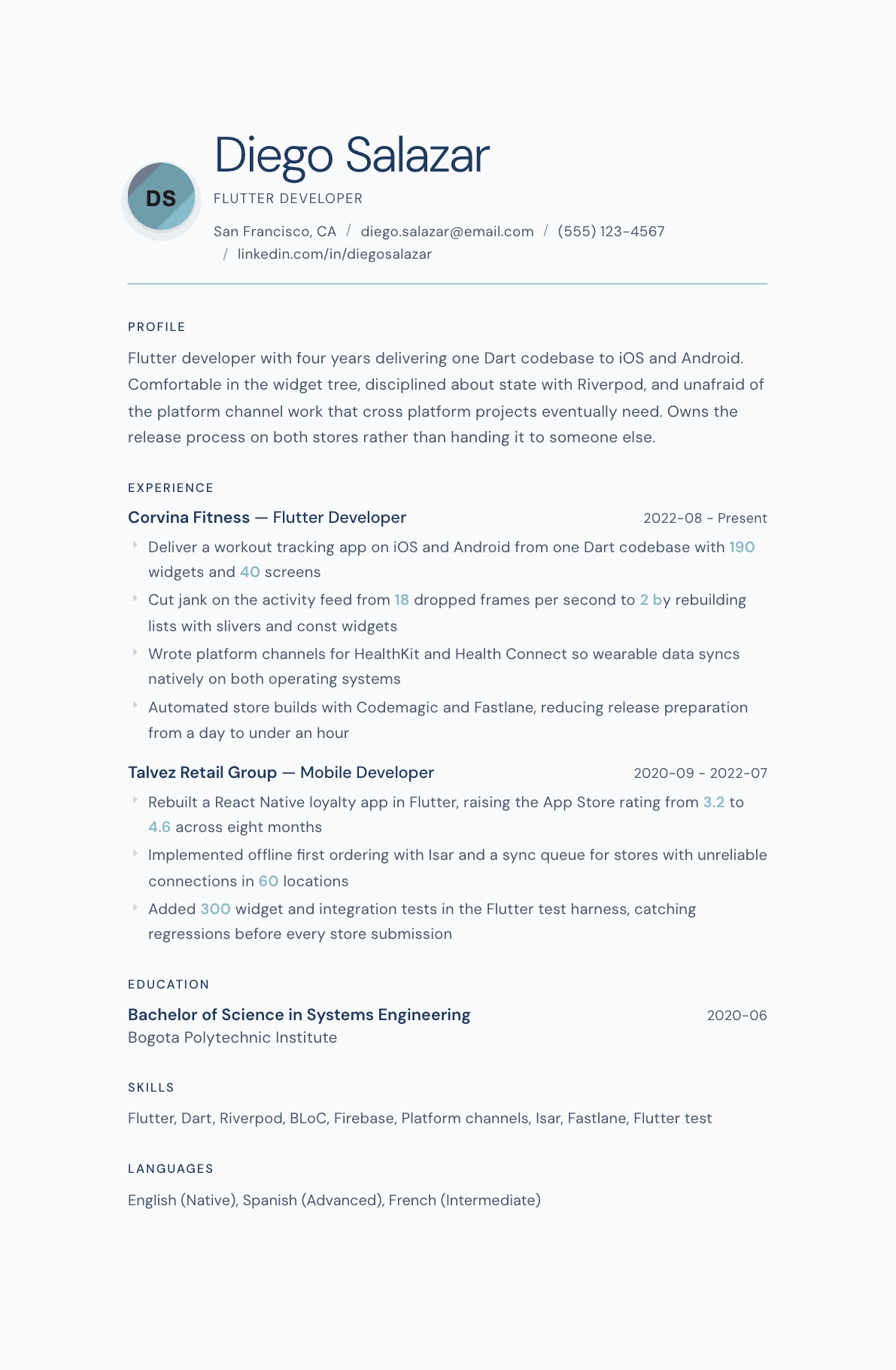
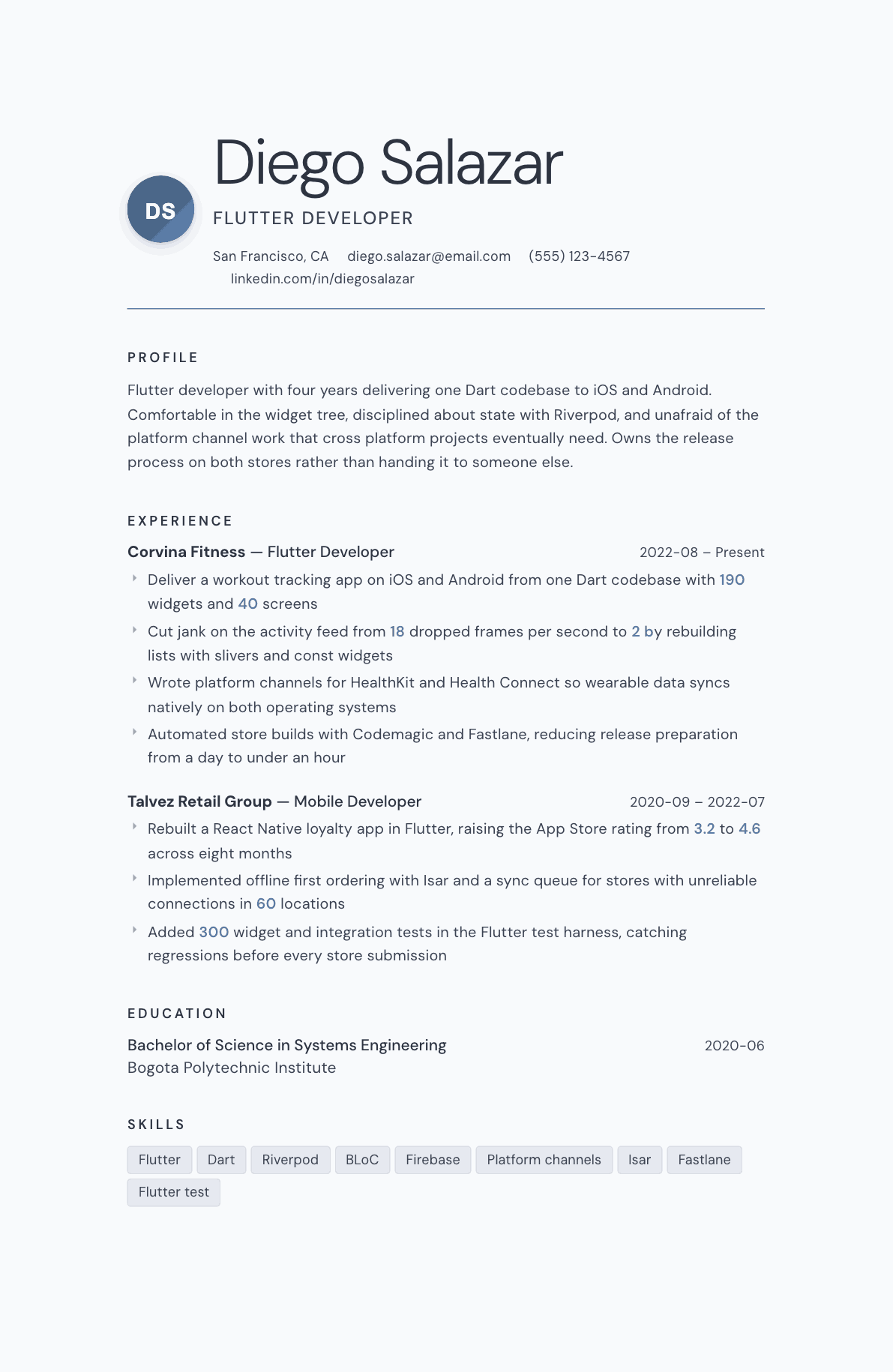
Example Flutter Developer summary
Flutter developer with four years delivering fitness and retail apps to iOS and Android from a single Dart codebase. Manages state with Riverpod, writes platform channels when native APIs are the only path, and automates both store releases with Fastlane and Codemagic. Rebuilt a poorly rated React Native app in Flutter and took its store rating from three to well above four. Seeking a senior mobile role.
Skills to list on a Flutter Developer resume
- Flutter
- Dart
- BLoC
- Riverpod
- Provider
- Firebase
- REST and GraphQL
- Platform channels
- SQLite and Isar
- Flutter test
- Fastlane
- Material and Cupertino design
- App Store and Play Console releases
- Push notifications
What actually gets this resume read
- Confirm you have released to both stores, with the review and signing steps you handled, since many candidates have not.
- Name your state management choice, BLoC, Riverpod, Provider or GetX, and the reasoning behind it for that project.
- Show one rendering performance fix with frame numbers, because jank is the first complaint reviewers raise about Flutter apps.
- Mention platform channel or native plugin work, as it proves you can pass the boundary a pure Dart resume cannot cross.
- Include app size, cold start or crash free rate, the same numbers a native mobile manager would ask a native candidate.
- Describe any migration from React Native or a native codebase with the reason and what happened to ratings afterward.
How to write a flutter developer resume
Companies choose Flutter to get two applications from one team, so the person reviewing your resume is checking whether you can actually deliver both. Have you released to the App Store and the Play Console, handled two review processes, signed two builds, and dealt with the platform differences that a single Dart codebase does not erase? A large share of Flutter applicants have only ever run their work on an emulator, and the reviewer is filtering for that in the first pass.
The second filter is rendering quality. Flutter draws its own widgets, which means jank is your problem rather than the platform toolkit. Reviewers look for evidence that you have opened the performance overlay, understood a rebuild that was happening too often, and fixed it with const widgets, slivers or a different state boundary.
Below is how to build the resume for that reader: the layout, the section wording, three career stage summaries, five rewritten bullets, the errors that get Flutter resumes filtered, and the questions this community asks most.
Format: released applications near the top, not buried
One column, reverse chronological, one page under six years. Mobile is one of the few fields where a short released work section directly under the summary earns its space, because it answers the reviewer's first question immediately.
Give each released application one line: what it does, the platforms, roughly how many users, and your role. If a store listing is public and looks professional, a link is worth including once in the header.
- Header: name, Flutter developer or mobile engineer, city, phone, email, store links.
- Order: summary, released applications, technical skills, experience, education.
- Each job line names the product, the platforms it runs on and the audience.
Summary: both stores, state approach, one performance fact
Three or four lines. Years, the kind of product, confirmation that you have released to both stores, your state management choice, and one number that proves you measure. Frame timings, application size or a store rating movement all work.
If you came to Flutter from native or React Native, say so and treat it as an advantage. Knowing what the platform channel is bridging to makes you more useful than a candidate who has only ever seen Dart.
Experience: widgets, state, offline behavior, and native boundaries
Size the codebase in screens, widgets and modules, then describe how it is organized. Feature first folders, a shared design system, and whether you used code generation for routing or serialization all tell a reviewer whether you have worked in something maintainable.
State management deserves a full bullet. Name the approach, BLoC, Riverpod, Provider or something the team built, and say why the project chose it. The reasoning matters more than the library, since teams change libraries and keep the reasoning.
Offline behavior and native boundaries are where Flutter projects get hard. A sync queue with conflict handling for stores on poor connections, or a platform channel written in Swift and Kotlin to reach a health or payment API, both prove you can carry a project past the point where pure Dart stops.
Performance: the numbers that answer the jank question
Every reviewer has seen a Flutter application that stutters, so a performance bullet lands hard. Use frame timings, dropped frame counts or a specific screen that was rebuilt. Then name the technique: const constructors, slivers instead of a nested scroll, moving a heavy computation to an isolate, or narrowing a listener so half the tree stops rebuilding.
Application size is the other measurable. Split builds per architecture, deferred components, removing unused fonts and asset variants, and tree shaking icons all reduce it. Managers notice because install conversion is affected by download size in a way they can see in their own analytics.
Release process: prove you have done it end to end
Name your build automation, Codemagic, Fastlane, GitHub Actions or whatever the team used, and say what it replaced. Then describe the release mechanics you handled: signing on both platforms, store metadata, App Store review responses, staged rollouts on Android, and what you watch in the first day after release.
Testing belongs beside it. Widget tests, integration tests through the Flutter driver harness, and golden tests for visual regressions. A candidate with a real test suite is rarer in this field than the tooling would suggest, so if you have one, give the count and what it caught.
Flutter Developer resume summary examples
First Flutter role
Mobile developer with a year of contract Flutter work, delivering two client applications to both stores from a single Dart codebase. Comfortable with Provider, Firebase authentication, REST integration and widget tests. Handled signing, store listings and staged rollout on both platforms without supervision.
Four years in
Flutter developer with four years building fitness and retail applications for iOS and Android. Manages state with Riverpod across 40 screens, wrote platform channels for native health APIs on both operating systems, and cut dropped frames on the activity feed from eighteen per second to two.
Senior mobile engineer
Senior Flutter engineer with eight years in mobile across native and cross platform work, currently leading a team of four. Owns the shared component package, the release automation on both stores, and the offline synchronization layer used by field staff in locations with poor connectivity.
Work experience bullets: before and after
Before: Developed a mobile app with Flutter.
After: Deliver a workout tracking application on iOS and Android from one Dart codebase of 190 widgets and 40 screens, released fortnightly to both stores.
Codebase size, both platforms and a release cadence describe a product rather than a project.
Before: Fixed performance problems in the app.
After: Cut dropped frames on the activity feed from eighteen per second to two by rebuilding the list with slivers, adding const constructors and narrowing the state listener scope.
Frame numbers plus three named techniques answer the jank question a reviewer is already asking.
Before: Integrated native features.
After: Wrote platform channels in Swift and Kotlin for HealthKit and Health Connect so wearable data syncs natively on both operating systems with a shared Dart interface.
Naming both native APIs and the shared interface proves you can work past the Dart boundary.
Before: Automated the build process.
After: Automated store builds with Codemagic and Fastlane including signing, metadata and staged rollout, reducing release preparation from a full day to under an hour.
The steps automated and the time saved show ownership of the whole release, not just the code.
Before: Rewrote an old app in Flutter.
After: Rebuilt a poorly rated React Native loyalty application in Flutter with offline first ordering, raising the App Store rating from 3.2 to 4.6 over eight months.
The starting rating, the end rating and the timescale make the rewrite a business result.
Hard skills
- Flutter and the widget tree
- Dart and asynchronous programming
- BLoC and Riverpod
- Provider and inherited widgets
- Platform channels with Swift and Kotlin
- Firebase authentication, Firestore and messaging
- REST and GraphQL integration
- Local storage with SQLite, Isar or Hive
- Widget, integration and golden tests
- Fastlane and Codemagic
- App Store Connect and Play Console releases
- Material and Cupertino design systems
Soft skills
- Owning a release from build to rollout
- Reading store reviews for real defects
- Working with designers across two platform conventions
- Scoping cross platform tradeoffs with product owners
- Debugging on real devices rather than emulators
Mistakes that cost flutter developer candidates the interview
- Never confirming that you have published to both stores, which is the first thing a reviewer wants to know.
- Listing a state management library without saying what the project needed it for.
- Skipping performance entirely, leaving the reader to assume your applications stutter like the ones they have seen.
- Presenting emulator only work as production experience with no install numbers behind it.
- Ignoring native code, which suggests you would stall the first time a feature needs a platform API.
- Filling the page with small practice applications instead of one product described properly.
Flutter Developer resume questions
Do I need native iOS or Android experience to get a Flutter job?
Not to start, but some native familiarity is expected once a project grows. Any Swift or Kotlin you have written for platform channels, and evidence you understand signing and store review on both sides, will separate you from most applicants.
Which state management approach should I claim?
The one you have actually used in a released product, described with the reason the team chose it. Teams differ on BLoC, Riverpod and Provider, and they hire on your ability to justify a choice more than on matching their current library.
How do I show Flutter performance work on a resume?
Use frame timings, jank counts or build times, then name the technique behind the improvement. Slivers, const constructors, isolates and narrower rebuild scopes are the vocabulary a Flutter interviewer expects to hear in that answer.
Should I list personal applications on the store?
Yes, when they have real installs and a rating you are willing to have opened in front of you. Give the install range and your role. One credible application beats five that have a handful of downloads between them.
Is web or desktop Flutter experience worth adding?
Add it in one line if you have delivered it, since some employers want a single team covering more surfaces. Keep it short on a mobile application, because the reviewer is hiring for two stores and wants the mobile evidence first.
Related resume examples
- iOS Developer Resume example
- Android Developer Resume example
- Kotlin Developer Resume example
- Mobile App Developer Resume example
- Manual QA Tester Resume example
- Software Engineer Resume example