Kotlin Developer Resume Examples: the lines they read
Craft a Kotlin Developer Resume For Android and Backend Roles
By Mustafa Tarabya, founder of CVBooster · Published · Updated
A Kotlin developer resume with Jetpack Compose and coroutine examples, Android and Ktor keywords, sample bullets and a full writing guide.
Sample resumes for a kotlin developer
The same kotlin developer content laid out in three CVBooster templates, so you can see what the finished document looks like before you write a word.
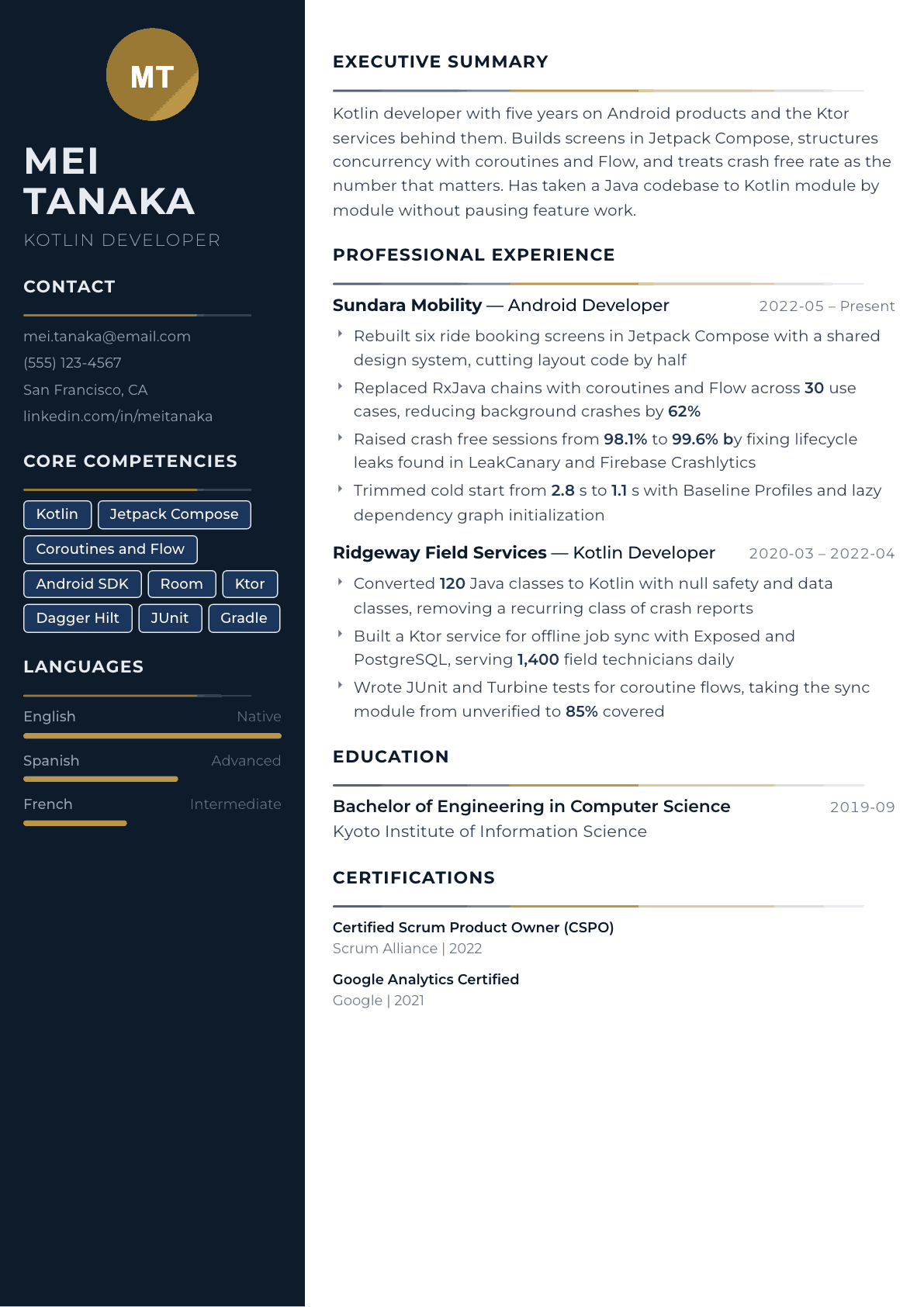
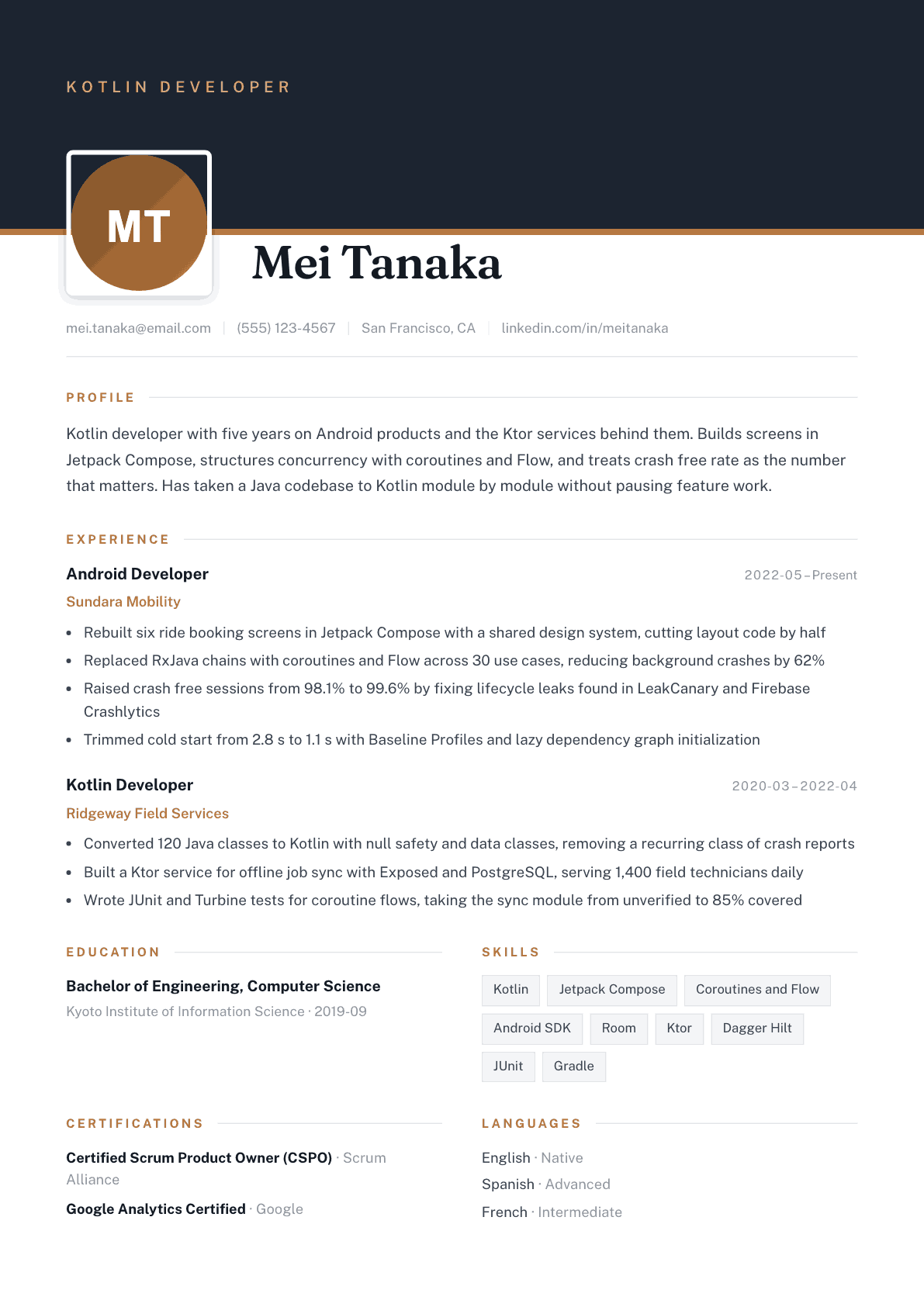
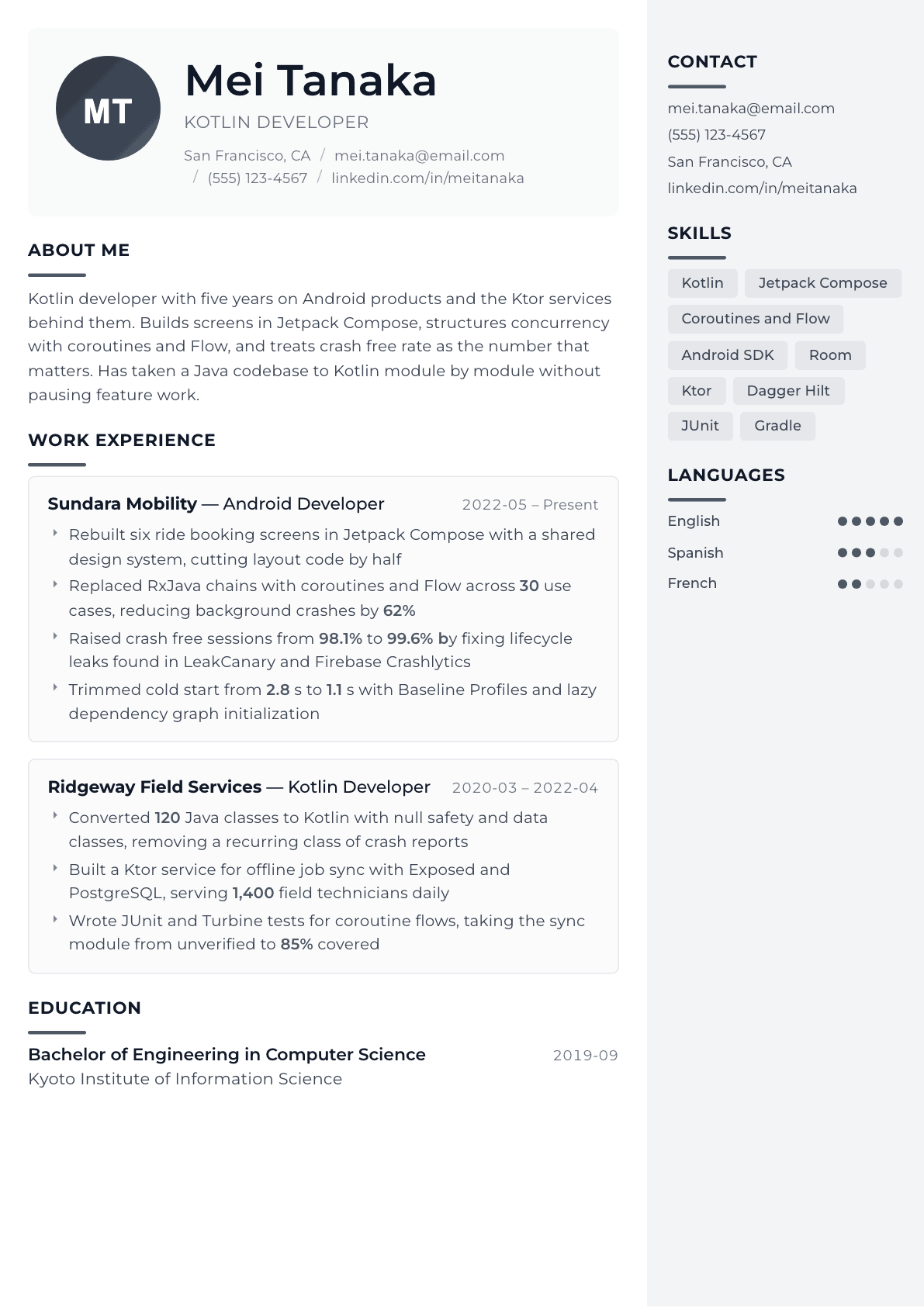
Example Kotlin Developer summary
Kotlin developer with five years split between Android applications and the Ktor services that feed them. Builds Compose screens against a shared design system, models asynchronous work with coroutines and Flow, and has converted a large Java codebase to Kotlin module by module. Took crash free sessions above ninety nine and a half and halved cold start with Baseline Profiles. Looking for a senior mobile role with product ownership.
Skills to list on a Kotlin Developer resume
- Kotlin
- Jetpack Compose
- Kotlin coroutines
- Kotlin Flow
- Android SDK
- Room
- Retrofit
- Dagger Hilt
- Ktor
- Kotlin Multiplatform
- Gradle Kotlin DSL
- JUnit
- Espresso
- Firebase Crashlytics
- Material Design
What actually gets this resume read
- Say whether your Kotlin is Android, server side or multiplatform, because those three tracks screen for different tools.
- Name the concurrency model you use, coroutines and Flow, and describe a case where structured concurrency fixed a bug.
- Give Compose work a scale: how many screens, whether a design system existed, and what the migration replaced.
- Include store facing metrics such as crash free sessions, cold start time or app size, which Android managers check first.
- Describe any Java to Kotlin migration by module count and how you kept features moving during the conversion.
- List your dependency injection and persistence choices, Hilt or Koin, Room or SQLDelight, since teams standardize on them.
How to write a kotlin developer resume
Kotlin sits across two hiring markets. The large one is Android, where Kotlin is the default language and the reviewer is a mobile lead judging you on crash rates, cold start and how well your screens behave when the network disappears. The smaller and growing one is server side Kotlin, where a backend lead is judging you on the same things they would judge a Java candidate on, with coroutines in place of thread pools.
Because the title covers both, the first job of the resume is to say which one you are. A mobile lead scanning for Compose and Crashlytics does not want to read three paragraphs about Ktor and Exposed before finding out you have released to the Play Console. Put the market you are applying to at the top and let the other work sit lower as evidence of range.
This guide covers the layout, the wording for each section, three summaries at different stages, five before and after bullets, the mistakes that filter Kotlin candidates out, and the questions developers in this stack ask when they write their resume.
Format: declare the track, then let the tools confirm it
One column, reverse chronological, one page under six years. In the header use the title the posting uses: Android developer, Kotlin backend engineer, or mobile engineer. Kotlin developer alone is accurate and slightly vague, which is fine as a label but weak as a match.
The skills block should confirm your track immediately. Compose, Room, Hilt and Crashlytics say Android. Ktor, Exposed, coroutines and PostgreSQL say server. Listing all of them without grouping leaves both readers unsure.
- Header: name, target title, city, phone, email, and a Play Store or code profile link.
- Order: summary, technical skills, experience, released apps if mobile, education.
- Each role opens with the product, its audience and the platform it runs on.
Summary: track, Compose or Ktor, and one product metric
Three or four lines. Years, the track, the framework, and a number that a lead in that market cares about. For Android that is crash free sessions, cold start, app size or monthly active users. For server side it is requests per second, service count or latency.
If you have carried a Java codebase into Kotlin, put it in the summary. Most organizations adopting Kotlin have exactly that job waiting, and a candidate who has done it module by module without stopping feature work is immediately relevant.
Experience: screens, concurrency, and what the store reported
For Android roles, size the work in screens, modules and users. Then give architecture: whether the project used a single activity with a navigation graph, how the modules were split, and which presentation pattern the team followed. Reviewers use that to judge whether you have worked in a codebase that grew past a weekend project.
Concurrency is where Kotlin experience is proven. Structured concurrency, coroutine scopes tied to lifecycle, Flow for streams of state, and the specific bugs that disappeared when you adopted them. If you migrated off callbacks or a reactive library, say what the migration removed and what it fixed.
Then the store numbers. Crash free session rate, cold start time, application size and rating are the metrics a mobile manager checks on their own product every morning, so a resume that speaks in those terms reads as someone who has owned a release rather than contributed to one.
Jetpack Compose: scale, design system, and migration
Compose experience is now the most searched term in Android hiring, so it needs more than a mention. Give the number of screens you built, whether a design system existed or you created one, and how state was hoisted. Reviewers want to know whether you can build composables other developers can reuse or only assemble screens.
If your project mixes Compose with the older view system, describe the interoperability honestly. Running both during a migration is normal and knowing where the seams hurt is valuable knowledge, so treat it as content rather than something to hide.
- How many screens moved to Compose, and over what period.
- Whether you built shared composables and where they were documented.
- State handling: hoisting, view models, and what survived configuration change.
- Performance work: recomposition counts, stability annotations, Baseline Profiles.
Testing and release: the parts most mobile resumes skip
Name your test tools and what they cover: JUnit for logic, Turbine for flows, Espresso or Compose test for the interface, and any device farm you used. Mobile bugs are expensive because a bad release sits in front of users until the next one is approved, and hiring managers know it.
Release ownership is the other differentiator. Signing, staged rollouts, release notes, monitoring the first hours of a rollout and rolling back when the crash rate moves. If you have done that, put it on the page, because a large share of Android applicants have never touched the Play Console.
Kotlin Developer resume summary examples
First Android role
Android developer with a year of internship and contract work, building Compose screens against a REST backend with Retrofit and Room caching. Comfortable with coroutines, Hilt and JUnit, and has published one small application to the Play Store with staged rollout and crash monitoring.
Five years in
Kotlin developer with five years across Android products and the Ktor services behind them. Rebuilt six ride booking screens in Compose with a shared design system, replaced RxJava chains with coroutines and Flow across 30 use cases, and raised crash free sessions from 98.1% to 99.6%.
Lead mobile engineer
Senior Kotlin engineer with nine years in mobile, currently lead for an Android team of five. Owns the modular architecture, the release train and the crash budget, drove the Compose migration across a large application, and shares a Kotlin Multiplatform module with the iOS team.
Work experience bullets: before and after
Before: Built screens using Jetpack Compose.
After: Rebuilt six ride booking screens in Jetpack Compose against a shared design system, halving layout code and removing two custom view classes that had been hard to test.
Screen count, the design system and what the rewrite deleted make the work measurable.
Before: Used coroutines instead of RxJava.
After: Replaced RxJava chains with coroutines and Flow across 30 use cases, tying every scope to a lifecycle owner and reducing background crashes by 62%.
The scope of the migration and the crash outcome show why the change was worth making.
Before: Fixed crashes in the app.
After: Raised crash free sessions from 98.1% to 99.6% by fixing lifecycle leaks found with LeakCanary and triaging the top ten Crashlytics clusters each release.
The tools and the process behind the number tell a manager how you would work on their product.
Before: Improved app startup time.
After: Cut cold start from 2.8 s to 1.1 s using Baseline Profiles, lazy dependency graph initialization and deferring three analytics libraries past first frame.
Three named techniques and both timings turn a common claim into an engineering account.
Before: Converted Java code to Kotlin.
After: Converted 120 Java classes to Kotlin with null safety and data classes, removing an entire class of null pointer crash reports while feature work continued.
The class count and the defect category removed answer the question managers ask about migrations.
Hard skills
- Kotlin language and null safety
- Jetpack Compose
- Coroutines and structured concurrency
- Kotlin Flow
- Android SDK and lifecycle
- Room and DataStore
- Retrofit and OkHttp
- Dagger Hilt or Koin
- Ktor and Exposed
- Kotlin Multiplatform
- Gradle with the Kotlin DSL
- JUnit, Turbine and Espresso
Soft skills
- Owning a release and its first hours
- Triaging crash reports without panic
- Working with designers on motion and states
- Explaining platform constraints to product owners
- Reviewing modular boundaries in code review
Mistakes that cost kotlin developer candidates the interview
- Leaving the reader unsure whether you are an Android developer or a server side Kotlin developer, so neither team claims you.
- Listing Compose without a screen count, a design system or any state handling detail behind it.
- Never mentioning crash free rate, cold start or app size, the numbers every mobile manager watches.
- Describing coroutines as a skill with no example of a bug or a callback chain they removed.
- Omitting Play Console release experience, which a large share of applicants genuinely lack and you may not.
- Presenting a personal application as production experience without saying how many people installed it.
Kotlin Developer resume questions
Should a Kotlin resume mention Java experience?
Yes, especially if you migrated code between them. Most teams adopting Kotlin still have Java in the repository, so a candidate comfortable in both is easier to hire than one who presents Kotlin as a clean break.
Are there recognized certifications for Kotlin developers?
There is no widely respected vendor credential for Kotlin or Android at present, so the space is better spent on released applications, store metrics and open source contributions. Cloud certifications can still help for server side Kotlin roles.
How do I show Compose experience if my project is still mostly views?
Describe the migration honestly: how many screens moved, how you handled interoperability between the two systems, and what the mixed state cost the team. That account is more useful to a reviewer than a claim of a fully Compose codebase.
Should I link my published apps?
Link them when you led or substantially built them and the store listing looks credible. One line each with the install range, the rating and your role is enough. A long list of small applications dilutes rather than strengthens the page.
Is Kotlin Multiplatform worth listing?
List it when you have shared real code between platforms in production, with the module and what it covered. Naming it after a tutorial invites questions about build setup and native interoperability that a weekend of reading will not answer.
Related resume examples
- Android Developer Resume example
- Mobile App Developer Resume example
- Java Developer Resume example
- Flutter Developer Resume example
- SQL Developer Resume example
- Frontend Developer Resume example