Manual QA Tester Resume Examples: the lines they read
A QA Tester Resume That Shows Real Defect Discipline
By Mustafa Tarabya, founder of CVBooster · Published · Updated
QA tester CV and resume samples for manual and mobile testing, with keywords and a guide to test cases, exploratory sessions, defect reports and sign off.
Sample resumes for a manual qa tester
The same manual qa tester content laid out in three CVBooster templates, so you can see what the finished document looks like before you write a word.
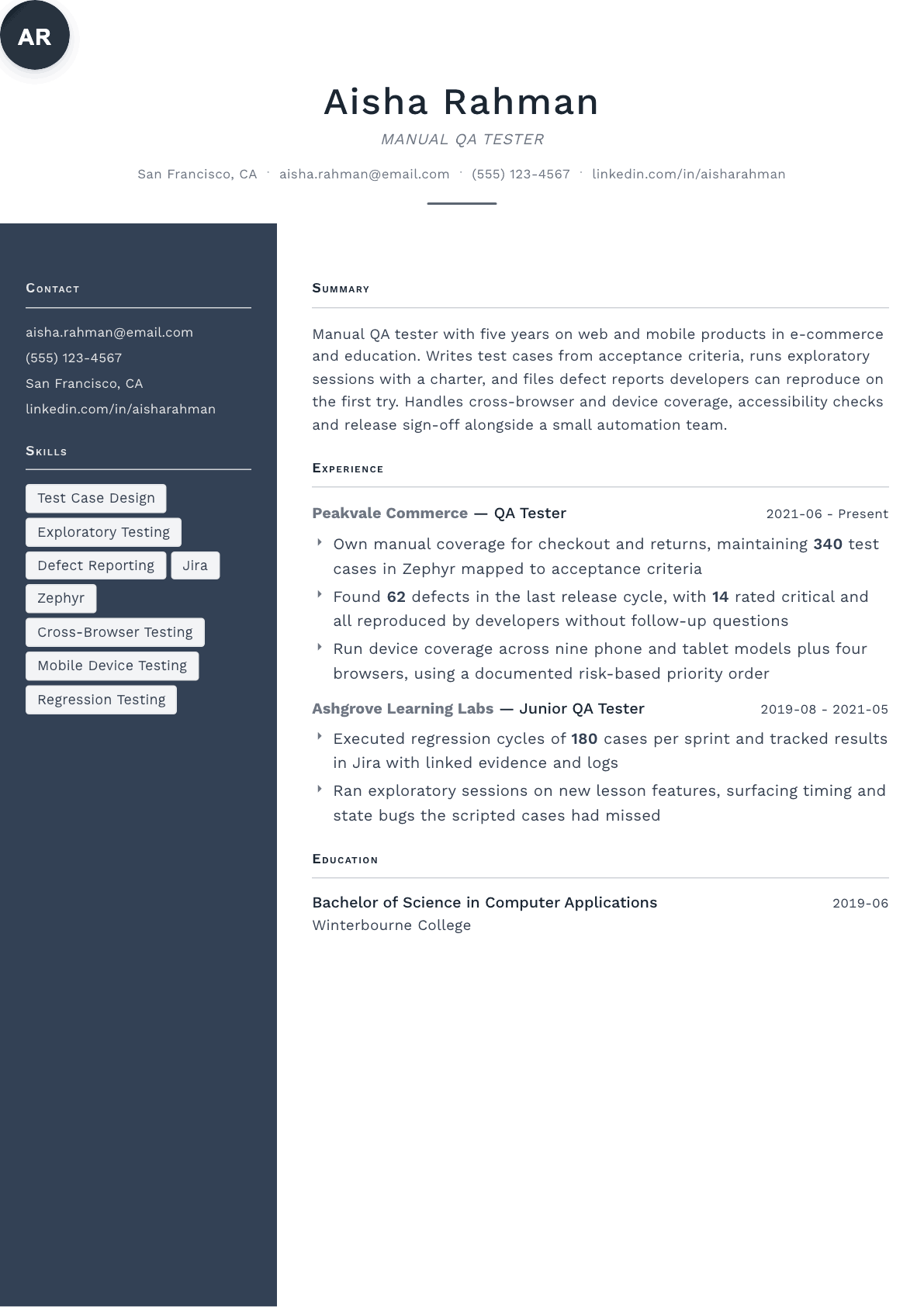
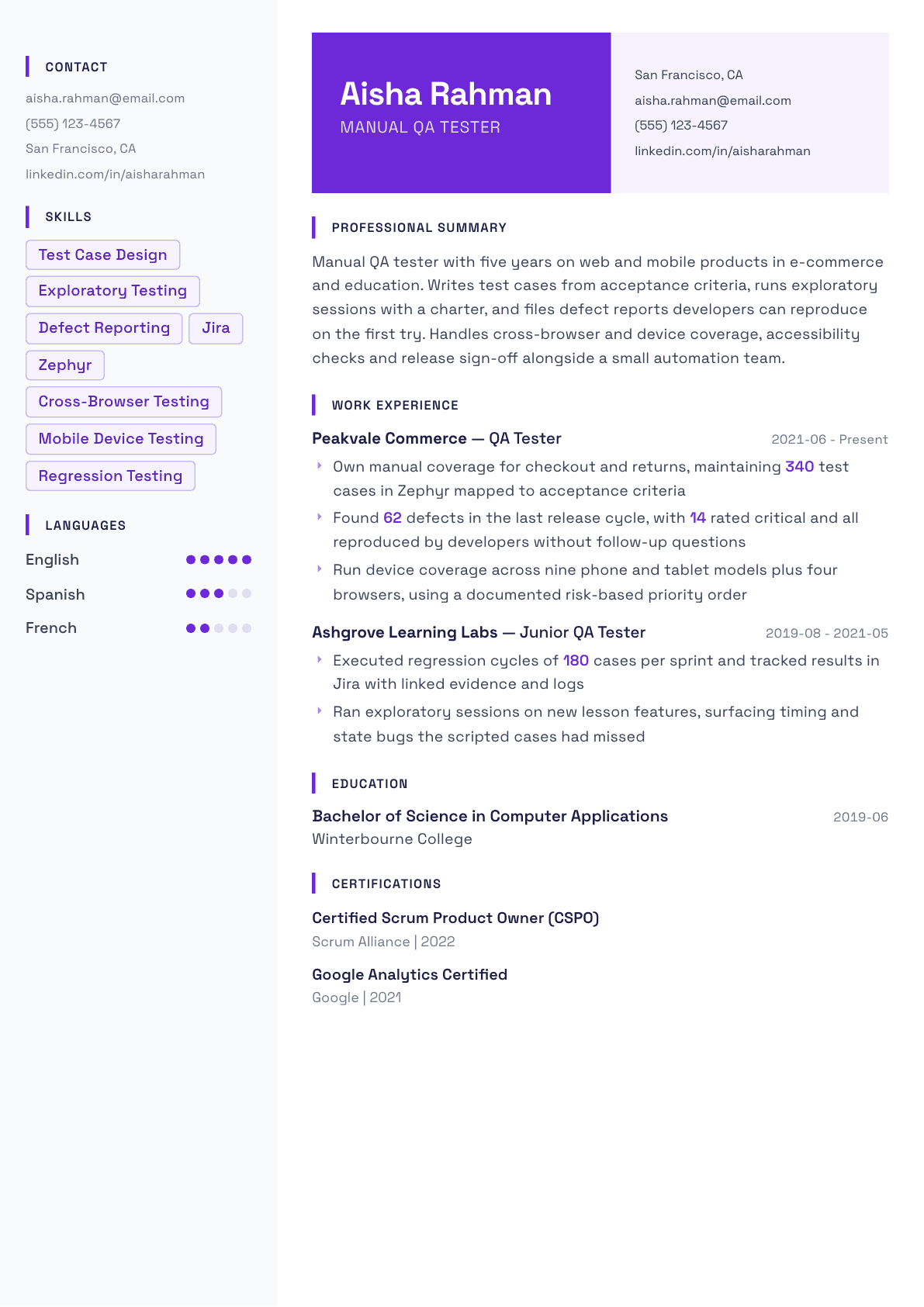
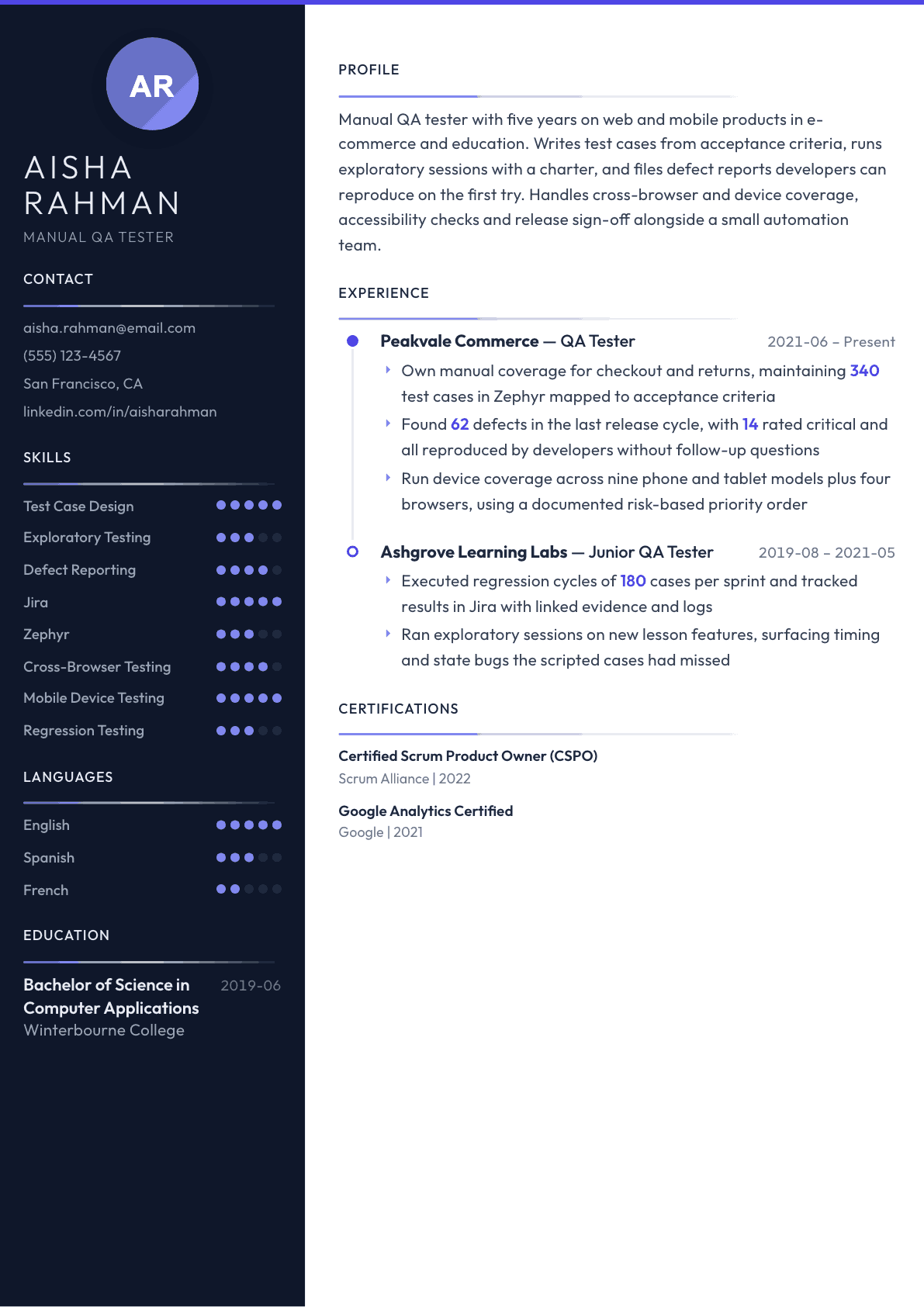
Example Manual QA Tester summary
Manual QA tester with five years covering checkout, returns and learning content across web and mobile. Builds test cases straight from acceptance criteria, runs charter-driven exploratory sessions, and writes defect reports developers reproduce without a follow-up thread. Handles device and browser coverage with a risk-based priority order and takes part in release sign-off. Now learning Playwright to add automation depth.
Skills to list on a Manual QA Tester resume
- Test Case Design
- Exploratory Testing
- Regression Testing
- Defect Reporting
- Jira
- TestRail
- Zephyr
- Cross-Browser Testing
- Mobile Device Testing
- API Testing with Postman
- SQL for Test Verification
- Accessibility Checks
- User Acceptance Testing
- Smoke and Sanity Testing
- Risk-Based Test Prioritization
- Release Sign-Off
What actually gets this resume read
- Give test case counts, defect counts and the severity mix, because volume alone says nothing about your judgment.
- Show that your defect reports are reproducible: steps, environment, evidence and the expected against actual result.
- Name your test management tool and your tracker, since Jira with Zephyr or TestRail is a common screening filter.
- Describe exploratory testing with charters and time boxes so it reads as a method rather than clicking around.
- List the browsers, devices and operating systems you cover, and explain how you choose the priority order.
- Say what part you play at release: sign-off, smoke on production, or a go and no-go call with the product owner.
How to write a manual qa tester resume
A manual QA tester resume is judged on one thing above all others: the quality of your defect reports. A team lead reading your application is imagining her developers picking up your tickets. If she believes they will reproduce the bug on the first attempt, she interviews you. If she suspects a stream of vague reports and back and forth comments, she does not.
The second thing she checks is whether you can think beyond the script. Executing written cases is table stakes. What earns the offer is evidence that you run charter driven exploratory sessions and find the state, timing and boundary problems the scripted set never covers.
This guide covers the resume structure that works for a manual testing role, a complete QA tester CV written out, how to write about coverage and defects with real numbers, three summaries across career stages, before and after bullets, and the questions testers ask when they worry the market only wants automation. A resume for a quality assurance tester, a QA tester CV and a software tester resume are one document under three names, so everything here applies to all of them.
Format: one page, plain layout, tools visible early
One page for most manual testers, two only with a decade of history across several products. Use a single column and standard headings. A tester who sends a heavily designed two column file is testing the recruiting system rather than the reader, and it usually parses badly.
Place a tools block directly under the summary: the tracker, the test management tool, the device lab or cloud device service, and whatever you use for API checks and log reading. These names are how recruiters filter.
- Header: name, title, city, phone, email, and certification abbreviations if you hold them.
- Order: summary, tools and testing skills, experience, certifications, education.
- Product line per role: what the application does, the platforms it runs on, and the release cadence.
Summary: product type, coverage, and your defect record
Three lines. Say what you test, on which platforms, and what your last release cycle looked like in defects found and severity mix. A tester who has covered checkout and refunds on a commerce product is a different candidate from one who has tested an internal admin tool, and the summary should make that obvious.
Mention where you sit in the release decision. Testers who take part in a go or no-go call carry more weight than testers who hand over a results sheet, and that distinction rarely appears on the page.
Experience: cases, exploratory sessions, defects, coverage
Case work should include the count you maintain, where the cases live, and how they trace back to acceptance criteria or requirements. Traceability is what makes a manual suite auditable, and it is a standard interview question in regulated products.
Exploratory work needs a method to be credible. Name the charter, the time box, and what you found that the scripted cases missed. Written this way it reads as a discipline. Written as performed ad hoc testing it reads as clicking around.
Defect bullets should carry volume plus quality. The count found in a cycle, the severity split, and any signal that your reports are clean: reproduced on the first try, evidence attached, environment stated, expected against actual. Also worth a line is any defect you caught that would have reached production, since that is the return on the whole function.
Coverage bullets should show your priority logic. Which browsers, devices and operating system versions you cover, how you chose them, and what you deliberately leave out. A tester who can defend an exclusion is more senior than one who claims to test everything.
Skills and automation: techniques first, scripts stated honestly
Include the techniques by name: equivalence partitioning, boundary value analysis, decision tables, state transition testing, and risk based prioritization. Those terms tell a lead you were trained rather than self taught by trial and error, and they appear in postings for a reason.
Add the technical edges that make a manual tester independent: reading application logs, checking a response in an API client, running a query to verify a record was written, and using browser developer tools. Those four skills routinely decide between two otherwise equal candidates.
Many postings for manual roles now ask for some automation awareness. The correct move is a short, honest line: the framework you are learning, what you have automated so far, and what you can maintain. Overclaiming here is the fastest way to fail a technical screen.
It is equally valid to position yourself as a specialist in the work automation cannot do: usability, accessibility, exploratory depth, and testing a feature the day it is built before any selector is stable.
QA tester CV for a software tester, start to finish
A CV for a software tester and a manual QA tester resume are the same document; the word changes with the country and the company, not the content. Here is a complete one for a tester with four years on web and mobile products. The person and companies are invented; the order is what to copy. For roles in the UK, Ireland or Australia, where CV is the usual word, the same content can run to a second page with a longer projects section; for a US posting titled quality assurance tester, keep it to one page.
Summary: Ravi Menon, Software Tester. Manual and exploratory tester on a web and mobile banking product, writing test cases from user stories, running regression before each release and logging defects in Jira that engineers reproduce on the first attempt. ISTQB Foundation certified, with basic SQL and API testing in Postman.
- Current role, QA Analyst, Brightpath Software, three years: test a consumer banking app on iOS, Android and web in two week sprints.
- Wrote and maintain about four hundred test cases in TestRail, grouped into smoke, regression and release suites.
- Run exploratory sessions on every new feature with written charters, and share session notes with the product owner.
- Log defects with steps, expected and actual results, screenshots and device details, and verify every fix before the release.
- Previous role, Junior Tester, Northfield Digital, one year: manual testing of client websites across browsers and screen sizes.
- Skills: test case design, boundary value analysis, exploratory testing, regression testing, Jira, TestRail, Postman, SQL.
- Certification and education: ISTQB Certified Tester Foundation Level; BS in Computer Science.
QA tester resume sample: a mobile app tester
A QA tester resume is what most postings call this job, whether the work is manual, exploratory or a mix with some automation. The page above has a full software tester sample; here is a second one for a QA tester on mobile apps, because device coverage and release cycles change what goes on the page. The person and employers are invented.
Notice that the summary names the platforms and the release rhythm, and the bullets describe test design and defect work, not just tools. If you have automation experience, put it in one honest line instead of making it the headline.
- Header: Kevin Tran, QA Tester. City, phone, email, LinkedIn.
- Summary: QA tester with four years on consumer iOS and Android apps released every two weeks. Writes and maintains test cases in TestRail, runs exploratory sessions on new features, and files clear, reproducible defects in Jira with logs and screen recordings.
- Skills: test case design, regression and smoke testing, exploratory testing, API checks in Postman, SQL for data checks, Charles Proxy, device and OS coverage planning. Basic Selenium and Appium scripting.
- QA Tester, a fitness app company, three years: owns regression for the payments and subscription flows on both platforms; built the device coverage matrix the team uses for each release; tests every release candidate and signs off with the release manager; pairs with engineers to reproduce intermittent crashes.
- Earlier: Customer Support Specialist, the same company, one year. Escalated reproducible bugs from user tickets, which led to the move into QA.
- Education: BA in Communication; ISTQB Foundation Level certificate.
Manual QA Tester resume summary examples
First testing role
Junior QA tester with one year on a learning platform, executing regression cycles of 180 cases a sprint and logging defects in Jira with linked evidence. Trained in boundary and equivalence techniques, comfortable reading browser console errors, and holds the ISTQB foundation certificate.
Five years, checkout owner
Manual QA tester with five years on commerce web and mobile products. Owns coverage for checkout and returns with 340 traceable cases in Zephyr, found 62 defects in the last cycle with 14 rated critical, and runs charter based exploratory sessions on every new payment flow.
QA lead
QA lead with nine years across regulated health and finance products. Sets the test strategy per release, runs risk workshops with product and engineering, mentors three testers, and owns the go or no-go recommendation. Built the traceability practice that carried the last external audit without a finding.
Work experience bullets: before and after
Before: Tested the website and reported bugs.
After: Owned manual coverage for checkout and returns, maintaining 340 test cases in Zephyr mapped to acceptance criteria and executed each release cycle.
Naming the area, the count, the tool and the traceability replaces an activity description with an ownership statement.
Before: Found many bugs during testing.
After: Logged 62 defects in the last release cycle, 14 of them critical, each reproduced by a developer on the first attempt with steps, environment and video evidence attached.
Severity mix plus first-attempt reproduction is the closest a resume gets to proving report quality.
Before: Did exploratory testing on new features.
After: Ran 90-minute exploratory charters on each new lesson feature, surfacing timing and state defects that the scripted regression set had no cases for.
The time box and the class of defect found turn an unstructured claim into a repeatable technique.
Before: Tested on different browsers and devices.
After: Covered nine phone and tablet models plus four browsers using a documented risk order based on analytics traffic share and past defect history.
Showing how the coverage list was chosen demonstrates prioritization rather than exhaustive box ticking.
Before: Worked with developers to fix issues.
After: Triaged the defect queue with the team lead twice a week, agreeing severity and target release, and verified 40 fixes per cycle before the ticket closed.
Triage cadence and verification volume show involvement in the workflow rather than a handoff at the end of it.
Hard skills
- Test case design and traceability
- Exploratory testing with charters
- Regression cycle execution
- Defect reporting and triage
- Jira and TestRail
- Zephyr test management
- Cross-browser and device coverage
- API checks with Postman
- SQL verification queries
- Accessibility checks
- User acceptance test support
- Risk based test prioritization
Soft skills
- Precise written reproduction steps
- Curiosity about edge cases
- Negotiating severity with developers
- Calm under release pressure
- Questioning ambiguous requirements
- Knowledge sharing with new testers
Certifications worth listing
- ISTQB Certified Tester Foundation Level (International Software Testing Qualifications Board)
- ISTQB Certified Tester Advanced Level Test Analyst (International Software Testing Qualifications Board)
- ISTQB Certified Tester Foundation Level Agile Tester (International Software Testing Qualifications Board)
Mistakes that cost manual qa tester candidates the interview
- Describing testing in general terms instead of naming the product area you own and the cases behind it.
- Giving a defect count with no severity mix, which leaves a lead unable to judge whether the finds mattered.
- Calling exploratory work ad hoc, which sounds unplanned rather than deliberate.
- Leaving out the tracker and test management tool, which are the exact strings recruiters filter on.
- Overstating automation ability to match a posting, then failing the first technical question about it.
- Presenting a decorated two column layout that recruiting systems reorder, burying your defect evidence.
Manual QA Tester resume questions
What should a QA tester resume include?
A summary naming the product type, platforms and release rhythm, a skills line with testing techniques and tools, then experience bullets about test design, regression ownership, exploratory testing, defect reporting and release sign off. Add any automation honestly as a supporting skill unless the job asks for it first.
Is a QA tester CV different from a resume for a quality assurance tester?
No. Software tester, QA tester, quality assurance tester and QA analyst describe the same job, and CV is the word many companies outside the United States use for a resume. Use the title from the posting in your header, keep it to one page or two at most, and put tools and certifications near the top.
How do I show defect report quality on a resume?
Use proxies a reader trusts: the share of defects reproduced without follow-up questions, the evidence you attach as standard, and the severity mix. One sentence about your reporting template also works well in an interview.
Should I learn automation before applying for QA roles?
Learning a framework helps, but you do not need to wait. Add one honest line about what you have automated and keep the emphasis on exploratory depth, technique knowledge and the domain you already know well.
What technical skills make a manual tester stand out?
Reading application logs, checking an endpoint response in an API client, running a verification query, and using browser developer tools. Those four remove your dependence on a developer to confirm what actually happened.
Related resume examples
- QA Engineer Resume example
- IT Specialist Resume example
- Test Automation Engineer Resume example
- IT Support Specialist Resume example
- Systems Analyst Resume example
- IT Business Analyst Resume example