Android Developer Resume Examples: the lines they read
Build an Android Developer Resume That Launches Your Career
By Mustafa Tarabya, founder of CVBooster · Published · Updated
Create a professional Android developer resume with Kotlin and Java expertise that stands out in the mobile development market.
Sample resumes for a android developer
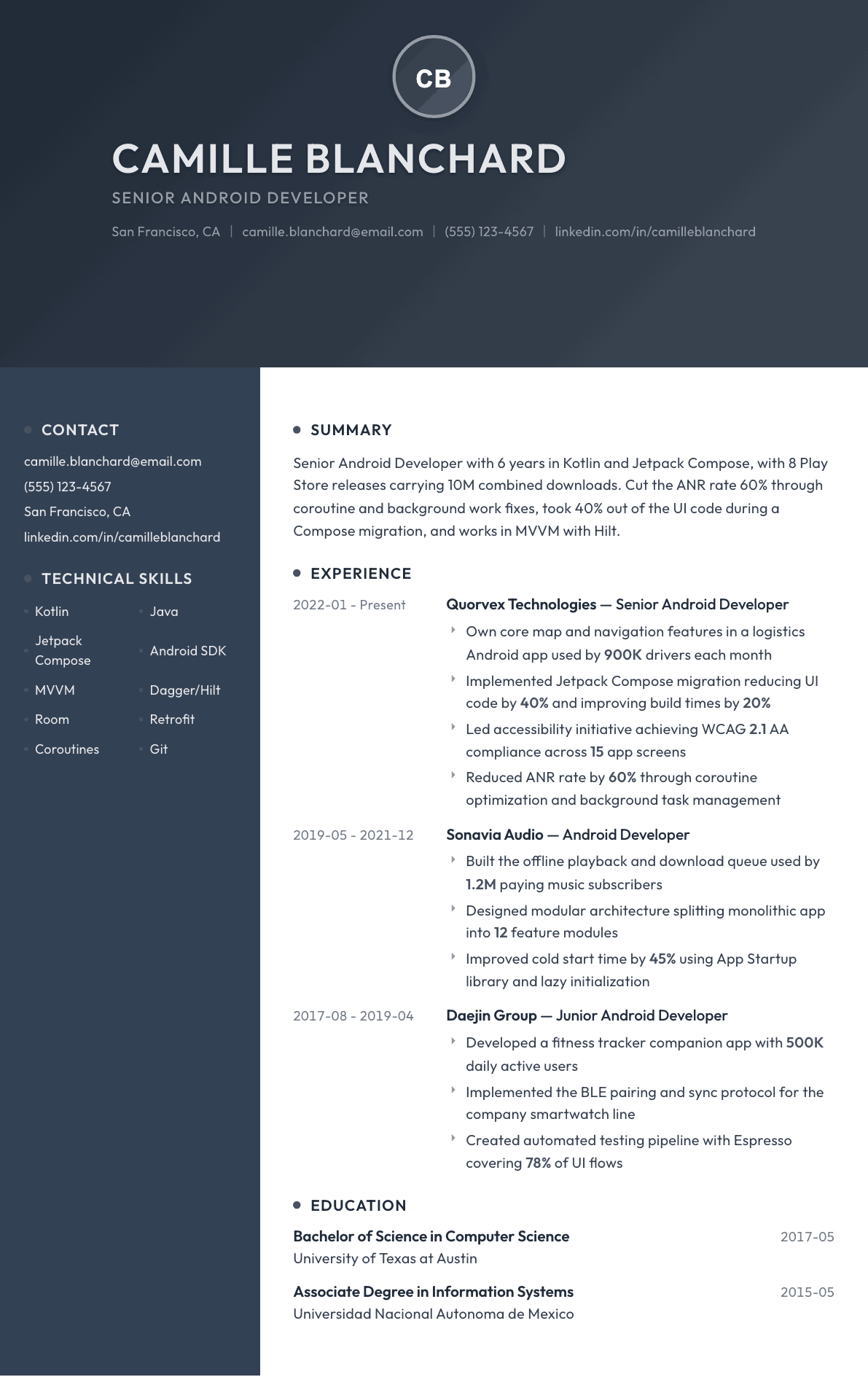
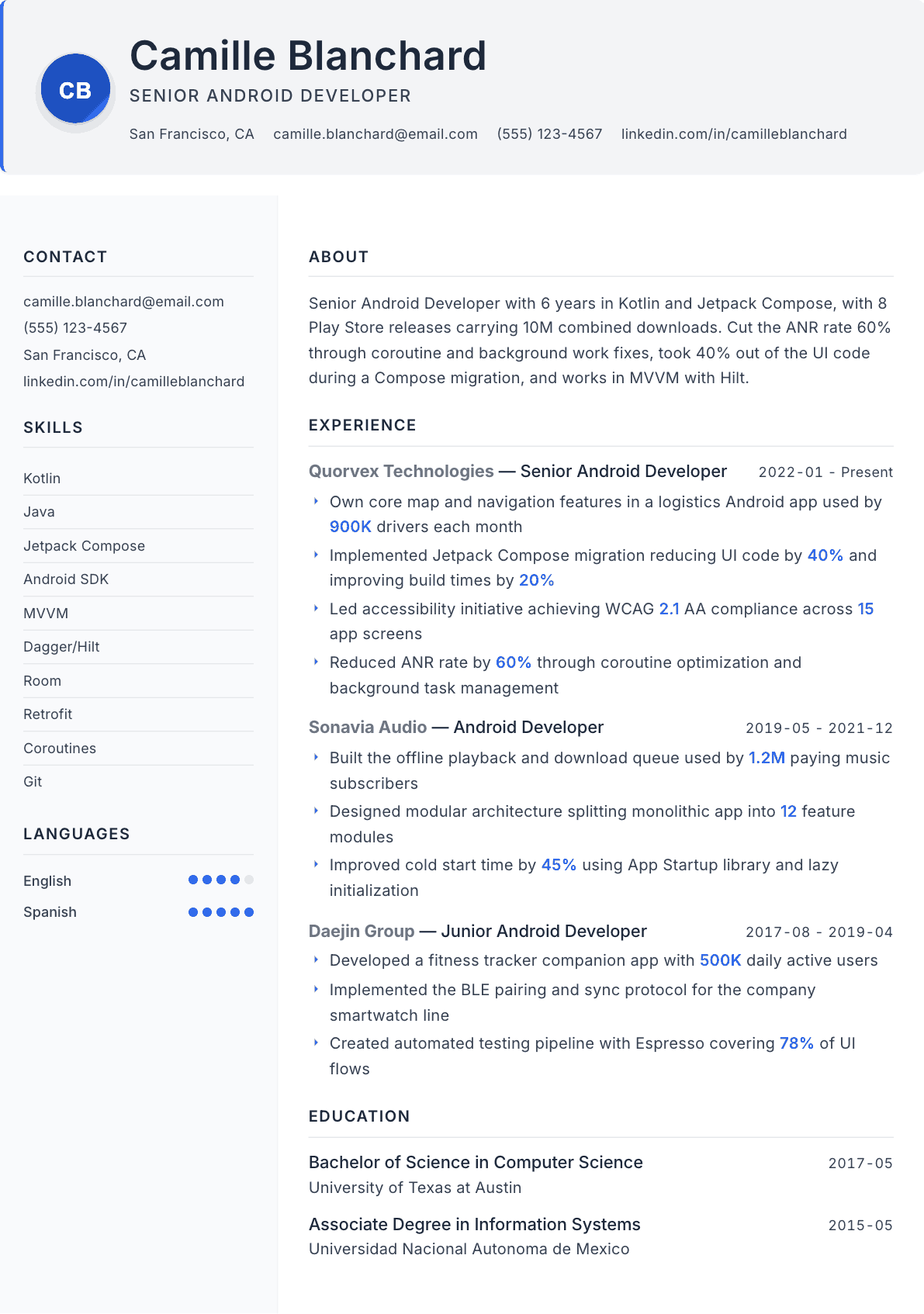
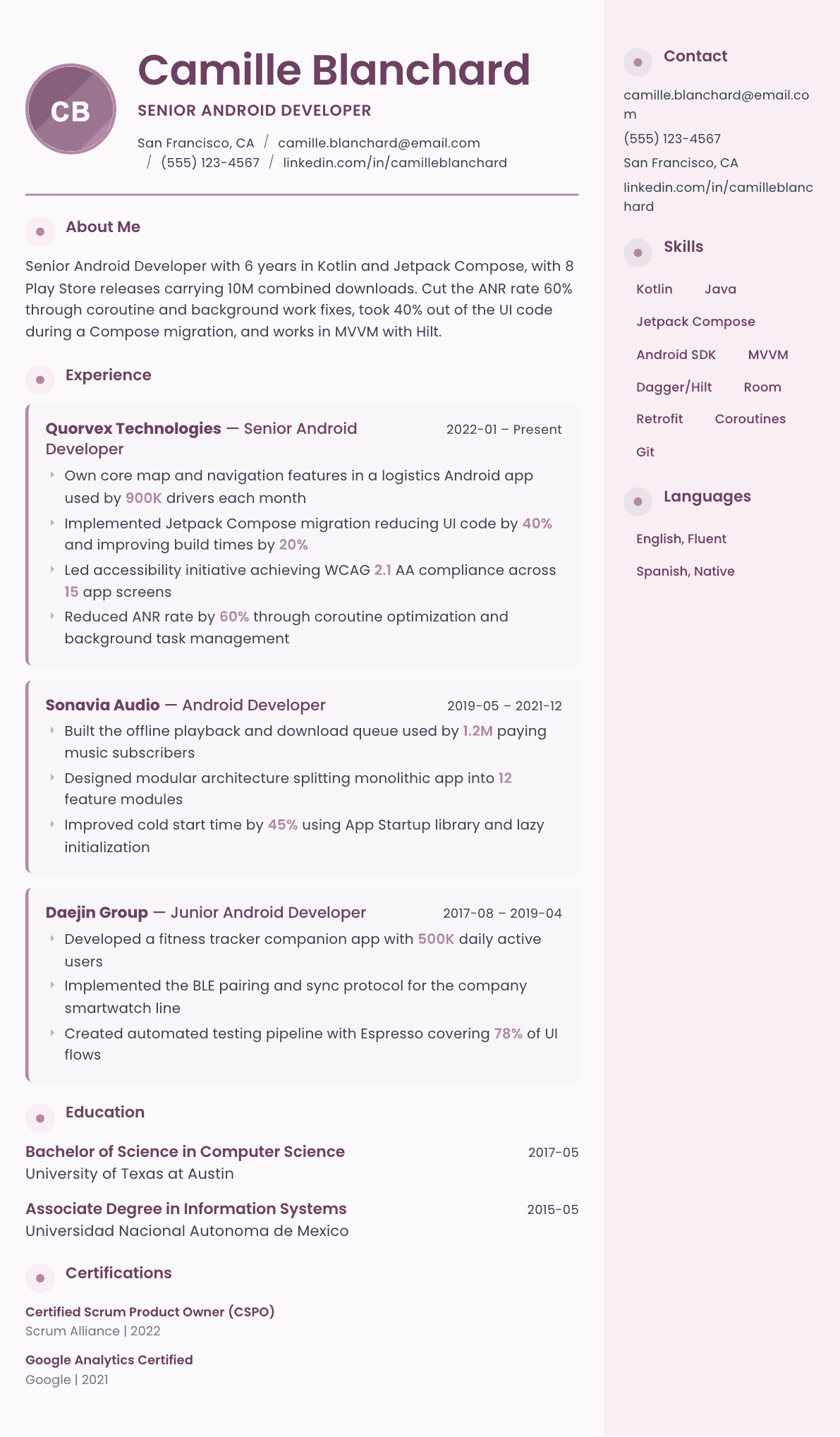
The same android developer content laid out in three CVBooster templates, so you can see what the finished document looks like before you write a word.
Example Android Developer summary
Android developer, 6 years, Kotlin and Jetpack Compose with eight published apps and 10M downloads behind them. Split a monolithic app into 12 feature modules, cut cold start 45%, and brought 15 screens to WCAG 2.1 AA.
Skills to list on a Android Developer resume
- Kotlin
- Java
- Jetpack Compose
- Android SDK
- MVVM
- Dagger/Hilt
- Room
- Retrofit
- Coroutines
- Firebase
- Google Play
- Material Design
- Espresso
- CI/CD
What actually gets this resume read
- Showcase Google Play apps with download metrics.
- Highlight Kotlin and Jetpack Compose skills.
- Include performance optimization achievements.
- Mention Material Design and accessibility experience.
- Show architecture pattern expertise (MVVM, MVI, Clean).
How to write a android developer resume
An Android developer resume is screened by an Android engineer, and Android engineers have a very short list of things they check first. Kotlin or Java, and how recently. Views or Jetpack Compose, and how deep. Which architecture you have actually shipped under, and whether you can talk about lifecycle, configuration change and process death without hand-waving. Everything else on the page is secondary to those four answers.
The second filter is production evidence. Anyone can build a sample app. What a hiring team wants is proof that you have kept an app healthy in the hands of real users: crash-free rate, application not responding incidents, cold start time, app size, and what you did when the numbers went the wrong way after a release. Play Console metrics are the closest thing this field has to a shared language, and using them signals immediately that you have owned a live app.
This guide covers how to lay out an Android resume, three summaries from junior to lead, five before-and-after bullets built from real mobile work, and the questions Android developers ask when they need to prove depth rather than a list of libraries.
Format: technical stack line, then apps, then experience
One page early, two once you have several years and multiple released apps. Reverse chronological, single column, no graphical skill meters. Directly under the summary put a stack line grouped by purpose rather than as one long run of nouns: language, user interface toolkit, architecture, dependency injection, persistence, networking, asynchrony, testing and build.
Then a short apps section listing the applications you have worked on with the platform, your role, the user scale and, where the app is public, the fact that it is on Google Play. A named app a reviewer can open changes the tone of the whole screen, because they can look at it while reading your bullets.
- Language and toolkit: Kotlin, Java, Jetpack Compose, and Views where you still maintain them.
- Architecture: MVVM or MVI, unidirectional data flow, modularization approach.
- Libraries: Hilt or Dagger, Room, Retrofit and OkHttp, coroutines and Flow, WorkManager.
- Quality and build: JUnit, Espresso, Compose UI tests, Gradle, and the continuous integration you use.
Summary: language, toolkit, app scale and one hard problem
Three sentences. Years in Android, the language and toolkit you work in now, the scale of the apps you have shipped, and one hard problem you have solved. Scale can be install base, monthly active users, or the fact that the app runs across a wide device and API level range, which is its own kind of difficulty.
If you are mid-migration from Views to Compose, say that plainly rather than implying full Compose experience. Most teams are in exactly the same position, and honesty about the split reads as maturity while an overstated claim collapses in the first technical conversation.
Experience: performance, stability and the numbers Play Console shows
Lead each role with what you owned: a feature area, a module, a shared library, or the whole app. Then use bullets that carry mobile-specific numbers. Crash-free user rate before and after a stability effort, application not responding rate reduction, cold start time in milliseconds, frame timing and jank reduction, application size in megabytes after shrinking resources or splitting a bundle.
Explain how you found the problem, not just that you fixed it. Traces from the system tracing tools, a memory profiler session, a leak detection library finding, a strict mode violation or a spike in a crash reporting dashboard after a staged rollout are the details that prove you debug rather than guess. Mobile hiring managers weigh diagnosis very heavily because most production mobile bugs are hard to reproduce.
Release engineering is worth a bullet. Staged rollouts, release halts after a crash spike, feature flags, in-app updates, and the internal testing tracks you used all show a developer who understands that on mobile a bad build cannot simply be rolled back for users who already installed it.
Architecture and modularization: show the decision, not the acronym
Every Android resume claims MVVM. Very few explain a decision. Write about the module boundaries you drew, why a feature module was split out, how you handled navigation across modules, what state holder pattern you used, and how you kept business logic out of composables and activities. Those specifics prove you have argued about architecture with other engineers rather than copied a sample.
Include the build side, because on a large Android codebase it is a real engineering discipline. Build time improvements from configuration caching, module graph changes, or dependency cleanup are concrete and immediately meaningful to anyone who has waited on a slow Gradle build.
- Module structure: how many modules, and how feature and core modules relate.
- State management: the pattern you use and how you handle process death restoration.
- Offline behavior: caching strategy, sync approach, and conflict handling.
- Build health: build time before and after, and what you changed.
Testing, accessibility and the keywords a screener matches
Testing on Android is a differentiator because so many codebases have little of it. Say what you test and how: unit tests around view models and repositories, fakes over mocks, Espresso or Compose UI tests for critical flows, screenshot testing, and whether the suite runs on emulators in continuous integration or on a device farm.
Accessibility is increasingly a hiring signal at larger employers. Content descriptions, touch target sizing, TalkBack verification and support for larger font scales are all specific and checkable. Alongside that, keep the searchable terms accurate: Kotlin, Jetpack Compose, Android SDK, coroutines, Material Design, Firebase, Gradle and Google Play, each placed next to work you actually did.
Android Developer resume summary examples
Junior Android developer
Android developer with 1 year of professional Kotlin experience and two apps published on Google Play. Works in Jetpack Compose with MVVM, Hilt and Retrofit, wrote the unit test suite for the networking layer, and reduced a startup crash rate to near zero after a rollout issue.
Six years in
Android Developer with 6 years building apps in Kotlin and Java, with 8 published titles and a combined install base in the tens of millions. Led a Jetpack Compose migration that cut interface code by 40%, and reduced the application not responding rate by 60% through coroutine and background work fixes.
Lead Android engineer
Lead Android engineer with 10 years, currently owning architecture for a modularized app used by millions of monthly users. Drove the move to a unidirectional data flow across 30 feature modules, cut cold start by a third, and mentors four engineers through design review and release ownership.
Work experience bullets: before and after
Before: Developed features for a large Android application.
After: Built offline playback for a music app used by millions of subscribers, covering download scheduling with WorkManager, encrypted local storage and conflict resolution when licenses expired while the device was offline.
A named feature with its real constraints shows the engineering problem rather than the existence of the app.
Before: Migrated the app to Jetpack Compose.
After: Led an incremental Jetpack Compose migration across 15 screens using interoperability with existing Views, cutting interface code by 40% and improving build times by 20% after removing the layout inflation path.
The incremental approach and two measured outcomes prove a real migration rather than a new project started in Compose.
Before: Fixed crashes and improved app stability.
After: Raised the crash-free user rate from 98.2% to 99.7% over two releases by fixing three lifecycle-related leaks found with a leak detection library and adding process death restoration to four state holders.
The tools, the specific defect class and the before and after rate show diagnostic skill instead of general maintenance.
Before: Improved app performance.
After: Cut cold start from 2.1 seconds to 1.3 by deferring three library initializations to a background thread, adding baseline profiles, and removing a synchronous disk read from the application startup path.
Naming the exact startup costs removed makes a performance claim something another Android engineer can evaluate.
Before: Made the app more accessible.
After: Led an accessibility pass across 15 screens to reach conformance with the recognized web content accessibility guidelines at the AA level, adding content descriptions, fixing touch target sizes and verifying every flow with TalkBack.
The standard, the screen count and the verification method turn a vague claim into auditable work.
Hard skills
- Kotlin
- Java
- Jetpack Compose
- Android SDK and lifecycle
- MVVM and MVI architecture
- Coroutines and Flow
- Hilt and Dagger
- Room and local persistence
- Retrofit and OkHttp
- WorkManager and background execution
- Espresso and Compose UI testing
- Gradle and build optimization
- Firebase Crashlytics and analytics
- Google Play Console and staged rollouts
Soft skills
- Debugging hard-to-reproduce issues
- Code review
- Design discussion
- Working with designers on Material patterns
- Release judgment
- Mentoring
Certifications worth listing
- Google Cloud Certified, Associate Cloud Engineer (Google Cloud)
Mistakes that cost android developer candidates the interview
- Listing every library used without saying which architecture decisions you made or defended.
- Claiming Jetpack Compose experience without stating whether the work was a migration, a new module or a sample project.
- Describing crashes as fixed without the crash-free rate, the defect class or the tooling used to find them.
- Leaving Google Play links and install scale off the resume when you have public apps a reviewer could open.
- Ignoring testing entirely, which reads as a codebase you could not safely change.
- Talking about performance in adjectives instead of cold start times, frame timing or application size.
- Omitting release practice, since staged rollouts and halted releases are core to mobile engineering judgment.
Android Developer resume questions
Should I list Java if the market has moved to Kotlin?
Yes, because a large share of production Android code is still Java and teams maintaining it screen for the ability to work across both. Lead with Kotlin, then note Java with the context, such as maintaining legacy modules while adding new features in Kotlin.
How do I show Android experience without a published app?
Describe the internal or enterprise apps you built with their user scale and distribution method, whether managed enterprise deployment or an internal track. If you have nothing shippable, build one real app and put it on Google Play with the crash and performance numbers you tracked.
Which performance numbers matter most on an Android resume?
Crash-free user rate, the application not responding rate, cold start time, and application size are the four a hiring team recognizes instantly. Give the before and after with the release window, since a static number without a baseline tells them nothing about your contribution.
How much should I write about architecture?
Enough for one substantive bullet per senior role. Name the pattern, the module structure and one decision you made with its tradeoff. Listing MVVM alone is worthless because nearly every competing resume says the same word.
Do I need to mention device fragmentation and API levels?
Mention it when it shaped your work, such as supporting a wide minimum API level, handling manufacturer-specific background restrictions, or testing across a device matrix. That detail proves real production exposure that emulator-only experience never produces.
Related resume examples
- iOS Developer Resume example
- Mobile App Developer Resume example
- Frontend Developer Resume example
- Kotlin Developer Resume example
- Flutter Developer Resume example
- Java Developer Resume example