PHP Developer Resume Examples: free ATS score and gap list
Build a PHP Developer Resume That Powers Your Career
By Mustafa Tarabya, founder of CVBooster · Published · Updated
Create a professional PHP developer resume highlighting Laravel, WordPress, and modern PHP expertise with templates designed for web development roles.
Sample resumes for a php developer
The same php developer content laid out in three CVBooster templates, so you can see what the finished document looks like before you write a word.
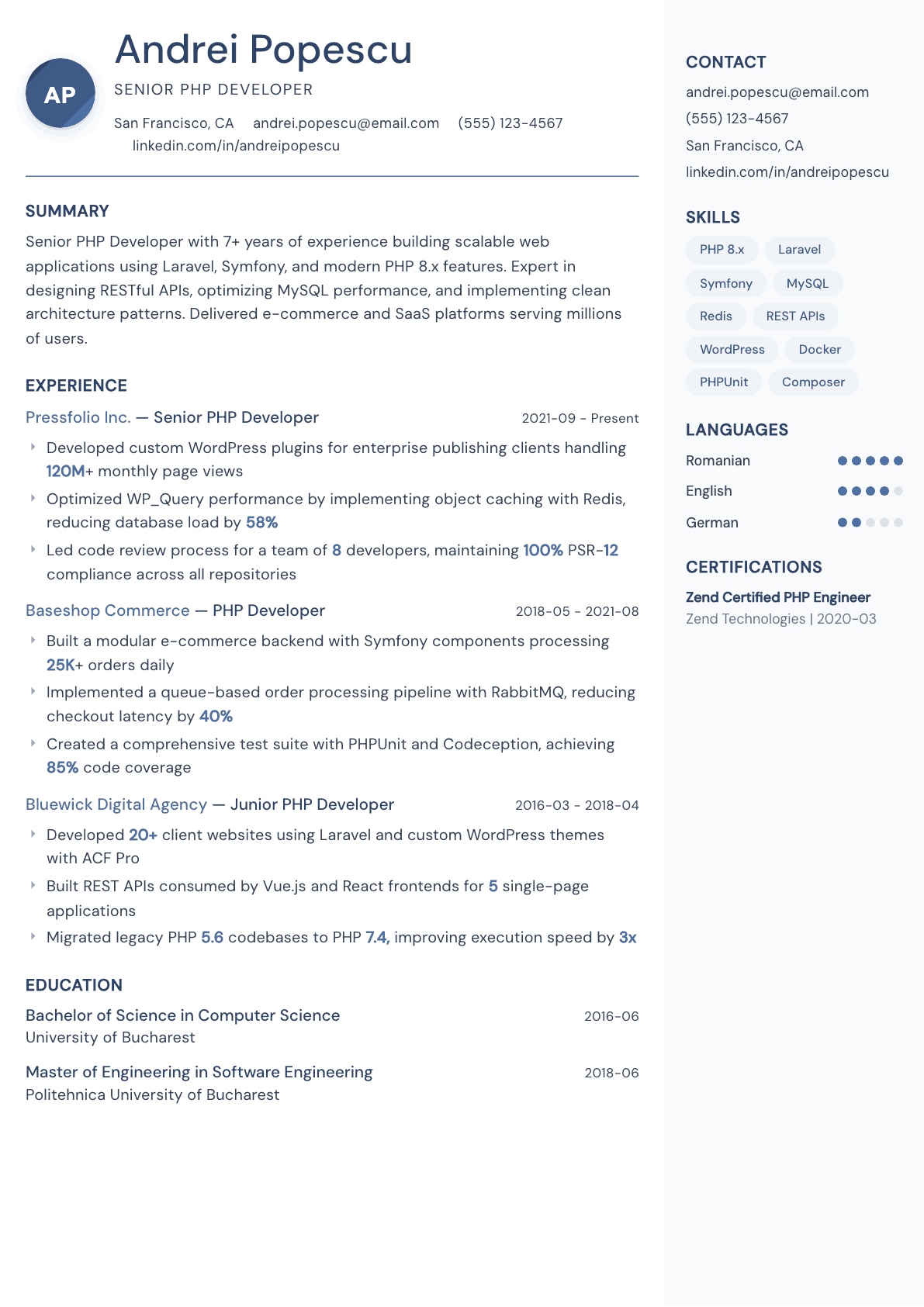
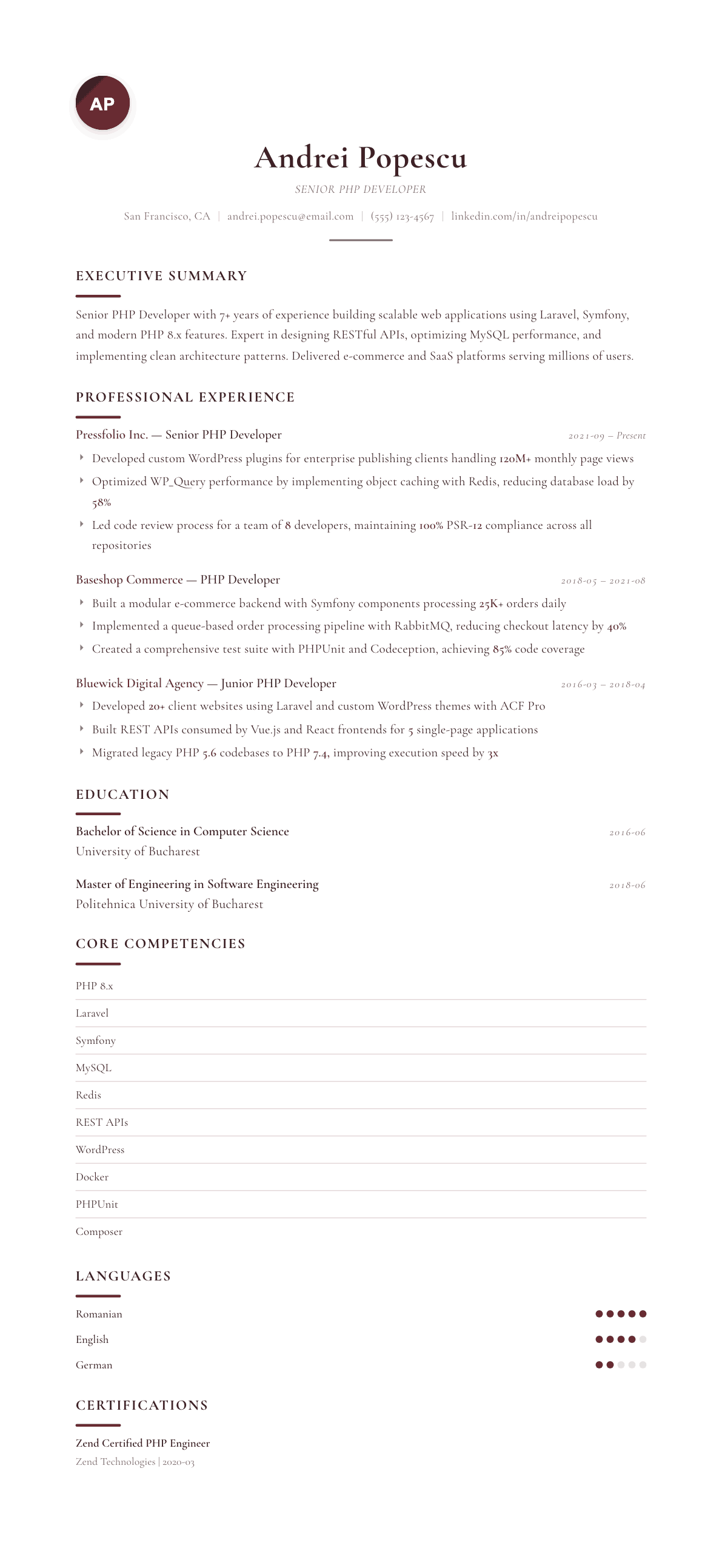
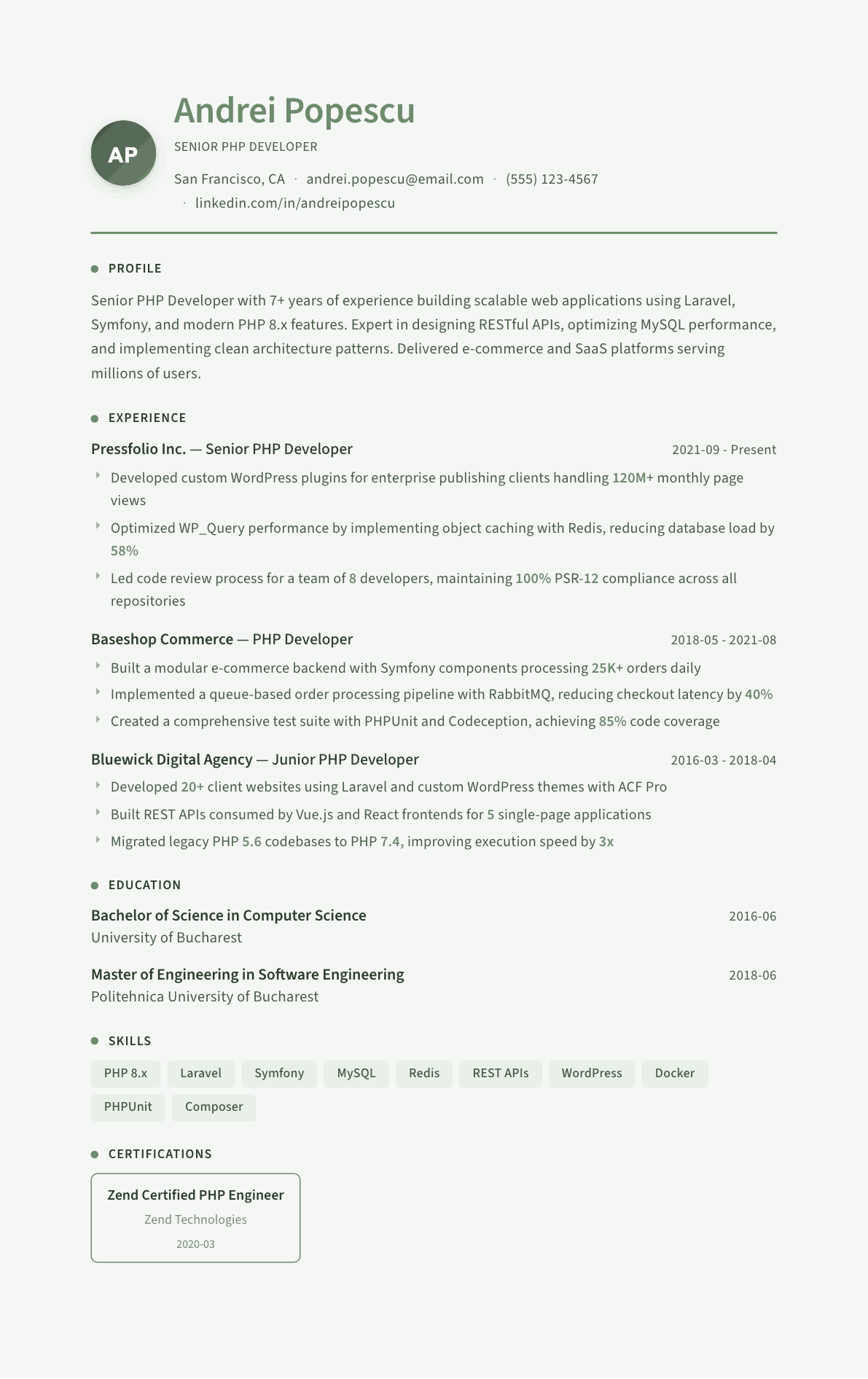
Example PHP Developer summary
PHP Developer with 7 years of experience building scalable web applications with Laravel, Symfony, and modern PHP 8.x. Delivered e-commerce platforms processing 25K+ daily orders and content management systems serving 120M+ monthly page views. Expert in MySQL optimization, Redis caching, and clean architecture principles.
Skills to list on a PHP Developer resume
- PHP 8.x
- Laravel
- Symfony
- MySQL
- PostgreSQL
- Redis
- REST APIs
- WordPress
- Docker
- PHPUnit
- Composer
- RabbitMQ
What actually gets this resume read
- Specify PHP versions and frameworks prominently: PHP 8.x, Laravel 10, Symfony 6, or CodeIgniter.
- Highlight modern PHP practices: type declarations, enums, fibers, attributes, and PSR standards.
- Quantify application scale: daily transactions, concurrent users, or monthly page views.
- Include database optimization experience with MySQL, PostgreSQL, or Redis caching strategies.
- Show testing discipline with PHPUnit, Pest, or Codeception and mention code coverage metrics.
How to write a php developer resume
PHP hiring is split down the middle, and the split decides how you should write. On one side sit product teams running Laravel or Symfony on a modern PHP release, with static analysis, typed properties, queues and a real test suite. On the other sit agencies and content shops running WordPress, WooCommerce and Drupal, where the work is plugin architecture, theme performance and keeping a large content estate fast. Both hire constantly, both call the role PHP developer, and a resume aimed at the wrong one lands as a mismatch.
The second thing a reader checks is how modern your PHP is. A resume that describes procedural includes, mysql queries built by string concatenation, and no dependency manager reads as someone who stopped in the previous decade. A resume that names typed properties, enums, readonly classes, PSR standards, Composer, PHPStan or Psalm at a stated level and a test suite reads as someone who kept up. The difference is often the same person describing the same job in different words.
This guide covers choosing your side of the split, the framework and version detail a lead scans for, how to write about legacy modernization without sounding like a maintenance programmer, and the performance numbers that mean something in a PHP application.
Format: framework and version in the first block
Reverse-chronological, one page under six years. Put the stack line under the summary: PHP version, framework and major version, database, cache, queue and test tooling. Leads scan for that line because it decides whether you can start on their codebase or need three months of ramp.
Do not build a separate section for every client site if you come from an agency. Group them under the agency employer and give the two or three with real technical substance their own bullets, with the rest summarized as a count and a common stack.
- Header: name, title, city, email, and a link in plain text to a repository or packagist profile if you maintain packages.
- Order: summary, stack line, experience, skills grouped by layer, education, certifications.
- Say which side you are on: application development on a framework, or content platform work on WordPress or Drupal.
- Name the deployment target, because shared hosting, a managed platform and container orchestration are different jobs.
Summary: framework, scale, and the hardest thing you have fixed
Three lines. Framework and years first, then the scale of the traffic or the transaction volume, then the hardest technical problem you have owned. In PHP work that is usually one of four things: a database that outgrew its queries, a monolith that needed decomposing, a legacy version upgrade with no test suite, or a checkout path that had to stay correct under concurrency.
Avoid the phrase full stack unless the posting uses it. PHP roles that want frontend work say so, and claiming it when your JavaScript is thin invites a technical screen you will not enjoy.
Experience: queries, queues, caching, and correctness
The bullets that separate PHP developers are about the database. Eloquent or Doctrine query counts per request, eager loading that removed an N plus one, an index that turned a table scan into a seek, a report query moved to a read replica, a migration executed on a large table without locking it. Name the tool you profiled with, whether that was Xdebug, Blackfire, Laravel Telescope, the slow query log or an application performance monitor.
Then the asynchronous layer. Queue workers with Horizon, Symfony Messenger or a raw broker, retry and backoff policy, idempotency for jobs that must not run twice, scheduled tasks, and how you kept a failed job from silently disappearing. Payment and order flows are where this matters and where a hiring manager will probe.
Caching deserves its own bullet: what you cached, at which layer, and how you invalidated it. Object cache in Redis, HTTP caching with Varnish or a content delivery network, opcode caching, and full page caching on a content site. Anyone can cache. Explaining invalidation is what shows judgment.
Modern PHP and legacy work: how to write both
Legacy modernization is valuable and most candidates undersell it as maintenance. Write it as engineering: the starting version and framework, the missing test coverage, the strategy you used, whether that was strangling routes behind a new front controller, extracting services, or adding characterization tests before touching behavior, and what the codebase looked like at the end.
Show current practice explicitly. Type declarations and strict types, enums, readonly properties, constructor promotion, attributes, PSR-4 autoloading and PSR-12 style, Composer with a lock file, static analysis at a named level, and a test suite in PHPUnit or Pest with a coverage figure you can defend. These terms are how a lead sorts modern from dated in under a minute.
- Static analysis: PHPStan or Psalm, with the level you run at and whether you raised it.
- Testing: PHPUnit, Pest, or Codeception, split into unit, feature and browser tests.
- Standards: PSR-4, PSR-12, PSR-7 and PSR-15 for middleware, enforced by a linter in continuous integration.
- Local and deploy environment: Docker, Laravel Sail, Deployer, or a managed platform.
Skills: layer by layer, WordPress kept separate
Group as language and frameworks, data, infrastructure, testing, and frontend touchpoints. Keep WordPress and Drupal in their own line rather than mixed among Laravel and Symfony, because a product team reading a mixed list assumes the content platform work is the majority of your experience.
If you write WordPress professionally, treat it seriously and use its own vocabulary: custom post types, the query loop, hooks and filters, the block editor and block development, WP-CLI, object caching, multisite, and the plugin conflicts you have resolved. Content platform work described in generic web terms looks weaker than it is.
PHP Developer resume summary examples
Junior PHP developer
Junior PHP developer with one year at a web agency building Laravel applications and custom WordPress themes. Comfortable with Eloquent, Blade, Composer and PHPUnit, and shipped a booking system handling 300 reservations a week. Looking for a product team with code review and mentoring.
Four years in
PHP developer with four years on Symfony and Doctrine building an order platform that processes 25k orders a day. Cut checkout response time by 40% by removing N plus one queries and adding a Redis object cache, and runs PHPStan at level 6 across the codebase.
Lead PHP engineer
Lead PHP engineer with nine years, currently owning a Laravel monolith serving 500M monthly page views. Led the upgrade from PHP 7.4 to 8.2 with no customer-visible downtime, introduced queue-based order processing, and sets the code review and static analysis standard for eight developers.
Work experience bullets: before and after
Before: Improved website performance.
After: Profiled the product listing endpoint with Blackfire, replaced 240 Eloquent queries per request with eager loading and a Redis object cache, and brought the median response from 1.9s to 210ms.
The profiler, the query count and the concrete before and after prove a diagnosis rather than a claim.
Before: Wrote unit tests for the application.
After: Added characterization tests around a legacy billing module with no coverage, then refactored it behind a service interface with 340 PHPUnit tests, which caught two rounding bugs before release.
It shows the sequence a careful engineer follows on legacy code and the defects it prevented.
Before: Upgraded PHP version on legacy project.
After: Migrated a 180k line PHP 5.6 codebase to 8.1 using Rector and PHPStan, converting deprecated extensions and adding strict types module by module across nine releases with no rollback.
The tooling, the size and the incremental release plan turn a version bump into a managed migration.
Before: Built REST APIs for frontend applications.
After: Designed a versioned JSON API in Laravel with resource transformers, token authentication, cursor pagination and rate limiting, consumed by a React app and two partner integrations.
Naming the API design decisions tells a reader you have thought past routing a controller.
Before: Developed custom WordPress plugins.
After: Built a custom WordPress plugin for editorial workflow with custom post types, REST endpoints and block editor panels, used across 12 publisher sites and kept compatible through three core releases.
Platform-specific vocabulary and the maintenance across core releases show depth instead of a plugin count.
Hard skills
- PHP 8 with typed properties and enums
- Laravel
- Symfony
- Doctrine ORM
- Eloquent ORM
- MySQL and PostgreSQL query optimization
- Redis caching
- Queues (Horizon, Messenger, RabbitMQ)
- REST and GraphQL API design
- PHPUnit and Pest
- PHPStan and Psalm
- Composer and PSR standards
- WordPress plugin and block development
- Docker and continuous deployment
Soft skills
- Code review with junior developers
- Estimating work on unfamiliar legacy code
- Client and stakeholder communication in agency settings
- Incident triage on production traffic
- Writing readable migration and rollback plans
Certifications worth listing
- Zend Certified PHP Engineer (Zend by Perforce)
- Laravel Certification (Laravel)
- Symfony Certification (SensioLabs)
- Acquia Certified Developer (Drupal) (Acquia)
Mistakes that cost php developer candidates the interview
- Not naming the PHP version anywhere, which makes a lead assume the oldest version you might plausibly have used.
- Mixing WordPress work into a Laravel skills list, so a product team reads the whole page as content site experience.
- Describing database work as "wrote queries" with no profiling, index or query count detail, when data access is where PHP applications actually fail.
- Calling yourself full stack because you edited Blade templates, then meeting a frontend screen you cannot pass.
- Framing legacy modernization as maintenance, which hides the most senior work on the page.
- Listing frameworks you touched once in a tutorial next to the one you have run in production for years.
PHP Developer resume questions
Is WordPress experience a liability on a PHP developer resume?
Not by itself. It becomes one when it is described vaguely and mixed into a framework list, because the reader assumes theme tweaking. Write it with platform vocabulary such as hooks, custom post types, block development and object caching, and keep it in its own section so a product team can see the framework work clearly.
Which PHP frameworks should I put on my resume?
The ones you have run in production, with the major version. Laravel and Symfony carry the most weight in product hiring, with Drupal and WordPress dominating content work. Listing four frameworks you have each touched once reads weaker than two you can discuss in depth for an hour.
How do I show modern PHP skills when my job is on an old codebase?
Write the modernization itself as your evidence: the version migration, Rector runs, strict types added module by module, a static analysis level you raised, and tests introduced before refactoring. That is stronger proof of current knowledge than a greenfield project, because it shows you applied it under constraints.
Do PHP certifications matter?
They are a modest signal, most useful for a career changer or a candidate without a well known employer on the page. The Zend and framework certifications get recognized, but no PHP team hires on a certificate. Production code you can explain in a technical interview outweighs all of them.
How should I present freelance and agency PHP work?
Group it under one heading with a date range, then give the two or three projects with real technical depth their own bullets and summarize the rest by count and stack. A list of twenty small sites buries the one interesting build and makes the reader do the sorting you should have done.
Related resume examples
- WordPress Developer Resume example
- Full-Stack Developer Resume example
- Backend Developer Resume example
- Ruby Developer Resume example
- Python Developer Resume example
- Node.js Developer Resume example