Working Together Civil Service Example: AO to Grade 7
By Mustafa Tarabya, founder of CVBooster · Published · Updated
13 min read
A Working Together example scores on the relationship you built and the friction you handled, not on how much you liked your team. Most adverts cap each behaviour at 250 words, so about 120 of them have to be your own actions.
Every indicator quoted here is lifted from the gov.uk publication Success Profiles: Civil Service behaviours, grade band by grade band.
Four complete statements follow, at AO, HEO, SEO and Grade 7, each annotated against the indicator it hits, plus the sentences that lose marks. Written by Mustafa Tarabya, who hired for his own company, read every application himself and now writes CVBooster's guides.
What the scoring actually rewards
gov.uk defines the behaviour as "Form effective partnerships and relationships with people both internally and externally, from a range of diverse backgrounds, sharing information, resources and support", which hands a sifter three things to tick.
A relationship. A range of backgrounds. Something shared. A team that simply got on well carries none of the three, which is where most drafts stall.
Two indicators run through every grade band and almost nobody writes to them: wellbeing, and the line that "bullying, harassment and discrimination are unacceptable". Each statement below carries one.
Working Together at AO grade, annotated
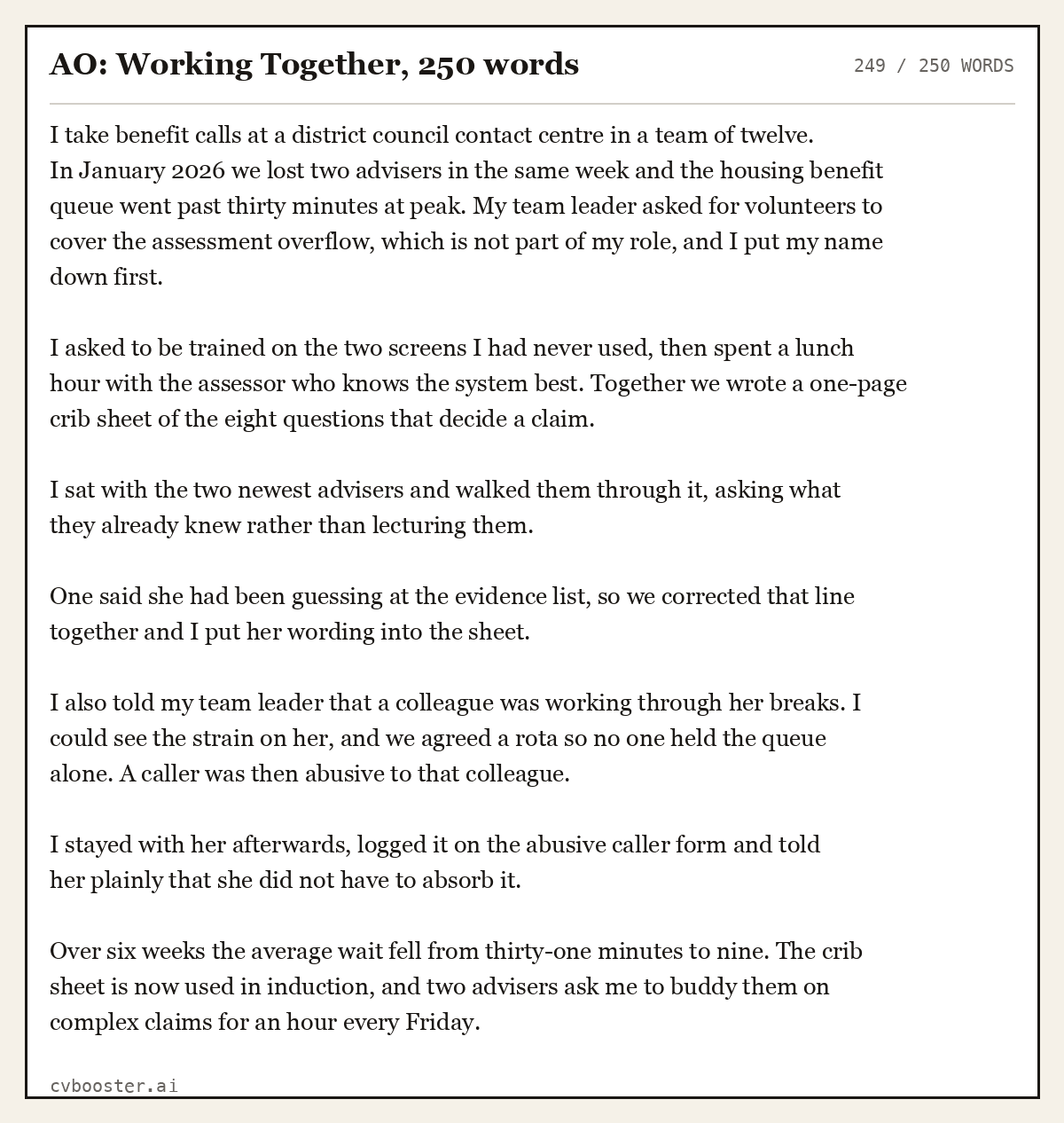
AO: Working Together, 250 words (249 words)
I take benefit calls at a district council contact centre in a team of twelve. In January 2026 we lost two advisers in the same week and the housing benefit queue went past thirty minutes at peak. My team leader asked for volunteers to cover the assessment overflow, which is not part of my role, and I put my name down first.
I asked to be trained on the two screens I had never used, then spent a lunch hour with the assessor who knows the system best. Together we wrote a one-page crib sheet of the eight questions that decide a claim.
I sat with the two newest advisers and walked them through it, asking what they already knew rather than lecturing them.
One said she had been guessing at the evidence list, so we corrected that line together and I put her wording into the sheet.
I also told my team leader that a colleague was working through her breaks. I could see the strain on her, and we agreed a rota so no one held the queue alone. A caller was then abusive to that colleague.
I stayed with her afterwards, logged it on the abusive caller form and told her plainly that she did not have to absorb it.
Over six weeks the average wait fell from thirty-one minutes to nine. The crib sheet is now used in induction, and two advisers ask me to buddy them on complex claims for an hour every Friday.
What the sifter is scoring
- Indicator quoted: "proactively contribute to the work of the whole team and remain open to taking on new and different roles" (gov.uk, AO). Shown by: volunteering first for assessment overflow that is not part of the role.
- Indicator quoted: "listen to alternative perspectives and needs, responding sensitively and checking understanding where necessary" (gov.uk, AO). Shown by: asking the new advisers what they already knew, then correcting the evidence list with the adviser's own wording.
- Indicator quoted: "are aware of the need to consider your own wellbeing and that of your colleagues" (gov.uk, AO). Shown by: raising the missed breaks and agreeing a rota.
- Indicator quoted: "understand that bullying, harassment and discrimination are unacceptable" (gov.uk, AO). Shown by: logging the abusive call and saying plainly that she did not have to absorb it.
Working Together at HEO grade, annotated
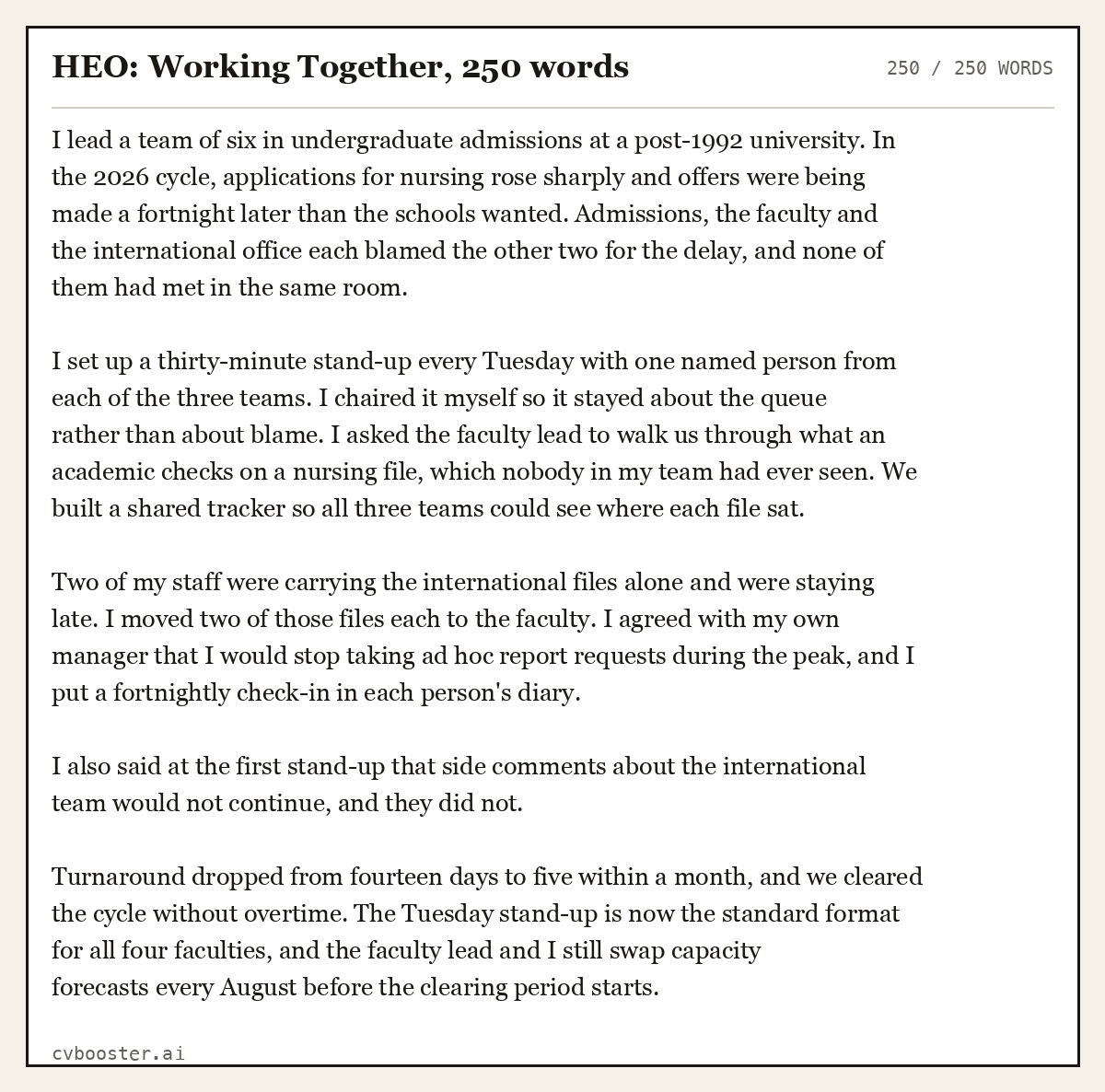
HEO: Working Together, 250 words (250 words)
I lead a team of six in undergraduate admissions at a post-1992 university. In the 2026 cycle, applications for nursing rose sharply and offers were being made a fortnight later than the schools wanted. Admissions, the faculty and the international office each blamed the other two for the delay, and none of them had met in the same room.
I set up a thirty-minute stand-up every Tuesday with one named person from each of the three teams. I chaired it myself so it stayed about the queue rather than about blame. I asked the faculty lead to walk us through what an academic checks on a nursing file, which nobody in my team had ever seen. We built a shared tracker so all three teams could see where each file sat.
Two of my staff were carrying the international files alone and were staying late. I moved two of those files each to the faculty. I agreed with my own manager that I would stop taking ad hoc report requests during the peak, and I put a fortnightly check-in in each person's diary.
I also said at the first stand-up that side comments about the international team would not continue, and they did not.
Turnaround dropped from fourteen days to five within a month, and we cleared the cycle without overtime. The Tuesday stand-up is now the standard format for all four faculties, and the faculty lead and I still swap capacity forecasts every August before the clearing period starts.
What the sifter is scoring
- Indicator quoted: "encourage joined up team work within your own team and across other groups" (gov.uk, HEO/SEO). Shown by: a chaired weekly stand-up with one named person from each of the three teams.
- Indicator quoted: "establish professional relationships with a range of stakeholders" and "collaborate with these to share information, resources and support" (gov.uk, HEO/SEO). Shown by: the shared tracker and the standing August forecast swap with the faculty lead.
- Indicator quoted: "put in place support for the wellbeing of individuals within the team, including consideration of your own needs" (gov.uk, HEO/SEO). Shown by: moving files off two overloaded staff, fortnightly check-ins, and pushing back on ad hoc reporting for myself.
- Indicator quoted: "make it clear to all team members that bullying, harassment and discrimination are unacceptable" (gov.uk, HEO/SEO). Shown by: naming the side comments about the international team at the first stand-up.
Working Together at SEO grade, annotated
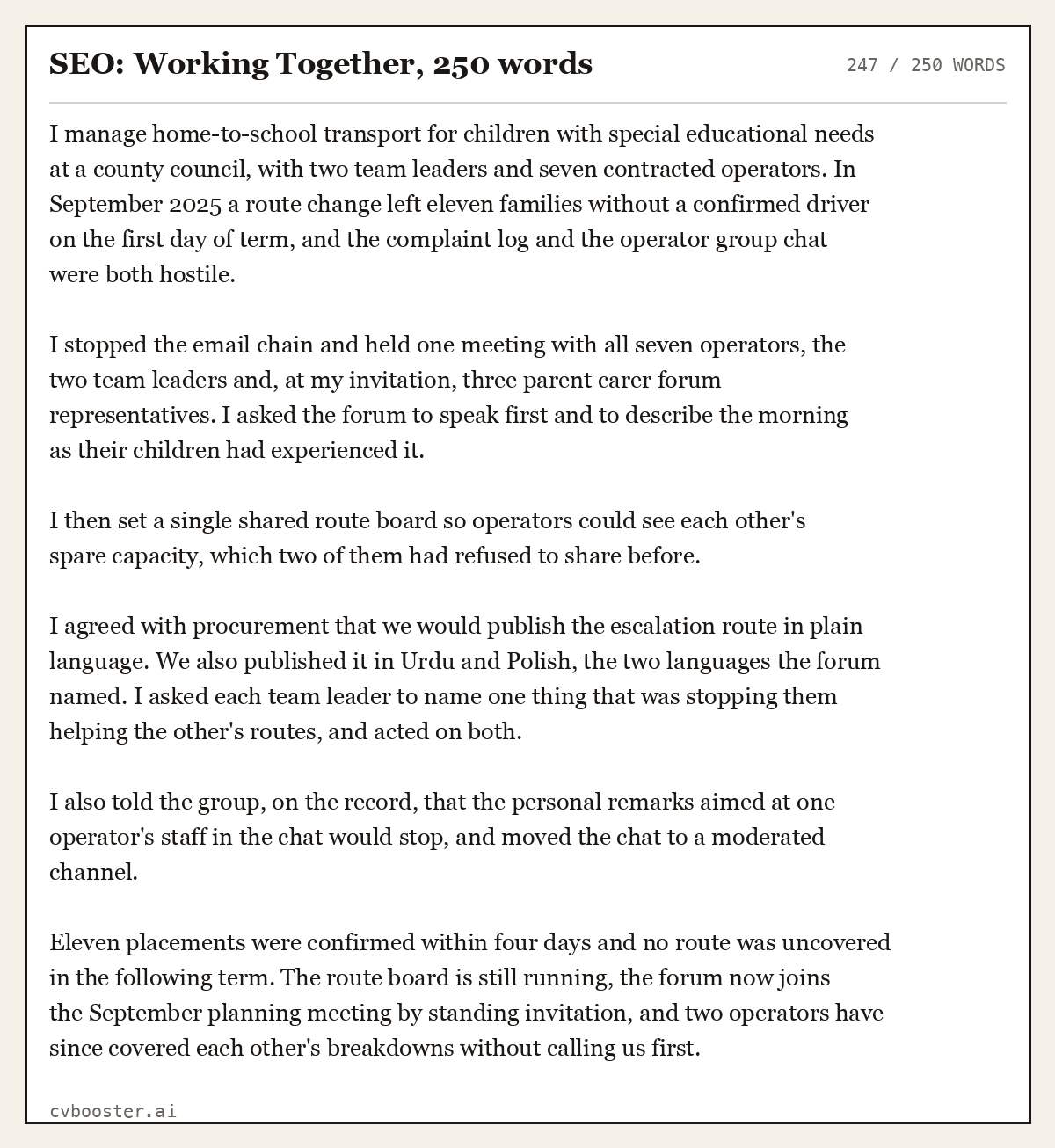
SEO: Working Together, 250 words (247 words)
I manage home-to-school transport for children with special educational needs at a county council, with two team leaders and seven contracted operators. In September 2025 a route change left eleven families without a confirmed driver on the first day of term, and the complaint log and the operator group chat were both hostile.
I stopped the email chain and held one meeting with all seven operators, the two team leaders and, at my invitation, three parent carer forum representatives. I asked the forum to speak first and to describe the morning as their children had experienced it.
I then set a single shared route board so operators could see each other's spare capacity, which two of them had refused to share before.
I agreed with procurement that we would publish the escalation route in plain language. We also published it in Urdu and Polish, the two languages the forum named. I asked each team leader to name one thing that was stopping them helping the other's routes, and acted on both.
I also told the group, on the record, that the personal remarks aimed at one operator's staff in the chat would stop, and moved the chat to a moderated channel.
Eleven placements were confirmed within four days and no route was uncovered in the following term. The route board is still running, the forum now joins the September planning meeting by standing invitation, and two operators have since covered each other's breakdowns without calling us first.
What the sifter is scoring
- Indicator quoted: "actively seek and consider input of people from diverse backgrounds and perspectives" (gov.uk, HEO/SEO). Shown by: inviting the parent carer forum and asking them to speak first, then publishing the escalation route in Urdu and Polish.
- Indicator quoted: "collaborate with these to share information, resources and support" (gov.uk, HEO/SEO). Shown by: the shared route board that made spare operator capacity visible.
- Indicator quoted: "invest time to develop a common focus and genuine positive team spirit where colleagues feel valued and respect one another" (gov.uk, HEO/SEO). Shown by: asking each team leader to name the blocker to helping the other, and acting on both.
- Indicator quoted: "make it clear to all team members that bullying, harassment and discrimination are unacceptable" (gov.uk, HEO/SEO). Shown by: naming the personal remarks on the record and moving the chat to a moderated channel.
Working Together at Grade 7, annotated
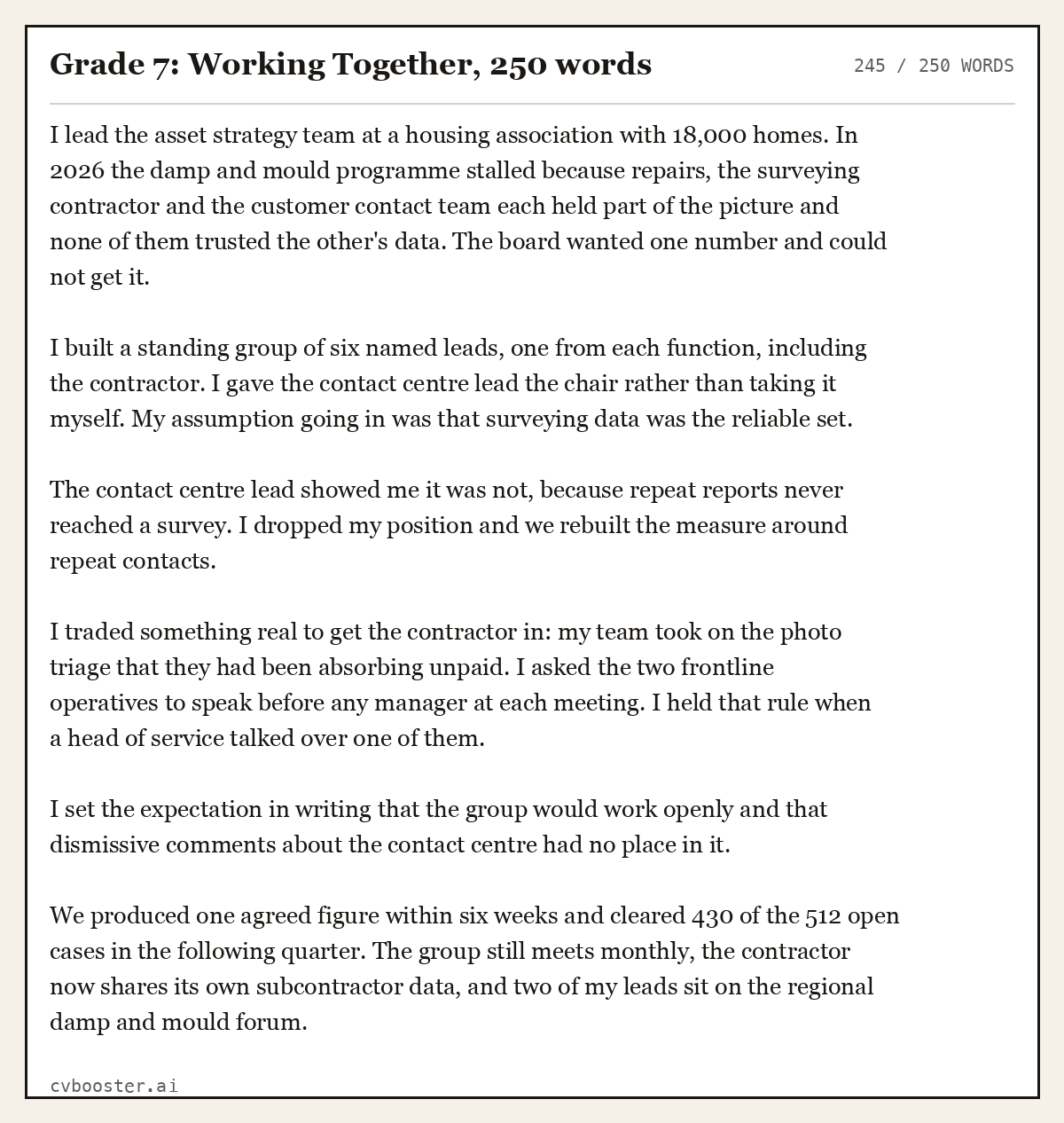
Grade 7: Working Together, 250 words (245 words)
I lead the asset strategy team at a housing association with 18,000 homes. In 2026 the damp and mould programme stalled because repairs, the surveying contractor and the customer contact team each held part of the picture and none of them trusted the other's data. The board wanted one number and could not get it.
I built a standing group of six named leads, one from each function, including the contractor. I gave the contact centre lead the chair rather than taking it myself. My assumption going in was that surveying data was the reliable set.
The contact centre lead showed me it was not, because repeat reports never reached a survey. I dropped my position and we rebuilt the measure around repeat contacts.
I traded something real to get the contractor in: my team took on the photo triage that they had been absorbing unpaid. I asked the two frontline operatives to speak before any manager at each meeting. I held that rule when a head of service talked over one of them.
I set the expectation in writing that the group would work openly and that dismissive comments about the contact centre had no place in it.
We produced one agreed figure within six weeks and cleared 430 of the 512 open cases in the following quarter. The group still meets monthly, the contractor now shares its own subcontractor data, and two of my leads sit on the regional damp and mould forum.
What the sifter is scoring
- Indicator quoted: "actively build and maintain a network of colleagues and contacts to achieve progress on shared objectives" (gov.uk, G6/G7). Shown by: a standing six-function group, and leads placed on the regional forum.
- Indicator quoted: "challenge assumptions while being willing to compromise if beneficial to progress" (gov.uk, G6/G7). Shown by: dropping my own position on surveying data and rebuilding the measure around repeat contacts.
- Indicator quoted: "remain available and approachable to all colleagues and be receptive to new ideas" (gov.uk, G6/G7). Shown by: frontline operatives speaking before managers, and the rule being held when a head of service talked over one.
- Indicator quoted: "create an inclusive working environment where all opinions and challenges are taken into account and bullying, harassment and discrimination are unacceptable" (gov.uk, G6/G7). Shown by: setting the expectation in writing and stopping dismissive comments about the contact centre.
The word budget: 40 / 40 / 120 / 50
All four statements above were built to one split. At a 250-word cap, spend the words like this.
- 40 on the situation: where, when, who else was there
- 40 on the task: what you had to make happen
- 120 on your actions: the verbs belong to you, not the team
- 50 on the result: a number first, then what stuck
Draft the action block before anything else. When it runs over, cut the situation and leave the actions whole.
Tip: count the word "we" in your draft. Every "we" is a sentence that could score for somebody else. Aim for fewer than five.
The marking scale is published by departments, not by gov.uk. The Crown Office and Procurator Fiscal Service sets out all seven points, and calls a 5 "Substantial positive evidence of the behaviour". Substantial means more indicators, each one evidenced.
What changed between the four
The story shape is identical. The scope moves.
| Level | Who you influenced | What you shared | The wellbeing move |
|---|---|---|---|
| AO | Two colleagues and a team leader | A crib sheet | Spotted missed breaks, asked for a rota |
| HEO | Three teams, one faculty | A tracker and a stand-up | Moved work off two staff, protected own time |
| SEO | Seven operators, two team leaders, a parent forum | A route board and a translated escalation route | Removed a blocker each team leader named |
| Grade 7 | Six functions, a contractor, a board | One agreed measure | Traded work in to keep a partner at the table |
At AO you join in. At HEO you convene. At SEO you get people who do not report to you to share a resource. At Grade 7 you give something up to keep a partnership alive. If your Grade 7 draft reads like the HEO one, that is the missing move.
The sentences that cost marks
- Before: We worked well as a team and always supported each other. After: I took two international files off each of the two staff who were staying late. I told my manager I would pause ad hoc reports until the peak ended.
- Before: I have excellent communication and interpersonal skills. After: I asked the faculty lead to walk the group through what an academic checks on a nursing file. Nobody in my team had seen it.
- Before: There was some conflict, but we resolved it. After: I said on the record that the personal remarks aimed at one operator's staff would stop, and moved the chat to a moderated channel.
- Before: We built a shared tracker. After: I built a shared tracker and gave the contact centre lead the chair, because her team held the data mine did not.
- Before: This improved efficiency significantly. After: Turnaround dropped from fourteen days to five within a month and we cleared the cycle without overtime.
- Before: I am a strong team player who thrives in a collaborative environment. After: Delete it. It carries no evidence and costs you 15 of your 250 words.
Before you submit
- Read the advert. It names the grade, and the indicators you write to must be that grade's.
- Count "we". Under five.
- Check you have touched wellbeing and the bullying, harassment and discrimination line. Almost no one does.
- Check one relationship survived past the end of the story. A partnership that ended when the project did is a project story, not this behaviour.
- Say what you shared: information, resources or support. gov.uk names all three in the definition.
- Read it aloud against the clock. If you cannot say it in ninety seconds at interview, it is too dense.
Then do the same for the other behaviours in the advert. Worked statements sit on the pages for Making Effective Decisions, Managing a Quality Service, Delivering at Pace, Communicating and Influencing and Seeing the Big Picture.
The full set, with one sample each, is on the behaviour statement hub. The level tables are in the behaviours framework guide, and the other four elements are in the Success Profiles guide.
Frequently asked questions
What is an example of working together?
A scoring example names three things: a relationship you built, something concrete you shared, and a moment of friction you handled. The AO example above is the simplest form. It volunteers for work outside the role, writes a crib sheet with an assessor, and raises a colleague's missed breaks. A story where everyone agreed from the start is not an example of this behaviour.
What does working together mean in Civil Service?
gov.uk defines it as: "Form effective partnerships and relationships with people both internally and externally, from a range of diverse backgrounds, sharing information, resources and support." Read literally, that is three tests. Partnerships beyond your own team. Difference in who those people are. A transfer of something real.
Every level also expects you to act on wellbeing, and to treat bullying, harassment and discrimination as unacceptable.
Can you give me an example of teamwork experience?
Yes, and the four statements above are complete ones you can model. Teamwork experience counts from anywhere, including volunteering or a hobby. Success Profiles guidance accepts evidence from outside paid work. Three things must be present: your own action in the first person, a named other party, and what changed afterwards for someone else.
Can you provide some examples of a 500-word Civil Service personal statement?
A 500-word personal statement is usually two behaviours at 250 words each. The other common shape is one behaviour plus a suitability paragraph against the essential criteria. Build it from the statements above: take the strongest one at your grade, then add a second behaviour from the advert.
Do not merge them into one narrative, because the sifter scores each behaviour separately on the 1 to 7 scale.
How long should Civil Service behaviour be?
Whatever the advert says, and the advert is the only authority. 250 words per behaviour is the most common cap, with 100 or 750 also used. The box usually enforces the limit, so anything over it is cut mid-sentence.
Write to within ten words of the cap, because under-using the space costs evidence. civil-service-careers.gov.uk confirms the panel "assesses each application against the advertised criteria".
How are behaviours assessed in the Civil Service?
Usually twice: at sift from your written statements, and again at interview. gov.uk also lists situational judgement tests, situational interview questions and "a structured behavioural assessment".
Evidence can come from outside work, including "work experience, volunteering or in connection with a hobby". Each behaviour is scored separately on the 1 to 7 scale.
More in this series: Civil Service applications
- Civil Service Behaviours Framework: All 9, Level by Level
- Civil Service Behaviours: 9 Examples, One Per Behaviour
- Civil Service Judgement Test: 8 Questions and Answers
- Civil Service Success Profiles: the Five Elements, Explained
- Communicating and Influencing: 4 Civil Service Examples
- Delivering at Pace: 4 Civil Service Examples, EO to G7
- Making Effective Decisions: 4 Civil Service Examples
- Managing a Quality Service: 4 Worked Examples, EO to G7
- Seeing the Big Picture Civil Service Example: AO to G7
Related articles
- Civil Service Behaviours Framework: All 9, Level by Level
- Seeing the Big Picture Civil Service Example: AO to G7
- Civil Service Behaviours: 9 Examples, One Per Behaviour
- Civil Service Interview Questions and 15 Full Answers
More articles
- Acting Resume: A Credits Sheet, Not a CV
- How to Address Selection Criteria: 6 Worked STAR Examples
- AI Cover Letters in the UK: What Employers Actually Notice
Looking for a worked example for your job title? Browse the resume examples by job title.