Node.js Developer Resume Examples: the lines they read
Build a Node.js Developer Resume Around Services You Own
By Mustafa Tarabya, founder of CVBooster · Published · Updated
A Node.js developer resume with Express and NestJS examples, event loop and streaming keywords, sample bullets and a full writing guide.
Sample resumes for a node.js developer
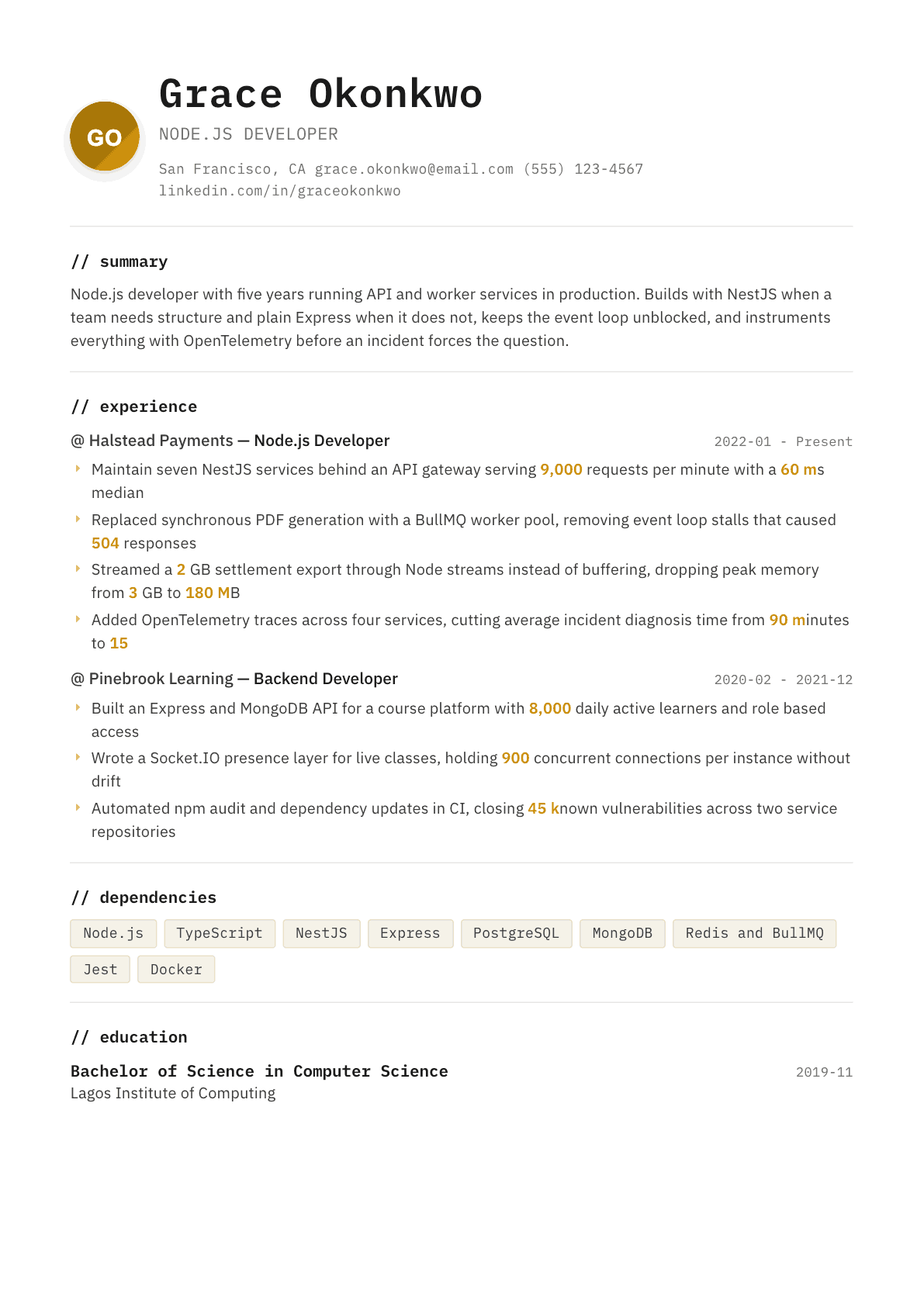
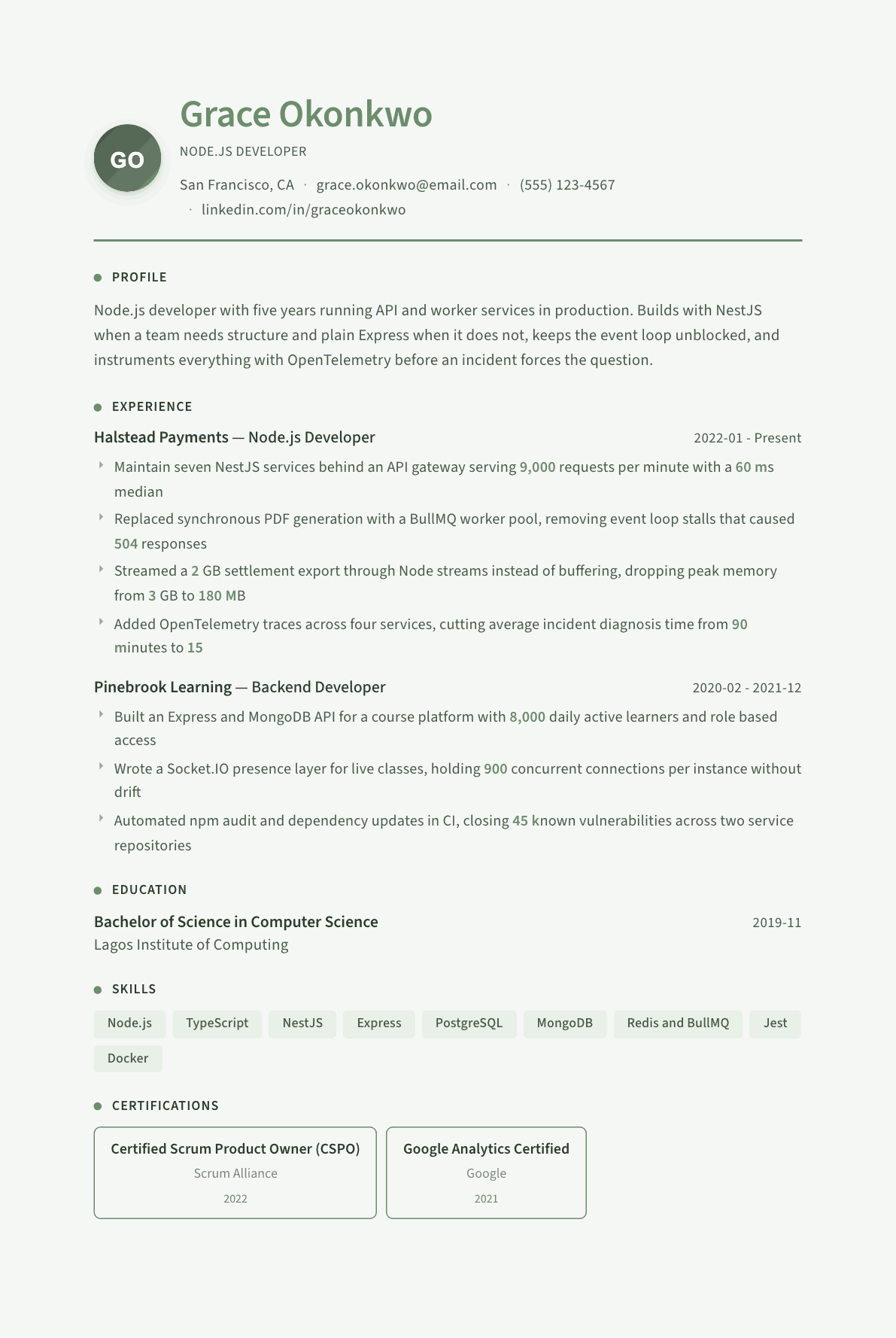
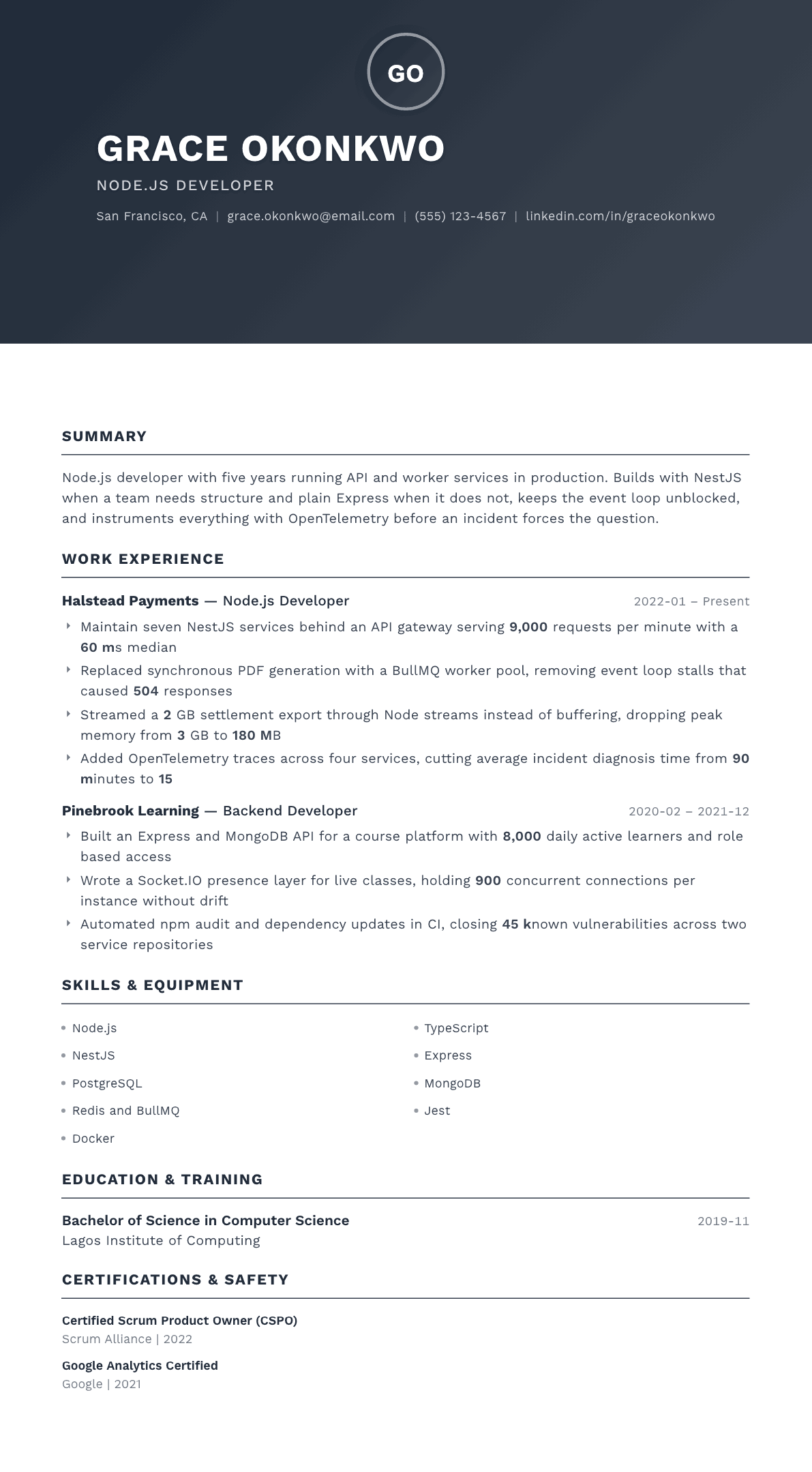
The same node.js developer content laid out in three CVBooster templates, so you can see what the finished document looks like before you write a word.
Example Node.js Developer summary
Node.js developer with five years building and operating API and worker services for payments and education products. Works in TypeScript with NestJS, moves heavy jobs to queues so the event loop stays free, and traces requests end to end with OpenTelemetry. Turned a memory hungry export into a streamed one and took peak usage from gigabytes to megabytes. Seeking a backend role with on call ownership and real traffic.
Skills to list on a Node.js Developer resume
- Node.js
- TypeScript
- Express
- NestJS
- Fastify
- REST API design
- GraphQL
- PostgreSQL
- MongoDB
- Redis
- Message queues
- Jest
- Docker
- CI/CD pipelines
- OpenTelemetry
What actually gets this resume read
- Separate your Node.js server work from any front end work, because backend screens want to see services you operated.
- Name the framework: Express, NestJS, Fastify or Koa, and say which one you chose for a project and why.
- Include one concurrency or memory story, such as a stream, a worker queue or an event loop block you found and fixed.
- List your database drivers and ORM by name, Prisma, TypeORM, Mongoose or raw SQL, since teams screen on that choice.
- Show observability work with the tool: OpenTelemetry, Pino logs or a dashboard, because on call readiness is part of the job.
- Mention package publishing or monorepo tooling if you have done it, as that signals you can share code across services.
How to write a node.js developer resume
A Node.js developer is hired to run services, not to write JavaScript. That distinction decides how the resume should read. The reviewer is a backend lead who wants to know what you have operated: how many services, what traffic they take, what happens when a dependency fails, and whether you were the one paged at three in the morning when it did.
Most Node.js resumes stop short of that. They describe endpoints built and databases used, then go quiet on the parts that make Node distinctive: the single threaded event loop, the memory profile of a process handling large payloads, backpressure in streams, and the queueing you need once a request does real work. Those subjects are where the interview goes, so they belong on the page.
What follows is how to structure the resume, how to write bullets that survive a backend screen, three summaries across career stages, five before and after rewrites, common filtering mistakes, and the questions Node developers ask most.
Format: backend first, front end work kept in its place
One column, reverse chronological, one page under six years. If you also write front end code, keep it to a short line in skills and at most one bullet per job. A Node.js posting is a backend posting, and a resume that reads as full stack will lose to one that reads as a service owner.
Group the skills block by runtime, frameworks, data, messaging, testing and operations. Operations is the group most Node resumes are missing and the one that separates candidates at the senior end.
- Header: name, Node.js developer or backend engineer, city, phone, email, code profile.
- Order: summary, technical skills, experience, education, certifications.
- Each job opens with the service count, the traffic and who depends on it.
Summary: what you run, at what volume, with what discipline
Three or four lines covering years, the domain, the framework, the traffic, and one habit that reads as production maturity. Tracing, structured logging, error budgets or on call rotation all serve that purpose in a handful of words.
Name TypeScript if you use it, because most Node teams now default to it and screen accordingly. If you work in plain JavaScript with strict linting, say that instead of leaving the reader to guess.
Experience: services, throughput, and the failure modes you handled
Start each role by sizing the system: how many services you owned, requests per minute, median and tail latency, and the number of consumers. Then write bullets about the engineering that kept those numbers true.
The strongest material is almost always about concurrency and memory. A synchronous task that blocked the event loop and caused gateway timeouts. A large export buffered in memory that you converted to a stream. A worker queue that took heavy jobs out of the request path. Each of these is a story a backend interviewer will happily spend ten minutes on.
Reserve a bullet for reliability work: retries with backoff, circuit breakers, idempotency keys, graceful shutdown that drains connections, or health checks that actually reflect readiness. These are the details that distinguish someone who has run Node in production from someone who has only built with it.
Data and messaging: name the driver, not just the database
Say which database and which access layer. Prisma, TypeORM, Knex, Mongoose or raw SQL are different working styles, and teams screen on the choice. If you have migrated between them, that is worth a bullet on its own because it usually means you hit a real limitation and understood it.
Messaging deserves the same precision. Redis with BullMQ, RabbitMQ, Kafka or a cloud queue each imply different guarantees. Mention the delivery semantics you designed for, because at least once delivery and the idempotency it forces is a favorite interview topic.
- Frameworks: Express, NestJS, Fastify, Koa, tRPC if you have used it.
- Data: PostgreSQL, MongoDB, Redis, Prisma, TypeORM, Mongoose.
- Messaging: BullMQ, RabbitMQ, Kafka, cloud queues and event buses.
- Operations: Docker, Kubernetes, OpenTelemetry, Pino, health checks, autoscaling.
Testing and packaging: the parts that show team maturity
Give your test stack and what it covers. Unit tests with Jest or Vitest, integration tests against a containerized database, and contract tests between services all say different things. Integration testing against a real database is the detail that most reassures a lead engineer.
If you have published internal packages, run a monorepo, or set up a release process for shared libraries, put it on the page. Node teams accumulate shared code quickly, and someone who has managed that is worth more than someone who has only consumed it.
Node.js Developer resume summary examples
First backend role
Backend developer with a year building Express and MongoDB APIs for an internal booking tool, plus a personal project running in Docker with Jest integration tests. Comfortable with async patterns, JWT authentication and Git based deployment. Looking for a junior Node.js position with mentorship.
Five years in
Node.js developer with five years running API and worker services in payments and education. Maintains seven NestJS services serving 9,000 requests per minute at a 60 ms median, moved report generation onto a BullMQ worker pool, and added tracing that cut incident diagnosis from 90 minutes to 15.
Senior backend engineer
Senior Node.js engineer with nine years and a decade of backend work overall, currently owning a service platform of fourteen deployables and the on call rotation around it. Set the observability standard, introduced contract testing between teams, and mentors four engineers through design review.
Work experience bullets: before and after
Before: Built APIs with Express.
After: Built and maintain seven NestJS services behind an API gateway, serving 9,000 requests per minute at a 60 ms median with contract tests protecting four consumer teams.
Service count, throughput, latency and consumers give the reader the size of what you own.
Before: Fixed performance issues in the application.
After: Traced intermittent 504 responses to synchronous PDF generation blocking the event loop, and moved the work to a BullMQ worker pool that cleared the timeouts entirely.
Naming the event loop and the fix demonstrates the Node specific knowledge the interview will test.
Before: Handled large file exports.
After: Streamed a 2 GB settlement export through Node streams with backpressure instead of buffering it, dropping peak process memory from 3 GB to 180 MB.
The memory figures and the word backpressure prove the mechanism rather than the outcome alone.
Before: Added monitoring to the services.
After: Instrumented four services with OpenTelemetry traces and structured Pino logs correlated by request id, cutting average incident diagnosis time from 90 minutes to 15.
Correlated traces and a diagnosis time show operations experience, not a dashboard screenshot.
Before: Worked with WebSockets for live features.
After: Built a Socket.IO presence layer for live classes holding 900 concurrent connections per instance, with Redis adapter fan out so reconnects survived a rolling deploy.
Connection counts and the reconnect behavior show you designed for the real failure case.
Hard skills
- Node.js runtime and the event loop
- TypeScript
- Express and NestJS
- Fastify
- REST and GraphQL API design
- PostgreSQL and MongoDB
- Prisma, TypeORM and Mongoose
- Redis and BullMQ
- Streams and backpressure
- Jest or Vitest with integration tests
- Docker and Kubernetes
- OpenTelemetry and structured logging
Soft skills
- Owning incidents through to a written follow up
- Designing APIs with the consumer in the room
- Saying no to work that belongs in a queue
- Explaining latency budgets to product managers
- Handing over services with usable documentation
Certifications worth listing
- OpenJS Node.js Application Developer (JSNAD) (OpenJS Foundation)
- OpenJS Node.js Services Developer (JSNSD) (OpenJS Foundation)
- AWS Certified Developer, Associate (Amazon Web Services)
- Certified Kubernetes Application Developer (CKAD) (Cloud Native Computing Foundation)
Mistakes that cost node.js developer candidates the interview
- Presenting Node.js work as front end experience with a server attached, which loses the backend reader in the first paragraph.
- Never mentioning the event loop, streams or queues, the three subjects a Node interview is almost certain to cover.
- Listing a database without the driver or ORM, so the team cannot tell whether you write SQL or generate it.
- Leaving out any operations detail, which reads as someone who has never been on call for what they built.
- Describing microservices when the codebase was one Express application with several route files.
- Naming npm packages instead of engineering decisions, so the bullet describes the ecosystem rather than your work.
Node.js Developer resume questions
Should a Node.js resume mention front end frameworks?
Keep them to the skills block unless the posting is explicitly full stack. A backend lead reading a Node application wants service ownership, and front end detail placed high on the page competes with the evidence they came to find.
How do I show event loop knowledge without sounding theoretical?
Attach it to an incident. Describe the symptom users saw, how you identified the blocking work, and what you moved it to. Theory stated abstractly reads as revision notes; the same knowledge inside a debugging story reads as experience.
Is NestJS worth listing separately from Express?
Yes. They imply different team sizes and conventions, and many postings name one specifically. If you have used both, say which project used which and what drove the choice, since that reasoning is often the interview question.
What do Node.js hiring managers want to see about testing?
Integration tests against a real database or a containerized dependency, plus whatever contract testing exists between services. Unit test coverage alone is weak evidence in a world where most Node bugs live at the boundaries.
How should I describe queue and worker experience?
Name the queue technology, the job types, the volume and the delivery guarantee you designed for. Mentioning idempotency keys or dead letter handling tells an interviewer that you have dealt with duplicate and poison messages in production.
Related resume examples
- Backend Developer Resume example
- Full-Stack Developer Resume example
- JavaScript Developer Resume example
- API Developer Resume example
- Software Engineer Resume example
- Java Developer Resume example