Linux Administrator Resume Examples: what gets the call
Create a Linux Administrator Resume Engineers Actually Respect
By Mustafa Tarabya, founder of CVBooster · Published · Updated
A Linux administrator resume centered on distributions, systemd, Ansible automation and incident work, with a sample resume and a detailed writing guide.
Sample resumes for a linux administrator
The same linux administrator content laid out in three CVBooster templates, so you can see what the finished document looks like before you write a word.
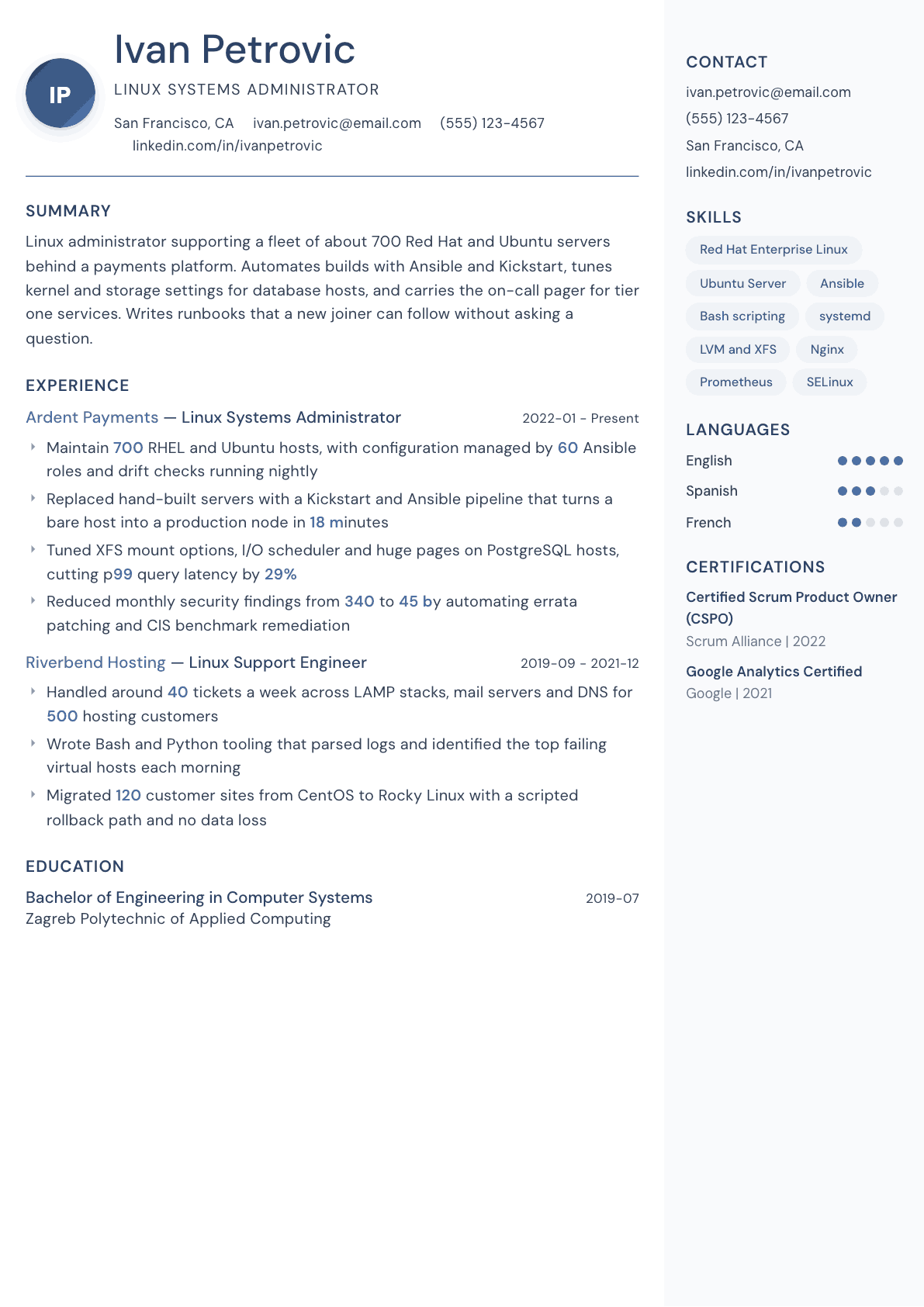
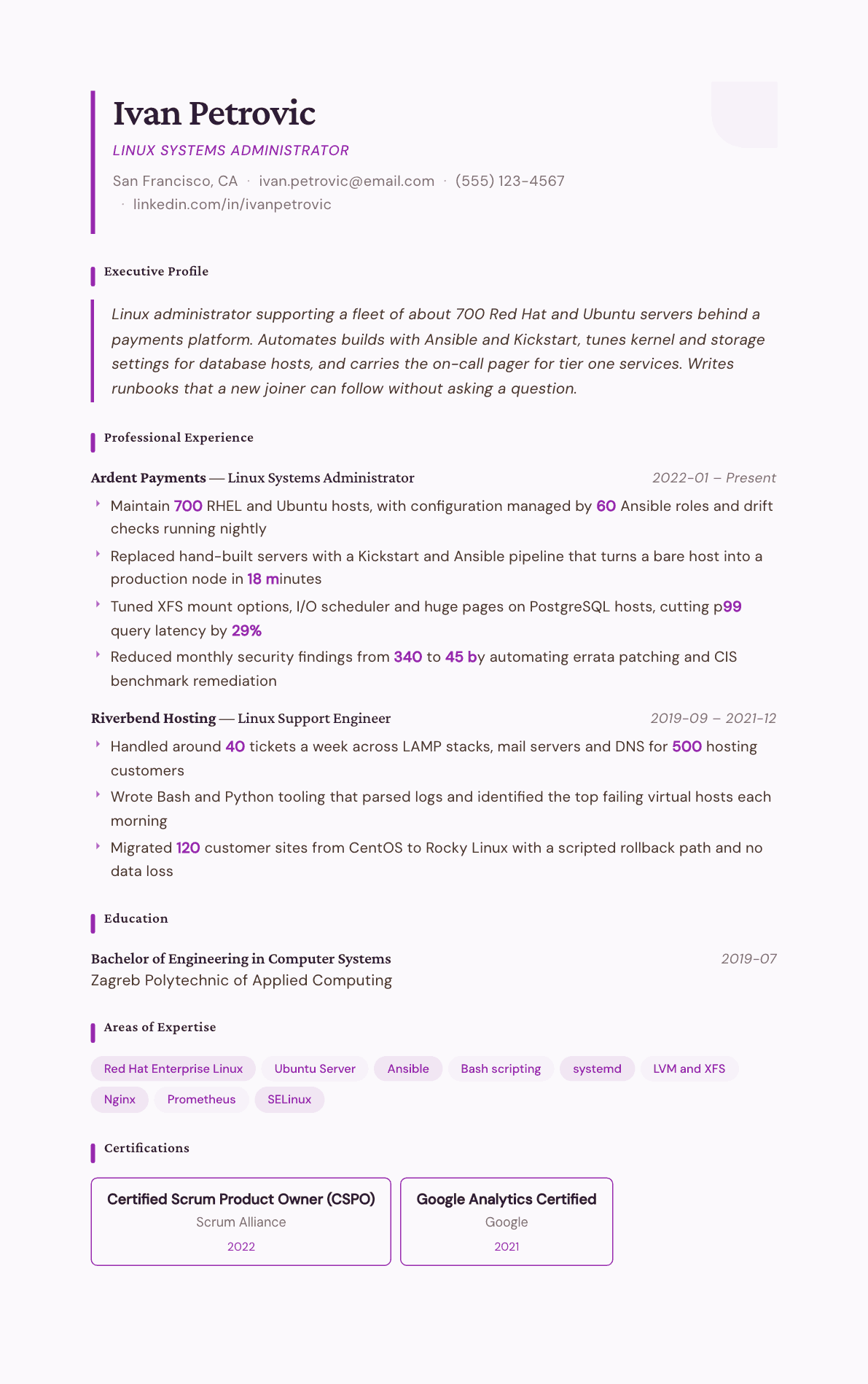
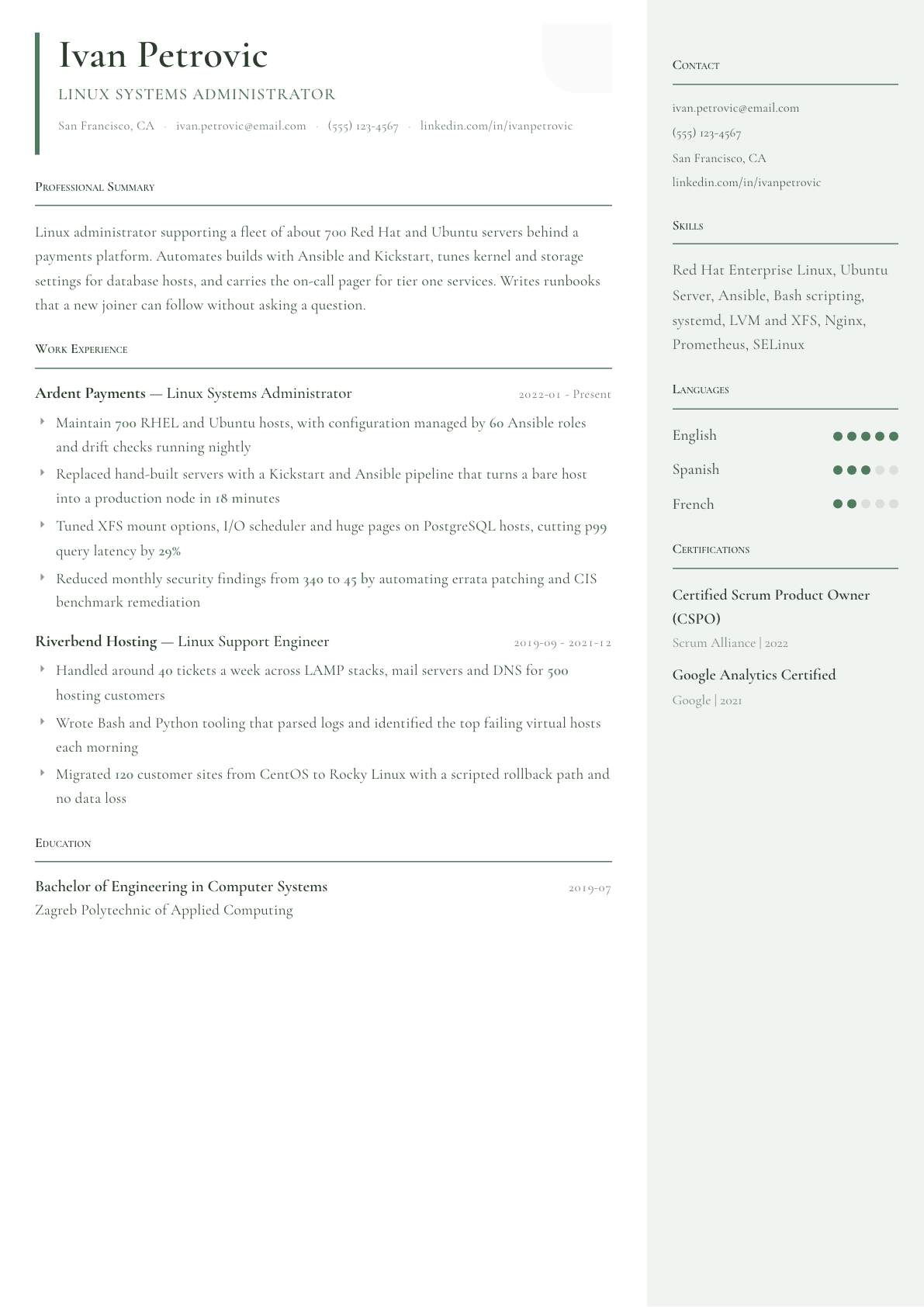
Example Linux Administrator summary
Linux administrator with six years keeping Red Hat and Ubuntu fleets healthy for payment and hosting workloads. Manages roughly 700 hosts through Ansible roles and automated provisioning, tunes storage and kernel parameters for database servers, and cut recurring security findings by more than 80% through automated errata patching. Carries the on-call pager for tier one services and writes runbooks a new administrator can follow unaided.
Skills to list on a Linux Administrator resume
- Red Hat Enterprise Linux
- Ubuntu and Debian
- Bash scripting
- Python scripting
- Ansible
- systemd
- LVM, XFS and ext4
- Networking and iptables
- SELinux hardening
- Nginx and Apache
- Prometheus and Grafana
- Kernel tuning
- RPM and package repositories
- Git and version control
- On-call incident response
What actually gets this resume read
- Name your distributions and their families, since Red Hat shops and Debian shops screen for different package and service habits.
- State the host count you manage and how much of it is under configuration management rather than hand edits.
- Show one deep troubleshooting story in a bullet: the symptom, the tool you reached for, and the root cause you found.
- Put your automation tool front and center, whether Ansible, Puppet or Salt, and say how many roles or manifests you own.
- Include hardening and compliance work by name, such as SELinux policy, CIS benchmarks or STIG remediation.
- Mention on-call scope honestly: rotation size, tier of services covered, and what you changed to reduce paging.
How to write a linux administrator resume
Linux administrator resumes get read by engineers, and engineers test claims. A line that says strong Linux skills will be checked in the first ten minutes of a technical screen with a question about systemd units, disk pressure or a stuck mount. The resume that survives that call is the one that already showed the distribution family, the fleet size, the automation tool and one real troubleshooting story.
The other thing a hiring team looks for is whether your servers are managed or merely maintained. Hand-edited configuration files across two hundred hosts is a very different job from an Ansible-managed fleet with drift detection, and your bullets should make clear which one you have run.
Below is the structure that suits this role, three summaries at different stages, before and after bullets drawn from the phrasing administrators reach for by default, and answers to the questions people ask when they move from support work into full systems ownership.
Format: dense, technical, no decoration
One clean column, reverse-chronological, no graphics and no skill rating bars. Engineers reading these files want density, and a rating bar that says your Bash is at four out of five communicates nothing that a bullet about a real script could not say better.
Add a compact environment block under the summary: distributions, automation, virtualization or cloud, monitoring, storage and languages. Keep it to five or six lines so the reader can scan the stack in seconds.
- Header: name, title, location, email, and a link to a public repository if the code there is worth reading.
- Order: summary, environment, experience, certifications, education, projects.
- Name distributions by family, for example Red Hat and Debian based, so a reader can map your habits to their fleet.
Summary: fleet size, distribution family, automation posture
Three lines that answer how many hosts, running what, managed how. A summary that says experienced Linux professional with a passion for open source is doing none of that work.
If you have on-call experience for production services, say so here. Willingness to carry a pager for tier one systems changes how a hiring manager reads the rest of the page.
Experience: provisioning, troubleshooting, hardening
Start each role with the fleet: host count, distributions, workloads and whether the machines are bare metal, virtual or cloud instances. Then use bullets to cover the three areas every interviewer probes. How new hosts are built, how you diagnosed something hard, and how the fleet is kept secure.
The troubleshooting bullet is where most candidates lose ground. Instead of resolved performance issues, name the symptom, the tool and the cause. A line about tracing a latency spike to an I/O scheduler choice, or to memory pressure from an unbounded cache, tells a reader far more than any adjective.
Hardening deserves specifics too: SELinux in enforcing mode, CIS benchmark remediation, SSH policy, package repository control, or the size of the vulnerability backlog you closed.
- Provisioning: the build pipeline, from bare host to production node, and how long it takes.
- Automation: the tool, the number of roles or manifests, and whether drift is detected automatically.
- Reliability: on-call rotation, incident volume, and one change that reduced paging.
Skills: name the layer, not just the logo
A useful skills section is grouped by layer: operating system and kernel, storage and filesystems, networking, automation and configuration, observability, and languages. This ordering matches how an interviewer builds their questions and makes your depth obvious.
Include the filesystem and volume tooling you have used under pressure, such as LVM, XFS, ZFS or software RAID. Storage is where quiet Linux experience shows, and few candidates mention it.
Keywords worth mirroring exactly
Postings for this role repeat a predictable vocabulary: Red Hat Enterprise Linux, Ubuntu, systemd, Bash, Ansible, Kubernetes, Nginx, Apache, iptables or nftables, SELinux, Prometheus, Git and patch management. Use the posting phrasing once in the environment block and once inside a bullet where the claim is backed by a number or an outcome.
Linux Administrator resume summary examples
First administrator role
Support engineer with two years on Ubuntu and CentOS web hosting, handling around 40 tickets a week across Apache, MySQL and DNS. Writes Bash tooling for log triage and has rebuilt a personal lab of eight virtual machines with automated provisioning. Studying for a Red Hat administrator credential.
Five years in
Linux administrator maintaining 500 Red Hat and Ubuntu hosts behind a retail platform, with configuration in 45 Ansible roles and nightly drift checks. Tuned storage and kernel parameters on database servers to cut p99 latency by 29%, and reduced monthly security findings by more than 80% through automated errata patching.
Senior or lead
Senior Linux administrator with nine years across payments and hosting infrastructure, currently responsible for a 700 host fleet and its provisioning pipeline. Owns the hardening baseline, the on-call rotation for tier one services, and the runbook library. Mentors two administrators and reviews all infrastructure changes.
Work experience bullets: before and after
Before: Managed Linux servers in a production environment.
After: Maintained 700 Red Hat and Ubuntu hosts across two regions, with configuration held in 60 Ansible roles and drift reports generated nightly.
Fleet size plus the automation posture tells the reader what kind of operation you have actually run.
Before: Built new servers as needed.
After: Replaced hand-built servers with a Kickstart and Ansible pipeline that turns a bare host into a production node in 18 minutes with no manual steps.
A named pipeline and a build time prove repeatability, which is the whole point of provisioning work.
Before: Resolved performance issues on database servers.
After: Traced p99 query latency to filesystem mount options and the I/O scheduler, then tuned XFS and huge pages to cut latency 29% without adding hardware.
The symptom, the diagnosis and the fix show real troubleshooting instead of a generic claim.
Before: Applied security patches regularly.
After: Automated errata patching and CIS benchmark remediation, taking monthly vulnerability findings from 340 down to 45 across the fleet.
A before and after count turns routine patching into a visible reduction in risk.
Before: Wrote scripts to help the team.
After: Wrote a Bash and Python log triage tool that ranks failing virtual hosts each morning, cutting the daily review from 45 minutes to under 5.
Naming what the tool decides and the time recovered makes the automation concrete.
Hard skills
- Red Hat Enterprise Linux
- Ubuntu and Debian
- systemd unit management
- Bash scripting
- Python scripting
- Ansible
- LVM, XFS and filesystem tuning
- Networking, iptables and nftables
- SELinux and hardening baselines
- Nginx and Apache
- Prometheus and Grafana
- Kernel parameter tuning
- RPM and repository management
- Git and change review
Soft skills
- Methodical troubleshooting
- Runbook writing
- On-call composure
- Peer review of infrastructure changes
- Mentoring junior administrators
- Communicating risk before a change window
Certifications worth listing
- Red Hat Certified System Administrator (Red Hat)
- Red Hat Certified Engineer (Red Hat)
- Linux Foundation Certified System Administrator (The Linux Foundation)
- CompTIA Linux+ (CompTIA)
Mistakes that cost linux administrator candidates the interview
- Writing strong Linux skills instead of naming the distributions, the fleet size and the tooling that manages it.
- Hiding automation work, which leaves the impression that every host was configured by hand over an SSH session.
- Skipping storage and filesystem experience, one of the few areas that separates deep administrators from casual ones.
- Using skill rating bars, which engineers ignore at best and treat as padding at worst.
- Describing incidents without a root cause, so the reader cannot tell whether you fixed the problem or restarted the service.
- Listing container tooling as the headline when the role you want is fleet and operating system ownership.
Linux Administrator resume questions
Should a Linux administrator resume mention specific distribution versions?
Mention the family and the major release generation rather than exact point releases. Employers care whether you work in a Red Hat or Debian style environment, because package tooling, service defaults and support habits differ enough to affect the first weeks on the job.
How do I show troubleshooting depth on paper?
Pick one incident per role and compress it into a bullet with three parts: what users saw, which tool exposed the cause, and what you changed. That structure reads as evidence, while a claim about excellent troubleshooting skills reads as filler.
Is Kubernetes experience expected in this role now?
It helps but rarely replaces the core. Most postings still center on fleet management, storage, networking and hardening, with container platforms as an adjacent responsibility. Mention your container work honestly and keep operating system depth as the spine of the resume.
Do I need Red Hat certification to get interviews?
It is not mandatory, though it is a common filter for enterprise and government employers because the exam is hands on. If your experience is mainly Debian based and you want enterprise roles, the credential is one of the faster ways to clear the screening stage.
How should I present on-call experience?
State the rotation shape, the tier of services covered and the volume of pages you handled, then add what you changed to reduce them. Employers read pager reduction as maturity, since it shows you address causes rather than absorbing repeated interruptions.
Related resume examples
- DevOps Engineer Resume example
- Site Reliability Engineer Resume example
- System Administrator Resume example
- Kubernetes Engineer Resume example
- Database Administrator Resume example
- Infrastructure Engineer Resume example