Licensed Clinical Social Worker Resume Examples: free
Craft a Licensed Clinical Social Worker Resume That Shows Clinical Depth
By Mustafa Tarabya, founder of CVBooster · Published · Updated
An LCSW resume guide covering licensure placement, modality keywords, caseload detail, supervision experience, and a full clinical sample.
Sample resumes for a licensed clinical social worker
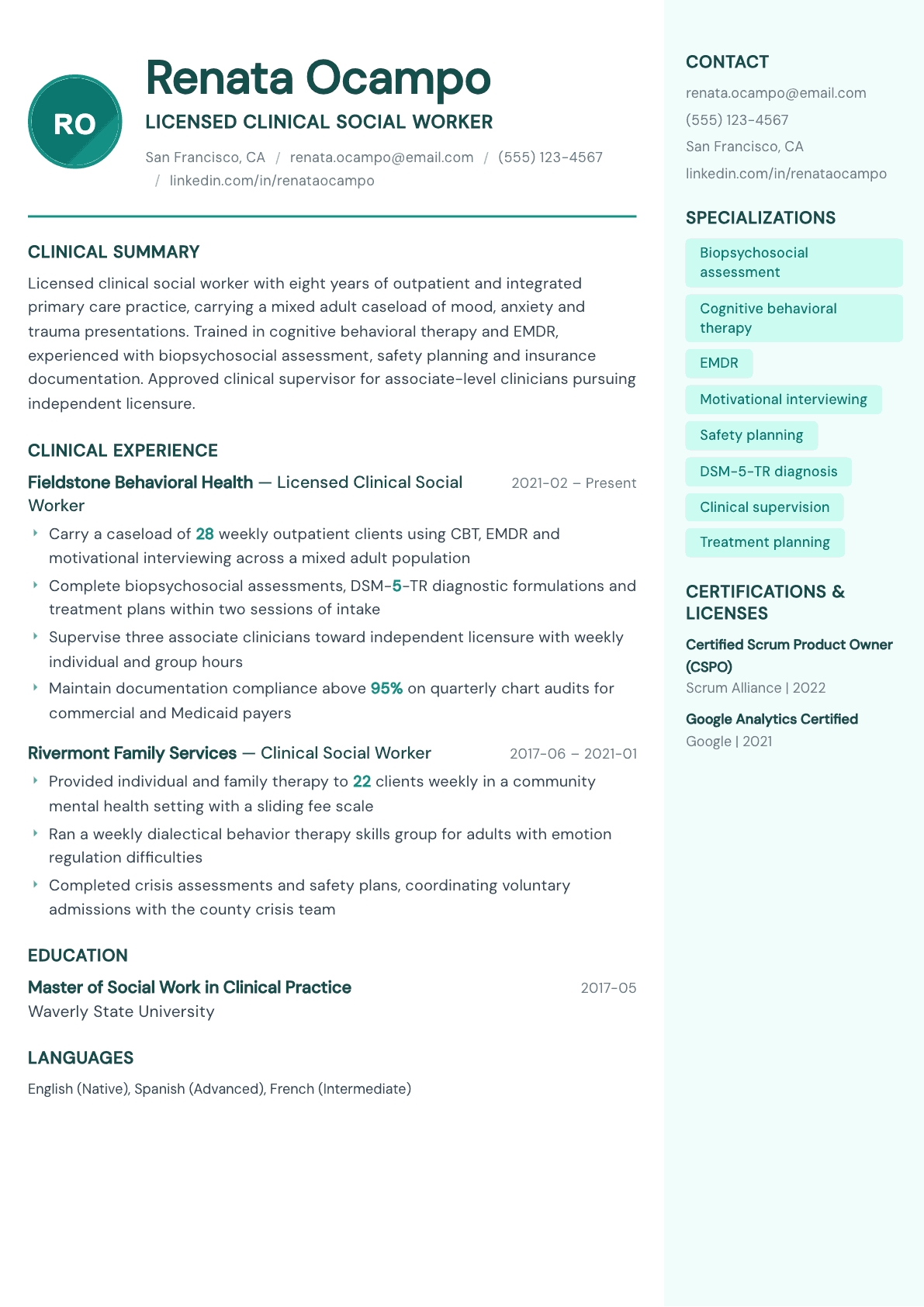
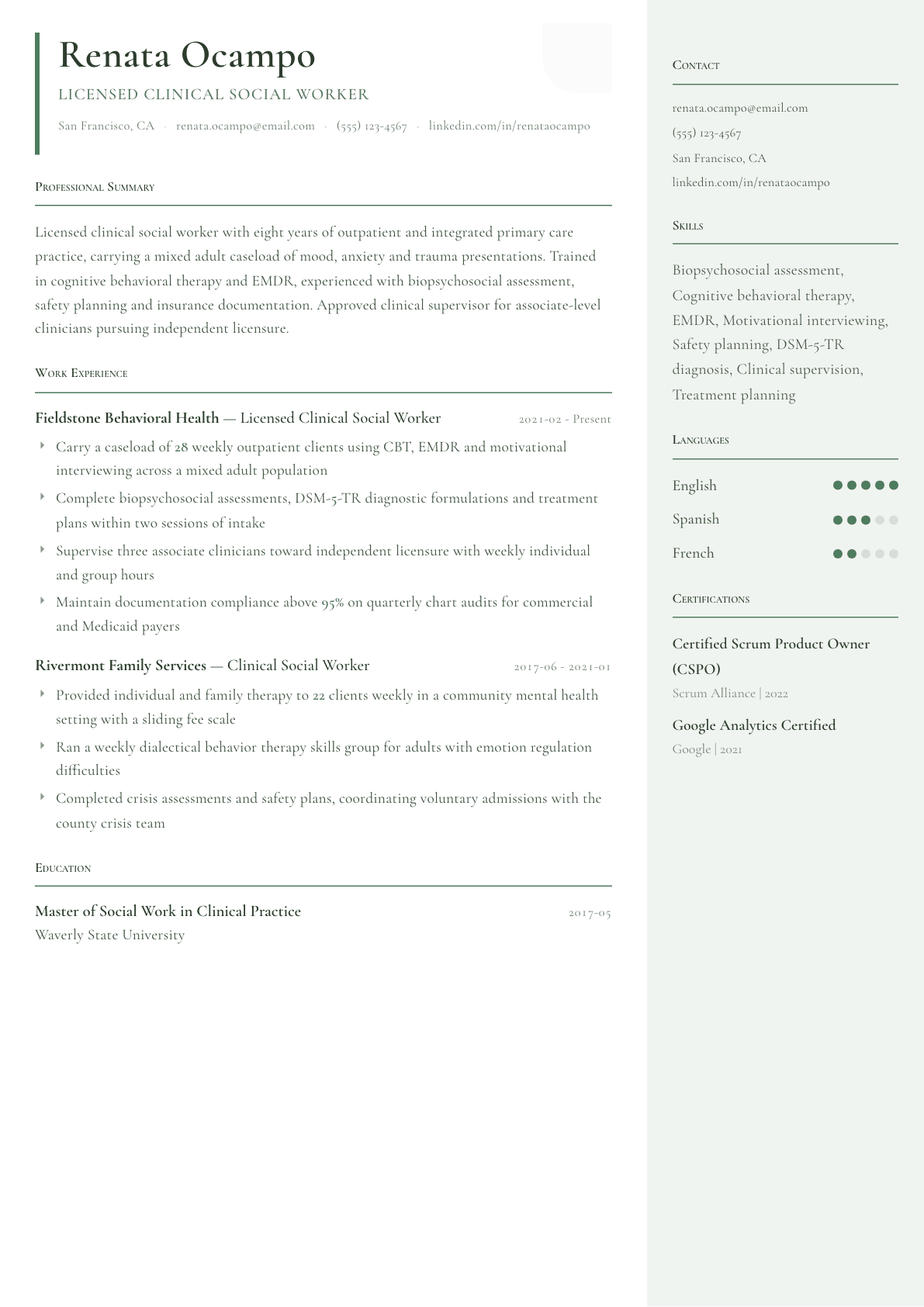
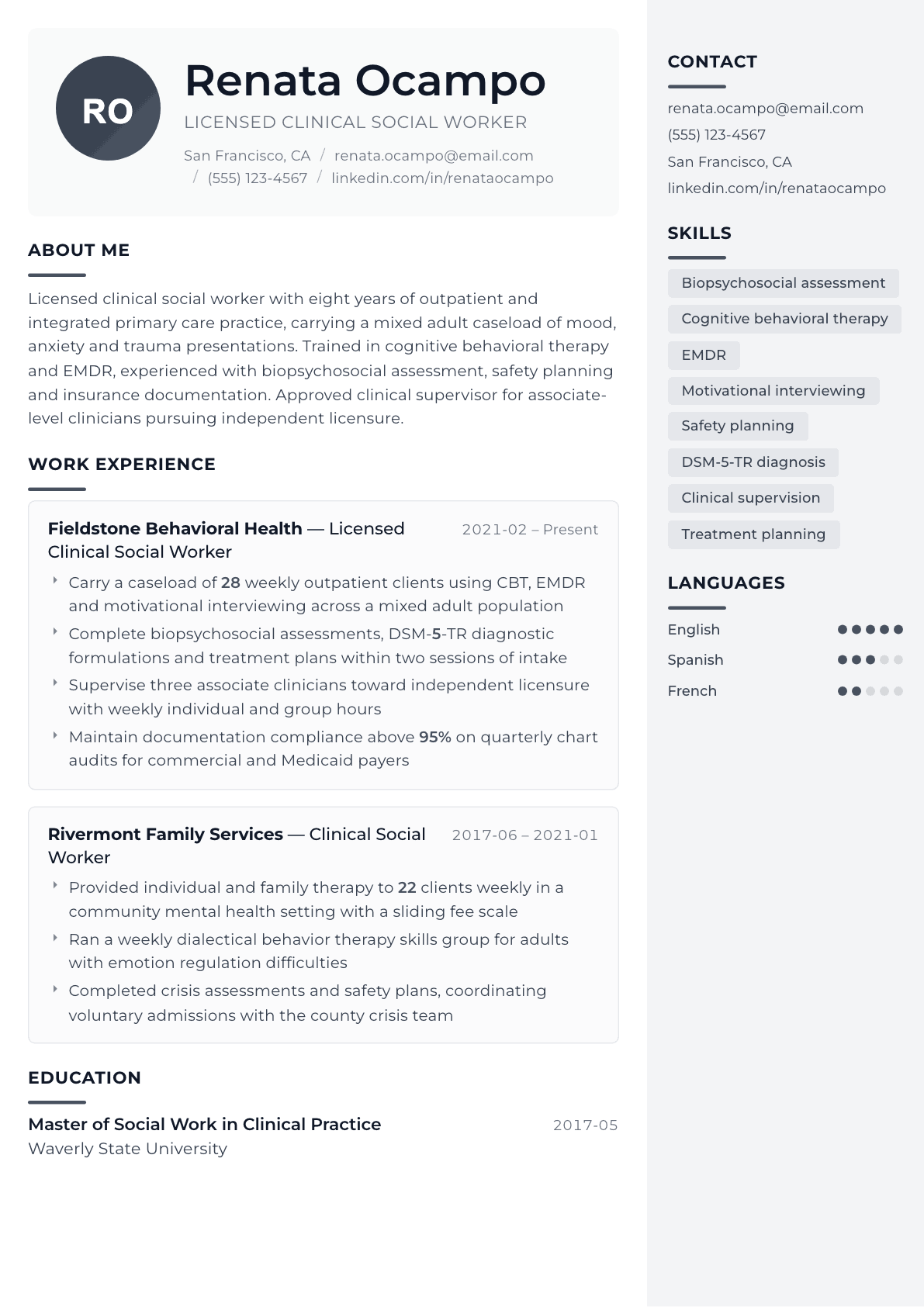
The same licensed clinical social worker content laid out in three CVBooster templates, so you can see what the finished document looks like before you write a word.
Example Licensed Clinical Social Worker summary
Licensed clinical social worker with eight years of outpatient practice treating adults with depression, anxiety and post-traumatic stress. Trained in cognitive behavioral therapy and EMDR, with steady experience in risk assessment, safety planning and payer documentation. Approved supervisor for pre-licensure clinicians and comfortable working inside an integrated primary care team. Seeking a clinical role with a caseload that supports depth rather than volume.
Skills to list on a Licensed Clinical Social Worker resume
- Biopsychosocial assessment
- Cognitive behavioral therapy
- Dialectical behavior therapy skills
- EMDR
- Motivational interviewing
- Trauma-informed care
- DSM-5-TR diagnosis
- Treatment planning
- Risk and safety assessment
- Clinical supervision
- Group therapy facilitation
- Case consultation
- Electronic health record documentation
- Discharge and aftercare planning
What actually gets this resume read
- Put the license type, state and number line in the header so credentialing staff can verify you immediately.
- Name the modalities you actually practice and the training that backs each one, not a list of buzzwords.
- Give caseload size, session frequency and the population you served in every clinical position you list.
- Say whether you are an approved supervisor, because agencies hiring for associate oversight filter on it.
- Include the electronic health record you charted in and your audit or documentation compliance record.
- Separate licensure, clinical training and continuing education so a reviewer is not hunting through paragraphs.
How to write a licensed clinical social worker resume
A licensed clinical social worker resume passes through three sets of hands, and each set stops at a different line. Credentialing checks the license number, the state and the expiration. The clinical director reads the modalities and the populations to decide whether you can take the referrals sitting in the queue. Billing quietly checks whether you can be paneled with the payers that keep the practice open. A resume that only sings about compassion satisfies none of them.
What makes an LCSW resume convincing is precision about clinical work. Not therapy in general, but the presentations you treat, the assessments you complete, the interventions you were trained in and by whom, the risk situations you have managed, and the documentation standard you held. Independent licensure means you practice without supervision, so the page has to show the judgment that autonomy assumes.
This guide walks the sections in the order a clinical director reads them, gives three summaries from associate level through supervisor, and rewrites the bullets that clinicians most often write as job descriptions instead of evidence.
Format: licensure line first, then clinical history
One page is possible early, two pages is normal once you have supervision, group work and multiple settings. Reverse-chronological order throughout. Directly under your name, put your credential string and a licensure line with the license type, the state and the status. If you hold licensure in more than one state or through an interstate arrangement, say so, because telehealth practices screen on it.
Keep clinical training in its own block rather than scattering it through the experience section. A director who is deciding whether you can take trauma referrals should not have to read three jobs to discover you completed EMDR training.
- Header: name and credential string, location, phone, email, then the license type and issuing state.
- Order: summary, licensure, clinical training and modalities, clinical experience, supervision, education, professional memberships.
- Note telehealth platform experience if you have carried a virtual caseload, since many practices run a hybrid schedule.
Summary: population, setting, modality, and what you can hold
Three sentences at most. Name the years since independent licensure, the population you treat, the setting you treat them in, the two or three modalities you actually practice, and whether you supervise. A clinician who says they treat adults with mood, anxiety and trauma presentations in an outpatient practice using cognitive behavioral therapy and EMDR has told a director exactly which referrals to route.
Avoid the phrase eclectic approach. It reads as an unwillingness to commit, and a director cannot match a referral to it. If you genuinely integrate, name the frames you integrate from and the presentations where you use each.
Clinical experience: caseload, presentations, and the hard cases
Open each position with the setting and the caseload before the bullets. Weekly session count, the population by age and presentation, and the payer mix if it shaped the work. Twenty-eight weekly outpatient clients on a mixed commercial and Medicaid panel is a different job from twelve sessions a week in an employee assistance contract, and both are real clinical jobs.
Then write bullets around the clinical decisions. Biopsychosocial assessment and diagnostic formulation, treatment planning with measurable goals, outcome measures you administered, risk assessment and safety planning, coordination with prescribers, and the transitions you managed when a client needed a higher level of care. These are the moments where independent judgment shows.
Include the difficult territory rather than avoiding it. Managing suicidal ideation without hospitalizing reflexively, holding a client through a psychiatric admission and back, working with mandated clients, and navigating a court subpoena are all things directors have to trust you with.
- Give weekly caseload and session volume, not a vague description of a full schedule.
- Name the outcome measures you used, such as PHQ-9, GAD-7 or the Columbia risk screener.
- Show coordination: prescribers, primary care, schools, probation, higher levels of care.
- State documentation performance if you have audit results, because payers audit and directors remember.
Supervision and teaching: the section that changes your value
If you are an approved supervisor, that belongs high on the page with the number of associates you have carried, the hours you provided, and whether the supervision was individual, group or both. Agencies with pre-licensure staff are constantly short of approved supervisors, and that single credential can move you from one interview to four.
Field instruction for graduate interns counts too. Name the school, the number of students, and the evaluation process you ran. Teaching, case consultation and clinical training you delivered to a team belong in the same block.
Keywords clinical directors and payers screen on
The recurring vocabulary is narrower than it looks: biopsychosocial assessment, diagnostic formulation, treatment plan, evidence-based practice, trauma-informed care, risk assessment, safety planning, crisis intervention, discharge planning, care coordination, clinical supervision and utilization review. Mirror the exact phrases the posting uses once in the skills block and once inside a bullet.
Add the electronic health record you charted in. A director estimating onboarding time reads that line and adjusts the start date in their head.
Licensed Clinical Social Worker resume summary examples
Newly independent
Clinical social worker newly licensed for independent practice after completing supervised hours in community mental health. Carries a mixed adult caseload treating depression, anxiety and adjustment presentations with cognitive behavioral therapy and motivational interviewing. Experienced with intake assessment, safety planning and Medicaid documentation standards. Seeking an outpatient position with strong case consultation.
Five years post-licensure
Licensed clinical social worker with five years of outpatient practice treating adults with post-traumatic stress, panic and complicated grief. Trained in EMDR and cognitive processing therapy, administers PHQ-9 and GAD-7 at intervals, and holds documentation compliance above 95% on payer audits. Ready to take on trauma-specific referrals in a group practice.
Approved supervisor
Approved clinical supervisor and LCSW with eleven years across community mental health and integrated primary care. Carries a reduced direct caseload while supervising six associates toward independent licensure, leading weekly group consultation and running the intake triage protocol. Experienced with high-risk cases, court testimony and program-level quality review.
Work experience bullets: before and after
Before: Provided individual therapy to clients with mental health issues.
After: Carried a weekly caseload of 28 adult outpatient clients presenting with major depression, generalized anxiety and post-traumatic stress, using cognitive behavioral therapy, EMDR and motivational interviewing.
Caseload size, named presentations and named modalities let a director route referrals to you instead of guessing.
Before: Completed assessments and treatment plans.
After: Completed biopsychosocial assessments with DSM-5-TR diagnostic formulations and measurable treatment plans within two sessions of intake, updating goals at each 90-day review.
The instrument, the timeline and the review cycle show a documented clinical process rather than a task list.
Before: Handled crisis situations when they came up.
After: Assessed suicide risk using a structured screener, built collaborative safety plans with means restriction and support contacts, and coordinated three voluntary admissions with the county crisis team.
Naming the screening method, the safety plan components and the coordination proves risk competence that a director must verify.
Before: Supervised newer staff.
After: Provided weekly individual and biweekly group supervision to three associate clinicians accruing hours toward independent licensure, with written competency evaluations each quarter.
Supervision format, frequency and evaluation practice turn a vague claim into a credential a hiring agency can use.
Before: Kept good records and met deadlines.
After: Maintained note completion within 48 hours of session and passed four consecutive quarterly chart audits for commercial and Medicaid payers with no corrective action.
A turnaround standard and an audit result speak to the compliance risk the practice is actually worried about.
Hard skills
- Biopsychosocial assessment
- DSM-5-TR diagnostic formulation
- Cognitive behavioral therapy
- Dialectical behavior therapy skills
- EMDR
- Motivational interviewing
- Trauma-focused treatment
- Suicide risk assessment
- Safety planning
- Treatment planning and goal measurement
- Group therapy facilitation
- Clinical supervision
- Care coordination with prescribers
- Electronic health record documentation
Soft skills
- Therapeutic alliance building
- Boundary setting
- Tolerance for clinical ambiguity
- Consultation seeking
- Cultural humility
- Self-management of vicarious trauma
Certifications worth listing
- Licensed Clinical Social Worker (LCSW) (State social work licensing board)
- Academy of Certified Social Workers (ACSW) (National Association of Social Workers)
- EMDR Certified Therapist (EMDR International Association)
- Approved Clinical Supervisor (ACS) (Center for Credentialing and Education)
- Certified Clinical Alcohol, Tobacco and Other Drugs Social Worker (C-CATODSW) (National Association of Social Workers)
Mistakes that cost licensed clinical social worker candidates the interview
- Burying the license type and state at the bottom, which stalls the file at credentialing before a clinician ever reads it.
- Listing a dozen modalities you have only read about, which collapses in an interview when someone asks how you would sequence a session.
- Describing therapy generically instead of naming presentations, so a director cannot match you to the referrals waiting.
- Leaving out risk work entirely, when managing suicidality and higher levels of care is the competence an employer must confirm.
- Omitting approved supervisor status, which is often the single most marketable credential an experienced clinician holds.
- Writing client stories with identifying detail, which signals a confidentiality problem to anyone who has done compliance work.
Licensed Clinical Social Worker resume questions
Should I put my license number on my resume?
Put the license type, state and status on the resume and leave the full number for the application or credentialing packet. Most boards publish license verification anyway, so the number adds little on the page while creating an unnecessary copy of your identifiers.
How do I list therapy modalities without overstating my training?
Separate completed formal training from familiarity. Name the modality, the training provider and whether you completed consultation hours or certification. A short honest list with real training behind it interviews far better than a long list you cannot defend clinically.
What belongs on an LCSW resume moving from agency work to private practice?
Lead with the payer panels you have been credentialed with, your caseload sustained over time, no-show management and documentation compliance. Group practices are hiring a clinician who can fill and hold a schedule, so business steadiness matters alongside clinical skill.
How much detail should I give about client populations?
Enough to route a referral and no more. Age range, presentation categories and level of acuity are appropriate. Individual case descriptions, unusual diagnoses paired with settings, or anything that could identify a person do not belong on a document that circulates.
Do I need a separate section for continuing education?
Only list continuing education that changes what you can treat or supervise. A short block of substantive trainings with providers and hours is useful. A list of every workshop you attended for renewal credit dilutes the page and tells a director nothing new about your practice.
Related resume examples
- Social Worker Resume example
- Case Manager Resume example
- Psychotherapist Resume example
- Behavioral Health Counselor Resume example
- Psychology Intern Resume example
- Psychologist Resume example