Psychology Intern Resume Examples: the lines they read
Build a Psychology Intern Resume From Practicum Hours
By Mustafa Tarabya, founder of CVBooster · Published · Updated
A psychology intern resume guide covering practicum hours, assessment batteries, supervision and research, with examples and keywords that match match sites.
Sample resumes for a psychology intern
The same psychology intern content laid out in three CVBooster templates, so you can see what the finished document looks like before you write a word.
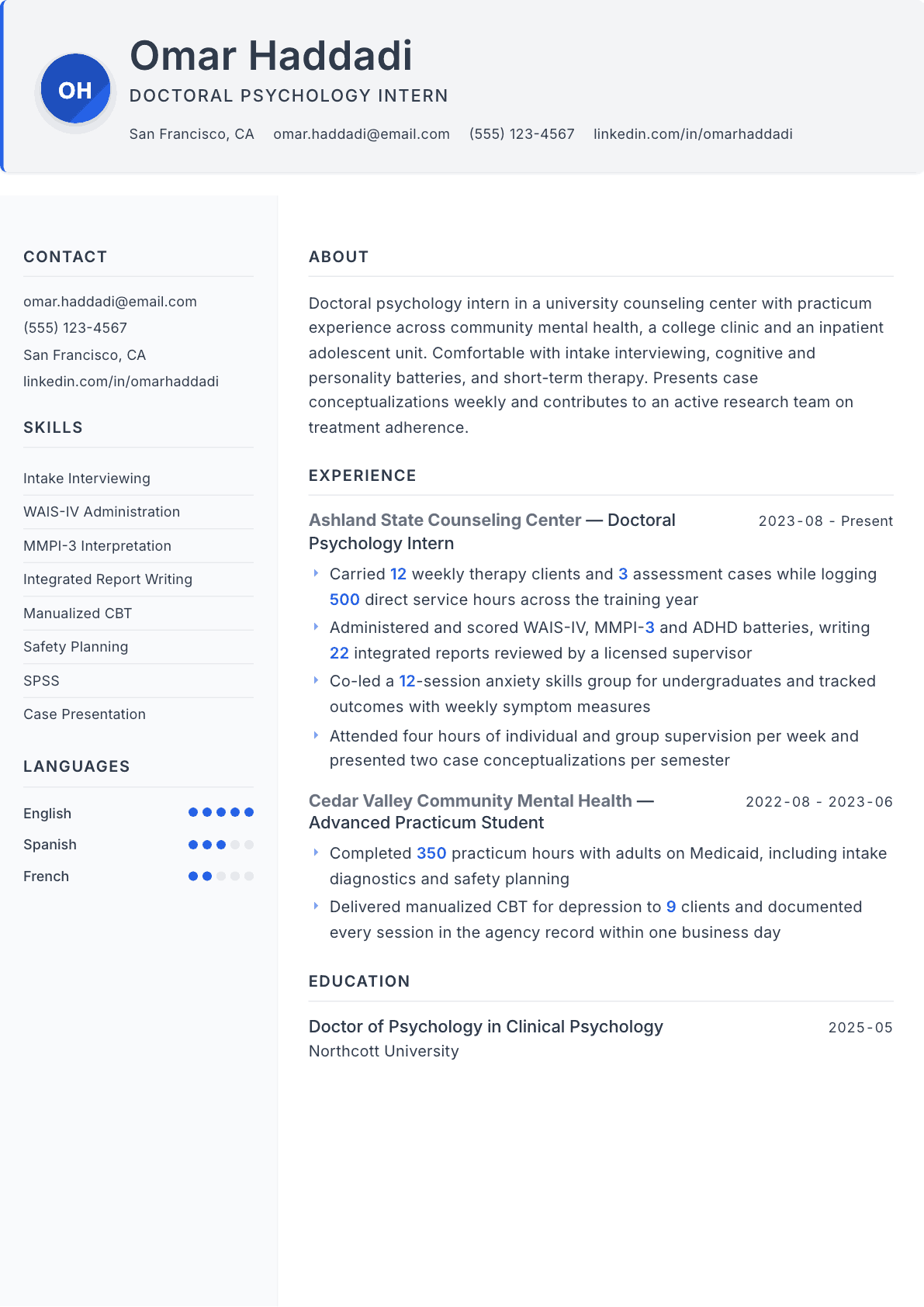
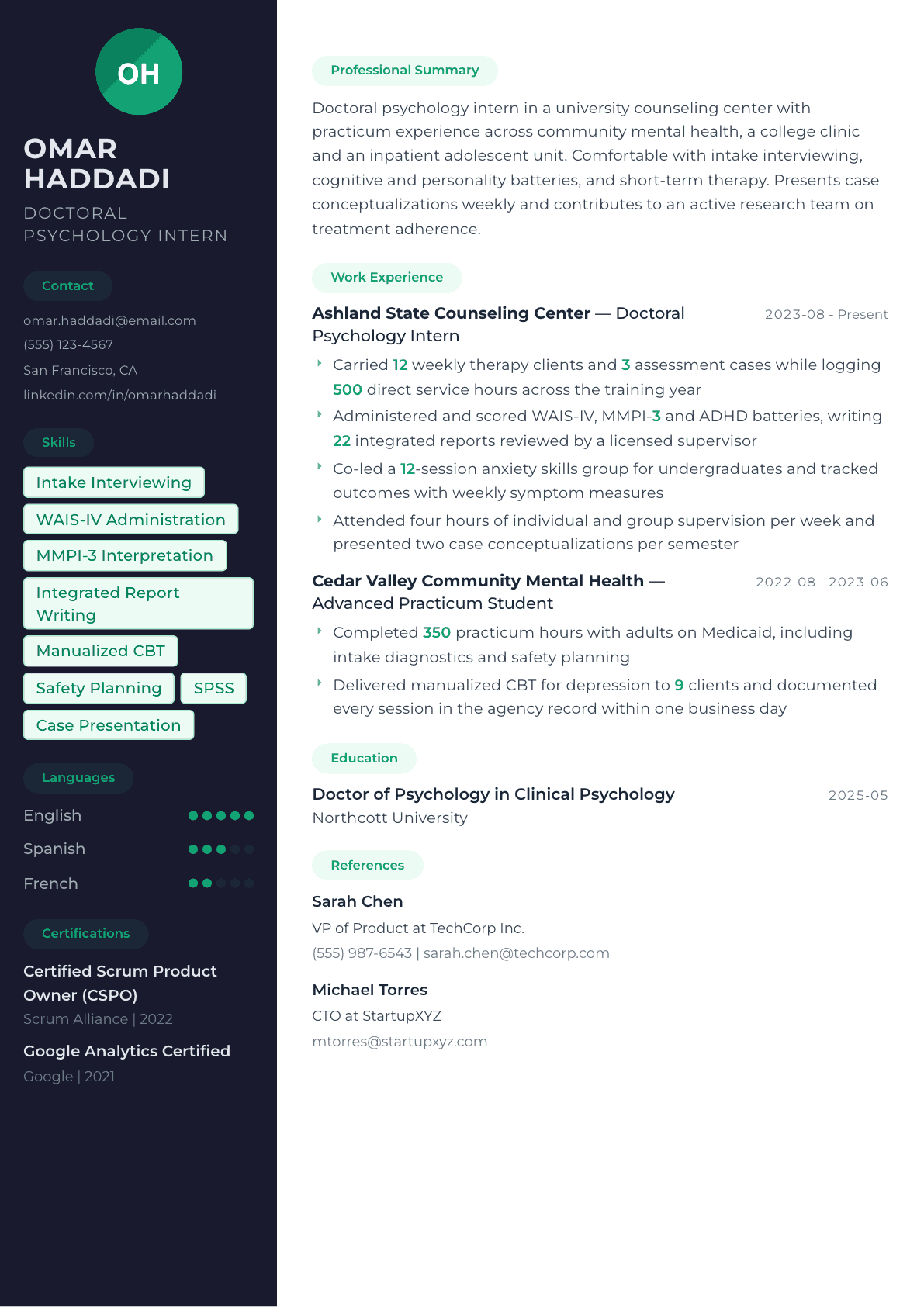
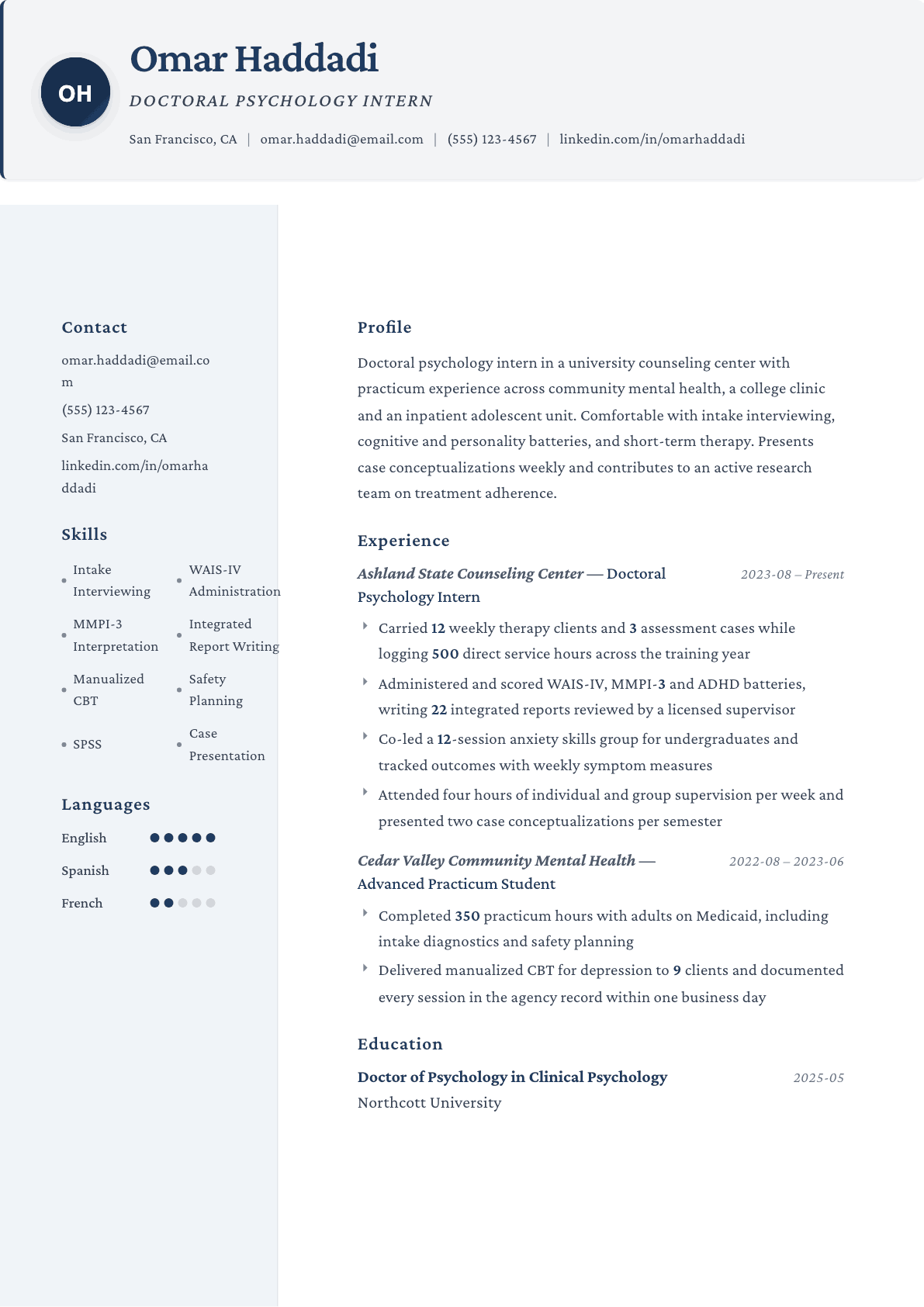
Example Psychology Intern summary
Doctoral psychology intern with practicum training across community mental health, a college counseling center and an adolescent inpatient unit. Logged direct service hours in individual therapy, group work and full assessment batteries including cognitive, personality and attention measures. Writes integrated reports under licensed supervision and presents case conceptualizations to a weekly training seminar. Seeking a health service psychology internship with a strong assessment rotation.
Skills to list on a Psychology Intern resume
- Intake Interviewing
- Psychological Assessment
- WAIS-IV
- MMPI-3
- Integrated Report Writing
- Cognitive Behavioral Therapy
- Group Therapy Co-Facilitation
- Safety Planning
- Case Conceptualization
- Treatment Planning
- Clinical Documentation
- SPSS
- Literature Review
- Supervision Participation
What actually gets this resume read
- Open with a training summary that names your degree track, your accrued direct hours and your assessment experience.
- Break practicum experience into separate entries with the site, population, supervisor credential and hours logged.
- List assessment instruments by name so a training director can match them against the battery their site uses.
- Separate direct service hours from support hours, because internship applications are read against those two totals.
- Include research, posters and dissertation topic in a short section rather than burying them inside experience bullets.
- Say which populations you have not worked with yet if the site trains on them, framed as a training goal.
How to write a psychology intern resume
A psychology intern application is read against a rubric, which makes it unlike almost any other resume. Training directors sit with a stack of files and a scoring sheet that asks about accrued direct hours, assessment breadth, population exposure, supervision received, and research productivity. Your curriculum vitae has to make those five totals findable in seconds, because a reviewer who has to hunt for them marks you down without meaning to.
The second thing a training committee looks for is fit with what their site actually trains. A site with a heavy neuropsychological battery wants to see instruments you have administered. A site running an integrated primary care rotation wants brief intervention experience and comfort with a fifteen minute consult. Listing everything you have ever touched, in one flat block, hides the match rather than showing it.
This guide covers how to build the training sections, how to present hours honestly, what to do when your assessment experience is thin, and how three different applicants at different points in a doctoral program should open the document.
Format: an academic curriculum vitae, not a one-page resume
A psychology intern uses a curriculum vitae. It runs three to six pages and it is expected to. Reverse chronological within each section, and no attempt to compress the training history to fit an arbitrary page limit. Compressing it removes the hours a reviewer is scoring.
Section order matters more here than typography. Education first, because your program, accreditation status and expected graduation date determine eligibility. Then clinical training, then assessment experience, then supervision received, then research, then teaching, then presentations and publications. Keep formatting plain so a reviewer reading twenty files in an evening can move quickly.
- Education block naming the doctoral program, degree track, accreditation status and anticipated graduation month.
- A clinical training section with one entry per practicum site, each showing dates, hours and supervisor credential.
- A separate assessment section listing instruments administered and the number of integrated reports written.
- Supervision received, stated as individual and group hours per week, because sites match training intensity.
Hours: report them the way the application portal asks
Direct service hours, support hours and supervision hours are counted separately and reviewers compare them across applicants. Report each practicum with its own totals rather than one grand number at the top, and use the same categories the standardized application uses so nothing has to be reconciled.
Do not round upward, and do not merge a site you attended for four months with one you attended for a year. If your totals are lower than the median for your target sites, the answer is not creative counting. It is a cover letter that explains the training arc and a curriculum vitae that shows depth in a narrower band.
Assessment: name the instrument, the population, the report count
This is where most psychology intern applications separate. Write the batteries you have administered, scored and interpreted, and say how many integrated reports you wrote under supervision. A reviewer needs to know whether you have written a full report or only administered subtests for someone else's file.
Group instruments by purpose so the reader can match them to a rotation: cognitive, achievement, personality, attention, memory and screening. If you have limited assessment exposure, say precisely what you have done rather than padding the list. Every training director has read a curriculum vitae claiming ten instruments and interviewed the applicant who had scored two.
- Cognitive: WAIS-IV, WISC-V, WRAML-3, or whichever editions you actually used, with the edition number.
- Personality and symptom: MMPI-3, PAI, MCMI-IV, Beck inventories, and structured interviews such as the SCID-5.
- Attention and behavior: Conners rating scales, continuous performance tests, and behavior rating inventories.
- Report writing: number of integrated reports completed, and whether feedback sessions were yours to deliver.
Therapy and population exposure: acuity beats variety
For each practicum, give the setting, the population, the modality and the format. A community mental health site with adults on public insurance, an inpatient adolescent unit and a university counseling center are three very different trainings, and the differences are the substance of your file.
Say what you carried, not what the clinic offered. "Rotation included exposure to crisis work" is a description of the site. "Completed 14 walk-in crisis assessments and wrote the resulting safety plans" is a description of you. Include any manualized protocol you delivered from start to finish, because completing a course of treatment is the marker of readiness.
Research, teaching and the sections people leave half-built
Give the dissertation a heading, a title, a committee chair and a status: proposed, data collection, defended. Scientist-practitioner sites read that line closely, because an unproposed dissertation predicts a difficult internship year. Then list posters, publications and any manuscript under review in a standard citation style used consistently.
Teaching, supervision of junior students, and program service belong here too. A psychology intern who has run an undergraduate lab section or mentored a first-year practicum student has evidence of the supervisory capacity every training year eventually demands.
Psychology Intern resume summary examples
Second-year practicum student
Second-year clinical psychology doctoral student with 320 direct service hours in a community outpatient clinic serving adults on public insurance. Delivers manualized CBT for depression, completes intake diagnostics under weekly supervision, and has administered cognitive and symptom screening batteries. Seeking an advanced practicum with assessment depth.
Internship applicant
Doctoral psychology intern applicant with 850 direct hours across community mental health, a college counseling center and an adolescent inpatient unit. Administered full cognitive and personality batteries and wrote 22 integrated reports under licensed supervision. Dissertation on treatment adherence in proposal stage. Seeking a health service psychology internship with an assessment rotation.
Postdoctoral applicant
Graduating psychology intern completing a university counseling center year with rotations in assessment, group therapy and outreach. Carried 12 weekly therapy clients and 3 concurrent assessment cases, co-led two skills groups, and supervised a practicum student. Dissertation defended. Seeking a postdoctoral fellowship leading toward licensure and a generalist practice.
Work experience bullets: before and after
Before: Gained experience with psychological testing.
After: Administered, scored and interpreted WAIS-IV, MMPI-3 and Conners batteries across 22 cases, writing integrated reports reviewed weekly by a licensed supervisor.
Named instruments, a case count and the report-writing role tell a training director exactly what you can do on day one.
Before: Saw therapy clients at the clinic.
After: Carried 12 weekly individual therapy clients presenting with anxiety, depression and adjustment concerns, delivering manualized CBT across full treatment courses.
The weekly number, the presentations and the phrase full treatment course show completion rather than exposure.
Before: Received supervision from a licensed psychologist.
After: Attended two hours of individual and two hours of group supervision weekly, presenting a formal case conceptualization twice per semester.
Supervision hours are a scored field on the application, so the format and frequency belong on the page rather than in a cover letter.
Before: Helped with a research project in the lab.
After: Coded 180 session recordings for therapist adherence, ran reliability analyses in SPSS, and co-authored a poster presented at a regional psychological association meeting.
A concrete task, a tool and a dissemination outcome show research contribution instead of lab membership.
Before: Worked with crisis situations.
After: Completed 14 walk-in crisis assessments including structured risk screening, and wrote the resulting safety plans with supervisor review the same day.
Crisis work is a liability area, so the volume, the screening structure and the review loop are what a site needs to see.
Hard skills
- Diagnostic intake interviewing
- WAIS-IV and WISC-V administration
- MMPI-3 and PAI interpretation
- Integrated report writing
- Manualized CBT delivery
- Structured risk screening
- Safety planning
- Group therapy co-facilitation
- Treatment planning
- Clinical documentation
- SPSS and statistical analysis
- Literature review and poster preparation
Soft skills
- Openness to supervisory feedback
- Case conceptualization thinking
- Ethical reasoning
- Time management across rotations
- Collegial consultation
- Self-reflective practice
Mistakes that cost psychology intern candidates the interview
- Burying accrued hours inside prose when the reviewer is filling in a scoring sheet field by field.
- Listing instruments you have watched rather than administered, which collapses the moment an interviewer asks about scoring.
- Describing what the practicum site offered instead of what you personally carried on your own caseload.
- Leaving the dissertation status vague, which reads to a training committee as a year at risk of interruption.
- Compressing an academic curriculum vitae onto one page and deleting the training detail the rubric rewards.
- Using a different citation style in every section, which signals carelessness to a scientist-practitioner reviewer.
Psychology Intern resume questions
How long should a psychology intern curriculum vitae be?
Three to six pages is normal for an internship applicant and nobody penalizes length here. What gets penalized is missing detail: hours, instruments, supervision structure and dissertation status all need room to appear in full.
Do I list every practicum site separately?
Yes. Each site gets its own entry with dates, setting, population, supervisor credential and the hours accrued there. Merging sites hides the training arc and makes it impossible for a reviewer to match your background to their rotations.
What if my assessment hours are low?
State them accurately and show depth where you have it, such as a smaller number of complete integrated reports with feedback sessions delivered. Then target sites that advertise assessment training, and say in the cover letter that building that skill is your goal.
Should a psychology intern include undergraduate work?
Only research assistantships, honors theses or clinically relevant employment. Retail and campus jobs come off once you are an internship applicant, unless one gave you a population or language skill that matters to the site you are applying to.
Where do posters and publications go?
In their own section after research experience, in a consistent citation style, newest first. Separate peer-reviewed publications from conference posters and from manuscripts under review, because a training committee reads those three categories very differently.
Related resume examples
- Clinical Psychologist Resume example
- Social Worker Resume example
- Psychologist Resume example
- Behavioral Health Counselor Resume example
- Licensed Clinical Social Worker Resume example
- Licensed Professional Counselor Resume example