Maintenance Engineer Resume Examples: what gets the call
Write a Maintenance Engineer Resume Focused on Asset Reliability
By Mustafa Tarabya, founder of CVBooster · Published · Updated
Maintenance engineer resume example with reliability bullets, CMMS and condition monitoring keywords, and a step by step writing guide.
Sample resumes for a maintenance engineer
The same maintenance engineer content laid out in three CVBooster templates, so you can see what the finished document looks like before you write a word.
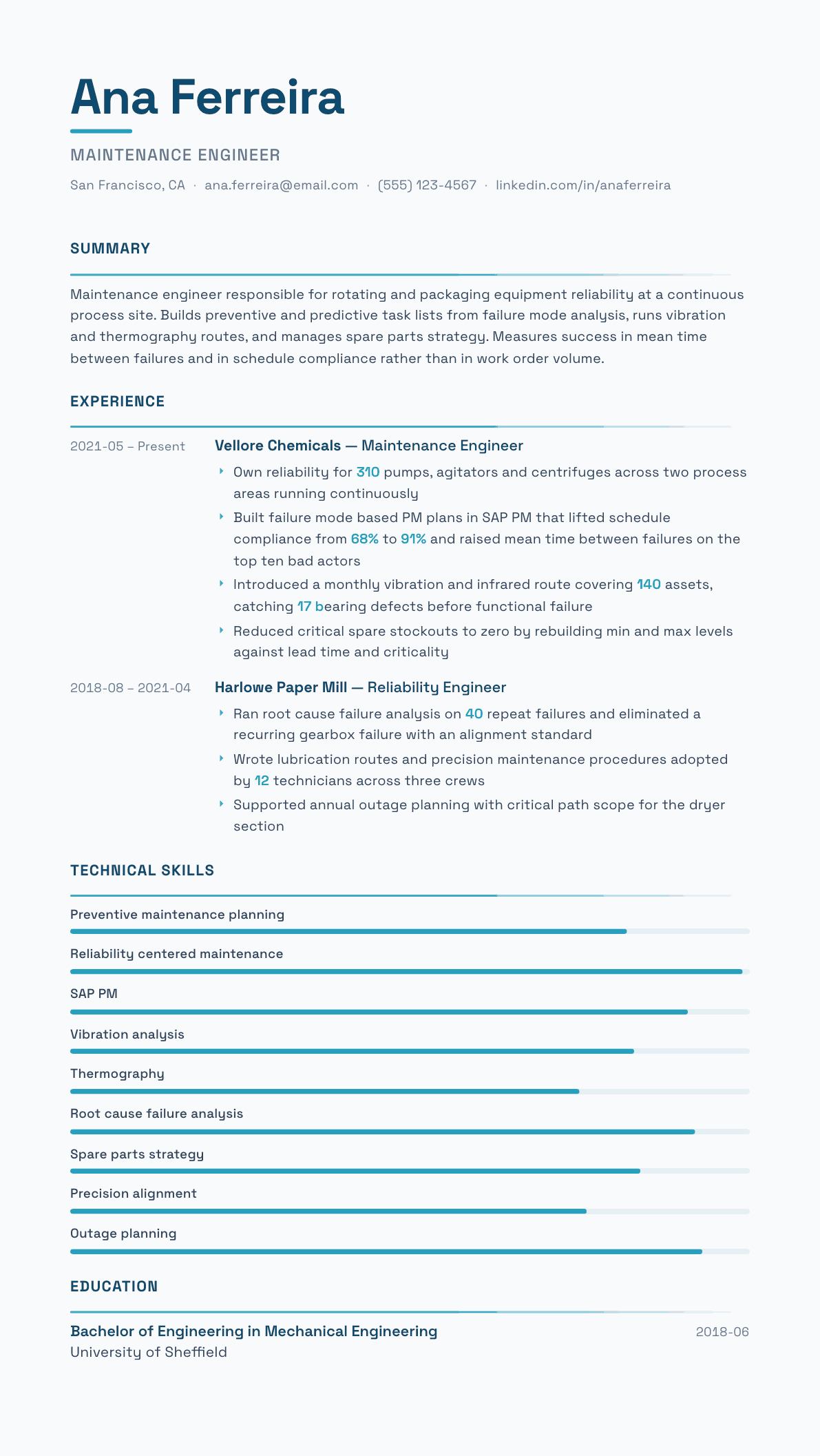
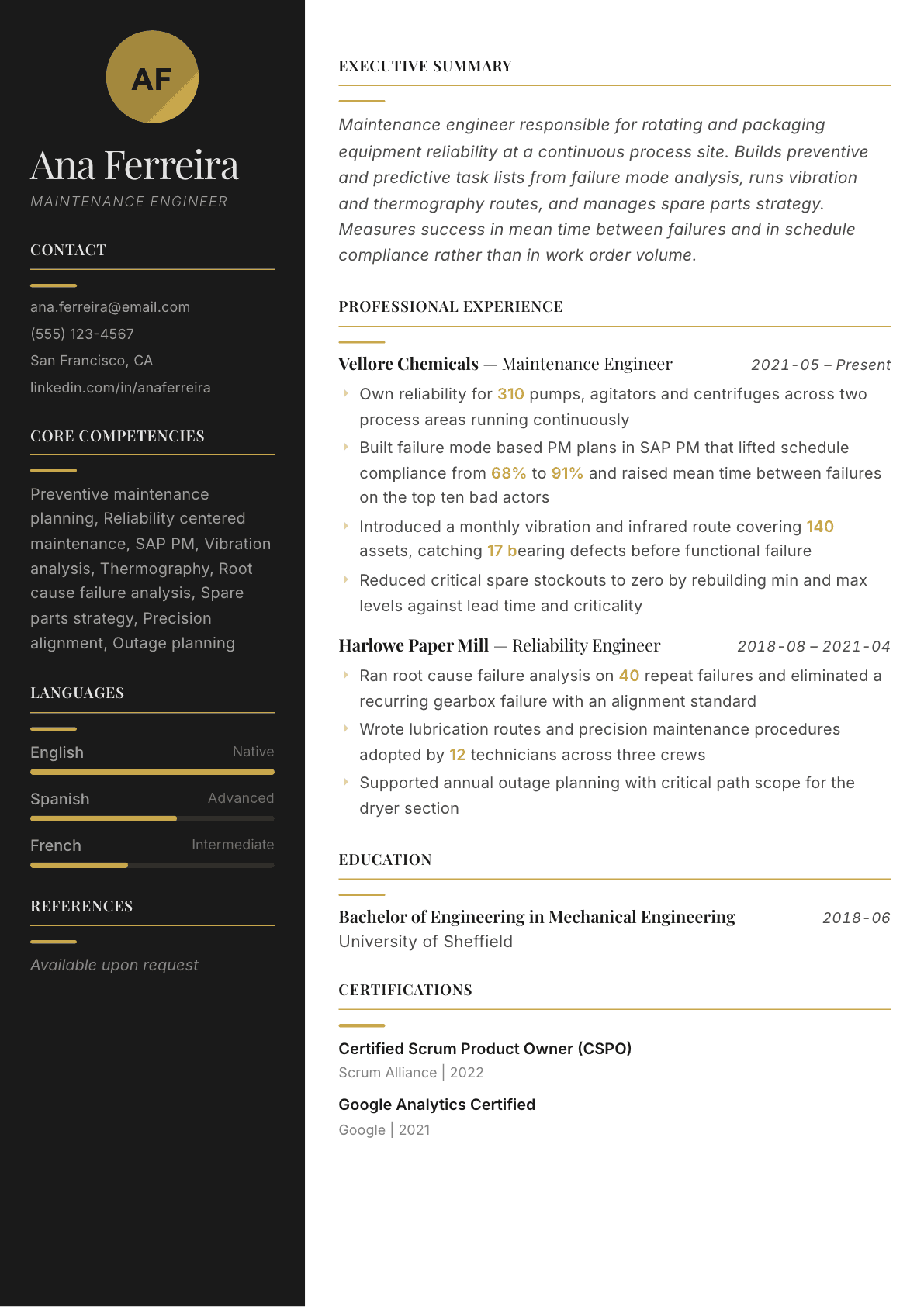
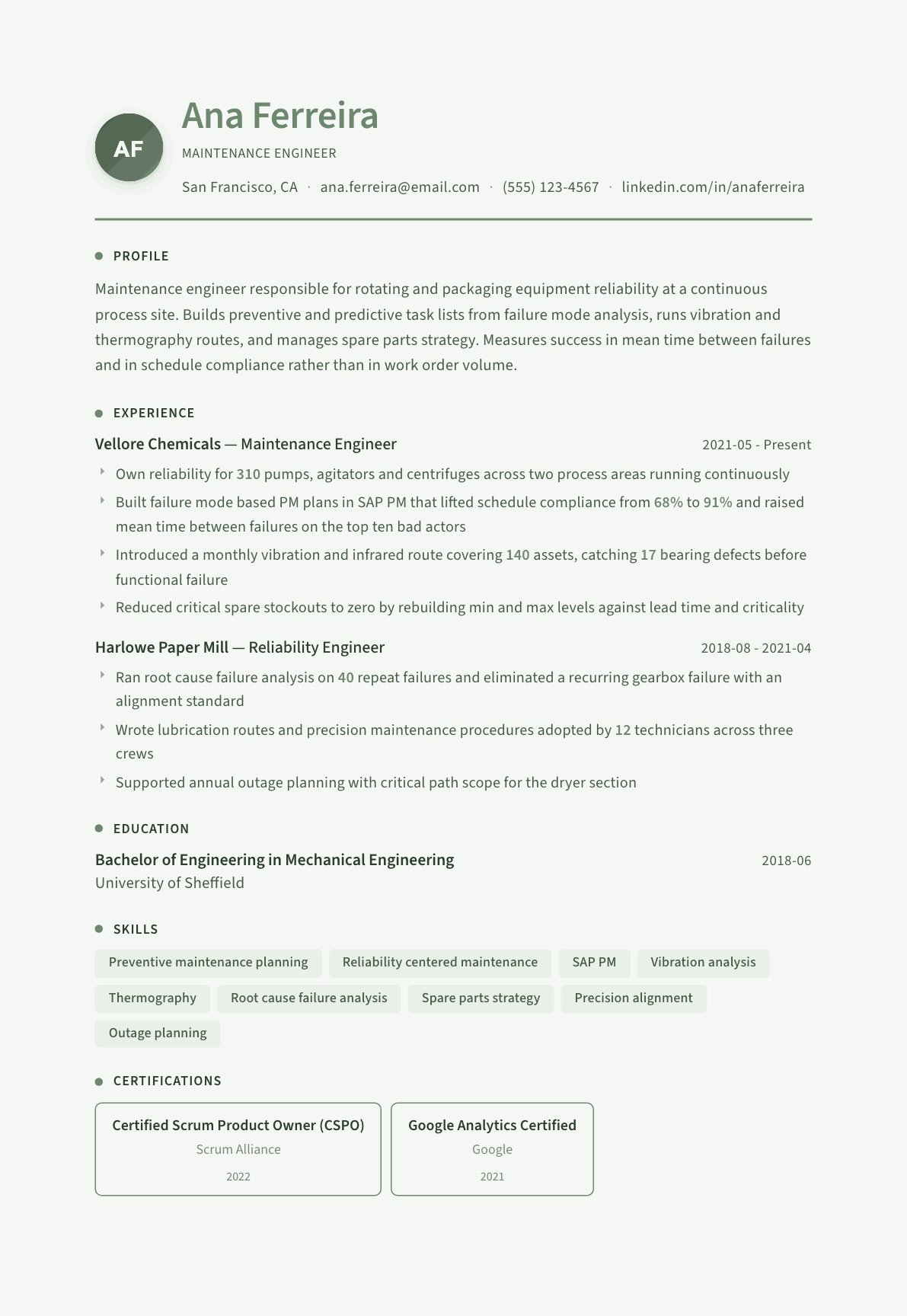
Example Maintenance Engineer summary
Maintenance engineer with six years raising asset reliability at chemical and paper manufacturing sites. Builds failure mode based preventive plans in SAP PM, runs vibration and thermography routes, and rebuilds spare parts strategy against criticality. Lifted maintenance schedule compliance from 68% to 91% across 310 rotating assets and eliminated a repeat gearbox failure through a precision alignment standard. Seeking a reliability lead position.
Skills to list on a Maintenance Engineer resume
- Reliability centered maintenance
- Preventive maintenance planning
- Predictive maintenance
- Vibration analysis
- Infrared thermography
- Oil analysis
- Root cause failure analysis
- Failure mode and effects analysis
- CMMS configuration
- SAP PM
- Spare parts and inventory strategy
- Precision alignment and balancing
- Outage and turnaround planning
- Lubrication programs
- Maintenance budgeting
What actually gets this resume read
- Give the asset count and the asset types you own, because reliability scope is measured in equipment not in buildings.
- Use schedule compliance, mean time between failures and emergency work percentage as your headline measures.
- Name the CMMS by product, whether that is SAP PM, Maximo, Fiix or eMaint, and say what you configured in it.
- Show condition monitoring by technique and by catches: vibration, thermography, oil analysis, ultrasound.
- Describe one failure you eliminated permanently, with the failure mode and the change you made to stop it.
- Keep supervision and technician training visible, since maintenance engineers rarely turn wrenches alone.
How to write a maintenance engineer resume
Maintenance engineering is measured in avoided failures, which makes it hard to write about. The work that matters most is the pump that never seized and the outage that never happened, and neither leaves a visible trace. The resumes that get interviews solve this by using the industry standard measures instead: schedule compliance, mean time between failures, emergency work as a share of total hours, and stockout rate on critical spares.
A maintenance manager reading applications wants to see asset ownership, not activity. How many pumps, motors, gearboxes, compressors and packaging machines were yours. What failure modes you eliminated permanently. Which condition monitoring techniques you ran yourself and what those routes caught before the equipment stopped. Whether you configured the maintenance management system or simply closed work orders in it.
This guide sets out the section order that reliability focused employers expect, three summaries covering a graduate through a reliability lead, before and after bullets from preventive and predictive work, and answers to the questions maintenance engineers ask when moving between process, discrete manufacturing and utilities.
Format: assets first, measures second, tools third
Reverse chronological in one column. Open each job with the asset base you carried: the equipment types, the count, the process they served and whether the plant ran continuously or in shifts. Continuous process work and shift based discrete manufacturing produce different maintenance strategies, and a reader wants to know which one shaped you.
Keep the resume to two pages. Maintenance engineering accumulates a long list of equipment types, and the temptation to name every model of pump is strong. Group by equipment family instead and leave the model detail for the interview.
- Header: name, city, phone, email, and any reliability or vibration analyst certification.
- Order: summary, certifications, experience, technical skills, education.
- Add a short block naming the condition monitoring techniques you personally perform.
Summary: asset base, strategy, and the measure you improved
Name the industry and the asset base, then the strategy you practice. Reliability centered maintenance, failure mode based task selection, condition based monitoring and precision maintenance are all distinct approaches and naming one tells a manager how you think.
Close with a single measure and its movement. Schedule compliance rising, emergency work falling, mean time between failures on the bad actor list improving. One measure that you can explain in detail beats four you half remember.
Experience: what you owned, what you changed, what stopped failing
Write bullets in three families. Program bullets describe what you built: preventive task lists derived from failure modes, lubrication routes, criticality rankings, spare parts min and max levels, planning and scheduling process. Detection bullets describe what you monitored: vibration routes, infrared surveys, oil analysis, ultrasonic leak detection, motor current signature analysis, and the defects each caught before functional failure.
Elimination bullets are the strongest. Take one repeat failure, name the failure mode, name the change and say that it stopped. A gearbox failing every eight months because of soft foot, corrected with an alignment standard and a laser alignment procedure, is a story a reliability manager will read twice.
Include the outage and turnaround side. Scope development, critical path input, contractor coordination and the equipment condition assessments that justified scope. Maintenance engineers who can build outage scope are hired faster than those who only execute it.
Systems, tools and analysis methods
Name the maintenance management system by product and say what you did inside it. Configuring task lists, building criticality fields, writing job plans and pulling failure history are different from closing work orders, and the difference decides the level you are hired at.
List analysis methods properly: failure mode and effects analysis, root cause failure analysis, reliability centered maintenance, Weibull analysis if you truly use it, criticality assessment, and precision techniques such as laser alignment, dynamic balancing and controlled bolting. Add data tools if you build reporting on work order history.
Certifications and the vocabulary of postings
Reliability and vibration credentials carry real weight here because they are examined and tiered. Put them near the top with their level. If you hold a trades background as well as an engineering qualification, say so, since maintenance teams respect an engineer who has done the work.
Posting language to mirror includes preventive maintenance optimization, predictive maintenance, condition monitoring, asset criticality, bad actor analysis, spare parts strategy, maintenance planning and scheduling, work order backlog, wrench time and turnaround support.
Maintenance Engineer resume summary examples
Graduate maintenance engineer
Mechanical engineering graduate with a placement year in a bottling plant supporting preventive maintenance scheduling and failure data cleanup for 200 assets. Trained in vibration data collection and root cause analysis, and seeking a maintenance engineer role at a continuous process site.
Five years in
Maintenance engineer covering 310 pumps, agitators and centrifuges at a continuous chemical plant. Builds failure mode based preventive plans in SAP PM, runs monthly vibration and infrared routes, and manages critical spare levels. Raised maintenance schedule compliance from the high sixties into the low nineties.
Reliability lead
Reliability lead with eleven years across chemical and paper manufacturing. Owns the bad actor program, sets the condition monitoring strategy across three sites, and coaches planners on job plan quality. Eliminated a repeat gearbox failure through a precision alignment standard adopted by twelve technicians.
Work experience bullets: before and after
Before: Responsible for preventive maintenance on plant equipment.
After: Owned preventive maintenance for 310 pumps, agitators and centrifuges across two continuously running process areas, rebuilding task lists from documented failure modes.
Asset count, equipment families and the basis for the task list turn a duty into demonstrated reliability practice.
Before: Used the CMMS to manage maintenance work.
After: Configured job plans, criticality fields and task lists in SAP PM, lifting maintenance schedule compliance from 68% to 91% over four quarters.
Saying what you configured, not just that you used the system, separates an engineer from a work order closer.
Before: Carried out condition monitoring on rotating equipment.
After: Introduced a monthly vibration and infrared route covering 140 assets and caught 17 bearing defects at an early stage, all replaced during planned windows.
Route size, defects found and planned replacement show the program prevented failures instead of documenting them.
Before: Investigated repeat equipment failures.
After: Traced a recurring gearbox failure to soft foot and thermal growth, then wrote a laser alignment standard and trained twelve technicians on it, ending the repeat failure.
A named failure mode, a permanent countermeasure and the training that made it stick is the strongest reliability evidence available.
Before: Managed spare parts for the maintenance department.
After: Rebuilt min and max levels for critical spares against lead time and asset criticality, reaching zero critical stockouts across a full year while holding inventory value steady.
It names the method used to set levels and pairs the service result with the inventory constraint it was achieved under.
Hard skills
- Reliability centered maintenance
- Failure mode and effects analysis
- Root cause failure analysis
- Preventive maintenance optimization
- Vibration analysis and route management
- Infrared thermography
- Oil analysis and lubrication programs
- Ultrasonic leak and bearing detection
- Asset criticality assessment
- CMMS configuration including SAP PM
- Maintenance planning and scheduling
- Precision alignment and dynamic balancing
- Spare parts and inventory strategy
- Turnaround scope development
Soft skills
- Working through technicians
- Data driven persuasion
- Cross shift communication
- Planning discipline
- Coaching on precision practices
- Negotiating downtime windows
Certifications worth listing
- Certified Maintenance and Reliability Professional (CMRP) (Society for Maintenance and Reliability Professionals)
- Certified Reliability Engineer (CRE) (American Society for Quality)
- Vibration Analyst Category I to IV (Mobius Institute Board of Certification)
- Certified Maintenance and Reliability Technician (CMRT) (SMRP Certifying Organization)
- Machine Lubrication Technician (MLT) (International Council for Machinery Lubrication)
Mistakes that cost maintenance engineer candidates the interview
- Reporting work orders completed, which measures activity rather than the reliability the role exists to produce.
- Naming a maintenance system without saying what you configured inside it, so the level of the role stays unclear.
- Listing condition monitoring techniques with no catches, which reads as tool exposure rather than a working program.
- Missing the asset count entirely, leaving a manager unable to compare your scope with their own plant.
- Presenting a failure investigation without the countermeasure, so the reader never learns whether it stopped happening.
- Ignoring planning and scheduling, since most maintenance improvement comes from better job plans rather than new technology.
Maintenance Engineer resume questions
What is the difference between a maintenance engineer and a reliability engineer?
Maintenance engineering leans toward executing and improving the maintenance program day to day. Reliability engineering leans toward analysis, criticality and design out work. Many sites use the titles interchangeably, so read the responsibilities rather than the title.
Which metrics belong on a maintenance engineer resume?
Schedule compliance, mean time between failures on your worst assets, emergency work as a share of hours, preventive maintenance completion and critical spare stockouts. Give a starting point and an ending point so the improvement is visible.
Do I need a vibration analyst certification?
It is not required, but it is verifiable and tiered, which makes it valuable on a resume. If you collect and interpret data yourself, list the category level. If a contractor collects and you only read reports, say that instead of implying more.
How do I show reliability results when nothing broke?
Report the defects your condition monitoring routes caught before functional failure and the planned windows in which they were fixed. Preventing failures is visible in early catches, planned versus unplanned work ratios and reduced overtime.
Can a technician move into a maintenance engineer role?
Yes, and the trades background is an advantage once the resume shows analysis rather than repair. Lead with failure investigations, task list improvements and any planning work, then place the hands on history underneath as supporting depth.
Related resume examples
- Mechanical Engineer Resume example
- Maintenance Technician Resume example
- Reliability Engineer Resume example
- Plant Engineer Resume example
- Field Engineer Resume example
- Supplier Quality Engineer Resume example