Reliability Engineer Resume Examples: what gets the call
Write a Reliability Engineer Resume That Proves Downtime Reduction
By Mustafa Tarabya, founder of CVBooster · Published · Updated
Reliability engineer resume example with RCM, FMEA and vibration analysis bullets, plus asset management keywords and a writing guide.
Sample resumes for a reliability engineer
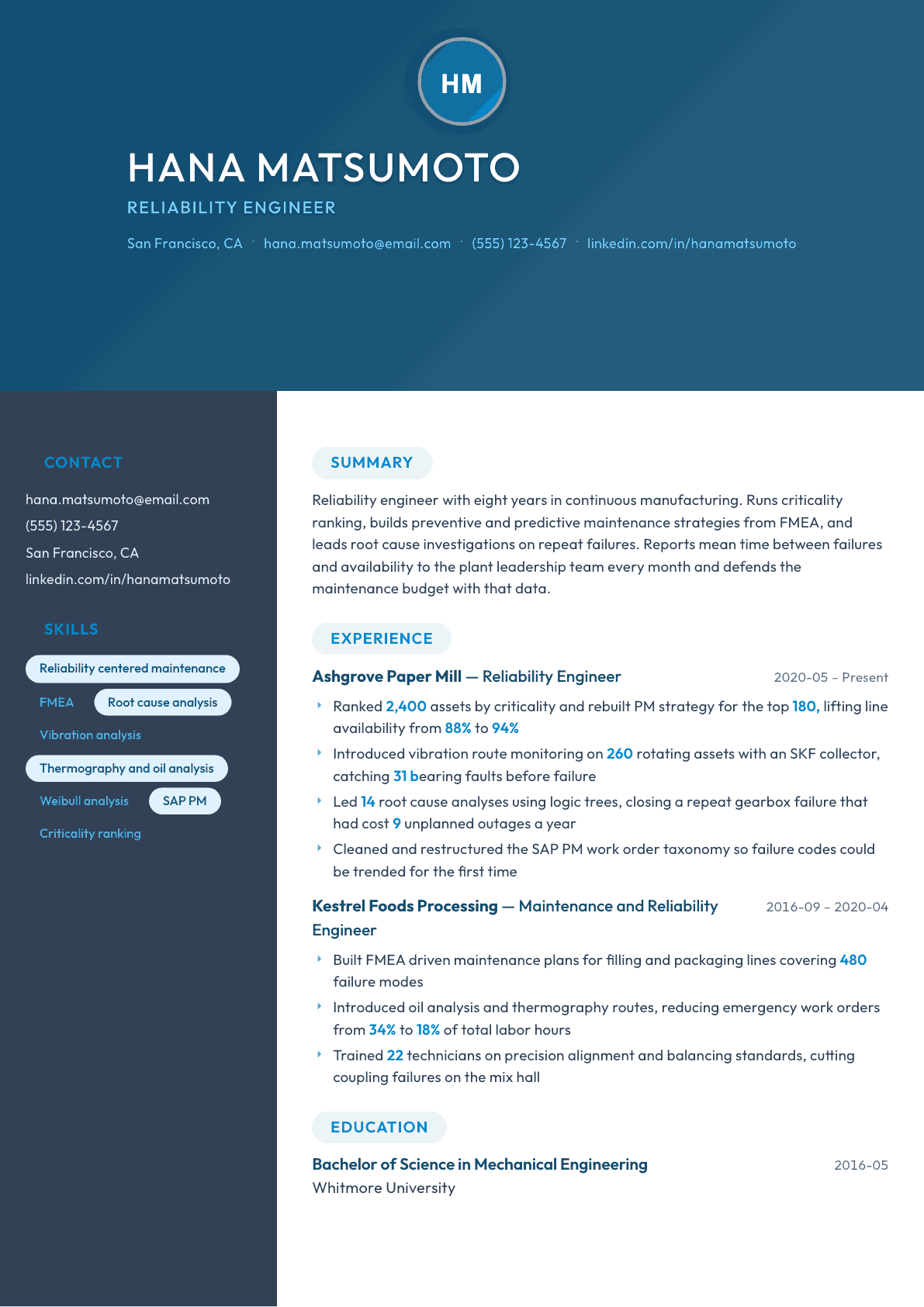
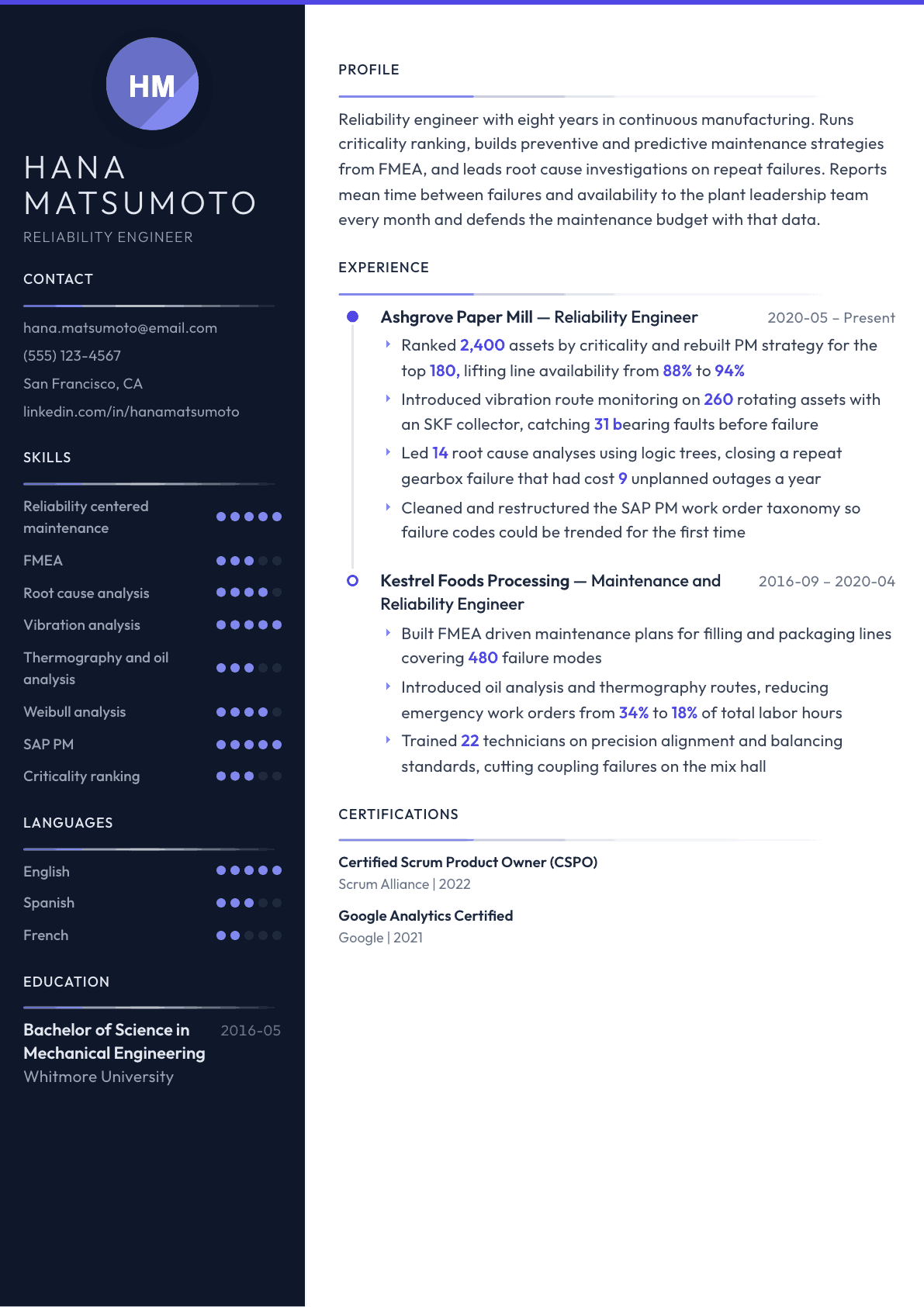
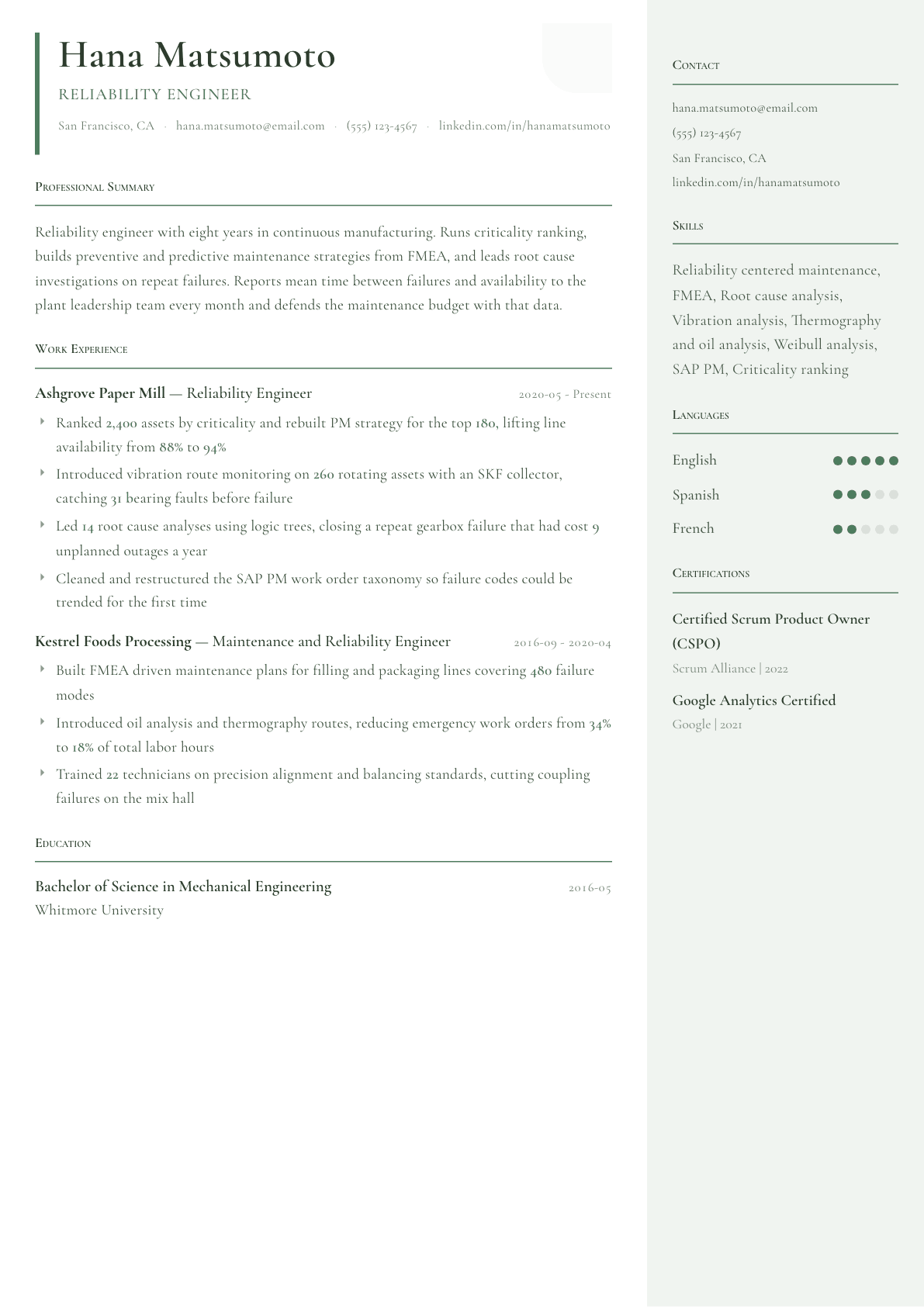
The same reliability engineer content laid out in three CVBooster templates, so you can see what the finished document looks like before you write a word.
Example Reliability Engineer summary
Reliability engineer with eight years in continuous process plants, responsible for maintenance strategy, condition monitoring and failure elimination. Builds FMEA based preventive plans, runs vibration and oil analysis routes, and leads structured root cause investigations on repeat failures. Reports availability and mean time between failures to plant leadership and uses the data to defend maintenance spend. Targeting a reliability lead position at a multi-site manufacturer.
Skills to list on a Reliability Engineer resume
- Reliability centered maintenance
- FMEA and FMECA
- Root cause analysis
- Weibull and failure data analysis
- Vibration analysis
- Infrared thermography
- Oil analysis
- Ultrasound testing
- Criticality ranking
- Preventive maintenance optimization
- Spare parts strategy
- SAP PM
- IBM Maximo
- Bad actor management
- Availability and MTBF reporting
What actually gets this resume read
- Lead with availability, mean time between failures or unplanned downtime hours, because those numbers are how the role is measured.
- Name the asset classes you have owned, since rotating equipment, fixed equipment and electrical assets need different analysis skills.
- Say which computerized maintenance management system you worked in, because SAP PM, Maximo and Infor each imply different data habits.
- Describe the condition monitoring technologies you personally collected and analyzed rather than the ones your contractor ran.
- Show one repeat failure you eliminated, including the analysis method and the change that finally closed it out.
- Include your certification progress toward CMRP or CRE, as many postings list one of them as preferred.
How to write a reliability engineer resume
Reliability engineering is judged by whether the plant runs. The maintenance manager reading your resume already tracks availability, unplanned downtime hours and emergency work order share, and is scanning for a candidate who speaks in those numbers rather than in maintenance philosophy. A resume full of methodology names with no movement in a plant metric reads as theory.
The second filter is asset familiarity. A reliability engineer who has owned rotating equipment in a paper mill and one who has owned fixed equipment in a refinery are not interchangeable, and neither is comparable to someone doing product reliability prediction in a design office. State which world you come from immediately.
This guide covers the resume structure that fits plant reliability work, what belongs in each section, three example summaries, five before and after bullets, and the questions reliability engineers ask when they rewrite.
Format: the plant metric in the first three lines
Reverse chronological, two pages after five years, because asset counts, strategy work and failure elimination projects all need room. Put a metric line right under the summary: availability achieved, unplanned downtime reduced, or emergency work share reduced. It gives the reader a reason to keep reading.
Add a plant context header to each job: industry, process type, approximate asset count in the maintenance system, and the size of the maintenance organization you worked with. Reliability engineering means something different in a plant with six technicians than in one with sixty.
- Header: name, reliability specialization, city and state, contact details, certification abbreviations.
- Section order: summary, plant results, experience, technical skills, education, certifications.
- Per job: industry, asset count, maintenance system, and shift or day role.
Summary: assets owned, strategy built, downtime removed
Say the industry and the asset families in the first sentence. Rotating equipment, fired equipment, pressure vessels, electrical distribution and instrumentation each have their own inspection regimes and analysis methods, and a manager staffing a specific gap is scanning for the match.
Follow with the strategy work. Criticality ranking, reliability centered maintenance analysis, preventive plan optimization and spare parts strategy are the deliverables of this discipline. Close with the plant number that moved as a result.
Experience: strategy, condition monitoring, and eliminated failures
Split your bullets into three kinds. Strategy bullets describe what you built: criticality models, maintenance task selection from failure mode analysis, inspection intervals justified by degradation mechanism. Monitoring bullets describe routes you personally collected and analyzed, with the technology and the catches. Elimination bullets describe repeat failures you removed for good.
Be specific about condition monitoring technology. Vibration analysis, infrared thermography, ultrasound, oil analysis and motor current signature analysis are separate certifications and separate instrument sets. Say which ones you hold and which ones you ran yourself rather than contracted out.
The strongest bullet in this discipline is a bad actor eliminated. Name the equipment, the failure frequency before, the analysis method, the change made and the frequency after. That single bullet answers most of what an interviewer wants to know.
Maintenance data and the system it lives in
Reliability work depends on work order data being usable, and most plants have data that is not. Describe any taxonomy cleanup, failure code structure, or work order discipline you introduced, because a reliability engineer who can make the maintenance system trustworthy is rare and immediately useful.
Name the computerized maintenance management system and what you did inside it. Building preventive plans, structuring equipment hierarchies, setting up condition based triggers and building failure trend reports are different depths of use, and hiring managers can tell the difference from how you describe it.
- Data work: equipment hierarchy, failure code taxonomy, work order quality standards, downtime capture.
- Analysis: Weibull fitting, mean time between failures trending, Pareto of downtime causes, cost of unreliability.
- Planning: task selection, interval justification, spares criticality and minimum and maximum settings.
Root cause analysis and the change that stuck
Name the method you use and be ready to defend it. Logic tree analysis, five why with verification, fault tree and structured problem solving formats each have a discipline behind them, and interviewers ask candidates to walk through a real case in detail.
Show that your recommendations were implemented. Many reliability engineers write excellent investigations that die in a report. Stating that the corrective action was funded, executed and verified against the failure rate afterward is what proves influence.
Reliability Engineer resume summary examples
Early career
Mechanical engineering graduate with two years in plant maintenance planning, building preventive task lists in a maintenance system and collecting vibration route data on 120 pumps. Trained to Category I vibration analysis. Seeking a reliability engineering role in continuous manufacturing.
Six years in
Reliability engineer with 6 years in food processing, owning criticality ranking for 1,400 assets and rebuilding preventive strategy on the top 200. Introduced thermography and oil analysis routes and cut emergency work orders from 34% to 18% of labor hours.
Reliability lead
Reliability lead with 14 years across paper and chemical plants, accountable for site availability and the bad actor elimination program. Runs reliability centered maintenance workshops, mentors two reliability engineers, and has lifted line availability from 88% to 94% over three years.
Work experience bullets: before and after
Before: Managed the preventive maintenance program.
After: Ranked 2,400 assets by criticality and rebuilt preventive strategy for the top 180 using failure mode analysis, lifting line availability from 88% to 94% over two years.
Asset count, the selection method and a plant level result show strategy work rather than schedule administration.
Before: Used condition monitoring to find problems early.
After: Established vibration routes on 260 rotating assets with a portable collector and monthly analysis, catching 31 bearing and misalignment faults before they reached functional failure.
Route size, cadence and the number of catches quantify a practice that is usually described in the abstract.
Before: Performed root cause analysis on equipment failures.
After: Led 14 logic tree investigations and eliminated a repeat gearbox failure responsible for 9 unplanned outages a year by correcting a lubrication specification and a coupling alignment standard.
Naming the failure, its cost in outages and the two changes that closed it proves the analysis reached implementation.
Before: Improved maintenance data quality.
After: Restructured the equipment hierarchy and failure code taxonomy in the maintenance system, making downtime trending by failure mode possible for the first time and driving the annual bad actor list.
Data work sounds administrative until you state what analysis it unlocked.
Before: Trained technicians on best practices.
After: Trained 22 technicians to precision alignment and dynamic balancing standards with practical assessment, after which coupling failures in the mix hall stopped appearing on the monthly downtime report.
Training only counts when the resume connects it to a failure mode that disappeared.
Hard skills
- Reliability centered maintenance analysis
- Failure mode and effects analysis
- Criticality ranking
- Root cause analysis using logic trees
- Weibull and failure data analysis
- Vibration analysis
- Infrared thermography
- Lubrication and oil analysis
- Ultrasound and motor current analysis
- Preventive maintenance optimization
- Spare parts and inventory strategy
- Maintenance system data structure
- Availability and downtime reporting
- Precision maintenance standards
Soft skills
- Persuading operations to fund a fix
- Facilitating analysis workshops
- Working with technicians on the floor
- Clear investigation write-up
- Long-horizon patience
Certifications worth listing
- Certified Maintenance and Reliability Professional (CMRP) (Society for Maintenance and Reliability Professionals)
- Certified Reliability Engineer (CRE) (American Society for Quality)
- Vibration Analyst Category II, ISO 18436-2 (Mobius Institute Board of Certification)
- Machine Lubrication Technician Level I (International Council for Machinery Lubrication)
Mistakes that cost reliability engineer candidates the interview
- Naming methodologies without a single plant metric that moved as a result of applying them.
- Failing to say which condition monitoring you ran personally versus what a contractor delivered.
- Leaving out the asset count, so the reader cannot judge whether you handled a small line or a whole site.
- Describing investigations that ended in a report rather than in a funded and verified change.
- Ignoring the maintenance system entirely when data quality is most of the daily work.
- Mixing product reliability prediction with plant reliability without explaining which one you are applying for.
Reliability Engineer resume questions
Which metrics belong on a reliability engineer resume?
Availability, unplanned downtime hours, mean time between failures on named assets, emergency work order share and preventive compliance. Pick the ones your target plant reports and show movement over a stated period rather than a single snapshot figure.
Is a CMRP or CRE certification worth listing prominently?
Yes. Many postings list one as preferred and some treat it as a screen. Put the abbreviation next to your name in the header and the full credential with its issuing body in the certifications section, along with any vibration analysis category you hold.
How do I present reliability work if my title was maintenance engineer?
Keep the real job title for accuracy and add a parenthetical scope note describing the reliability content. Then let the bullets carry it: strategy building, condition monitoring and failure elimination will read as reliability work regardless of what the payroll system called you.
Should I list the condition monitoring instruments by brand?
Name the technology first and the instrument family second. A reviewer cares that you can interpret a spectrum or a thermal image, then wants a quick sense of whether you will need training on their collector and analysis software.
How do I show impact when reliability gains take years?
State the period alongside the improvement so the reader understands the horizon, and include leading indicators as well. Faults caught before failure, preventive compliance and the number of bad actors closed all demonstrate progress before the availability curve moves.
Related resume examples
- Maintenance Technician Resume example
- Industrial Engineer Resume example
- Maintenance Engineer Resume example
- Plant Engineer Resume example
- Supplier Quality Engineer Resume example
- Facilities Engineer Resume example