AI Engineer Resume Examples: free ATS score and gap list
Write an AI Engineer Resume That Shows Working Systems Not Demos
By Mustafa Tarabya, founder of CVBooster · Published · Updated
AI engineer resume examples, wording for model integration and evaluation, the keywords hiring teams search, and a complete writing guide.
Sample resumes for a ai engineer
The same ai engineer content laid out in three CVBooster templates, so you can see what the finished document looks like before you write a word.
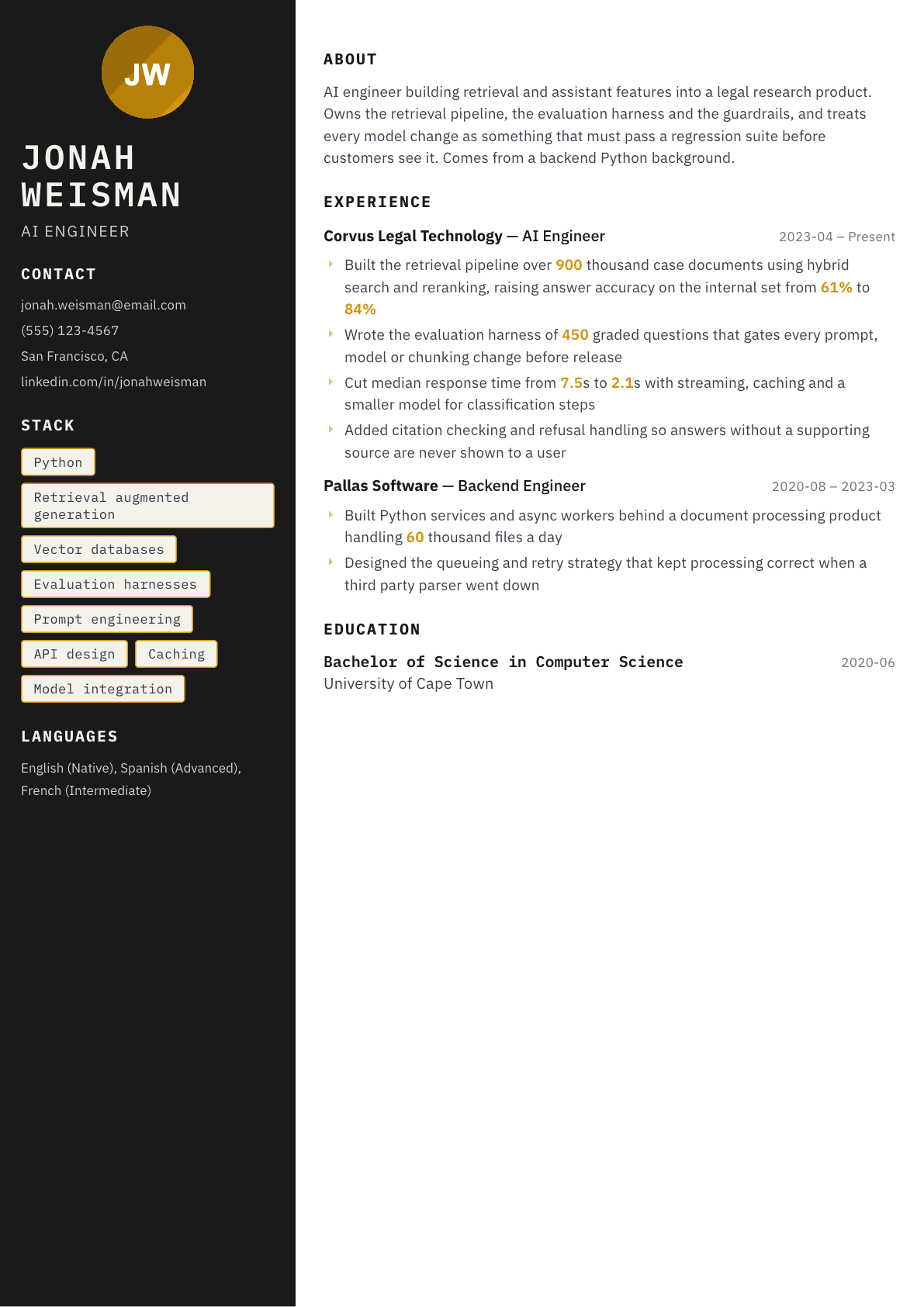
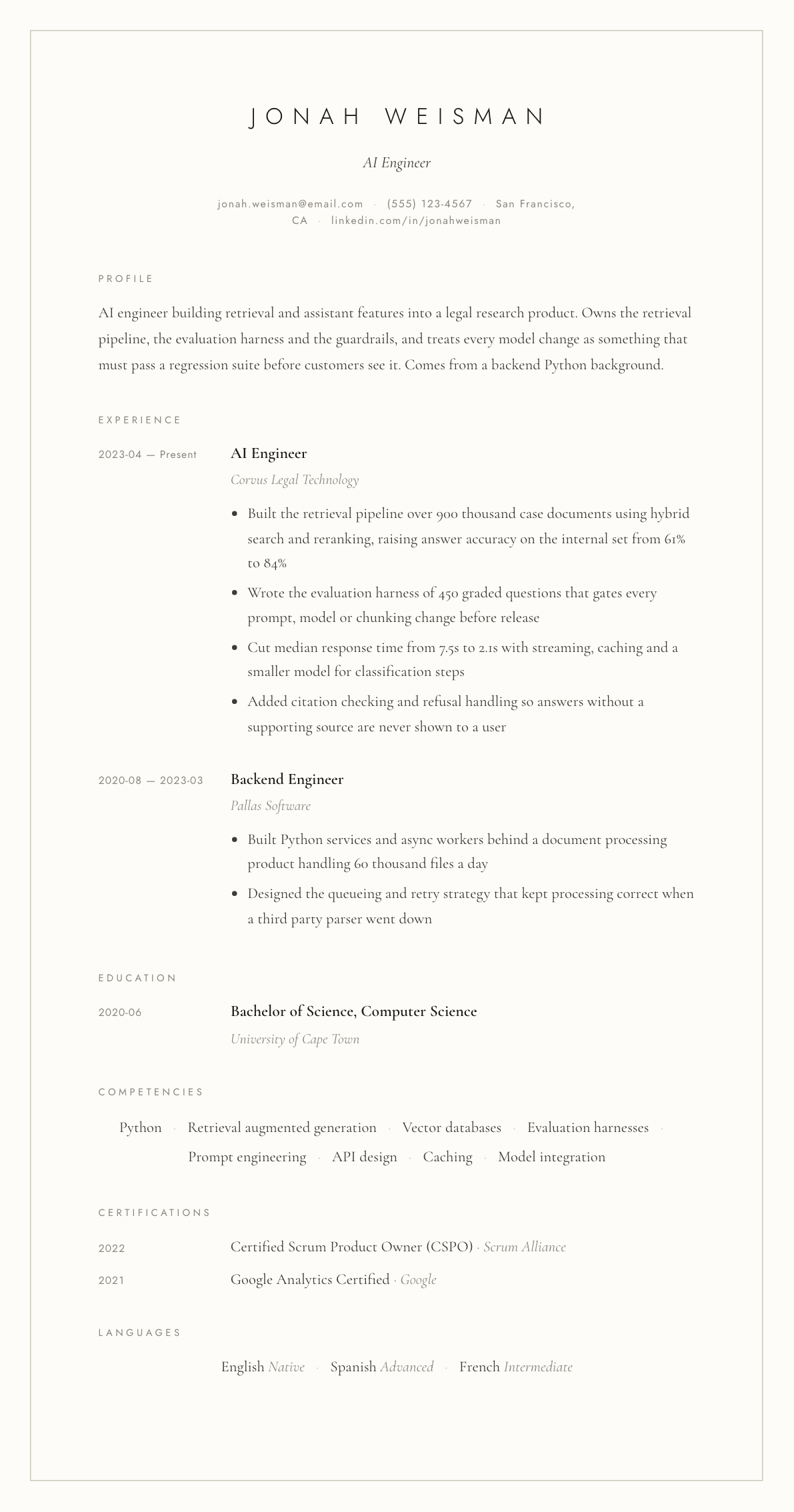
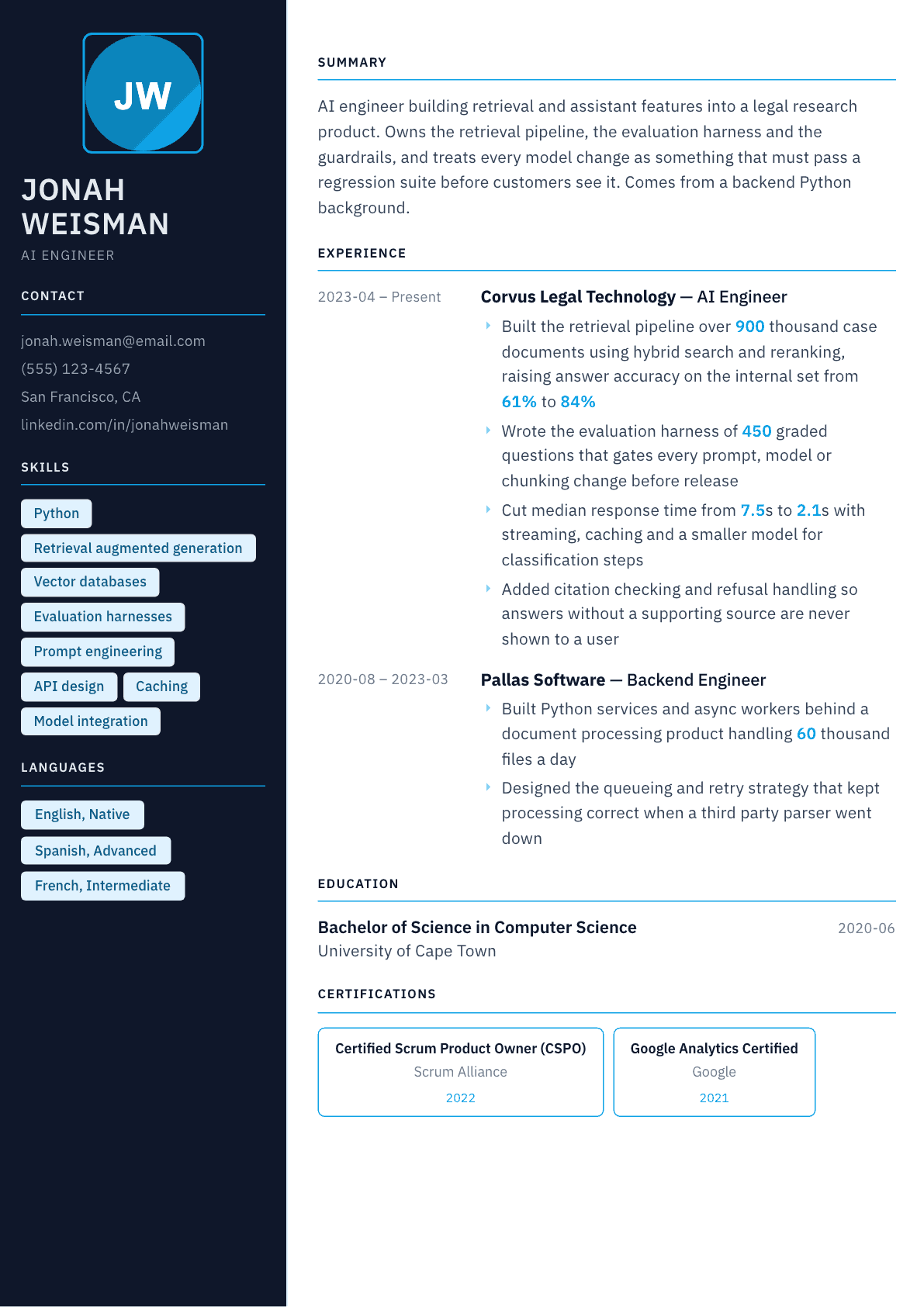
Example AI Engineer summary
AI engineer with five years in backend Python and two building retrieval and assistant features in a legal research product. Owns a hybrid retrieval pipeline over a large case corpus, a graded evaluation harness that gates every prompt and model change, and the guardrails that keep uncited answers from reaching users. Cut median response time by more than half through streaming and caching.
Skills to list on a AI Engineer resume
- Python
- Retrieval augmented generation
- Vector databases
- Embeddings
- Prompt engineering
- Evaluation and benchmarking
- Model fine-tuning
- PyTorch
- API design
- Streaming responses
- Caching strategies
- Guardrails and safety
- Cost optimization
- Distributed systems
What actually gets this resume read
- Show a system in production with real users, because demo projects read as tutorials to an experienced reviewer.
- Describe your evaluation method, since the ability to measure quality is what separates this role from prototyping.
- Give latency and cost numbers per request, as both decide whether an assistant feature can actually launch.
- Name the retrieval stack precisely: chunking approach, embedding model, vector store and reranking step.
- Include the safety work such as guardrails, citation checking, refusal behavior and handling of sensitive input.
- Keep your software engineering background visible, because most of this job is still services, queues and tests.
How to write a ai engineer resume
The AI engineer title covers a real job that did not exist in this shape a few years ago: taking large models somebody else trained and turning them into a product feature that holds up under real users. The person hiring for it has usually already seen an impressive prototype fall over on contact with customers, which is why the screening question behind every one of these resumes is whether you have run one of these systems in production rather than built a demo.
That changes what belongs on the page. Model names matter less than the surrounding engineering: how you retrieve context, how you measure whether an answer is good, what you do when the model is confidently wrong, what a request costs, and how long a user waits. A page full of frameworks with no evaluation method reads as a tutorial follower to anyone who has run one of these systems.
This guide covers how to lead with a production system, how to write about evaluation so it sounds like engineering, how to handle latency, cost and safety work, and how to position yourself if you are arriving from backend engineering or from data science.
Format: one to two pages, production system first
Reverse chronological, with the role containing your production system at the top and given the most space. Under it, write one system line: what the feature does, how many users or requests, what corpus or data it works over, and the model provider or family. That line frames everything after it.
Keep a technical block near the top split into languages, frameworks, model and vector infrastructure, and evaluation tooling. Recruiters in this space do search on specific names, and hiding them in prose costs matches.
- Header: name, city, phone, email, GitHub, and a link to a public system or write-up if one exists.
- Order: summary, technical stack, experience with a system line, selected projects, education.
- Keep your software engineering roles in full, since most of this job is still services, queues and tests.
Summary: what you built, for whom, and how you know it works
Three or four lines. Name the product surface, the technique, the scale, and your evaluation approach. An assistant over a legal corpus with a graded evaluation set is a completely different claim from having integrated an API into a side project, and the summary is where that difference registers.
Say where you came from. Backend engineers arriving in this field bring reliability habits, data scientists bring evaluation rigor, and hiring managers weight the rest of the resume differently depending on which one you are.
Experience: retrieval and evaluation are the two hard parts
For retrieval, describe the pipeline precisely: how documents are chunked and why, which embedding model, which vector store, whether you combine dense and keyword search, and whether you rerank. Chunking strategy in particular is where most quality problems live, and naming your approach signals that you have debugged real failures rather than accepted defaults.
For evaluation, describe the harness. A graded question set with expected answers, an automated scoring method, and a gate that blocks a release when the score drops. Say how many cases, who wrote them, and how often the suite runs. This is the single most convincing thing on an AI engineer resume because it is the part that prototypes never have.
Then treat the model itself as a component with trade-offs. Choosing a smaller model for classification steps, caching repeated calls, streaming so the first token arrives quickly, and setting a token budget per request are all engineering decisions with measurable effects.
Latency, cost and failure behavior
Say what a request costs and how long it takes, because those two numbers decide whether a feature launches at all. Give a before and after if you improved them, and name the change: streaming, caching, a smaller model for a sub-step, batching, or cutting the retrieved context down.
Then describe failure behavior. What happens when the provider returns an error or rate limits you, when retrieval finds nothing relevant, when the answer has no supporting source. Fallbacks, retries, refusal handling and citation checking are what separate a feature customers trust from one that gets switched off after a bad week.
Safety work and the keywords that carry it
Guardrails belong on the page as engineering, not policy. Input filtering, handling of sensitive or personal data, prompt injection defenses on any system that reads untrusted content, output validation against a schema, and a rule that an answer without a citation is not shown. Each of those is a design decision an interviewer can dig into.
These postings reuse a compact vocabulary: retrieval augmented generation, embeddings, vector database, prompt engineering, evaluation, fine-tuning, inference latency, token cost, guardrails and semantic search. Use the posting phrasing once in the summary and once inside a bullet where the work is visible.
AI Engineer resume summary examples
Backend engineer moving across
Backend engineer with four years in Python services, now building assistant features on an internal support tool. Built a retrieval pipeline over 20 thousand help articles, a small graded evaluation set that runs on every prompt change, and the caching layer that keeps median response time under two seconds.
Two years building with models
AI engineer building retrieval and assistant features into a legal research product. Owns a hybrid search pipeline over a large case corpus, an evaluation harness of 450 graded questions that gates every model or prompt change, and the citation checking that stops unsupported answers reaching users.
Lead on applied AI
Lead AI engineer responsible for three customer-facing assistant features and the shared retrieval and evaluation platform behind them. Sets the release gate on quality scores, owns the token budget across the product, and mentors four engineers moving into applied model work from backend teams.
Work experience bullets: before and after
Before: Built a chatbot using a large language model.
After: Built a research assistant over 900 thousand case documents using hybrid dense and keyword retrieval with reranking, raising accuracy on the internal graded set from 61% to 84%.
Corpus size, the retrieval design and a measured accuracy change turn a demo claim into an engineering result.
Before: Tested the model outputs before releasing changes.
After: Wrote an evaluation harness of 450 graded questions with expected sources, run automatically on every prompt, model or chunking change, blocking release when the score falls below the current baseline.
A gated suite with a size and a trigger shows quality is enforced by a system rather than checked by hand.
Before: Improved response times for the assistant.
After: Cut median response time from 7.5s to 2.1s by streaming the first tokens, caching repeated retrievals and moving the intent classification step to a smaller, cheaper model.
Three named techniques with a measured result show latency was engineered rather than hoped for.
Before: Added safety checks to the assistant.
After: Added citation checking and refusal handling so any answer without a supporting retrieved source is withheld, and logged every refusal so the retrieval gaps causing them could be fixed.
The refusal path plus the feedback loop shows safety work that also improves the product over time.
Before: Reduced the cost of running the feature.
After: Brought the average cost per request down by roughly half through prompt caching, trimming retrieved context to the top eight passages, and routing simple classification calls to a smaller model.
Naming the three levers makes the saving repeatable and shows an understanding of where tokens are actually spent.
Hard skills
- Python
- Retrieval augmented generation
- Embeddings and vector databases
- Hybrid search and reranking
- Prompt design and versioning
- Evaluation harness design
- Model fine-tuning and adaptation
- PyTorch
- API and service design
- Streaming responses and caching
- Guardrails and output validation
- Token cost and latency optimization
Soft skills
- Setting expectations about model limits
- Working with domain experts on evaluation
- Written design proposals
- Judging when a feature is not ready
- Explaining probabilistic behavior to stakeholders
Certifications worth listing
- AWS Certified Machine Learning, Specialty (Amazon Web Services)
- Google Cloud Professional Machine Learning Engineer (Google Cloud)
- Microsoft Certified: Azure AI Engineer Associate (Microsoft)
- DeepLearning.AI TensorFlow Developer Certificate (DeepLearning.AI)
Mistakes that cost ai engineer candidates the interview
- Leading with a demo project instead of a system that real users depend on, which experienced reviewers spot immediately.
- Listing frameworks and model names with no evaluation method, so a reader cannot tell whether quality was ever measured.
- Omitting latency and cost per request, the two numbers that decide whether an assistant feature can launch.
- Describing retrieval as vector search without naming the chunking, embedding model or reranking approach.
- Dropping your software engineering history, when most of this job is still services, queues, tests and monitoring.
- Claiming fine-tuning experience for a single small experiment, which the first technical question will expose.
AI Engineer resume questions
What is the difference between an AI engineer and a machine learning engineer?
A machine learning engineer usually trains models on the company own data. An AI engineer mostly builds products on top of existing large models: retrieval, prompting, evaluation, guardrails and the service around them. The overlap is growing, so read the posting carefully before choosing your framing.
Do I need a machine learning degree to be an AI engineer?
Usually not. Strong software engineering plus demonstrated production work with models is the common path, and many teams prefer it. A degree helps when the role includes training or fine-tuning rather than integration and evaluation work.
How do I prove model quality on a resume without inventing numbers?
Describe the measurement instead of asserting the result. Say how large your graded set is, who wrote the expected answers, how scoring works and what gates a release. If you have a genuine before and after on your own set, use it and say it is internal.
Should I list every model provider I have used?
List the ones you have built something real with, grouped in the technical block. Providers change quickly and hiring managers know it, so the transferable signals are your retrieval design, evaluation practice and cost control rather than a particular vendor.
Are personal projects worth including on an AI engineer resume?
Only when they have users, an unusual constraint or a real evaluation set. A weekend integration adds nothing at this point because everyone has one. A small tool people actually use, with measured quality, is worth a full entry.
Related resume examples
- Machine Learning Engineer Resume example
- Software Engineer Resume example
- MLOps Engineer Resume example
- Prompt Engineer Resume example
- Data Scientist Resume example
- Software Architect Resume example