Salesforce Developer Resume Examples: what gets the call
Close the Deal with a Salesforce Developer Resume
By Mustafa Tarabya, founder of CVBooster · Published · Updated
Craft a winning Salesforce developer resume highlighting your expertise in Apex, Lightning Web Components, and Salesforce platform customization.
Sample resumes for a salesforce developer
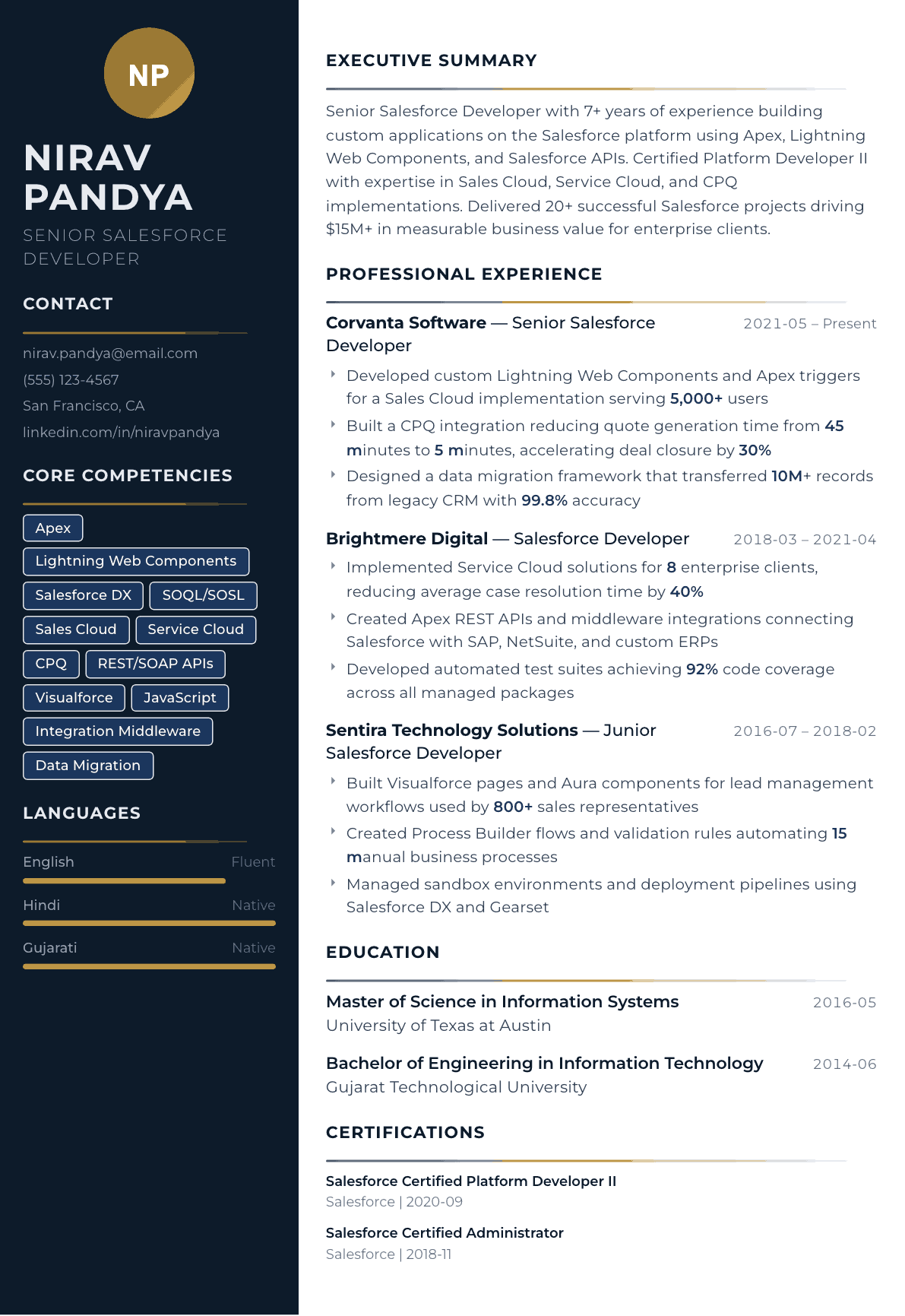
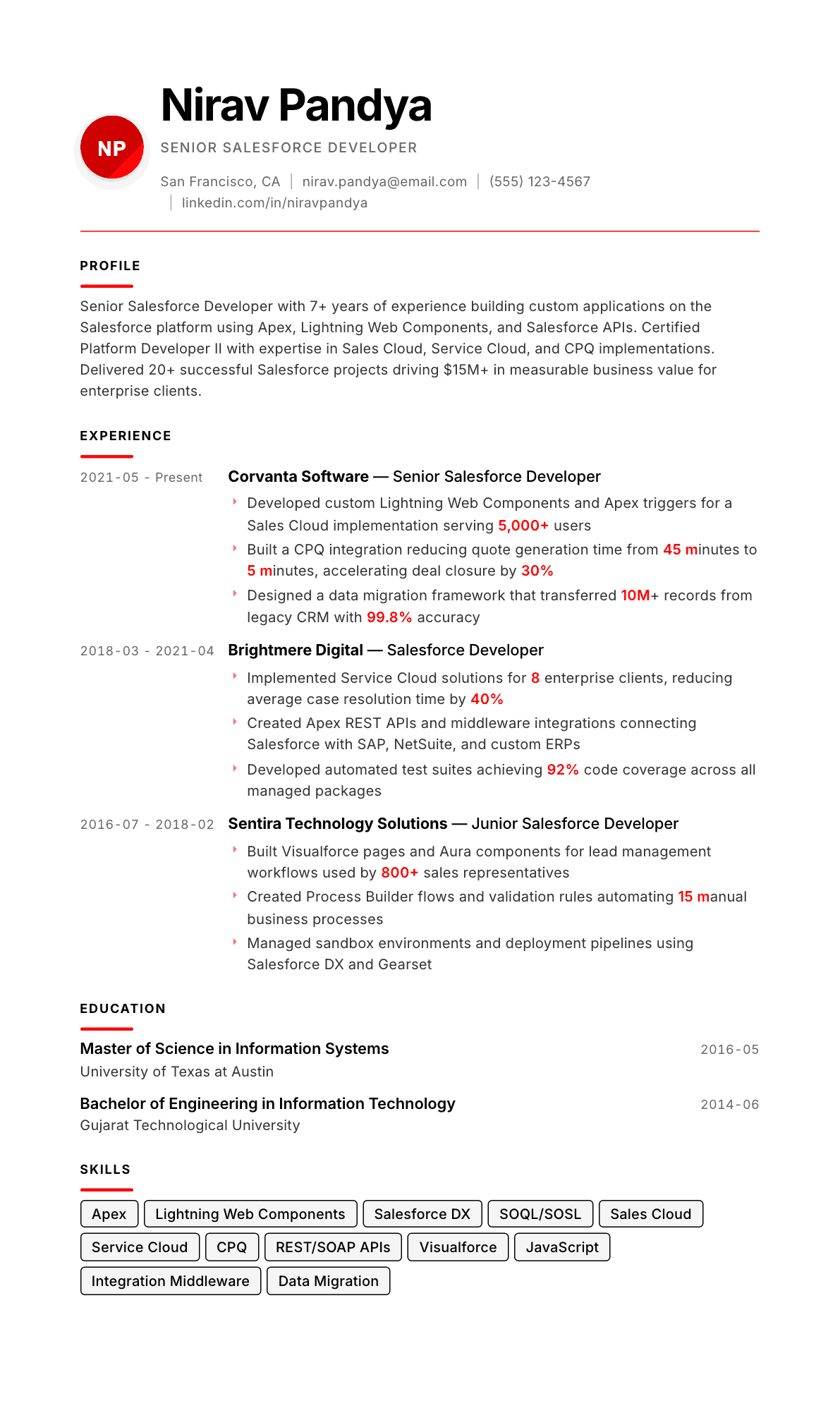
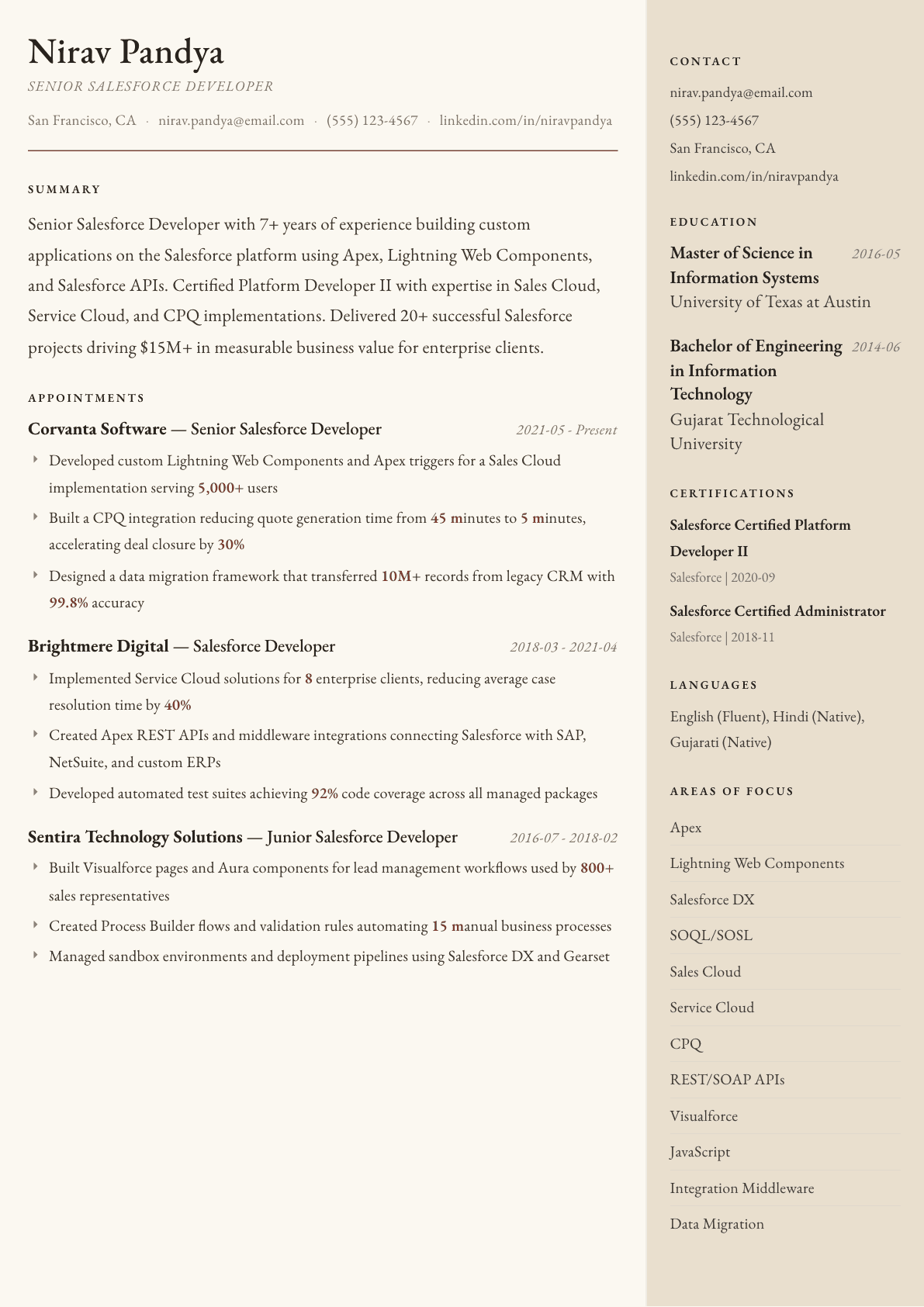
The same salesforce developer content laid out in three CVBooster templates, so you can see what the finished document looks like before you write a word.
Example Salesforce Developer summary
Senior Salesforce Developer with 7 years of experience building enterprise solutions on the Salesforce platform. Certified Platform Developer II with expertise in Apex, Lightning Web Components, and CPQ implementations. Delivered 20+ projects driving $15M+ in business value, including a CPQ integration that accelerated deal closure by 30%.
Skills to list on a Salesforce Developer resume
- Apex
- Lightning Web Components
- Salesforce DX
- SOQL/SOSL
- Sales Cloud
- Service Cloud
- CPQ
- REST/SOAP APIs
- Visualforce
- JavaScript
- Flow Builder
- Data Migration
What actually gets this resume read
- List all Salesforce certifications prominently: PD1, PD2, Admin, Architect, or specialty certs.
- Specify Salesforce clouds and products: Sales Cloud, Service Cloud, CPQ, Marketing Cloud, or Experience Cloud.
- Quantify business impact: deal closure acceleration, case resolution improvement, or data migration accuracy.
- Highlight integration experience: REST/SOAP APIs, middleware connectors, or ETL tool integrations.
- Mention modern Salesforce development: LWC over Aura, Salesforce DX, scratch orgs, and CI/CD pipelines.
How to write a salesforce developer resume
Salesforce hiring runs on credentials more than almost any other development field. Recruiters filter by certification name, partner consultancies must report certified headcount to keep their partner status, and a Trailhead profile is a public record anyone can open. That makes the certification block the most valuable real estate on a Salesforce developer resume, and burying it under education is a straightforward way to lose interviews you would have won.
The second filter is which Salesforce you know. The platform is a collection of products, and Sales Cloud, Service Cloud, Experience Cloud, CPQ, Field Service, Marketing Cloud and the Industries clouds each have their own data model, quirks and job market. A resume that says Salesforce without naming clouds forces the reader to guess, and she will usually guess low.
This guide covers where credentials belong, how to write about declarative and programmatic work without appearing to be only an administrator, the governor limits and integration detail that prove real platform depth, and how to describe project work when your last four years were consultancy engagements.
Format: certifications high, clouds named, org profile stated
Reverse-chronological, one page under six years. Put certifications directly under the summary as a single scannable line, then repeat them with dates in a full section. Add your Trailhead profile in the header as plain text, because many hiring managers check ranks and superbadges before scheduling a call.
Under each role, add an org profile line: the clouds in use, the number of users, whether the org is a managed package publisher or an end customer implementation, and how much technical debt or customization it carries. A heavily customized org with thousands of users is a different job from a clean small implementation, and the reader needs that context.
- Header: name, title, city, email, Trailhead profile.
- Order: summary, certifications, experience with org profiles, technical skills, education.
- Name the clouds explicitly: Sales, Service, Experience, CPQ, Field Service, Marketing.
- Say whether you worked for a customer, a consultancy or an independent software vendor building on the platform.
Summary: certification level, clouds, and what you build
Open with the highest developer credential you hold and the years on platform, then the clouds, then the type of work: custom Lightning Web Components and Apex, integrations into external systems, a managed package, or configuration-led builds with Flow and minimal code.
Be explicit about the mix of declarative and programmatic work. The platform rewards choosing configuration when configuration is enough, and a developer who says she reached for Flow where it fit and Apex where it did not sounds more experienced than one who wrote code for everything.
Experience: Apex, LWC, and the limits that shape both
Write bullets that show you design for the platform rather than against it. Bulkified triggers with a single handler per object, SOQL outside loops, asynchronous processing with Queueable, Batch or Platform Events when volume demands it, and selective queries against large data volumes with the right indexed fields. Governor limits are the daily reality of Apex work, and naming how you designed around them is the clearest proof of experience.
On the front end, name Lightning Web Components work specifically: wire adapters and imperative Apex calls, Lightning Data Service, Lightning Message Service between components, custom events, and where you had to keep Aura or Visualforce alive for compatibility. Say whether your components run in Lightning Experience, an Experience Cloud site or a Flow screen, since each imposes different constraints.
Integration work carries a lot of weight because it is where most implementations fail. Name the pattern and the system: REST and SOAP callouts, named credentials, Platform Events or Change Data Capture for streaming, middleware such as MuleSoft, and external objects through Salesforce Connect. Include the error handling and retry design, not just the connection.
Delivery: DevOps, testing, and data
Salesforce delivery practice has moved a long way, and hiring managers use it as a maturity signal. Say whether you work with Salesforce DX, scratch orgs and source-driven development, or with change sets and sandboxes. Name your deployment tooling, such as Gearset, Copado, or a pipeline built on the Salesforce CLI, and how you handled metadata conflicts between parallel teams.
Testing on the platform is mandatory but usually done badly, so doing it well is a differentiator. Write about Apex test classes with meaningful assertions rather than coverage padding, test data factories, mocking callouts with the HTTP callout mock interface, and Jest tests for Lightning Web Components. State your coverage figure alongside a note about assertion quality.
Data migration deserves a bullet if you have done it. Record volumes, the loader used, external ID strategy, deduplication, relationship rebuilding and the validation you ran afterwards. Migrations are high risk and high visibility, and a clean one is a strong story.
- Source control and deployment: Salesforce DX, scratch orgs, Gearset or Copado pipelines.
- Testing: Apex tests with assertions, callout mocks, Jest for components.
- Data: Data Loader or a bulk API tool, external IDs, large data volume considerations.
- Security: sharing model, with sharing and without sharing, field level security enforced in Apex and components.
Skills: platform depth, then the surrounding stack
Group into programmatic, declarative, integration, delivery and clouds. Under declarative name Flow Builder in its current form rather than obsolete tools, validation rules, approval processes, sharing rules and permission sets. Presenting configuration skill confidently matters, because pure code-only developers often build things the platform already does.
Add the non-Salesforce skills that make you useful on an integration project: JavaScript, SQL, REST API design, JSON and XML handling, and whichever enterprise systems you have connected to such as an enterprise resource planning system or a billing platform. Those broaden the roles you can be considered for without diluting your platform identity.
Salesforce Developer resume summary examples
Junior Salesforce developer
Salesforce Certified Platform Developer I and Administrator with a year supporting a Sales Cloud org of 400 users. Built Flows, validation rules and three Lightning Web Components, and wrote bulkified Apex triggers with test classes. Trailhead Ranger with two superbadges.
Four years in
Salesforce developer with four years across Sales and Service Cloud, currently in an org with 5,000 users and a large managed package footprint. Built an Apex integration layer to an enterprise resource planning system with named credentials and retry handling, and moved the team to Salesforce DX with a Gearset pipeline.
Lead Salesforce developer
Platform Developer II certified lead with nine years across consultancy and in-house roles, including CPQ and Experience Cloud builds. Owns architecture and code review for a team of six, redesigned a trigger framework that removed recursive updates, and led a migration of 10M records with external ID matching.
Work experience bullets: before and after
Before: Wrote Apex triggers and classes for business requirements.
After: Rebuilt Opportunity and Quote automation on a single trigger handler per object with bulkified logic and no SOQL in loops, eliminating recursive updates and clearing the CPU time limit errors that had blocked bulk imports.
Trigger framework design and a named governor limit failure prove platform experience that a generic Apex claim does not.
Before: Built Lightning Web Components for the sales team.
After: Built a quote configurator Lightning Web Component using wire adapters, Lightning Data Service and Lightning Message Service to coordinate with a sibling component, cutting quote entry from 45 minutes to 5 for 5,000 sales users.
Naming the component APIs and the user population turns a build into evidence of design judgment.
Before: Integrated Salesforce with external systems.
After: Designed an integration to an enterprise resource planning system using named credentials, Platform Events for asynchronous updates and a Queueable retry with exponential backoff, keeping order status current for 10k daily transactions.
Integration pattern, authentication approach and failure handling are what separate a working integration from a fragile one.
Before: Achieved high code coverage on Apex tests.
After: Replaced coverage-padding tests with a test data factory and assertion-driven Apex tests including HTTP callout mocks and bulk scenarios, holding coverage at 92% with tests that actually failed when logic broke.
It addresses the well known weakness of Salesforce test suites instead of quoting a coverage number alone.
Before: Helped with data migration to Salesforce.
After: Migrated 10M account, contact and opportunity records from a legacy CRM using the Bulk API with external ID matching, deduplication rules and a post-load validation report, reaching 99.8% record accuracy on reconciliation.
Volume, matching strategy and a reconciliation step show a controlled migration rather than a file upload.
Hard skills
- Apex
- Lightning Web Components
- SOQL and SOSL
- Trigger frameworks and bulkification
- Asynchronous Apex (Queueable, Batch, Future)
- Platform Events and Change Data Capture
- Flow Builder and declarative automation
- Salesforce DX and scratch orgs
- Deployment pipelines (Gearset, Copado, Salesforce CLI)
- REST and SOAP integrations with named credentials
- Sales Cloud and Service Cloud data models
- CPQ configuration and customization
- Apex testing and Jest for components
- Data migration with the Bulk API
Soft skills
- Requirements gathering with business stakeholders
- Choosing configuration over code when it fits
- Explaining platform limits to clients
- Working within consultancy delivery timelines
- Code review and mentoring on platform practice
Certifications worth listing
- Salesforce Certified Platform Developer I (Salesforce)
- Salesforce Certified Platform Developer II (Salesforce)
- Salesforce Certified Administrator (Salesforce)
- Salesforce Certified Platform App Builder (Salesforce)
- Salesforce Certified JavaScript Developer I (Salesforce)
- Salesforce Certified CPQ Specialist (Salesforce)
- Salesforce Certified Application Architect (Salesforce)
Mistakes that cost salesforce developer candidates the interview
- Putting certifications at the bottom, in a market where recruiters screen on credential names before reading anything else.
- Writing Salesforce without naming the clouds, which leaves the reader unable to match you to her implementation.
- Describing only configuration work when applying for developer roles, or only code when the posting is configuration-led.
- Quoting a code coverage figure with no mention of assertions, which every experienced platform lead reads skeptically.
- Listing consultancy clients as separate employers, which fragments the timeline and makes tenure look unstable.
- Never mentioning governor limits, large data volumes or deployment tooling, the three things that prove you have worked in a real org rather than a training playground.
Salesforce Developer resume questions
How many Salesforce certifications do I need?
Administrator plus Platform Developer I is the practical baseline for developer roles, with Platform Developer II marking the step to senior. Beyond that, add the credential that matches your target work, such as CPQ Specialist or an architect track exam. Collecting unrelated certifications adds less than depth in one cloud.
Should I put my Trailhead profile on my resume?
Yes. Many hiring managers open it, and superbadges are a credible demonstration of hands-on work because they require building in an org rather than answering questions. Include the link in the header and keep the profile current, since a stale profile is worse than none.
How do I present consultancy project work?
Keep the consultancy as the employer with one date range, then list engagements underneath as projects with the client industry, cloud, org size and your role. That preserves tenure while still showing breadth, and it prevents a reader from thinking you changed jobs six times in three years.
Is admin experience a disadvantage when applying for developer roles?
No, it is an advantage if you frame it as platform judgment. Say where you chose Flow over Apex, how you use permission sets and the sharing model, and how admin knowledge kept your code from duplicating native features. Then make sure the programmatic work is clearly visible in every role.
What technical details prove real Salesforce depth?
Governor limits you designed around, trigger framework structure, large data volume and selective query handling, integration patterns with named credentials and retry logic, and your deployment approach. Those are the topics that only come up once someone has worked in a busy production org.
Related resume examples
- Software Engineer Resume example
- Business Analyst Resume example
- Full-Stack Developer Resume example
- Salesforce Administrator Resume example
- Solutions Architect Resume example
- JavaScript Developer Resume example