Full Stack Development: Layers, Skills, Pay and Examples

Full stack development is building every layer of a web application yourself: the screen people click (front end), the server logic behind it (back end), the database that stores the data, and the deployment that puts it online. The constraint is depth: nobody is an expert in every layer, so a full stack engineer is strong in one or two and competent in the rest. The pay figures below come from the Bureau of Labor Statistics Occupational Outlook Handbook. On this page: the four layers, a skills table, pay, and six examples, including a full stack engineer resume.
The job ad wants React, Node, Python, Go, Kubernetes, AWS, Figma and "a passion for clean code", all for one person. That is not a job description. That is a department that left one by one and nobody updated the posting. Here is what full stack actually means day to day.
Full stack development in one example
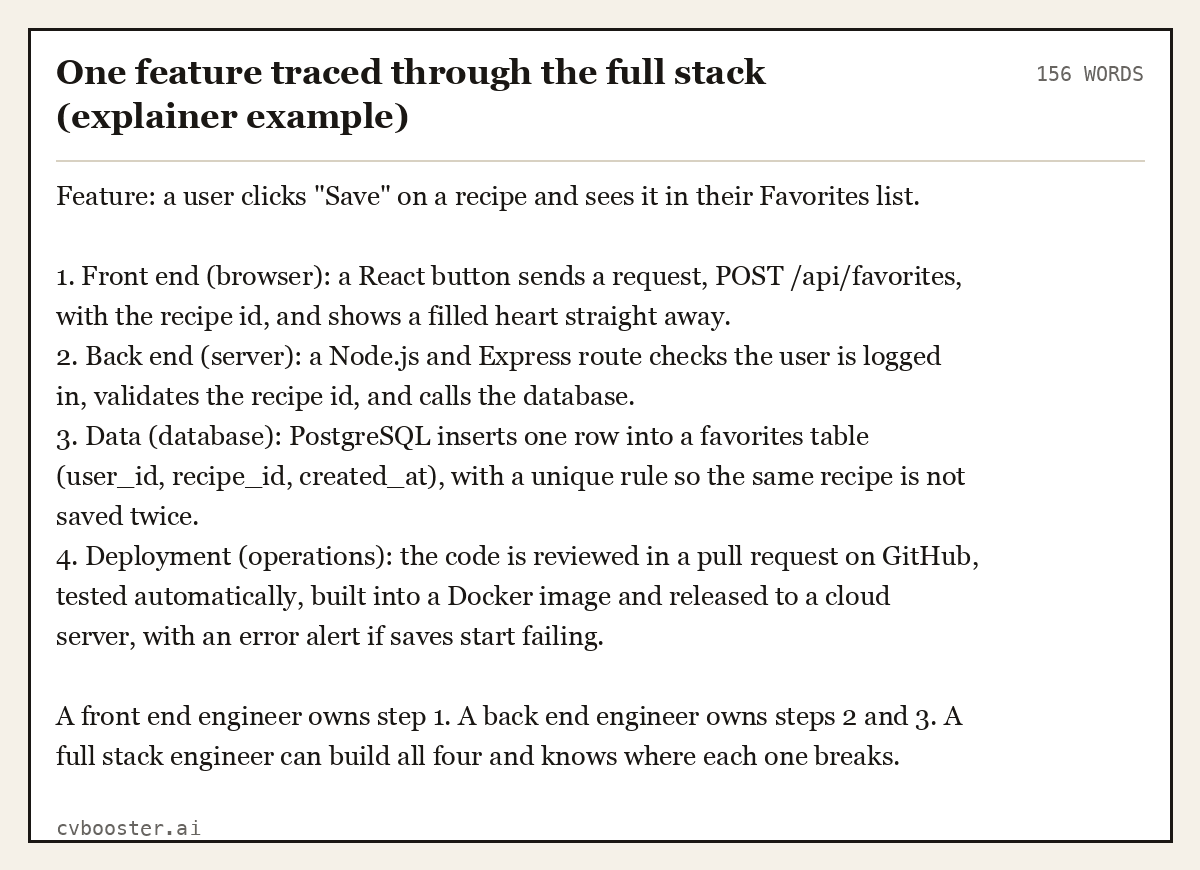
The fastest way to understand the stack is to follow one click through it. Here is a simple feature, a "save to favorites" button on a recipe site, traced through all four layers.
One feature traced through the full stack (explainer example)
156 wordsFeature: a user clicks "Save" on a recipe and sees it in their Favorites list.
1. Front end (browser): a React button sends a request, POST /api/favorites, with the recipe id, and shows a filled heart straight away. 2. Back end (server): a Node.js and Express route checks the user is logged in, validates the recipe id, and calls the database. 3. Data (database): PostgreSQL inserts one row into a favorites table (user_id, recipe_id, created_at), with a unique rule so the same recipe is not saved twice. 4. Deployment (operations): the code is reviewed in a pull request on GitHub, tested automatically, built into a Docker image and released to a cloud server, with an error alert if saves start failing.
A front end engineer owns step 1. A back end engineer owns steps 2 and 3. A full stack engineer can build all four and knows where each one breaks.
Create my CVOr start from one of our free resume templates
The four layers of the stack
Every web product, from a bakery's order form to a banking app, has the same four layers. The tools change; the layers do not.
Front end. Everything the user sees and touches in the browser or app. The base languages are HTML, CSS and JavaScript, built on open standards that the W3C publishes. Most teams add a framework such as React, Vue or Angular, and TypeScript for safer code.
Back end. The server code that runs the rules: logins, payments, permissions, emails. Common choices are Node.js, Python (Django, FastAPI), Java (Spring), C# (.NET), Go and Ruby on Rails. The back end exposes an API, usually REST or GraphQL, that the front end calls.
Data. Where the information lives. Relational databases such as PostgreSQL and MySQL hold structured records; document stores such as MongoDB hold flexible ones; Redis keeps fast caches. Knowing SQL well is still the most portable skill in the stack.
Deployment and operations. Getting code from a laptop to real users and keeping it running. That means version control with Git, which its own project describes as free and open source (git-scm.com), plus automated tests, containers (Docker), a cloud platform (AWS, Azure, Google Cloud) and monitoring.
Running through all four is security. The OWASP Top 10 calls itself "the reference standard for the most critical web application security risks", and a full stack engineer is expected to know it, because a bug in any layer can expose the data in all of them.
Full stack skills table
Use this table two ways: to see what to learn next, and to pick the words that belong on your resume. Put on the resume only what you have used on a real project.
| Layer | Core skills | Common tools | How to prove it |
|---|---|---|---|
| Front end | HTML, CSS, JavaScript, responsive layout, accessibility | React, Vue, Angular, TypeScript, Tailwind | A live site or app you built, with a link |
| Back end | API design, authentication, business logic, testing | Node.js, Express, Python, Django, Java, Spring, .NET | An API with docs and tests in a public repository |
| Data | SQL, data modeling, indexing, migrations | PostgreSQL, MySQL, MongoDB, Redis | A schema you designed and the queries you tuned |
| Deployment | Version control, CI/CD, containers, cloud basics | Git, GitHub Actions, Docker, AWS, Azure | A pipeline that deploys on every merge |
| Across the stack | Security, debugging, performance, code review | OWASP Top 10, browser dev tools, logging | A bug you found and fixed, written up |
| People skills | Clear writing, estimating, working with design and product | Jira, Figma, pull request reviews | A feature you took from idea to release |
For more on how to present technical tools, see our list of hard skills for a resume.
What full stack engineers earn
The Bureau of Labor Statistics does not publish a separate "full stack" occupation, so the closest official numbers are its two nearby groups. On its software occupation page, BLS reports a median annual wage of $135,980 in May 2025. On its web occupation page, the 2025 median pay for its web and digital designer group is $99,520 per year.
Two honest notes on those figures. First, they are medians for the whole occupation, so a first job usually pays less and senior roles more. Second, a full stack title alone does not decide pay: the employer, the city and how much of the back end you own matter more. Use the BLS pages as a starting point and check the pay range printed in the postings you apply for.
The same BLS software page lists a bachelor's degree as the typical entry-level education. Plenty of full stack engineers also come in through community college programs, bootcamps or self-taught portfolios; what gets you hired is proof you can ship.
How to become a full stack engineer
You do not learn the whole stack at once. You build one small, complete thing, then a slightly bigger one.
- Learn the front end base. HTML, CSS and JavaScript until you can build a page without a framework.
- Add one framework. React, Vue and Angular are the usual choices; pick one and stay with it for a year.
- Learn one back end language. If you already know JavaScript, Node.js keeps you in one language.
- Learn SQL properly. Joins, indexes and transactions. It outlives every framework.
- Deploy something real. Put a project online with Git, a test suite and a cloud host.
- Read the OWASP Top 10. Then check your own project against it.
- Write it up. A short README per project is the bridge between your code and a hiring manager.
When you start interviewing, our guide to technical interview questions covers the kinds of questions to expect.
Full stack resume and career examples
The examples below are the pieces a full stack job search needs: a complete resume, a skills section, project bullets, a summary for a junior, a LinkedIn About section and an interview answer.
Full stack engineer resume (mid level, 5 years)
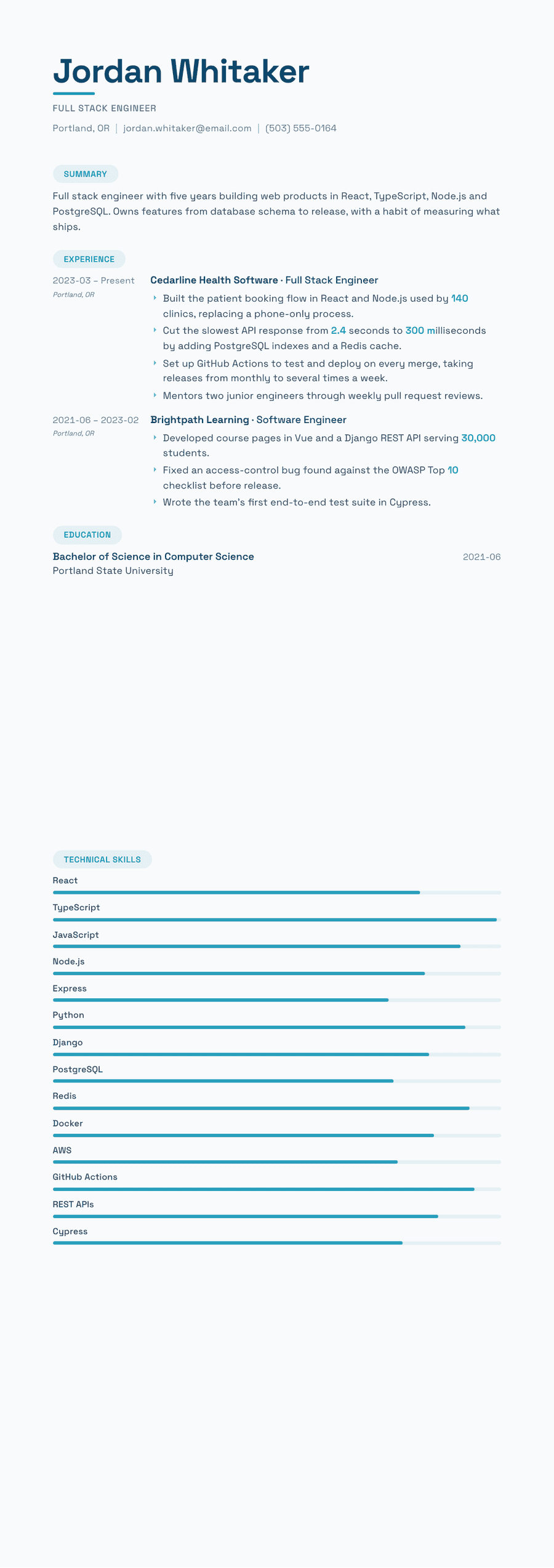
202 wordsJordan Whitaker Full Stack Engineer (503) 555-0164 · jordan.whitaker@email.com · Portland, OR
Summary Full stack engineer with five years building web products in React, TypeScript, Node.js and PostgreSQL. Owns features from database schema to release, with a habit of measuring what ships.
Experience Full Stack Engineer, Cedarline Health Software, Portland, OR | Mar 2023 to Present - Built the patient booking flow in React and Node.js used by 140 clinics, replacing a phone-only process. - Cut the slowest API response from 2.4 seconds to 300 milliseconds by adding PostgreSQL indexes and a Redis cache. - Set up GitHub Actions to test and deploy on every merge, taking releases from monthly to several times a week. - Mentors two junior engineers through weekly pull request reviews.
Software Engineer, Brightpath Learning, Portland, OR | Jun 2021 to Feb 2023 - Developed course pages in Vue and a Django REST API serving 30,000 students. - Fixed an access-control bug found against the OWASP Top 10 checklist before release. - Wrote the team's first end-to-end test suite in Cypress.
Education Bachelor of Science, Computer Science, Portland State University, 2021
Skills React, TypeScript, JavaScript, Node.js, Express, Python, Django, PostgreSQL, Redis, Docker, AWS, GitHub Actions, REST APIs, Cypress
Horizon template: Use this template
Full stack skills section for a resume (copy and edit)
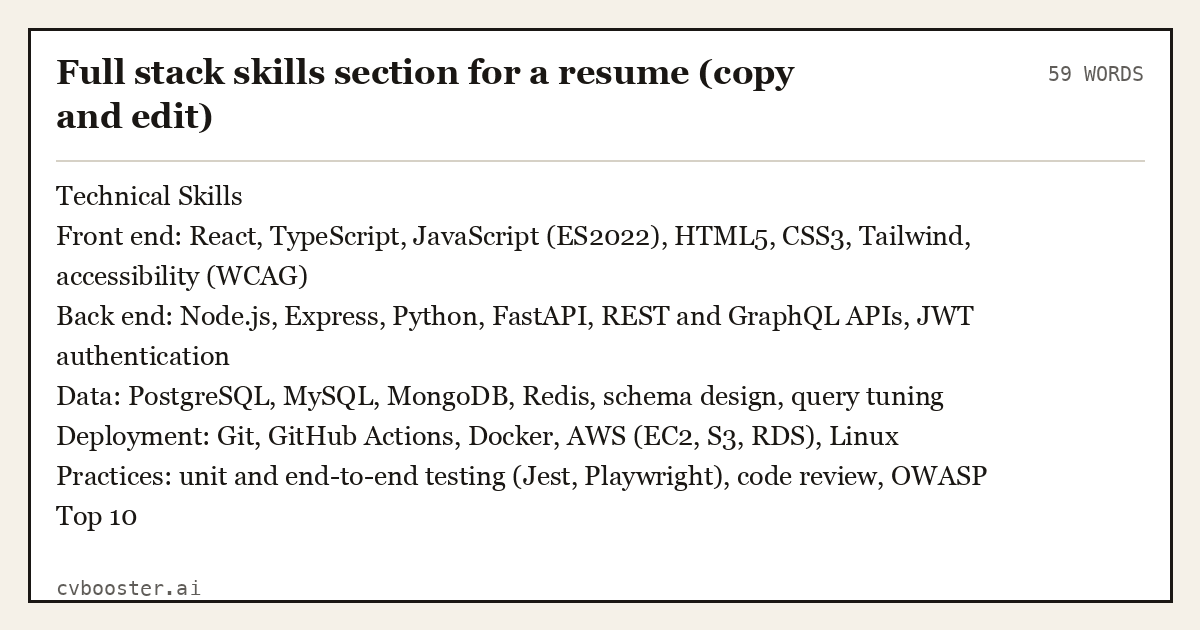
59 wordsTechnical Skills Front end: React, TypeScript, JavaScript (ES2022), HTML5, CSS3, Tailwind, accessibility (WCAG) Back end: Node.js, Express, Python, FastAPI, REST and GraphQL APIs, JWT authentication Data: PostgreSQL, MySQL, MongoDB, Redis, schema design, query tuning Deployment: Git, GitHub Actions, Docker, AWS (EC2, S3, RDS), Linux Practices: unit and end-to-end testing (Jest, Playwright), code review, OWASP Top 10
Project bullets for a portfolio project (junior level)
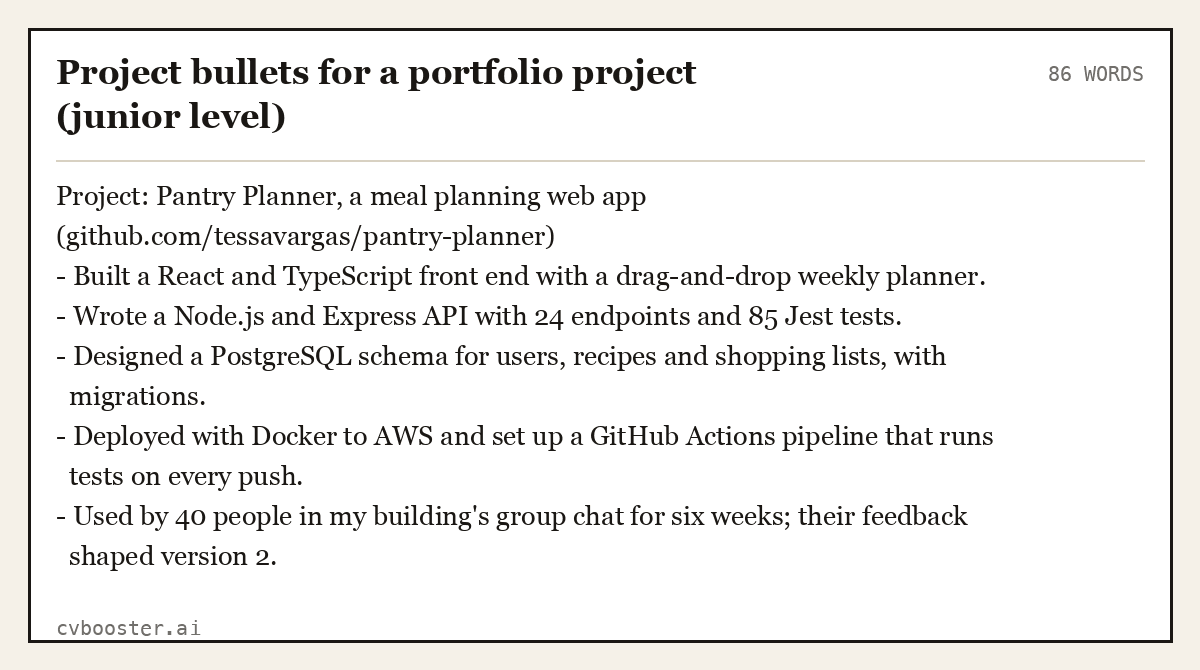
86 wordsProject: Pantry Planner, a meal planning web app (github.com/tessavargas/pantry-planner) - Built a React and TypeScript front end with a drag-and-drop weekly planner. - Wrote a Node.js and Express API with 24 endpoints and 85 Jest tests. - Designed a PostgreSQL schema for users, recipes and shopping lists, with migrations. - Deployed with Docker to AWS and set up a GitHub Actions pipeline that runs tests on every push. - Used by 40 people in my building's group chat for six weeks; their feedback shaped version 2.
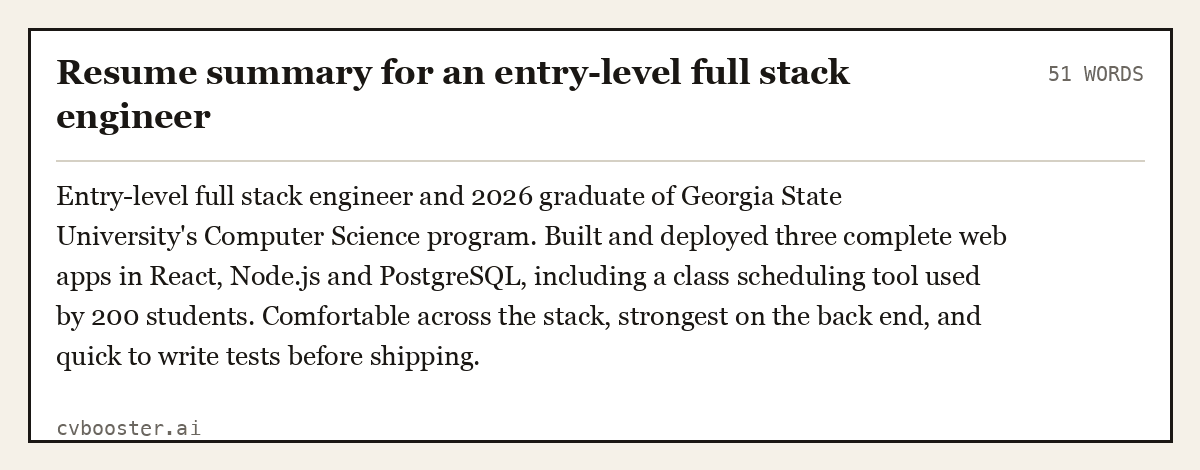
Resume summary for an entry-level full stack engineer
51 wordsEntry-level full stack engineer and 2026 graduate of Georgia State University's Computer Science program. Built and deployed three complete web apps in React, Node.js and PostgreSQL, including a class scheduling tool used by 200 students. Comfortable across the stack, strongest on the back end, and quick to write tests before shipping.
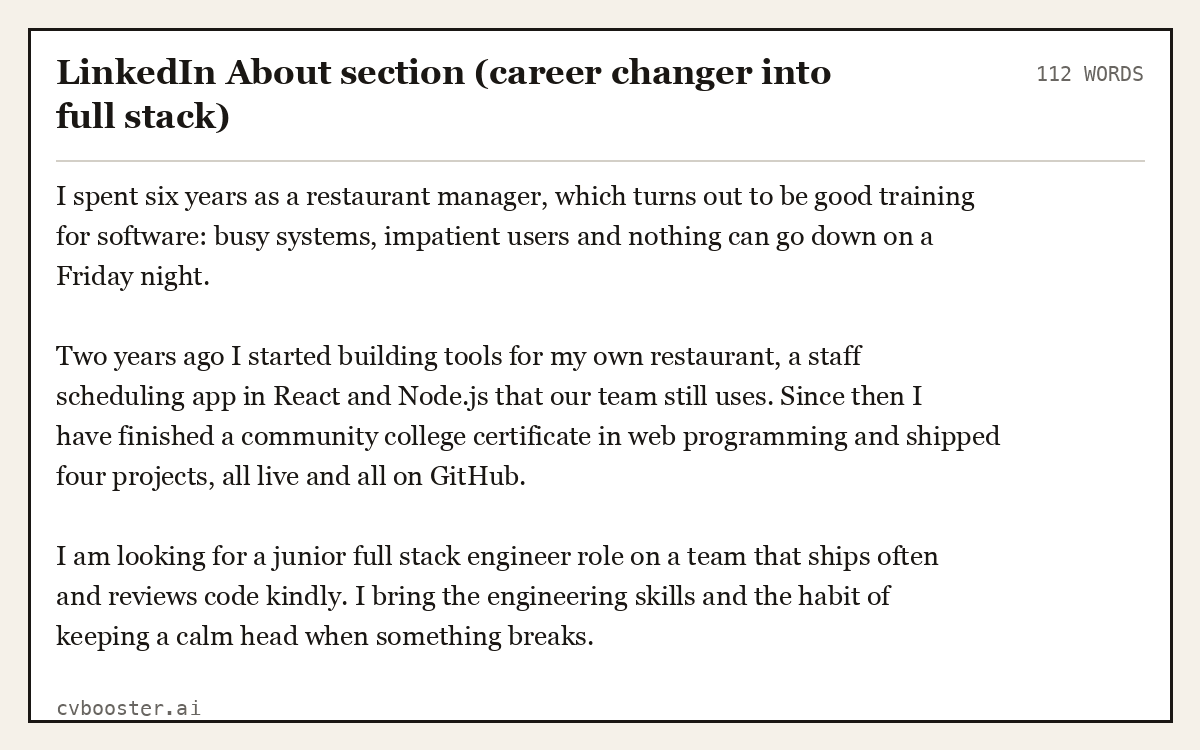
LinkedIn About section (career changer into full stack)
112 wordsI spent six years as a restaurant manager, which turns out to be good training for software: busy systems, impatient users and nothing can go down on a Friday night.
Two years ago I started building tools for my own restaurant, a staff scheduling app in React and Node.js that our team still uses. Since then I have finished a community college certificate in web programming and shipped four projects, all live and all on GitHub.
I am looking for a junior full stack engineer role on a team that ships often and reviews code kindly. I bring the engineering skills and the habit of keeping a calm head when something breaks.
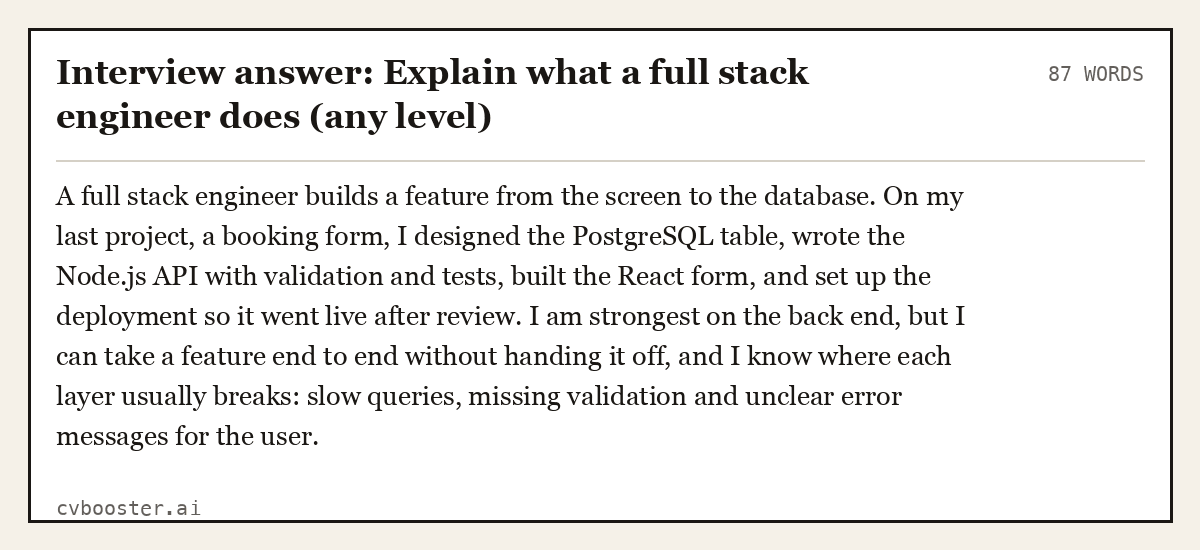
Interview answer: Explain what a full stack engineer does (any level)
87 wordsA full stack engineer builds a feature from the screen to the database. On my last project, a booking form, I designed the PostgreSQL table, wrote the Node.js API with validation and tests, built the React form, and set up the deployment so it went live after review. I am strongest on the back end, but I can take a feature end to end without handing it off, and I know where each layer usually breaks: slow queries, missing validation and unclear error messages for the user.
Full stack vs front end vs back end
The three titles overlap more than job ads admit. Here is the short version.
- Front end engineer: owns the interface, performance in the browser and accessibility. Deep in one framework.
- Back end engineer: owns APIs, data, security and scale. Deep in one language and the database.
- Full stack engineer: owns whole features across both, usually with one side stronger. Common in startups and small teams, where one person carrying a feature end to end saves a handoff.
If you are choosing between titles for your own resume, use the one the posting uses, and back it with the role page that fits: our software engineer resume examples, or DevOps engineer if your strength is deployment. If your history is mostly older code, our computer programmer resume guide fits better. A portfolio link helps more than a longer list; our page on portfolio vs resume explains how to use both.
Frequently asked questions
What is full stack development in simple words?
Full stack development means building both sides of a website or app: the part people see in the browser and the server and database behind it. A full stack engineer can take one feature, such as a login or a checkout, and build every layer of it, then put it online and keep it running.
What skills do you need for full stack development?
You need HTML, CSS and JavaScript plus one front end framework such as React, one back end language such as Node.js or Python, SQL and a database such as PostgreSQL, Git, and basic deployment with Docker and a cloud platform. Add security basics from the OWASP Top 10 and the ability to explain your work clearly.
Is full stack development hard to learn?
It is wide rather than deep, which makes it slow more than hard. Most people learn one layer well, usually the front end, then add a back end language and a database over the next year. The trick is building small, complete projects that touch every layer, instead of collecting tutorials for each tool separately.
How much does a full stack engineer make?
BLS has no separate full stack occupation. Its software occupation page reports a median annual wage of $135,980 in May 2025, and its web occupation page lists a 2025 median of $99,520 per year for web and digital designers. Your pay depends on employer, city, seniority and how much of the stack you own.
Do you need a degree for full stack development?
BLS lists a bachelor's degree as the typical entry-level education for its software occupation, and many postings ask for one. Many full stack engineers are also hired from community college programs, bootcamps or self-taught portfolios. Whatever your route, live projects with clean code, tests and a short write-up are what get you interviews.
More in this series: related guides
- AI Letter Writer: 7 Prompts and the Fixed Letters They Need
- Amazon Resume Example: 6 Resumes Using Leadership Principles
- Best Resume Builder: 9 Tools Compared on the Free Download
- Business Analyst Cover Letter: 8 Examples by Level
- Career Change Cover Letter: 8 Examples by Career Switch
- Chef Cover Letter: 8 Examples From Line Cook to Exec Chef
- Cover Letter Heading: Format and 10 Complete Examples
- Creative Resume Template: 6 Designs with Complete Examples
- Data Scientist Cover Letter: 8 Examples From Entry Level
- Digital Marketing Cover Letter: 8 Examples by Specialty
- EAP Program: What It Covers, Is It Confidential, 7 Scripts
- Help With Resume Wording: 60 Before and After Lines
- How to Make Your Resume Stand Out: 15 Moves That Work
- How to Quit a Job: 7 Steps and 8 Scripts You Can Use
- How to Start a Cover Letter: 30 Openings and 3 Letters
- Resume Fixer: 15 Fixes With Before and After Examples
- Resume PDF Download: 6 Ready Formats and How to Save a PDF
- Resume Screening: The 6 Stages and 8 Lines That Pass Them
- Simple CV Format: Section Order and 6 Examples for Any Job
- Truck Driver Cover Letter: 8 Examples for CDL Drivers
- US Resume Format: Rules and 6 Examples for American Jobs
- Walmart Resume Example: 6 Resumes for Real Store Roles
- Warehouse Worker Cover Letter: 8 Examples by Job Type
- What Is Practical Nursing: LPN Role, Training, Pay, Exam
Looking for a worked example for your job title? Browse the resume examples by job title.