Making Effective Decisions: 4 Civil Service Examples
By Mustafa Tarabya, founder of CVBooster · Published · Updated
14 min read
A Making Effective Decisions civil service example is scored on how you reached the decision. The outcome matters less than the trail you left behind it. Civil Service Jobs adverts usually cap each behaviour at 250 words, so the evidence, the rejected option and the sign off share about 120 words. Every indicator quoted here is taken from the Cabinet Office framework, Success Profiles: Civil Service behaviours, as it stood on 12 September 2026. Statements for EO, HEO, SEO and Grade 7 sit below, each marked up against the bullets for its own grade. Written by Mustafa Tarabya, who hired for his own company, read every application himself and now writes CVBooster's guides.
What the scoring actually rewards
Success Profiles: Civil Service behaviours sets out this behaviour in two sentences.
The behaviour, quoted: "Use evidence and knowledge to support accurate, expert decisions and advice. Carefully consider alternative options, implications and risks of decisions" (gov.uk, Making effective decisions).
A sifter marking this behaviour hunts for four things. The evidence you used. The options you weighed and dropped. The people you involved. The record you left afterwards. A happy ending with none of those in view is a 3.
Grade decides which bullets apply. The Success Profiles: Civil Service Behaviours PDF puts it plainly: "Civil Service Behaviours are specific to the grade level of the job role". The framework runs Higher Executive Officer and Senior Executive Officer together in one list. The two middle statements below answer identical bullets at different scope.
Example at EO, annotated
This is written for an EO advert in a jobcentre. Compare it with the Working Together example if your advert pairs the two.
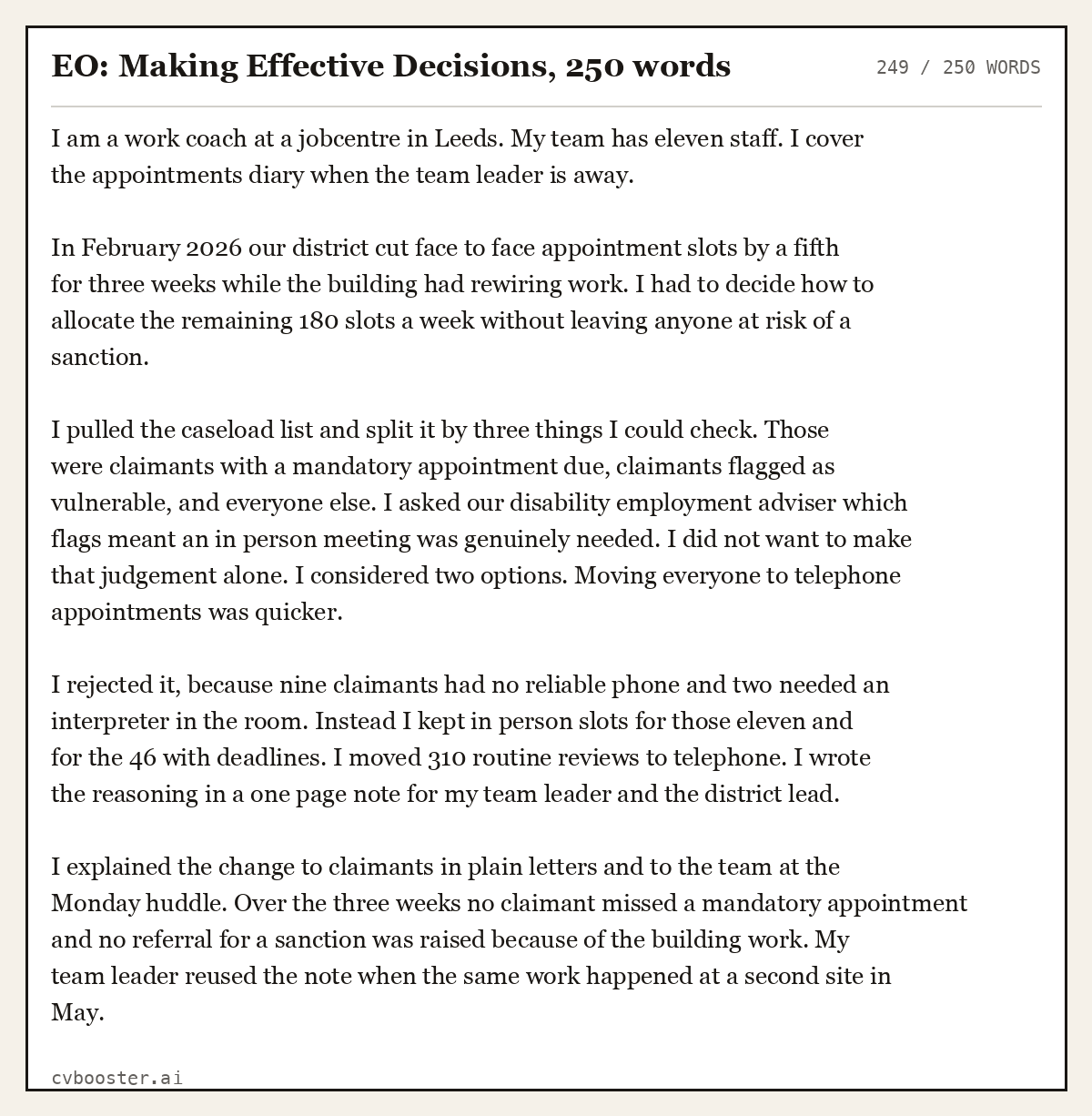
EO: Making Effective Decisions, 250 words (249 words)
I am a work coach at a jobcentre in Leeds. My team has eleven staff. I cover the appointments diary when the team leader is away.
In February 2026 our district cut face to face appointment slots by a fifth for three weeks while the building had rewiring work. I had to decide how to allocate the remaining 180 slots a week without leaving anyone at risk of a sanction.
I pulled the caseload list and split it by three things I could check. Those were claimants with a mandatory appointment due, claimants flagged as vulnerable, and everyone else. I asked our disability employment adviser which flags meant an in person meeting was genuinely needed. I did not want to make that judgement alone. I considered two options. Moving everyone to telephone appointments was quicker.
I rejected it, because nine claimants had no reliable phone and two needed an interpreter in the room. Instead I kept in person slots for those eleven and for the 46 with deadlines. I moved 310 routine reviews to telephone. I wrote the reasoning in a one page note for my team leader and the district lead.
I explained the change to claimants in plain letters and to the team at the Monday huddle. Over the three weeks no claimant missed a mandatory appointment and no referral for a sanction was raised because of the building work. My team leader reused the note when the same work happened at a second site in May.
What the sifter is scoring
- Indicator: "take responsibility for making effective and fair decisions, in a timely manner" (gov.uk, EO). In the statement: the call is made inside a three week window, on stated criteria.
- Indicator: "analyse and research further information to support decisions" (gov.uk, EO). In the statement: the caseload list and the system flags.
- Indicator: "talk to relevant people to get advice and information when unsure how to proceed" (gov.uk, EO). In the statement: the disability employment adviser.
- Indicator: "demonstrate the consideration of all options, costs, risks and wider implications, including the diverse needs of end users and any accessibility requirements" (gov.uk, EO). In the statement: the rejected telephone only option.
- Indicator: "explain how decisions have been reached in a clear and concise way, both verbally and in writing" (gov.uk, EO). In the statement: the note, the letters, the huddle.
Example at HEO, annotated
At HEO a decision usually binds a budget or a caseload.
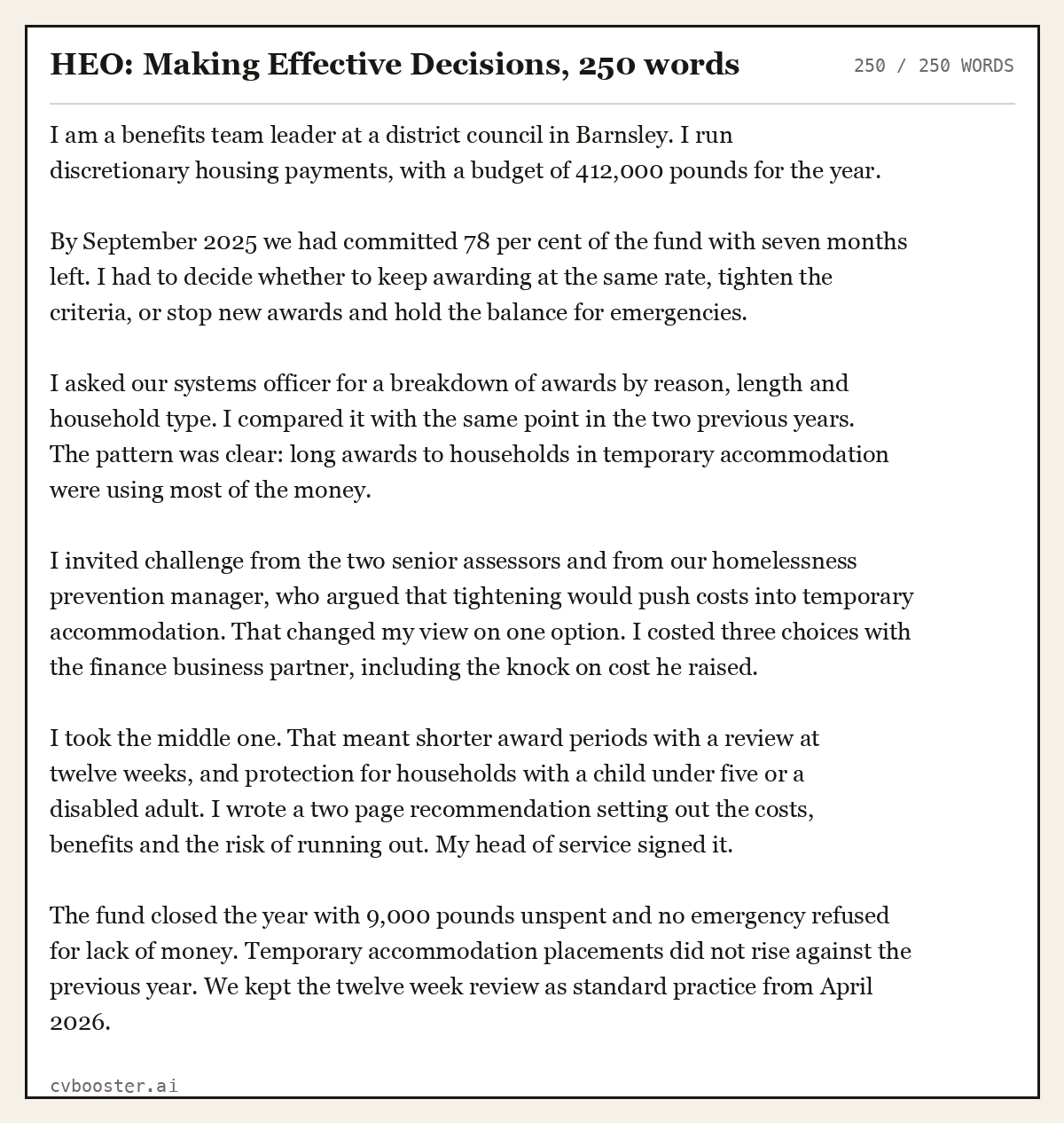
HEO: Making Effective Decisions, 250 words (250 words)
I am a benefits team leader at a district council in Barnsley. I run discretionary housing payments, with a budget of 412,000 pounds for the year.
By September 2025 we had committed 78 per cent of the fund with seven months left. I had to decide whether to keep awarding at the same rate, tighten the criteria, or stop new awards and hold the balance for emergencies.
I asked our systems officer for a breakdown of awards by reason, length and household type. I compared it with the same point in the two previous years. The pattern was clear: long awards to households in temporary accommodation were using most of the money.
I invited challenge from the two senior assessors and from our homelessness prevention manager, who argued that tightening would push costs into temporary accommodation. That changed my view on one option. I costed three choices with the finance business partner, including the knock on cost he raised.
I took the middle one. That meant shorter award periods with a review at twelve weeks, and protection for households with a child under five or a disabled adult. I wrote a two page recommendation setting out the costs, benefits and the risk of running out. My head of service signed it.
The fund closed the year with 9,000 pounds unspent and no emergency refused for lack of money. Temporary accommodation placements did not rise against the previous year. We kept the twelve week review as standard practice from April 2026.
What the sifter is scoring
- Indicator: "analyse and use a range of relevant, credible information from internal and external sources to support decisions" (gov.uk, HEO and SEO). In the statement: the award breakdown compared against two previous years.
- Indicator: "invite challenge and where appropriate involve others in decision making" (gov.uk, HEO and SEO). In the statement: the homelessness prevention manager changing the assessment of one option.
- Indicator: "consult with others to ensure the potential impacts on end users have been considered" (gov.uk, HEO and SEO). In the statement: the protected categories for children and disabled adults.
- Indicator: "present strong recommendations in a timely manner outlining the consideration of other options, costs, benefits and risks" (gov.uk, HEO and SEO). In the statement: the two page recommendation with three costed options.
Example at SEO, annotated
At SEO the panel wants a decision other teams had to live with, and a delegation you named.
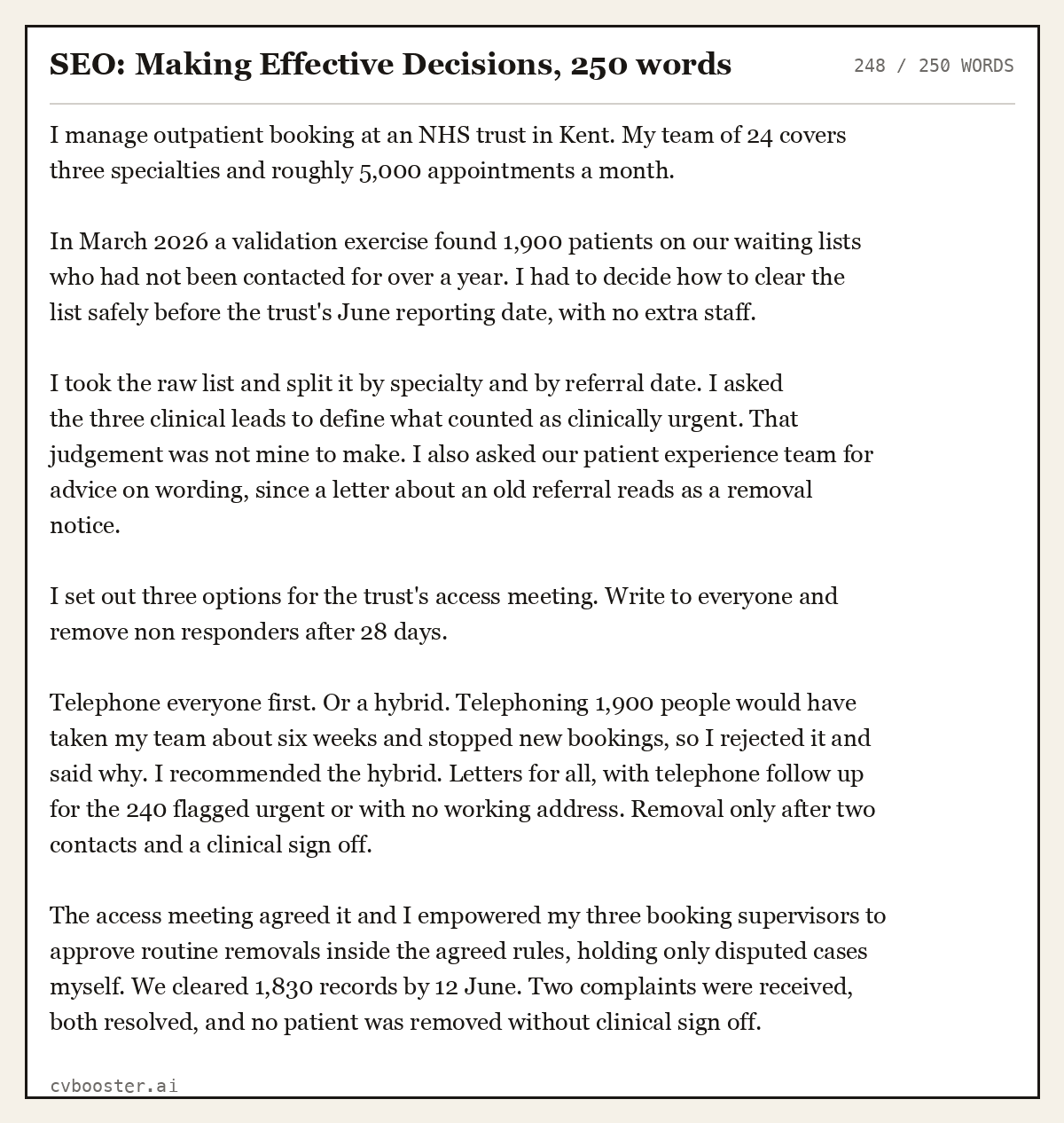
SEO: Making Effective Decisions, 250 words (248 words)
I manage outpatient booking at an NHS trust in Kent. My team of 24 covers three specialties and roughly 5,000 appointments a month.
In March 2026 a validation exercise found 1,900 patients on our waiting lists who had not been contacted for over a year. I had to decide how to clear the list safely before the trust's June reporting date, with no extra staff.
I took the raw list and split it by specialty and by referral date. I asked the three clinical leads to define what counted as clinically urgent. That judgement was not mine to make. I also asked our patient experience team for advice on wording, since a letter about an old referral reads as a removal notice.
I set out three options for the trust's access meeting. Write to everyone and remove non responders after 28 days.
Telephone everyone first. Or a hybrid. Telephoning 1,900 people would have taken my team about six weeks and stopped new bookings, so I rejected it and said why. I recommended the hybrid. Letters for all, with telephone follow up for the 240 flagged urgent or with no working address. Removal only after two contacts and a clinical sign off.
The access meeting agreed it and I empowered my three booking supervisors to approve routine removals inside the agreed rules, holding only disputed cases myself. We cleared 1,830 records by 12 June. Two complaints were received, both resolved, and no patient was removed without clinical sign off.
What the sifter is scoring
- Indicator: "understand your own level of responsibility and empower others to make decisions where appropriate" (gov.uk, HEO and SEO). In the statement: delegating routine removals to supervisors and keeping disputed cases.
- Indicator: "display confidence when making difficult decisions, even if they prove to be unpopular" (gov.uk, HEO and SEO). In the statement: rejecting the telephone first option in front of the access meeting and giving the reason.
- Indicator: "analyse and use a range of relevant, credible information from internal and external sources to support decisions" (gov.uk, HEO and SEO). In the statement: the split of the raw list and the clinical definitions of urgency.
- Indicator: "consult with others to ensure the potential impacts on end users have been considered" (gov.uk, HEO and SEO). In the statement: the patient experience advice on the letter wording.
Example at Grade 7, annotated
Grade 7 has its own bullets. Two of them are about evidence that is incomplete, which is the usual gap in a promotion statement.
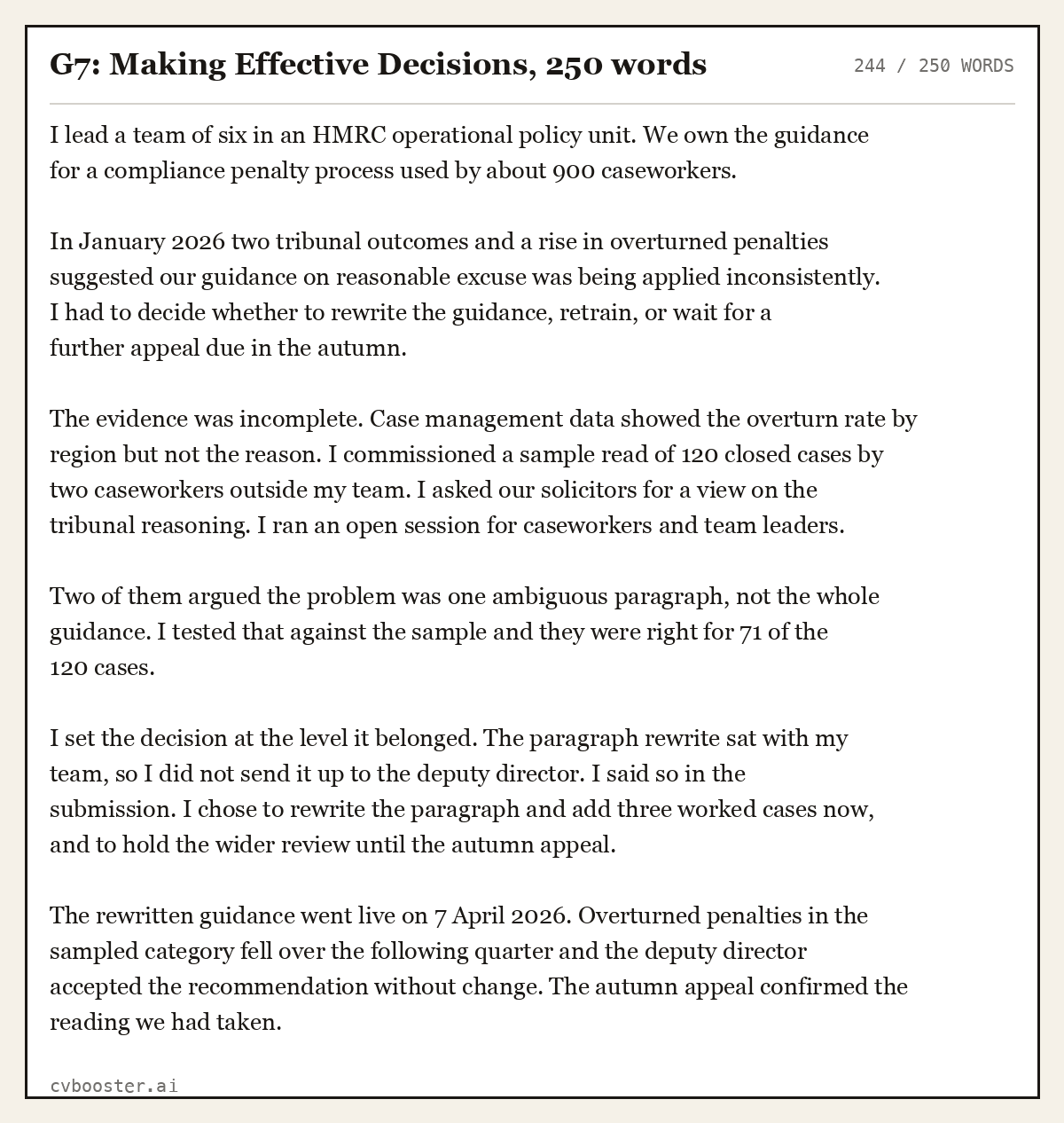
G7: Making Effective Decisions, 250 words (244 words)
I lead a team of six in an HMRC operational policy unit. We own the guidance for a compliance penalty process used by about 900 caseworkers.
In January 2026 two tribunal outcomes and a rise in overturned penalties suggested our guidance on reasonable excuse was being applied inconsistently. I had to decide whether to rewrite the guidance, retrain, or wait for a further appeal due in the autumn.
The evidence was incomplete. Case management data showed the overturn rate by region but not the reason. I commissioned a sample read of 120 closed cases by two caseworkers outside my team. I asked our solicitors for a view on the tribunal reasoning. I ran an open session for caseworkers and team leaders.
Two of them argued the problem was one ambiguous paragraph, not the whole guidance. I tested that against the sample and they were right for 71 of the 120 cases.
I set the decision at the level it belonged. The paragraph rewrite sat with my team, so I did not send it up to the deputy director. I said so in the submission. I chose to rewrite the paragraph and add three worked cases now, and to hold the wider review until the autumn appeal.
The rewritten guidance went live on 7 April 2026. Overturned penalties in the sampled category fell over the following quarter and the deputy director accepted the recommendation without change. The autumn appeal confirmed the reading we had taken.
What the sifter is scoring
- Indicator: "present reasonable conclusions from a wide range of complex and sometimes incomplete evidence" (gov.uk, Grade 6 and Grade 7). In the statement: acting on a sample read and legal advice when case data lacked reasons.
- Indicator: "ensure decision making happens at the right level, not allowing unnecessary bureaucracy to hinder delivery" (gov.uk, Grade 6 and Grade 7). In the statement: keeping the paragraph rewrite in the team and saying so.
- Indicator: "encourage both innovative suggestions and challenge from others, to inform decision making" (gov.uk, Grade 6 and Grade 7). In the statement: the open session that narrowed the problem.
- Indicator: "find the best option by identifying positives, negatives, risks and implications" (gov.uk, Grade 6 and Grade 7). In the statement: splitting the fix from the wider review and timing it against the appeal.
How a sift score of 1 to 7 is built
One rating scale covers both stages. The Crown Office and Procurator Fiscal Service publishes every descriptor, and departments use the same seven points.
| Score | Published label and descriptor | What that means in a decisions statement |
|---|---|---|
| 1 | Not Demonstrated: "No positive evidence and/ or substantial negative evidence demonstrated" | No decision of your own in the story |
| 2 | Minimal Demonstration: "Limited positive evidence and/ or mainly negative evidence demonstrated" | A decision, no evidence behind it |
| 3 | Moderate Demonstration: "Moderate positive evidence but some negative evidence demonstrated" | Evidence named, no option rejected |
| 4 | Acceptable Demonstration: "Adequate positive evidence and any negative evidence would not cause concern" | Evidence, one option dropped, a decision you owned |
| 5 | Good Demonstration: "Substantial positive evidence of the behaviour" | Plus who you consulted and what their input changed |
| 6 | Strong Demonstration: "Substantial positive evidence; includes some evidence of exceeding expectations at this level" | Plus a record others reused, or a call made on thin evidence |
| 7 | Outstanding Demonstration: "The evidence provided wholly exceeds expectation at this level" | Everything above, at the scope of the grade above |
COPFS also states the pass mark most departments apply: "candidates must demonstrate the minimum essential criteria for all roles, this includes scoring 4 or more in all behaviours".
The word budget: 40 / 40 / 120 / 50
Situation 40 words, task 40, actions 120, result 50. The 120 carries the marks, and it is where the evidence, the rejected option and the person you consulted have to appear.
Tip: the rejected option needs one sentence, no more. It is the cheapest proof that you considered alternatives before you chose.
What changed between the four
The shape holds at every grade. What grows is the reach of the decision and the number of people bound by it.
| Level | Decision owned | Evidence used | Who was consulted | What the result proves |
|---|---|---|---|---|
| EO | Allocating 180 slots a week for three weeks | One caseload list, system flags | An adviser, a team leader | No claimant missed a mandatory appointment |
| HEO | A 412,000 pound fund for seven months | Three years of award data, costings | Two assessors, two managers | Fund closed in balance, no refusals |
| SEO | 1,900 patient records across three specialties | Raw list, clinical definitions | Three clinical leads, patient experience | List cleared, no removal without sign off |
| G7 | Guidance used by 900 caseworkers | A 120 case sample, legal advice | Caseworkers, solicitors, the DD | Overturn rate fell, reading confirmed |
The sentences that cost marks
Each pair below is the same fact. The first version scores nothing because it has no evidence, no option and no decision maker in it.
- Before: I am an excellent decision maker who stays calm under pressure. After: I decided within two days, using the caseload list and the vulnerability flags.
- Before: I looked at all the options and chose the best one. After: I rejected telephone only appointments because nine claimants had no reliable phone.
- Before: I consulted widely with stakeholders. After: I asked the disability employment adviser which flags needed an in person meeting.
- Before: The decision was well received by senior management. After: My head of service signed the recommendation and we kept the twelve week review.
- Before: This resulted in significant improvements to the service. After: The fund closed with 9,000 pounds unspent and no emergency application refused.
- Before: We had to make a decision quickly with limited information. After: Case data showed the overturn rate but not the reason, so I sampled 120 closed cases.
Before you submit
- Count the words. The advert's limit is the limit, and 250 means 250.
- Check the grade. Read the bullets for the grade in the advert, not the one above.
- Name one rejected option and the reason in a single sentence.
- Name one person you consulted and what their input changed.
- Put a number in the result that someone in the job would recognise.
- Use "I" for your actions. "We" in the action paragraph reads as someone else's decision.
- The civil service behaviours framework page covers the other eight behaviours in the same way.
- For strengths, ability and experience alongside behaviours, read the Success Profiles guide.
- Sibling statements: Managing a Quality Service and Delivering at Pace.
- Also worked in full: Communicating and Influencing and Working Together.
- Start from Seeing the Big Picture or the hub of behaviour statement examples.
Frequently asked questions
What is a good example of making effective decisions?
A good example shows the evidence you gathered, the options you rejected and why, the people you consulted, and the decision you personally made. The outcome matters less than the reasoning. The EO statement above is a working model. It has a jobcentre appointment allocation, one rejected option, one adviser consulted, and a checkable result.
What are 5 decision making examples?
Five work well in a civil service statement. Allocating a limited resource under a deadline. Choosing between two suppliers or processes. Deciding whether to escalate a case. Pausing work when the evidence is thin. Setting a rule other people then apply. Each of the four statements on this page is one of these.
Can you give me some examples of decision-making skills?
The framework names analysing information and spotting gaps or errors in it. It also names weighing costs, risks and wider implications. Then consulting people affected, deciding in a timely manner, and explaining the reasoning in writing. The gov.uk bullets are the safest checklist, because they are the words the panel is marking against.
How many words should a civil service behaviour statement be?
Most adverts ask for 250 words per behaviour, and some ask for 500 or a single 1,250 word personal statement covering several behaviours. The advert sets the limit and the form usually enforces it. Write to the limit in the advert, not to a general rule, and spend roughly half the words on your own actions.
Is making effective decisions the same at every grade?
No. The gov.uk framework publishes separate bullets for AA and AO, EO, HEO and SEO, Grade 6 and Grade 7, and Deputy Director. HEO and SEO share one list. At EO the bullets are about your own decisions and explaining them. At Grade 7 they are about incomplete evidence, decision levels and confident calls.
More in this series: Civil Service applications
- Civil Service Behaviours Framework: All 9, Level by Level
- Civil Service Behaviours: 9 Examples, One Per Behaviour
- Civil Service Judgement Test: 8 Questions and Answers
- Civil Service Success Profiles: the Five Elements, Explained
- Communicating and Influencing: 4 Civil Service Examples
- Delivering at Pace: 4 Civil Service Examples, EO to G7
- Managing a Quality Service: 4 Worked Examples, EO to G7
- Seeing the Big Picture Civil Service Example: AO to G7
- Working Together Civil Service Example: AO to Grade 7
Related articles
- Communicating and Influencing: 4 Civil Service Examples
- Delivering at Pace: 4 Civil Service Examples, EO to G7
- Managing a Quality Service: 4 Worked Examples, EO to G7
- Changing and Improving Civil Service Example: AO to G7
More articles
Looking for a worked example for your job title? Browse the resume examples by job title.