Communicating and Influencing: 4 Civil Service Examples
By Mustafa Tarabya, founder of CVBooster · Published · Updated
14 min read
A communicating and influencing civil service example only scores when somebody else moves. A clear update, on its own, earns nothing at all. The 250-word cap that most adverts set leaves about 120 words for the audience, the resistance and the shift. Indicator wording below is lifted from the Cabinet Office framework, Success Profiles: Civil Service behaviours, as published on 12 September 2026. Statements written for the EO, HEO, SEO and Grade 7 grades are set out below, mapped to the bullets a panel marks. Written by Mustafa Tarabya, who hired for his own company, read every application himself and now writes CVBooster's guides.
What earns the marks here
Two sentences on Success Profiles: Civil Service behaviours carry the whole behaviour.
The behaviour, quoted: "Communicate purpose and direction with clarity, integrity and enthusiasm. Respect the needs, responses and opinions of others" (gov.uk, Communicating and influencing).
Marks come from movement. Show where a person or a group stood before you spoke, and where they stood afterwards. The bullets add the channel you picked, how you handled challenge, and at senior grades being "persuasive when required". A statement about newsletters, briefings and regular updates has none of that in it.
The Success Profiles: Civil Service Behaviours PDF states the test behind every bullet. It says: "Behaviours are the actions and activities that people do which result in effective performance in a job". One bullet list covers Higher Executive Officer and Senior Executive Officer, so those two statements are marked on identical wording at different reach.
Example at EO, annotated
Written against an EO advert in a council contact centre. If your advert pairs this with service delivery, see the Managing a Quality Service example.
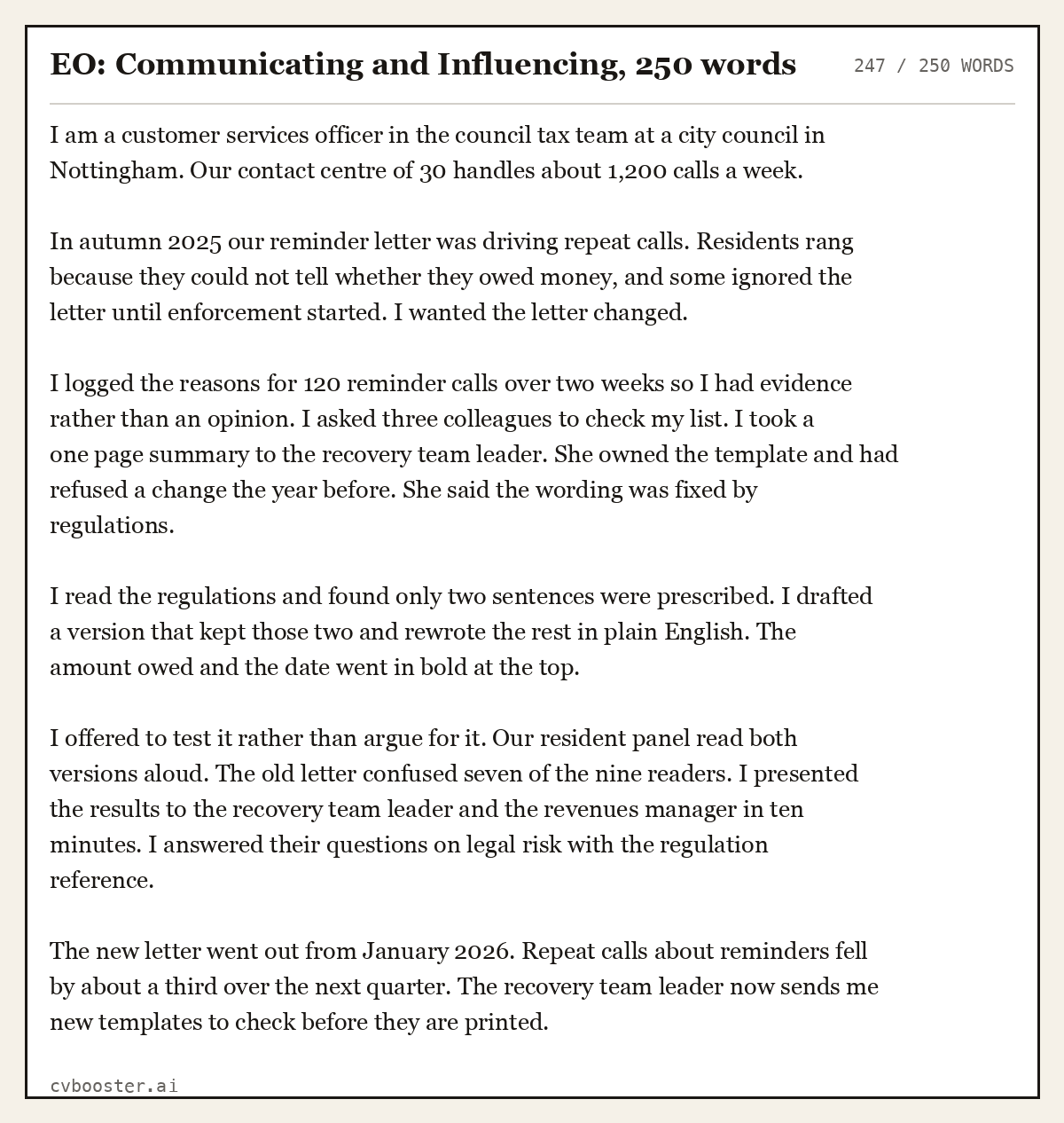
EO: Communicating and Influencing, 250 words (247 words)
I am a customer services officer in the council tax team at a city council in Nottingham. Our contact centre of 30 handles about 1,200 calls a week.
In autumn 2025 our reminder letter was driving repeat calls. Residents rang because they could not tell whether they owed money, and some ignored the letter until enforcement started. I wanted the letter changed.
I logged the reasons for 120 reminder calls over two weeks so I had evidence rather than an opinion. I asked three colleagues to check my list. I took a one page summary to the recovery team leader. She owned the template and had refused a change the year before. She said the wording was fixed by regulations.
I read the regulations and found only two sentences were prescribed. I drafted a version that kept those two and rewrote the rest in plain English. The amount owed and the date went in bold at the top.
I offered to test it rather than argue for it. Our resident panel read both versions aloud. The old letter confused seven of the nine readers. I presented the results to the recovery team leader and the revenues manager in ten minutes. I answered their questions on legal risk with the regulation reference.
The new letter went out from January 2026. Repeat calls about reminders fell by about a third over the next quarter. The recovery team leader now sends me new templates to check before they are printed.
What the sifter is scoring
- Indicator: "communicate clearly and concisely both orally and in writing" (gov.uk, EO). In the statement: a one page summary and a ten minute presentation.
- Indicator: "take time to consider the best communication channel to use for the audience, including making the best of digital resources and considering value for money" (gov.uk, EO). In the statement: a read aloud test with residents instead of a written consultation.
- Indicator: "respond constructively and objectively to comments and questions" (gov.uk, EO). In the statement: the legal risk question answered with the regulation reference.
- Indicator: "handle challenging conversations with confidence and sensitivity" (gov.uk, EO). In the statement: reopening a change the team leader had refused the year before.
- Indicator: "listen to and value different ideas, views and ways of working" (gov.uk, EO). In the statement: the two prescribed sentences kept because she was right about them.
Example at HEO, annotated
At HEO the panel wants a message shaped for one audience.
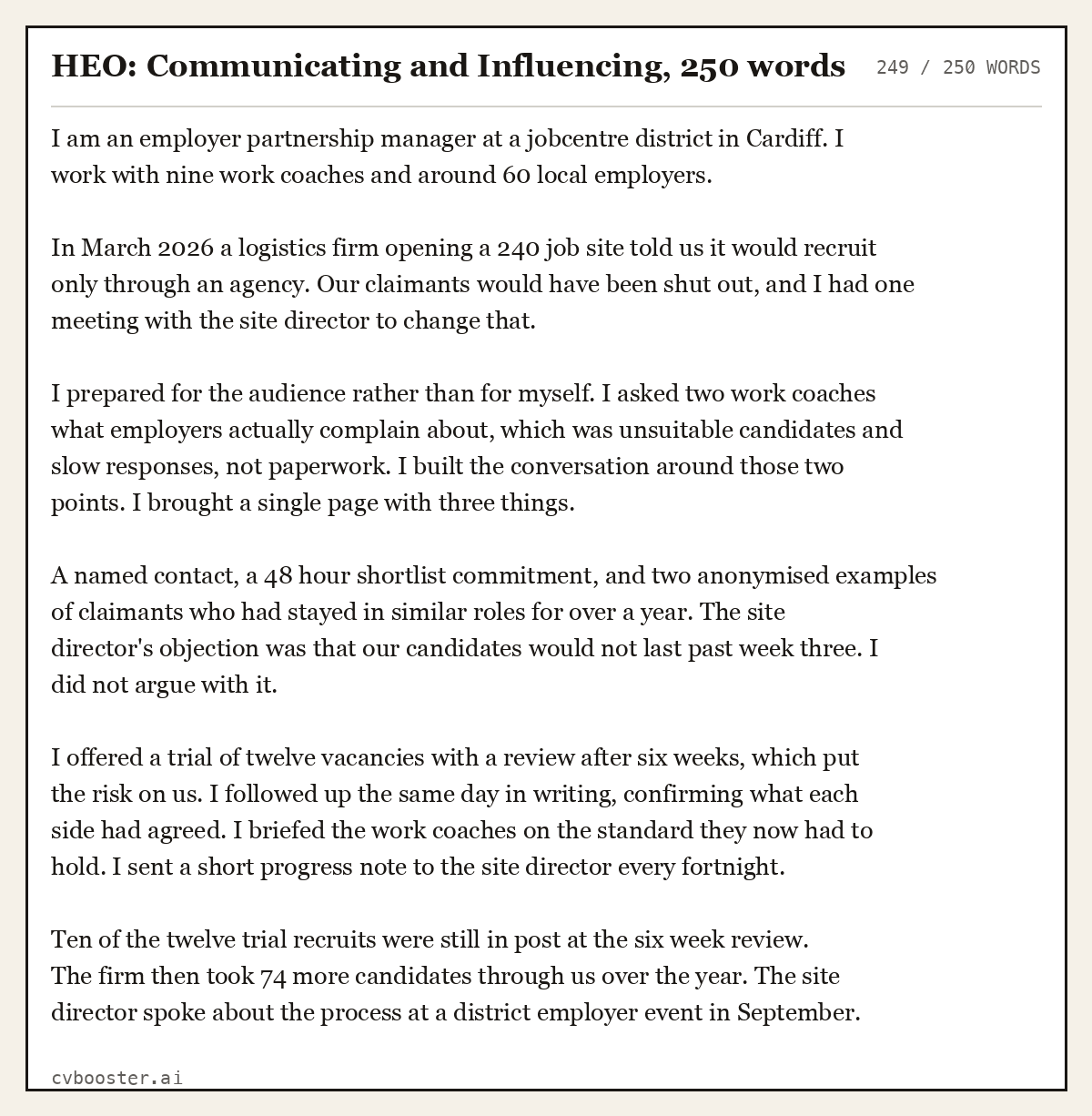
HEO: Communicating and Influencing, 250 words (249 words)
I am an employer partnership manager at a jobcentre district in Cardiff. I work with nine work coaches and around 60 local employers.
In March 2026 a logistics firm opening a 240 job site told us it would recruit only through an agency. Our claimants would have been shut out, and I had one meeting with the site director to change that.
I prepared for the audience rather than for myself. I asked two work coaches what employers actually complain about, which was unsuitable candidates and slow responses, not paperwork. I built the conversation around those two points. I brought a single page with three things.
A named contact, a 48 hour shortlist commitment, and two anonymised examples of claimants who had stayed in similar roles for over a year. The site director's objection was that our candidates would not last past week three. I did not argue with it.
I offered a trial of twelve vacancies with a review after six weeks, which put the risk on us. I followed up the same day in writing, confirming what each side had agreed. I briefed the work coaches on the standard they now had to hold. I sent a short progress note to the site director every fortnight.
Ten of the twelve trial recruits were still in post at the six week review. The firm then took 74 more candidates through us over the year. The site director spoke about the process at a district employer event in September.
What the sifter is scoring
- Indicator: "communicate in a straightforward, honest and engaging manner - choosing appropriate styles to maximise understanding and impact" (gov.uk, HEO and SEO). In the statement: the meeting built around the two things employers complain about.
- Indicator: "ensure communication has a clear purpose and takes into account people's individual needs" (gov.uk, HEO and SEO). In the statement: a one page offer with a named contact and a 48 hour commitment.
- Indicator: "share information as appropriate and check understanding" (gov.uk, HEO and SEO). In the statement: the same day written confirmation and fortnightly notes.
- Indicator: "ensure that important messages are communicated with colleagues and stakeholders respectfully, taking into consideration the diversity of interests" (gov.uk, HEO and SEO). In the statement: the objection accepted rather than argued down, with the risk carried by the trial.
Example at SEO, annotated
An SEO example usually means persuading professionals who do not report to you.
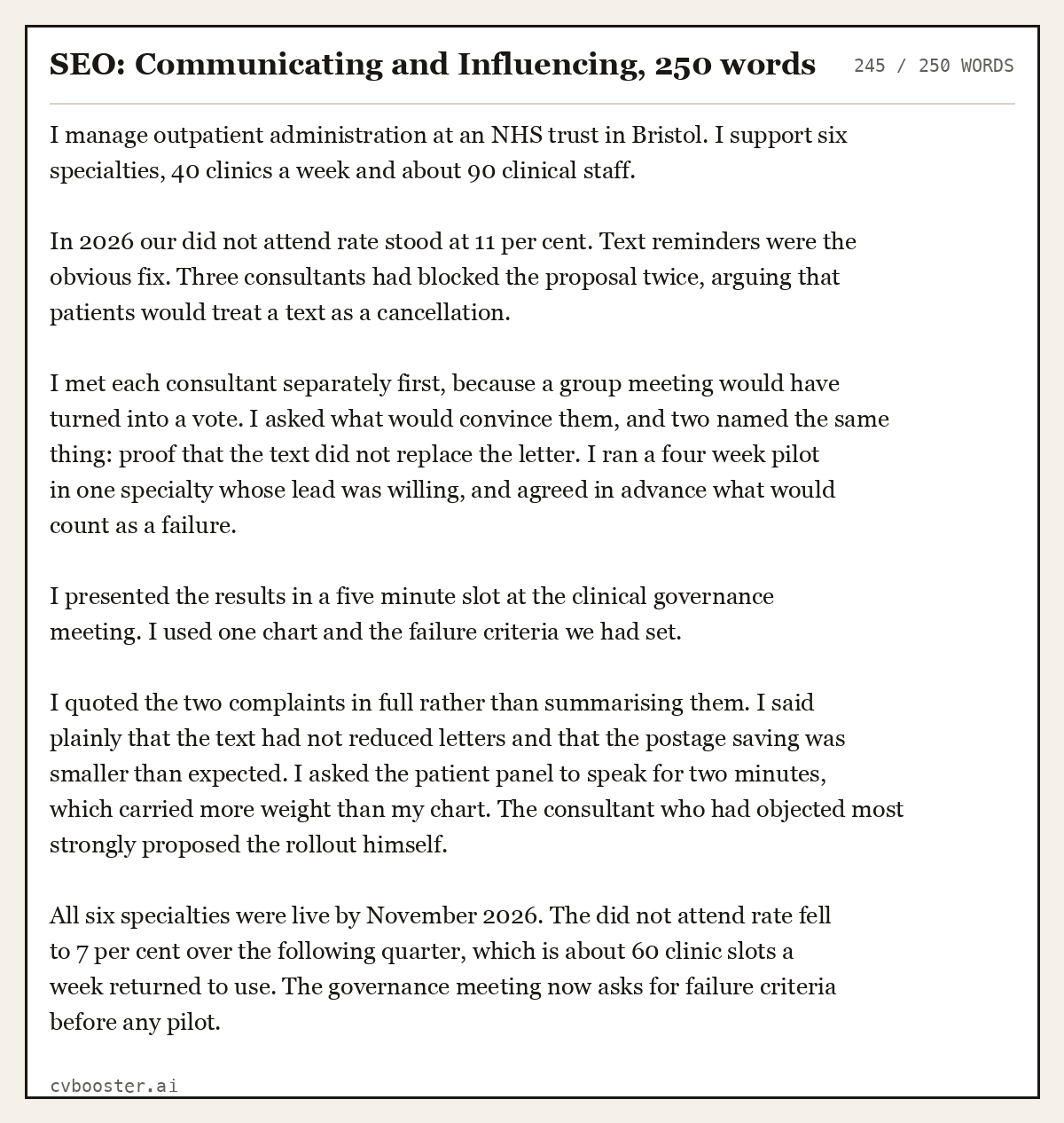
SEO: Communicating and Influencing, 250 words (245 words)
I manage outpatient administration at an NHS trust in Bristol. I support six specialties, 40 clinics a week and about 90 clinical staff.
In 2026 our did not attend rate stood at 11 per cent. Text reminders were the obvious fix. Three consultants had blocked the proposal twice, arguing that patients would treat a text as a cancellation.
I met each consultant separately first, because a group meeting would have turned into a vote. I asked what would convince them, and two named the same thing: proof that the text did not replace the letter. I ran a four week pilot in one specialty whose lead was willing, and agreed in advance what would count as a failure.
I presented the results in a five minute slot at the clinical governance meeting. I used one chart and the failure criteria we had set.
I quoted the two complaints in full rather than summarising them. I said plainly that the text had not reduced letters and that the postage saving was smaller than expected. I asked the patient panel to speak for two minutes, which carried more weight than my chart. The consultant who had objected most strongly proposed the rollout himself.
All six specialties were live by November 2026. The did not attend rate fell to 7 per cent over the following quarter, which is about 60 clinic slots a week returned to use. The governance meeting now asks for failure criteria before any pilot.
What the sifter is scoring
- Indicator: "communicate in a straightforward, honest and engaging manner - choosing appropriate styles to maximise understanding and impact" (gov.uk, HEO and SEO). In the statement: the postage saving admitted as smaller than expected.
- Indicator: "encourage the use of different communication methods, including digital resources and highlight the benefits, including ensuring cost effectiveness" (gov.uk, HEO and SEO). In the statement: text reminders proposed, piloted and costed against letters.
- Indicator: "share information as appropriate and check understanding" (gov.uk, HEO and SEO). In the statement: one to one meetings first, then the complaints quoted in full.
- Indicator: "ensure communication has a clear purpose and takes into account people's individual needs" (gov.uk, HEO and SEO). In the statement: failure criteria agreed in advance with the people who had objected.
Example at Grade 7, annotated
Grade 7 bullets add persuasion, difficult messages and monitoring whether your communications worked.
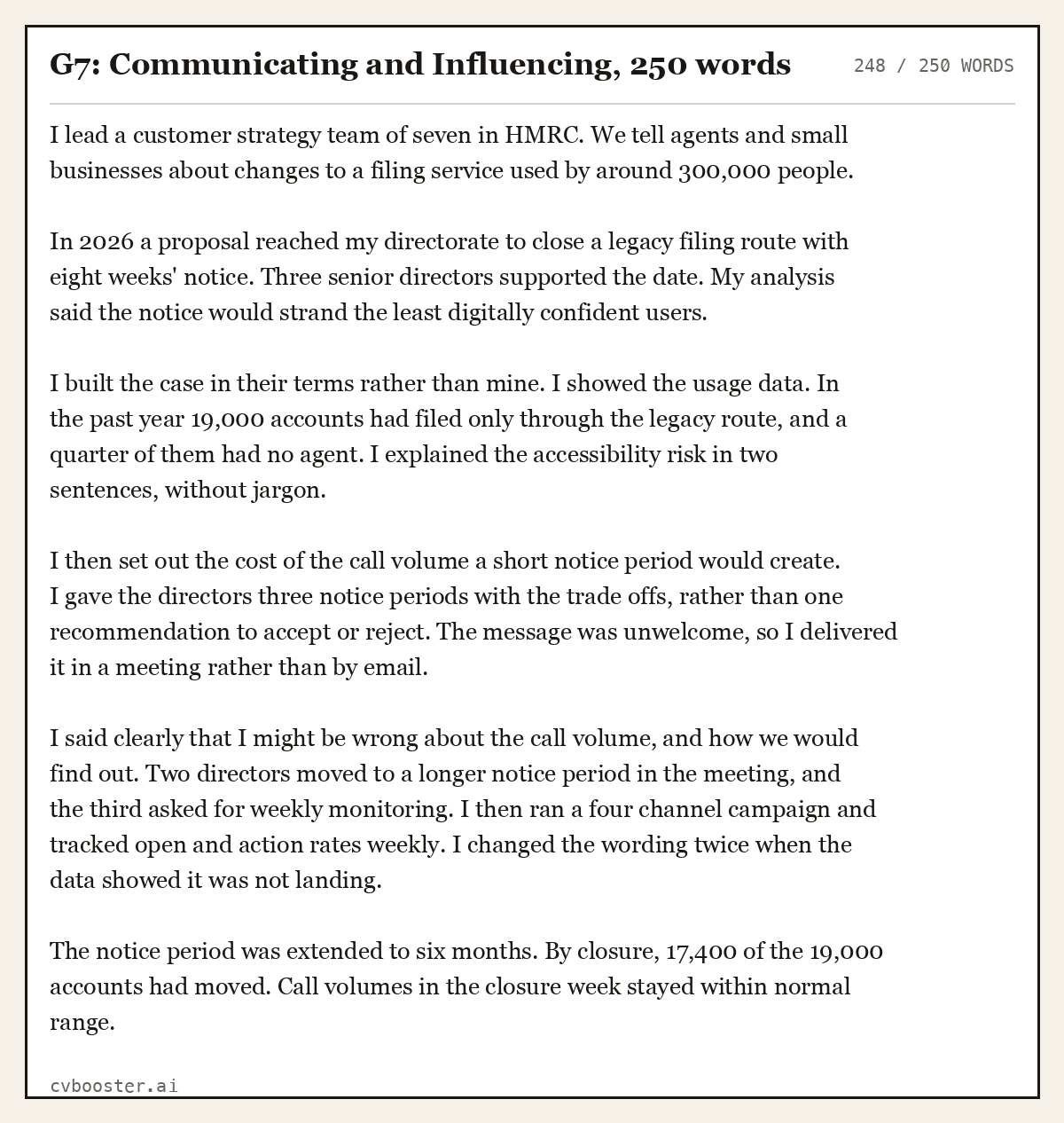
G7: Communicating and Influencing, 250 words (248 words)
I lead a customer strategy team of seven in HMRC. We tell agents and small businesses about changes to a filing service used by around 300,000 people.
In 2026 a proposal reached my directorate to close a legacy filing route with eight weeks' notice. Three senior directors supported the date. My analysis said the notice would strand the least digitally confident users.
I built the case in their terms rather than mine. I showed the usage data. In the past year 19,000 accounts had filed only through the legacy route, and a quarter of them had no agent. I explained the accessibility risk in two sentences, without jargon.
I then set out the cost of the call volume a short notice period would create. I gave the directors three notice periods with the trade offs, rather than one recommendation to accept or reject. The message was unwelcome, so I delivered it in a meeting rather than by email.
I said clearly that I might be wrong about the call volume, and how we would find out. Two directors moved to a longer notice period in the meeting, and the third asked for weekly monitoring. I then ran a four channel campaign and tracked open and action rates weekly. I changed the wording twice when the data showed it was not landing.
The notice period was extended to six months. By closure, 17,400 of the 19,000 accounts had moved. Call volumes in the closure week stayed within normal range.
What the sifter is scoring
- Indicator: "deliver difficult messages with clarity and sensitivity, being persuasive when required" (gov.uk, Grade 6 and Grade 7). In the statement: the unwelcome analysis delivered in a meeting, with three options rather than one.
- Indicator: "explain complex issues in a way that is easy to understand" (gov.uk, Grade 6 and Grade 7). In the statement: the accessibility risk put in two sentences without jargon.
- Indicator: "remain open-minded and impartial in discussions, whilst respecting the diverse interests and opinions of others" (gov.uk, Grade 6 and Grade 7). In the statement: saying he might be wrong and naming how it would be tested.
- Indicator: "monitor the effectiveness of own and team communications and take action to improve where necessary" (gov.uk, Grade 6 and Grade 7). In the statement: weekly tracking and two wording changes during the campaign.
From 1 to 7: how influence is scored
One scale covers sift and interview. Both labels and descriptors come from the Crown Office and Procurator Fiscal Service.
| Score | The published label and wording | What that means in an influencing statement |
|---|---|---|
| 1 | Not Demonstrated: "No positive evidence and/ or substantial negative evidence demonstrated" | Information passed on, nobody affected |
| 2 | Minimal Demonstration: "Limited positive evidence and/ or mainly negative evidence demonstrated" | An audience named, no reaction from them |
| 3 | Moderate Demonstration: "Moderate positive evidence but some negative evidence demonstrated" | Clear communication, no position changed |
| 4 | Acceptable Demonstration: "Adequate positive evidence and any negative evidence would not cause concern" | A chosen channel and somebody who agreed |
| 5 | Good Demonstration: "Substantial positive evidence of the behaviour" | Plus an objection quoted and answered |
| 6 | Strong Demonstration: "Substantial positive evidence; includes some evidence of exceeding expectations at this level" | Plus a person senior to you who changed position |
| 7 | Outstanding Demonstration: "The evidence provided wholly exceeds expectation at this level" | All of it, with the effect of the message measured |
Benchmarks vary by advert. COPFS notes that "A Selection Panel may set a benchmark for interview where there is a job and business need".
Dividing the 250 words: 40 / 40 / 120 / 50
Forty words to place yourself and the audience. Forty for what had to change and why it was hard. One hundred and twenty for the action. Fifty for the shift. The action block belongs to the channel you chose, the objection you met, and the answer you gave it.
Tip: put the objection in the other person's words. It proves you listened, and it makes the result read as a change rather than a claim.
How the four statements differ
All four have the same spine. Someone holds a position, you choose a channel on purpose, you meet the objection, and the position moves. Seniority is what changes.
| Level | Audience | Channel chosen | The objection | What moved |
|---|---|---|---|---|
| EO | A team leader who had said no | One page, plus a read aloud test | "The wording is fixed by regulations" | Letter rewritten, repeat calls down a third |
| HEO | An employer using an agency | One meeting, one page, written follow up | "Your candidates will not last" | Twelve vacancy trial, then 74 more hires |
| SEO | Three consultants outside her line | One to ones, then five minutes at governance | "A text reads as a cancellation" | Rollout proposed by the main objector |
| G7 | Three directors above him | A meeting, three options, weekly tracking | An eight week notice period | Notice extended to six months |
The sentences that cost marks
The first line of each pair is the wording that keeps statements at a 3.
- Before: I have excellent communication skills at all levels. After: I logged the reasons for 120 reminder calls before I asked for anything.
- Before: I kept all stakeholders regularly updated. After: I sent the site director a progress note every fortnight for six months.
- Before: I presented my findings to senior management. After: I gave three directors three notice periods with the trade offs, not one recommendation.
- Before: I persuaded them to accept my proposal. After: The consultant who had objected most strongly proposed the rollout himself.
- Before: I listened to their concerns and addressed them. After: She said the wording was fixed by regulations, so I read them and kept the two that were.
- Before: I tailored my communication style to my audience. After: Two work coaches told me employers complain about slow responses, so I opened with 48 hours.
Before you submit
- Name the person or group whose position you needed to change.
- Quote their objection in their words, in one sentence.
- Say which channel you chose and why that one.
- Show the shift in the result, not the message you sent.
- Add one line on how you knew it worked, especially at Grade 7.
- The other eight behaviours are worked through on the civil service behaviours framework page.
- For the interview version of this behaviour, and the other Success Profiles elements, see the Success Profiles guide.
- Commonly paired with this behaviour: Working Together and Making Effective Decisions.
- Full statements for Delivering at Pace and for Managing a Quality Service sit on their own pages.
- Wider context comes from Seeing the Big Picture and the hub of behaviour statement examples.
Frequently asked questions
What is a good example of Communicating and influencing civil service?
A good example shows someone changing position because of how you communicated. The EO statement above is one. A council tax reminder letter was rewritten after the team leader who owned it had refused a change. The evidence was 120 logged call reasons and a read aloud test with residents. Repeat calls fell by about a third.
Can you give me some examples of Communicating and influencing in the civil service for Grade 7 students?
At Grade 7 the framework asks you to "deliver difficult messages with clarity and sensitivity, being persuasive when required". It also asks you to monitor whether your communications worked. Strong examples include moving directors off a decision with data. Others are explaining a technical risk to non specialists, and changing a campaign because the tracking said it was not landing.
Can you give me some examples of Communicating with influence?
Communicating with influence means the other person acts differently afterwards. Examples that score: an employer who recruits through you instead of an agency. A clinician who proposes the change he once blocked. A director who extends a deadline. A customer who fills the form in correctly because your letter made sense. All four are on this page in full.
Can you give me some example questions about Communicating and influencing?
Common questions are short. Tell me about a time you had to influence someone who disagreed with you. Describe a time you explained a complex issue to a non specialist audience. Give an example of delivering an unwelcome message. Tell me about a time your communication did not land. Prepare one story you can tell at two lengths.
How do you write a 250 word Communicating and Influencing statement?
Use a 40 / 40 / 120 / 50 budget: situation, task, action, result. Put the audience and their starting position in the task. Spend the action words on the channel, the objection and your response. Make the result a position that moved. Keep one sentence for how you knew the message worked.
More in this series: Civil Service applications
- Civil Service Behaviours Framework: All 9, Level by Level
- Civil Service Behaviours: 9 Examples, One Per Behaviour
- Civil Service Judgement Test: 8 Questions and Answers
- Civil Service Success Profiles: the Five Elements, Explained
- Delivering at Pace: 4 Civil Service Examples, EO to G7
- Making Effective Decisions: 4 Civil Service Examples
- Managing a Quality Service: 4 Worked Examples, EO to G7
- Seeing the Big Picture Civil Service Example: AO to G7
- Working Together Civil Service Example: AO to Grade 7
Related articles
- Delivering at Pace: 4 Civil Service Examples, EO to G7
- Making Effective Decisions: 4 Civil Service Examples
- Managing a Quality Service: 4 Worked Examples, EO to G7
- Changing and Improving Civil Service Example: AO to G7
More articles
- Competency Based Application Form: 5 Filled Examples
- Competency Based Interview Questions and 20 Answers
- Competency-Based Interview Questions and 15 Answers, Ireland
Looking for a worked example for your job title? Browse the resume examples by job title.