Managing a Quality Service: 4 Worked Examples, EO to G7
By Mustafa Tarabya, founder of CVBooster · Published · Updated
14 min read
A managing a quality service civil service example is judged on the system you ran or improved. One grateful customer is not evidence. The form limit is normally 250 words per behaviour, which buys roughly 120 words to show the standard, the change and the check that followed. Bullets are quoted throughout from the Cabinet Office framework called Success Profiles: Civil Service behaviours, checked against the live page on 12 September 2026. Complete statements for the EO, HEO, SEO and Grade 7 grades appear below, annotated bullet by bullet. Written by Mustafa Tarabya, who hired for his own company, read every application himself and now writes CVBooster's guides.
What a sifter marks on this behaviour
The definition on Success Profiles: Civil Service behaviours is one sentence long. Two phrases inside it do most of the marking.
The behaviour, quoted: "Deliver service objectives with professional excellence, expertise and efficiency, taking account of diverse customer needs" (gov.uk, Managing a quality service).
"Objectives" means a standard you can state as a number, a time or a rule. "Diverse customer needs" means you found out who the service failed and did something about it. Miss either phrase and the statement reads as a story about being helpful.
The Success Profiles: Civil Service Behaviours PDF explains why panels want that detail. It says: "As behaviours can be observed and measured, they can help us to predict what your performance in the role could be". One list covers the Higher Executive Officer and Senior Executive Officer grades, so the middle two statements answer the same bullets with different reach.
Example at EO, annotated
Written against an EO advert in a repairs service. If your advert also asks for pace, see the Delivering at Pace example.
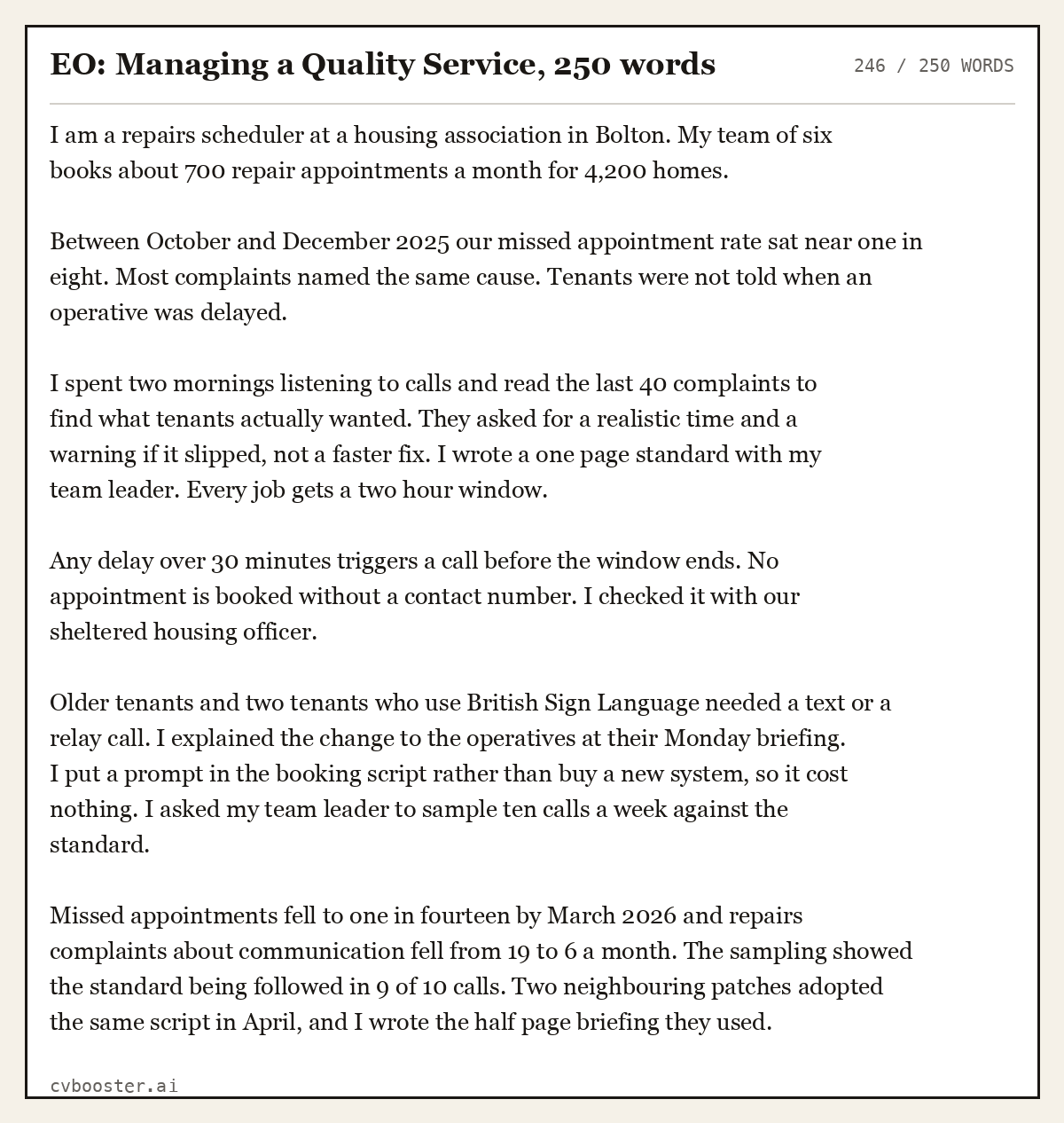
EO: Managing a Quality Service, 250 words (246 words)
I am a repairs scheduler at a housing association in Bolton. My team of six books about 700 repair appointments a month for 4,200 homes.
Between October and December 2025 our missed appointment rate sat near one in eight. Most complaints named the same cause. Tenants were not told when an operative was delayed.
I spent two mornings listening to calls and read the last 40 complaints to find what tenants actually wanted. They asked for a realistic time and a warning if it slipped, not a faster fix. I wrote a one page standard with my team leader. Every job gets a two hour window.
Any delay over 30 minutes triggers a call before the window ends. No appointment is booked without a contact number. I checked it with our sheltered housing officer.
Older tenants and two tenants who use British Sign Language needed a text or a relay call. I explained the change to the operatives at their Monday briefing. I put a prompt in the booking script rather than buy a new system, so it cost nothing. I asked my team leader to sample ten calls a week against the standard.
Missed appointments fell to one in fourteen by March 2026 and repairs complaints about communication fell from 19 to 6 a month. The sampling showed the standard being followed in 9 of 10 calls. Two neighbouring patches adopted the same script in April, and I wrote the half page briefing they used.
What the sifter is scoring
- Indicator: "work with customers to understand their needs and expectations" (gov.uk, EO). In the statement: two mornings of call listening and 40 complaints read.
- Indicator: "create clear plans and set priorities which meet the needs of both the customer and the business" (gov.uk, EO). In the statement: the one page standard with a two hour window.
- Indicator: "identify common problems that affect service, report them and find possible solutions" (gov.uk, EO). In the statement: the single cause named in most complaints.
- Indicator: "deliver good customer service which balances quality and cost effectiveness" (gov.uk, EO). In the statement: a script prompt instead of a new system, so it cost nothing.
- Indicator: "keep colleagues and stakeholders fully informed of plans, possibilities and progress" (gov.uk, EO). In the statement: the Monday briefing and the weekly sampling.
Example at HEO, annotated
At HEO the service should be one you own end to end.
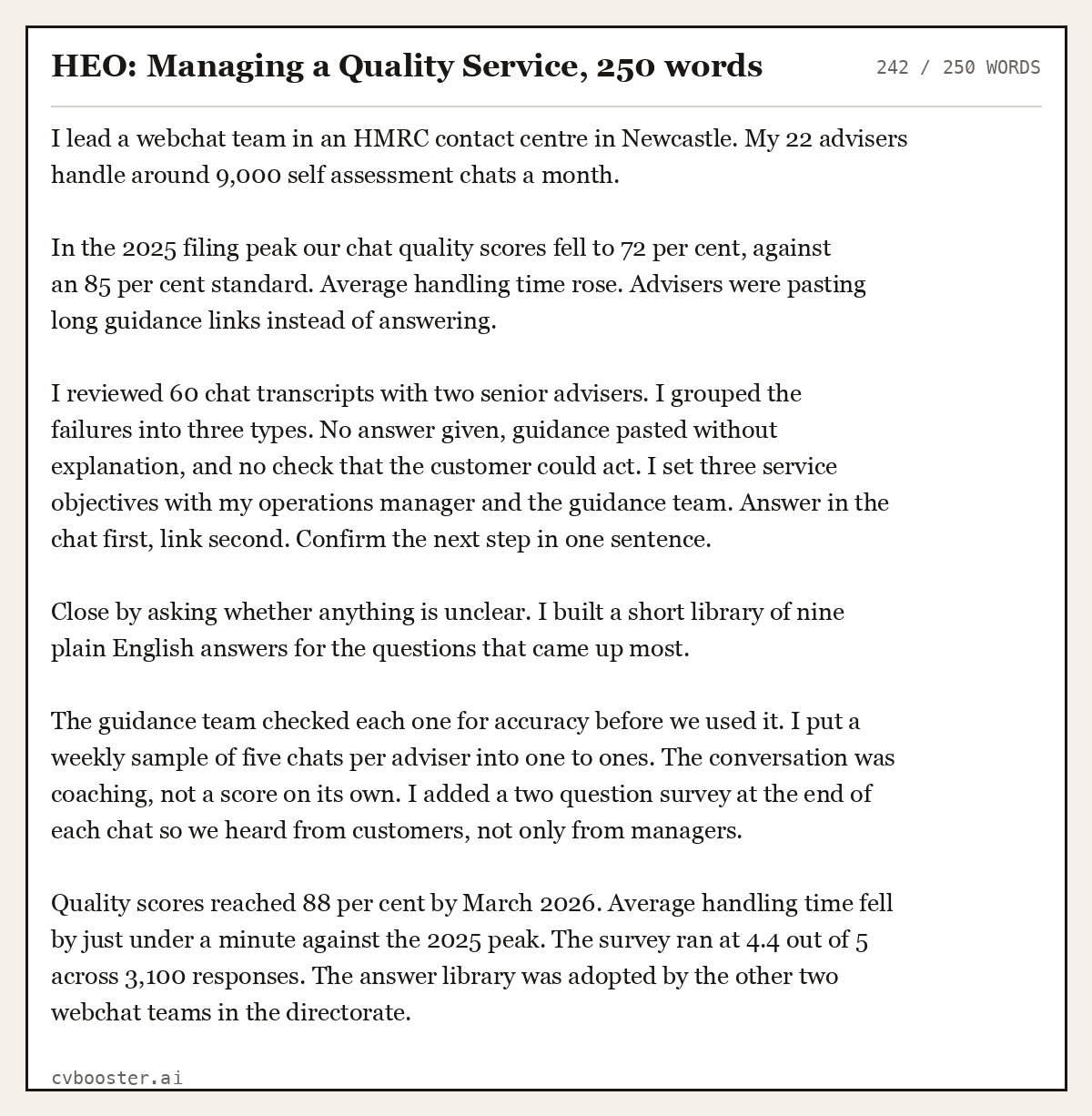
HEO: Managing a Quality Service, 250 words (242 words)
I lead a webchat team in an HMRC contact centre in Newcastle. My 22 advisers handle around 9,000 self assessment chats a month.
In the 2025 filing peak our chat quality scores fell to 72 per cent, against an 85 per cent standard. Average handling time rose. Advisers were pasting long guidance links instead of answering.
I reviewed 60 chat transcripts with two senior advisers. I grouped the failures into three types. No answer given, guidance pasted without explanation, and no check that the customer could act. I set three service objectives with my operations manager and the guidance team. Answer in the chat first, link second. Confirm the next step in one sentence.
Close by asking whether anything is unclear. I built a short library of nine plain English answers for the questions that came up most.
The guidance team checked each one for accuracy before we used it. I put a weekly sample of five chats per adviser into one to ones. The conversation was coaching, not a score on its own. I added a two question survey at the end of each chat so we heard from customers, not only from managers.
Quality scores reached 88 per cent by March 2026. Average handling time fell by just under a minute against the 2025 peak. The survey ran at 4.4 out of 5 across 3,100 responses. The answer library was adopted by the other two webchat teams in the directorate.
What the sifter is scoring
- Indicator: "develop, implement, maintain and review systems and services to ensure delivery of professional excellence" (gov.uk, HEO and SEO). In the statement: the answer library plus a weekly sampling routine.
- Indicator: "work with stakeholders to set priorities, objectives and timescales" (gov.uk, HEO and SEO). In the statement: three service objectives agreed with operations and the guidance team.
- Indicator: "establish ways to find and respond to feedback from customers about the services provided" (gov.uk, HEO and SEO). In the statement: the two question end of chat survey.
- Indicator: "successfully deliver high quality outcomes that meet the customers' needs and gives value for money" (gov.uk, HEO and SEO). In the statement: quality up and handling time down at the same time.
Example at SEO, annotated
An SEO statement should cross team boundaries and name the risks you logged before you changed anything.
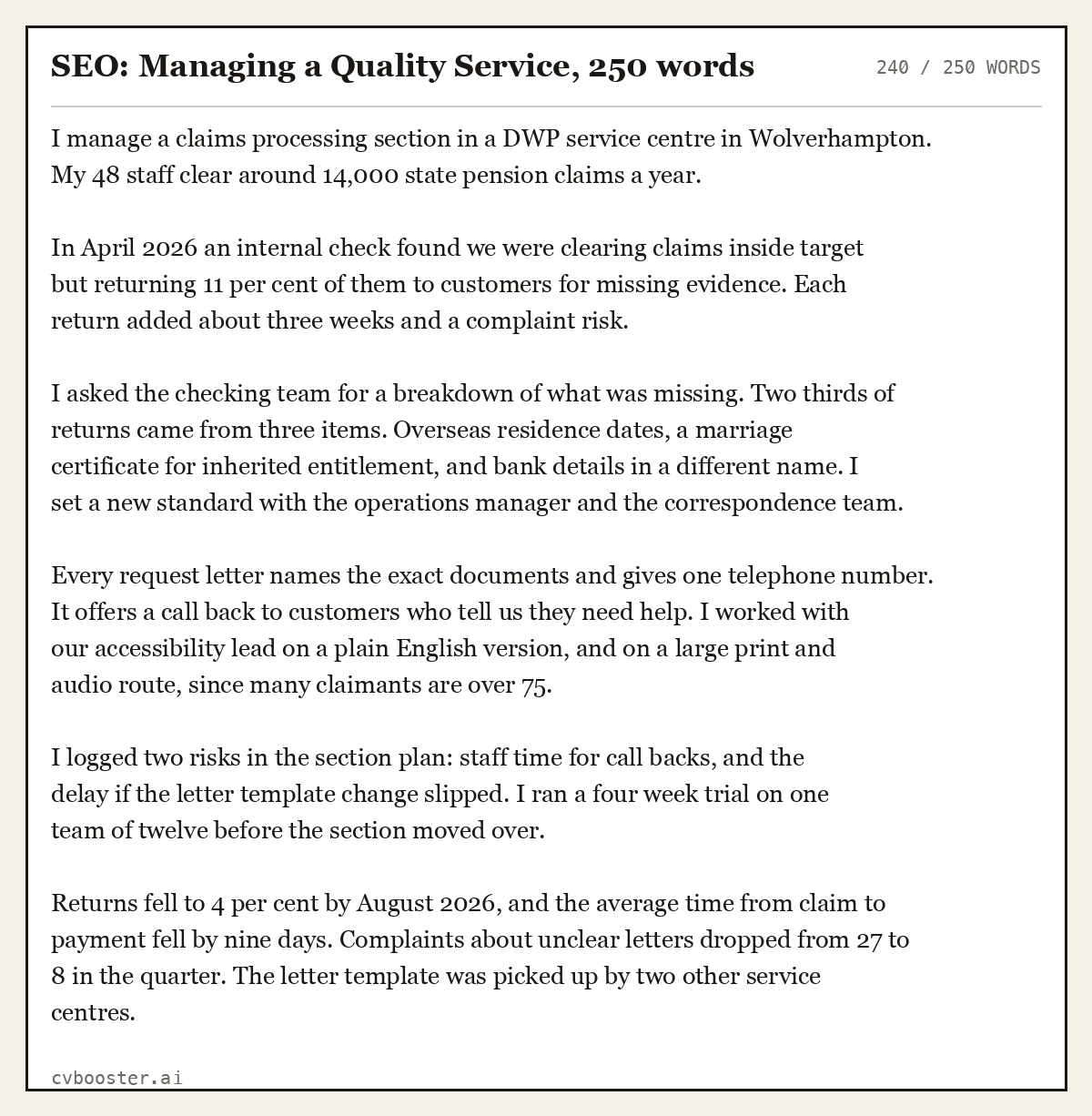
SEO: Managing a Quality Service, 250 words (240 words)
I manage a claims processing section in a DWP service centre in Wolverhampton. My 48 staff clear around 14,000 state pension claims a year.
In April 2026 an internal check found we were clearing claims inside target but returning 11 per cent of them to customers for missing evidence. Each return added about three weeks and a complaint risk.
I asked the checking team for a breakdown of what was missing. Two thirds of returns came from three items. Overseas residence dates, a marriage certificate for inherited entitlement, and bank details in a different name. I set a new standard with the operations manager and the correspondence team.
Every request letter names the exact documents and gives one telephone number. It offers a call back to customers who tell us they need help. I worked with our accessibility lead on a plain English version, and on a large print and audio route, since many claimants are over 75.
I logged two risks in the section plan: staff time for call backs, and the delay if the letter template change slipped. I ran a four week trial on one team of twelve before the section moved over.
Returns fell to 4 per cent by August 2026, and the average time from claim to payment fell by nine days. Complaints about unclear letters dropped from 27 to 8 in the quarter. The letter template was picked up by two other service centres.
What the sifter is scoring
- Indicator: "identify risks and resolve issues efficiently" (gov.uk, HEO and SEO). In the statement: two risks logged in the section plan and a trial before rollout.
- Indicator: "involve a diverse range of colleagues, stakeholders and delivery partners in developing suggestions for improvements" (gov.uk, HEO and SEO). In the statement: checking team, operations, correspondence and the accessibility lead.
- Indicator: "develop, implement, maintain and review systems and services to ensure delivery of professional excellence" (gov.uk, HEO and SEO). In the statement: the rewritten request letter and the four week trial.
- Indicator: "successfully deliver high quality outcomes that meet the customers' needs and gives value for money" (gov.uk, HEO and SEO). In the statement: fewer returns, nine days faster, fewer complaints.
Example at Grade 7, annotated
Grade 7 has its own bullets. Two are usually missing from promotion statements: legal and security requirements, and how the area compares to best practice.
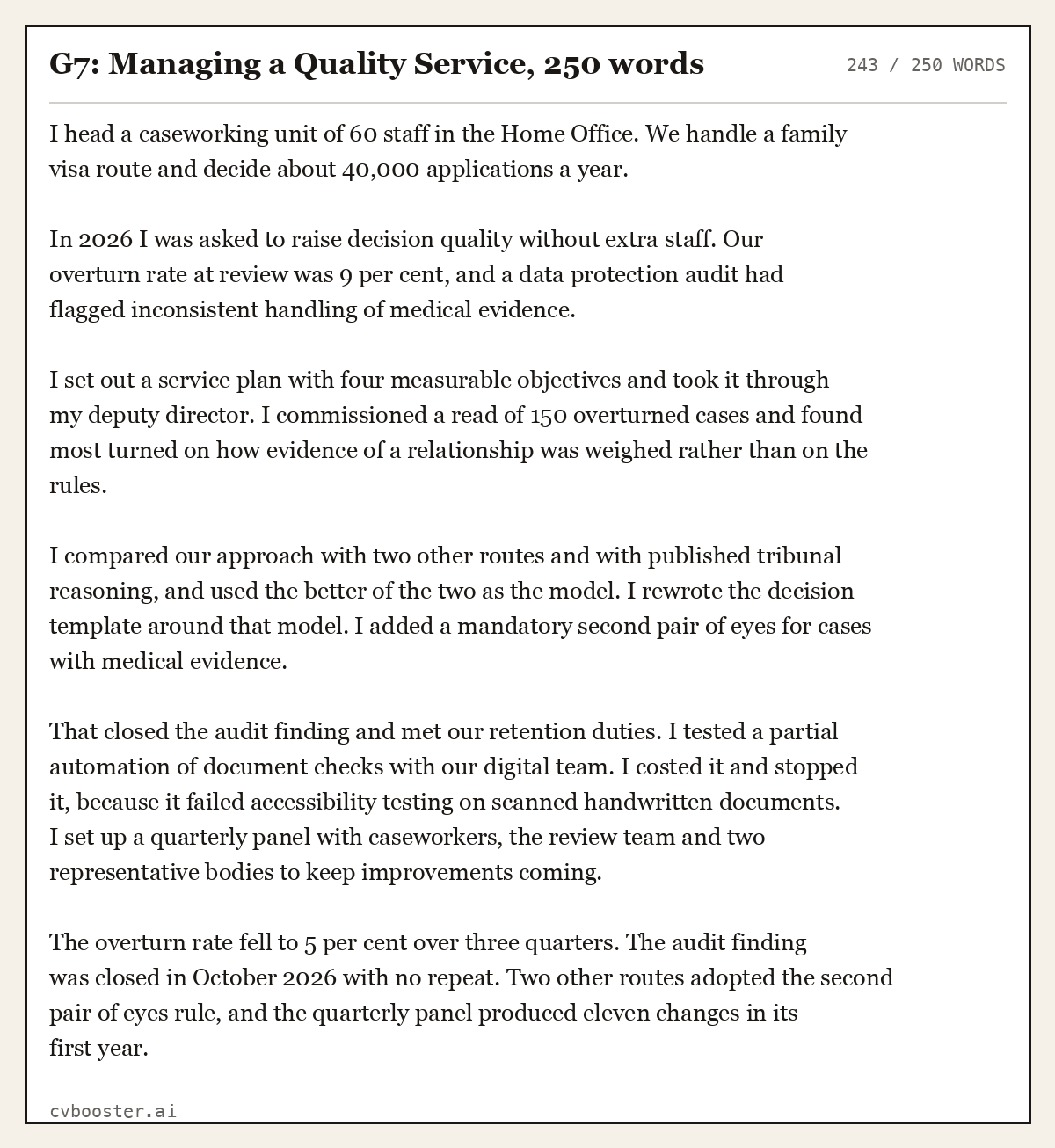
G7: Managing a Quality Service, 250 words (243 words)
I head a caseworking unit of 60 staff in the Home Office. We handle a family visa route and decide about 40,000 applications a year.
In 2026 I was asked to raise decision quality without extra staff. Our overturn rate at review was 9 per cent, and a data protection audit had flagged inconsistent handling of medical evidence.
I set out a service plan with four measurable objectives and took it through my deputy director. I commissioned a read of 150 overturned cases and found most turned on how evidence of a relationship was weighed rather than on the rules.
I compared our approach with two other routes and with published tribunal reasoning, and used the better of the two as the model. I rewrote the decision template around that model. I added a mandatory second pair of eyes for cases with medical evidence.
That closed the audit finding and met our retention duties. I tested a partial automation of document checks with our digital team. I costed it and stopped it, because it failed accessibility testing on scanned handwritten documents. I set up a quarterly panel with caseworkers, the review team and two representative bodies to keep improvements coming.
The overturn rate fell to 5 per cent over three quarters. The audit finding was closed in October 2026 with no repeat. Two other routes adopted the second pair of eyes rule, and the quarterly panel produced eleven changes in its first year.
What the sifter is scoring
- Indicator: "ensure adherence to legal, regulatory and security requirements in service delivery" (gov.uk, Grade 6 and Grade 7). In the statement: the data protection finding closed by the second pair of eyes rule.
- Indicator: "establish how the business area compares to industry best practice" (gov.uk, Grade 6 and Grade 7). In the statement: the comparison with two other routes and tribunal reasoning.
- Indicator: "ensure full consideration of new technologies, accessibility and costings" (gov.uk, Grade 6 and Grade 7). In the statement: the automation costed, tested and stopped on accessibility grounds.
- Indicator: "create regular opportunities for colleagues, stakeholders, delivery partners and customers to help improve the quality of service" (gov.uk, Grade 6 and Grade 7). In the statement: the quarterly improvement panel.
The 1 to 7 scale a service statement is marked against
Sift and interview share one rating scale. It is set out in full by the Crown Office and Procurator Fiscal Service.
| Score | The official label and wording | What that means in a service statement |
|---|---|---|
| 1 | Not Demonstrated: "No positive evidence and/ or substantial negative evidence demonstrated" | A service described, nothing you did to it |
| 2 | Minimal Demonstration: "Limited positive evidence and/ or mainly negative evidence demonstrated" | One customer helped, no service change |
| 3 | Moderate Demonstration: "Moderate positive evidence but some negative evidence demonstrated" | A change made, no standard and no measure |
| 4 | Acceptable Demonstration: "Adequate positive evidence and any negative evidence would not cause concern" | A named standard, a change, a result |
| 5 | Good Demonstration: "Substantial positive evidence of the behaviour" | Plus customer evidence and a cost or value line |
| 6 | Strong Demonstration: "Substantial positive evidence; includes some evidence of exceeding expectations at this level" | Plus a feedback loop that kept running after you |
| 7 | Outstanding Demonstration: "The evidence provided wholly exceeds expectation at this level" | All of it, across teams that do not report to you |
A single behaviour can be carried by the rest. In the COPFS wording, "a candidate can score a single score of 3 where scores for all other behaviours are high".
Where the 250 words go: 40 / 40 / 120 / 50
Forty for the service and its size. Forty for the problem you had to fix. One hundred and twenty for what you did. Fifty for what changed. Inside the 120, name the standard first, then the evidence of customer need, then how you checked.
Tip: one sentence on cost or value for money scores at every grade above AO. The bullets repeat it in different words at EO, HEO, SEO and Grade 7.
What changes as the grade rises
Each statement sets a standard and proves it held. The service gets bigger, the standard binds more teams, and the evidence of quality travels further.
| Level | Service owned | The standard set | How quality was checked | Result |
|---|---|---|---|---|
| EO | 700 appointments a month | Two hour window, call on delay | Ten sampled calls a week | Missed jobs 1 in 8 to 1 in 14 |
| HEO | 9,000 webchats a month | Answer first, link second | Five chats per adviser, plus a survey | Quality 72 to 88 per cent |
| SEO | 14,000 pension claims a year | Letters naming exact documents | Four week trial, returns tracked | Returns 11 to 4 per cent |
| G7 | 40,000 visa decisions a year | New template, second pair of eyes | 150 case read, quarterly panel | Overturns 9 to 5 per cent |
The sentences that cost marks
Same facts, two versions. The first version is what a 3 looks like.
- Before: I always provide excellent customer service. After: I listened to two mornings of calls and read the last 40 complaints.
- Before: I helped a customer who was very upset and resolved their issue. After: I changed the booking script so every delay over 30 minutes triggers a call.
- Before: I introduced a new process which improved the service. After: Missed appointments fell from one in eight to one in fourteen by March 2026.
- Before: I gathered feedback from stakeholders. After: I added a two question survey at the end of every chat, answered by 3,100 customers.
- Before: I ensured value for money at all times. After: A script prompt instead of a new system, so the change cost nothing.
- Before: I considered the needs of all our diverse customers. After: Our sheltered housing officer confirmed two tenants needed a relay call, not a text.
Before you submit
- Name the service and its size in the first forty words.
- Name the standard. A number, a time, or a rule someone else could follow.
- Say how you learned what customers needed, and from how many of them.
- Say how you checked the change worked after it landed.
- Add one line on cost or value for money.
- All nine behaviours are broken down the same way on the civil service behaviours framework page.
- The Success Profiles guide explains where behaviours sit next to strengths, ability and experience.
- Statements for the behaviours most often paired with this one: Delivering at Pace and Communicating and Influencing.
- Also written out in full: Making Effective Decisions and Working Together.
- Or browse Seeing the Big Picture and the hub of behaviour statement examples.
Frequently asked questions
What is an example of managing a quality service in the Civil Service?
An example is a service you planned, ran or improved against a standard, with evidence of customer need and a check that it worked. The EO statement above is one. A repairs booking service, a two hour window, a call when a job slips. Missed appointments fell from one in eight to one in fourteen.
Can you provide an example of a 250-word statement about managing a quality service?
Yes, four of them are on this page in full, at EO, HEO, SEO and Grade 7. Each is written to the 250 word limit. Each follows a 40 / 40 / 120 / 50 word budget. Each is annotated against the gov.uk indicators for that grade, so you can see which sentence earns which mark.
What are some examples of leadership in the civil service?
Leadership is a separate behaviour from Managing a Quality Service.
Its gov.uk bullets include "show pride and passion for your work" at EO. At Grade 7 they include "inspire and motivate teams to be fully engaged in their work". Usable examples are running a team through a change, holding a standard when it is unpopular, and dealing with poor behaviour early.
What is a good example situation where I demonstrated leadership qualities?
A good situation is one where you set direction for other people and stayed accountable for the outcome. Running a service change your team had to follow works. So does chairing a group outside your team, or standing by a decision under challenge. Avoid situations where your only role was doing good work yourself.
How do you answer Managing a Quality Service questions?
Answer with a service, a standard and a loop. Say what the service was and who used it. Say what standard you set, what you changed, and how you found out whether it worked. At interview, expect a follow up about a customer whose needs were different from most, so have that detail ready before you go in.
More in this series: Civil Service applications
- Civil Service Behaviours Framework: All 9, Level by Level
- Civil Service Behaviours: 9 Examples, One Per Behaviour
- Civil Service Judgement Test: 8 Questions and Answers
- Civil Service Success Profiles: the Five Elements, Explained
- Communicating and Influencing: 4 Civil Service Examples
- Delivering at Pace: 4 Civil Service Examples, EO to G7
- Making Effective Decisions: 4 Civil Service Examples
- Seeing the Big Picture Civil Service Example: AO to G7
- Working Together Civil Service Example: AO to Grade 7
Related articles
- Communicating and Influencing: 4 Civil Service Examples
- Delivering at Pace: 4 Civil Service Examples, EO to G7
- Making Effective Decisions: 4 Civil Service Examples
- Changing and Improving Civil Service Example: AO to G7
More articles
- Microsoft Word Resume Templates: How to Find & Use Them
- What a Modern Resume Actually Means in 2026
- NHS Interview Questions and 15 Full Answers, Band 2 to 6
Looking for a worked example for your job title? Browse the resume examples by job title.