Aerospace Engineer Salary, Career Path and CV
By CVBooster TeamPublished Updated
The median aerospace engineer salary in the United States is $134,960 a year, or $64.89 an hour, according to the U.S. Bureau of Labor Statistics (BLS), OEWS May 2025. That is the national middle: states, employers and hours move it, and BLS publishes nothing by years of experience. Who signs the paycheck matters here: a research lab, a federal agency and an aircraft plant all pay aerospace engineers differently.
Below: a check of your own pay, the pay percentiles, hourly pay, pay by state, the top-paying metro areas, what aerospace engineers do, how to become an aerospace engineer, the skills that go on a CV, and a CV example.
- Median annual pay
- $134,960
- Median hourly pay
- $64.89
- Employed, May 2025
- 67,710
Am I underpaid as an aerospace engineer?
Pick your state and type your pay. You get your place in the BLS pay range for aerospace engineers there, as a percentile.
Aerospace Engineer salary in the United States
The BLS counts aerospace engineers in the occupation Aerospace Engineers (SOC 17-2011). Half of them earn less than $134,960 a year and half earn more. The average, which a few very high earners pull up, is $142,060. The lowest-paid tenth earn $86,700 or less, and the highest-paid tenth earn $205,890 or more, which is about 2.4 times as much. The ratio is our arithmetic on two BLS figures.
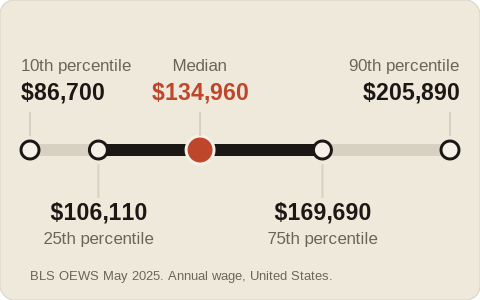
| Measure | Annual wage |
|---|---|
| 10th percentile | $86,700 |
| 25th percentile | $106,110 |
| Median (50th) | $134,960 |
| Mean (average) | $142,060 |
| 75th percentile | $169,690 |
| 90th percentile | $205,890 |
Source: U.S. Bureau of Labor Statistics, Occupational Employment and Wage Statistics (OEWS), May 2025, Aerospace Engineers, retrieved 23 to 25 November 2026 from the BLS OEWS May 2025 national, state and metropolitan area files.
Aerospace Engineer hourly pay
The median hourly wage for aerospace engineers is $64.89, as published by BLS for May 2025. That is the hourly view of the same national middle as the $134,960 annual median above, so use it when an employer quotes you a rate and not a salary. Annual pay for a job with part-time or shift work depends on the hours you are given, which no national table can tell you.
| Measure | Per hour |
|---|---|
| 10th percentile | $41.68 |
| 25th percentile | $51.01 |
| Median (BLS hourly figure) | $64.89 |
| 75th percentile | $81.58 |
| 90th percentile | $98.99 |
For aerospace engineers the median is the hourly wage BLS publishes. The other rows are our division of the BLS annual percentiles by 2,080 hours, the full-time year BLS uses to turn hourly pay into annual pay.
Aerospace Engineer salary by state
Where you work changes the number more than most things. The highest published median is in Minnesota, at $159,060. The lowest published median is in Wisconsin, at $88,400, a gap of $70,660 a year between two states. The gap is our subtraction of two BLS state medians. All figures below are the annual median wage in each state for May 2025.
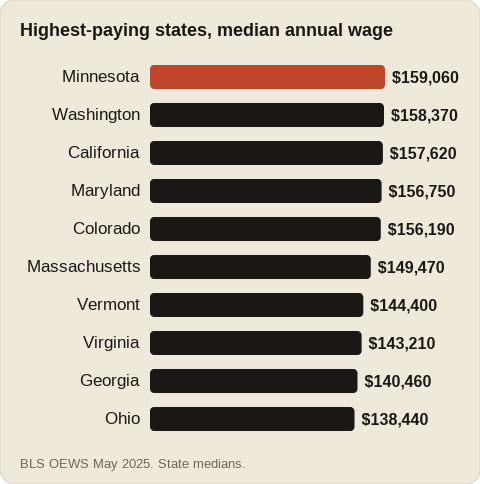
Top-paying states for aerospace engineers
| Rank | State | Median wage | vs US median |
|---|---|---|---|
| 1 | Minnesota | $159,060 | +$24,100 |
| 2 | Washington | $158,370 | +$23,410 |
| 3 | California | $157,620 | +$22,660 |
| 4 | Maryland | $156,750 | +$21,790 |
| 5 | Colorado | $156,190 | +$21,230 |
| 6 | Massachusetts | $149,470 | +$14,510 |
| 7 | Vermont | $144,400 | +$9,440 |
| 8 | Virginia | $143,210 | +$8,250 |
| 9 | Georgia | $140,460 | +$5,500 |
| 10 | Ohio | $138,440 | +$3,480 |
Aerospace Engineer salary by state
| State | Median annual wage |
|---|---|
| Minnesota | $159,060 |
| Washington | $158,370 |
| California | $157,620 |
| Maryland | $156,750 |
| Colorado | $156,190 |
| Massachusetts | $149,470 |
| Vermont | $144,400 |
| Virginia | $143,210 |
| Georgia | $140,460 |
| Ohio | $138,440 |
| Hawaii | $137,240 |
| South Carolina | $137,030 |
| Louisiana | $136,970 |
| Utah | $135,840 |
| Nebraska | $135,670 |
| Pennsylvania | $133,940 |
| New Mexico | $132,850 |
| Missouri | $130,680 |
| Kansas | $130,330 |
| New York | $130,330 |
| Texas | $130,270 |
| Connecticut | $129,500 |
| Florida | $129,280 |
| Michigan | $128,960 |
| Tennessee | $128,510 |
| Alabama | $127,540 |
| New Jersey | $126,430 |
| Kentucky | $126,130 |
| Oklahoma | $125,470 |
| Oregon | $124,630 |
| Arizona | $123,170 |
| North Carolina | $122,930 |
| Mississippi | $109,200 |
| Illinois | $108,940 |
| Indiana | $107,400 |
| Arkansas | $102,040 |
| Alaska | $101,710 |
| Nevada | $96,730 |
| Idaho | $95,700 |
| Wisconsin | $88,400 |
| Delaware | Not published by BLS |
| Iowa | Not published by BLS |
| Maine | Not published by BLS |
| Montana | Not published by BLS |
| New Hampshire | Not published by BLS |
| North Dakota | Not published by BLS |
| Rhode Island | Not published by BLS |
| South Dakota | Not published by BLS |
| West Virginia | Not published by BLS |
| Wyoming | Not published by BLS |
BLS does not publish a figure for Delaware, Iowa, Maine, Montana, New Hampshire, North Dakota, Rhode Island, South Dakota, West Virginia, Wyoming, usually because there are too few aerospace engineers in the survey sample to report one safely.
Top-paying metro areas for aerospace engineers
| Metro area | Median wage | Employed |
|---|---|---|
| San Francisco-Oakland-Fremont, CA | $191,260 | 510 |
| San Jose-Sunnyvale-Santa Clara, CA | $181,630 | 930 |
| Omaha, NE-IA | $171,380 | n/a |
| Boulder, CO | $167,160 | 800 |
| Baltimore-Columbia-Towson, MD | $166,980 | 1,220 |
| Washington-Arlington-Alexandria, DC-VA-MD-WV | $166,420 | 2,420 |
| Seattle-Tacoma-Bellevue, WA | $163,580 | 5,480 |
| Los Angeles-Long Beach-Anaheim, CA | $163,280 | 5,200 |
| Minneapolis-St. Paul-Bloomington, MN-WI | $159,950 | 120 |
| Denver-Aurora-Centennial, CO | $156,190 | 2,010 |
BLS publishes the aerospace engineer median for 89 metro areas; the national median is $134,960. 1 of these ten count fewer than 100 aerospace engineers or have no published headcount, so treat them as rough. Source: U.S. Bureau of Labor Statistics, OEWS May 2025, metropolitan area estimates.
Compare aerospace engineer pay
Put two states side by side, or set aerospace engineers next to another job. Every figure is from BLS OEWS May 2025.
| Measure | Minnesota | Wisconsin |
|---|---|---|
| Median annual wage | $159,060 | $88,400 |
| Median hourly wage | $76.47 | $42.50 |
| 10th percentile | $85,330 | $65,720 |
| 25th percentile | $100,300 | $73,940 |
| 75th percentile | $180,350 | $131,400 |
| 90th percentile | $194,950 | $147,560 |
| Employed, May 2025 | 140 | 120 |
The Minnesota median is $70,660 a year higher. That difference is our subtraction of two BLS state medians. n/a means this page has only the BLS median for that state so far, or BLS released no figure for it. Source: BLS OEWS May 2025, Aerospace Engineers.
Starting pay for aerospace engineers
BLS does not publish pay by years of experience, so nobody can honestly quote an official entry-level aerospace engineer salary. What the data gives is the bottom of the market. One in ten aerospace engineers earns $86,700 or less, and one in four earns $106,110 or less. Read those as the low end of the national range, not as what a new graduate will be offered, because older workers sit in the bottom tenth too.
Research labs pay more than the aircraft plants
The OOH lists five industry medians for aerospace engineers, and the factory floor is not on top. Research and development in the physical, engineering and life sciences leads at $149,260, then the federal government at $142,630, aerospace product and parts manufacturing at $137,030, engineering services at $132,440 and instruments manufacturing at $126,740.
Manufacturing is still where the jobs are, with 38 percent of aerospace engineers, against 8 percent in research and development. The federal government is a real option at 15 percent of jobs, and it pays above the $134,960 national median. BLS does not say which agencies hire them.
Clearance, citizenship and the defense side of the job
Aerospace engineers design military airplanes, helicopters, missiles and rockets as well as commercial aircraft and satellites. On national defense projects BLS says a security clearance may be needed, and some types and levels of clearance require U.S. citizenship. That makes citizenship a hard gate for part of the job market, not a preference.
BLS does not say what share of positions need a clearance, or whether cleared engineers earn more. On the growth side, BLS points to quieter and more fuel efficient aircraft, cheaper satellite launches, small commercial satellites, and drones for uses such as forest fire detection.
How aerospace pay compares, and where it clusters
The aerospace median of $134,960 sits $30,850 above the mechanical engineer median of $104,110 and $14,330 above the electrical engineer median of $120,630, by our subtraction of BLS figures. The hourly median is $64.89.
San Francisco-Oakland-Fremont, CA has the highest metro median at $191,260. The two largest groups on the top-paying list are Seattle-Tacoma-Bellevue, WA, about 5,480 jobs, and Los Angeles-Long Beach-Anaheim, CA, about 5,200. BLS did not publish a job count for Omaha, NE-IA, so treat that median as rough. BLS publishes a state median for 40 states.
Related jobs
- Mechanical Engineer salary and career path: On the BLS list of similar occupations; mechanical engineers design and test mechanical and thermal sensors and devices.
- Electrical Engineer salary and career path: Also on the BLS similar list; electrical engineers design, develop and test electrical and electronic equipment, components and systems.
- Aircraft Mechanic salary and career path: The hands-on side of aviation: mechanics keep aircraft flying after engineers design them.
What aerospace engineers do
Aerospace engineers design, develop and test aircraft, spacecraft, satellites and missiles, and they build and test prototypes to check that each one works as designed. Their focus can be aerodynamic fluid flow, structural design, guidance, navigation and control, instrumentation and communication, robotics, or propulsion and combustion.
BLS names two common types. Aeronautical engineers work on aircraft and flight inside the Earth's atmosphere, including propulsion systems and the aerodynamic performance of aircraft and materials. Astronautical engineers work on spacecraft and how they perform inside and outside the atmosphere, from small cubesats to large traditional satellites.
Duties BLS lists
- Coordinate and direct the design, manufacture and testing of aircraft and aerospace products
- Assess project proposals to judge whether they are technically and financially feasible
- Decide whether proposed projects will be safe and meet their defined goals
- Evaluate designs against engineering principles, customer requirements and environmental regulations
- Set criteria for design, quality, completion and sustainment after delivery
- Make sure projects meet the required standards
- Inspect malfunctioning or damaged products to find the source of a problem and possible fixes
A typical day
Most of the day is at a desk and a computer: checking a design against requirements and regulations, judging whether a proposal is feasible, writing the criteria a finished product must meet. Some days bring a trip to a client. When a test goes wrong or a part fails, the work turns to inspecting the damaged product and tracing the cause, and BLS notes that monitoring progress and troubleshooting can mean extra hours.
Where they work
- Aerospace engineers held about 68,700 jobs in 2025. Aerospace product and parts manufacturing employed 38 percent, engineering services 16 percent, the federal government 15 percent, and navigational, measuring, electromedical and control instruments manufacturing and research and development in the physical, engineering and life sciences 8 percent each.
- They typically work in an office setting, often at a computer, and may travel to meet clients.
- Most work full time and some work more than 40 hours a week, with extra hours to monitor progress and troubleshoot problems.
- Engineers on national defense projects may need a security clearance, and some types and levels of clearance require U.S. citizenship.
Source: U.S. Bureau of Labor Statistics, Occupational Outlook Handbook, Aerospace Engineers, read 25 November 2026. BLS counted about 68,700 jobs in 2025 and projects 8% growth from 2025 to 2035, much faster than the average for all occupations.
How to become an aerospace engineer: the career path
Typical entry-level education, according to BLS: bachelor's degree. BLS says the usual entry is a bachelor's degree in aerospace engineering or a related field, and some schools run a 5-year program that ends in both a bachelor's and a master's degree. Each step below comes from the BLS Occupational Outlook Handbook, and the last step is the pay.
- 1Prepare
Chemistry, physics and math in high school
BLS points students who want to study aerospace engineering toward these three subjects before college.
- 2Study
Bachelor's degree in aerospace engineering or a related field
Programs mix classroom, laboratory and field courses in stability and control, structures and mechanics. Employers may prefer programs accredited by a professional association, and some schools offer a 5-year program that leads to both a bachelor's and a master's degree.
- 3Experience
Co-op or internship
Cooperative education programs and internships, run with local businesses, give practical experience while you finish the degree.
- 4Requirements
Security clearance for defense work
Projects related to national defense may need a security clearance. Some types and levels of clearance require U.S. citizenship.
- 5License
Professional Engineering (PE) license, optional
Not required for entry-level jobs. Experienced engineers may get one to oversee other engineers, sign off on projects and serve the public. It generally takes an accredited degree, a passing score on the Fundamentals of Engineering (FE) exam, several years of work experience and a passing score on the PE exam.
- 6Advance
Technical lead, engineering manager or project manager
With experience, more education or credentials, aerospace engineers may move into technical or supervisory roles. Those with leadership skills may become engineering managers or project management specialists.
- 7Pay
Median $134,960 a year
BLS median annual wage for aerospace engineers. The lowest-paid tenth earn $86,700 or less and the highest-paid tenth earn $205,890 or more.
The next pay step
Architectural and engineering manager
$171,270 median a year
+$36,310 a year vs the aerospace engineer median
BLS says aerospace engineers with leadership skills may become engineering managers.
Pay: U.S. Bureau of Labor Statistics, OEWS May 2025, Architectural and Engineering Managers, set against Aerospace Engineers. Each difference is our subtraction of two BLS national medians, the next job's minus the aerospace engineer median.
Steps 1 to 6 for aerospace engineers: U.S. Bureau of Labor Statistics, Occupational Outlook Handbook, Aerospace Engineers, "How to Become One", read 25 November 2026. Pay step: U.S. Bureau of Labor Statistics, OEWS May 2025.
Aerospace Engineer skills and certifications
These come from the CVBooster aerospace engineer resume guide, which lists what employers look for on a aerospace engineer CV. Put the ones you really have near the top of your CV, in the words the job ad uses.
Core skills
People skills
Licenses and certifications
- Fundamentals of Engineering (FE) and Engineer in Training, National Council of Examiners for Engineering and Surveying
- Professional Engineer (PE) License, State Board of Professional Engineers
- Certified Systems Engineering Professional (CSEP), International Council on Systems Engineering
- Airframe and Powerplant Mechanic Certificate, Federal Aviation Administration
- Project Management Professional (PMP), Project Management Institute
Aerospace Engineer salary questions
How much do aerospace engineers make?
The BLS median for aerospace engineers is $134,960 a year, or $64.89 an hour, for May 2025. The lowest-paid tenth earn $86,700 or less and the top tenth $205,890 or more. Research and development employers pay the highest industry median in the OOH list.
Which state pays aerospace engineers the most?
Of the 40 states with a published figure, Minnesota leads at $159,060, followed by Washington at $158,370 and California at $157,620. The top five sit within a few thousand dollars of each other. For the remaining states BLS published no median at all.
Do aerospace engineers need a security clearance?
Not always. BLS says engineers on projects related to national defense may need one, and some types and levels of clearance require U.S. citizenship. The federal government employs 15 percent of aerospace engineers, and defense work also runs through private manufacturers.
Do aerospace engineers need a PE license?
No, not to start. BLS says licensure is not required for entry-level aerospace jobs. An experienced engineer may earn a PE license to oversee other engineers, sign off on projects and serve the public directly, after the FE exam, several years of work and the PE exam.
Do aerospace engineers earn more than mechanical engineers?
On BLS medians, yes. Aerospace engineers sit at $134,960 and mechanical engineers at $104,110, a gap of $30,850 a year by our subtraction. Mechanical engineers are on the BLS list of occupations similar to aerospace, and both start from an engineering bachelor's degree.
Is aerospace engineering a growing field?
BLS projects employment to grow 8 percent from 2025 to 2035, much faster than the average, with about 3,800 openings a year. It ties the demand to quieter, more fuel efficient aircraft, cheaper satellite launches and drones for uses such as forest fire detection.
Sources and method
- Pay: U.S. Bureau of Labor Statistics, Occupational Employment and Wage Statistics (OEWS), May 2025, Aerospace Engineers (SOC 17-2011), national, state and metro area estimates, retrieved 23 to 25 November 2026 from the BLS OEWS May 2025 national, state and metropolitan area files. Wages are before tax. BLS defines what its wage figure includes and leaves out in the OEWS technical notes.
- The job, the route in and the outlook: U.S. Bureau of Labor Statistics, Occupational Outlook Handbook, Aerospace Engineers, read 25 November 2026.
- Skills and certifications: the CVBooster aerospace engineer resume guide.
- Where we subtract or divide two BLS figures on this aerospace engineer page, the page says so. The pay check is an estimate between the published BLS percentiles for aerospace engineers and says so. Nothing else here is estimated.
Aerospace Engineer CV example
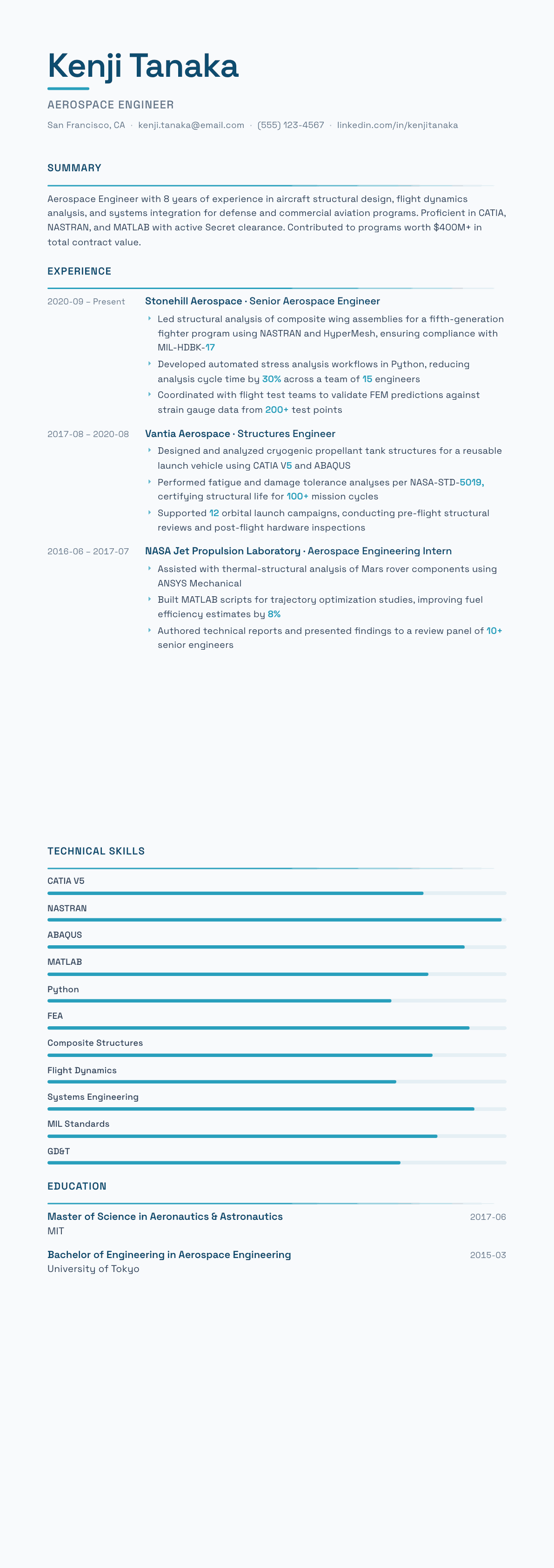
The CVBooster aerospace engineer resume guide has a finished example, three written summaries, before and after bullets and answers to the questions people ask.
Build your aerospace engineer CV
Create my CV