Lineman Salary, Career Path and CV
By CVBooster TeamPublished Updated
The median lineman salary in the United States is $95,320 a year, or $45.83 an hour, according to the U.S. Bureau of Labor Statistics (BLS), OEWS May 2025. That is the national middle: states, employers and hours move it, and BLS publishes nothing by years of experience. BLS calls the job electrical power-line installer and repairer. The pay is high for a job you can start with a high school diploma, and it comes with live wires, heights and storm callouts.
Below: a check of your own pay, the pay percentiles, hourly pay, pay in every state, the top-paying metro areas, what linemen do, how to become a lineman, the skills that go on a CV, and a CV example.
- Median annual pay
- $95,320
- Median hourly pay
- $45.83
- Employed, May 2025
- 131,070
Am I underpaid as a lineman?
Pick your state and type your pay. You get your place in the BLS pay range for linemen there, as a percentile.
Lineman salary in the United States
The BLS counts linemen in the occupation Electrical Power-Line Installers and Repairers (SOC 49-9051). Half of them earn less than $95,320 a year and half earn more. The average, which a few very high earners pull up, is $91,970. The lowest-paid tenth earn $51,470 or less, and the highest-paid tenth earn $128,690 or more, which is about 2.5 times as much. The ratio is our arithmetic on two BLS figures.
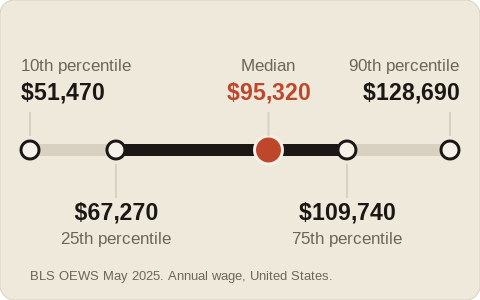
| Measure | Annual wage |
|---|---|
| 10th percentile | $51,470 |
| 25th percentile | $67,270 |
| Median (50th) | $95,320 |
| Mean (average) | $91,970 |
| 75th percentile | $109,740 |
| 90th percentile | $128,690 |
Source: U.S. Bureau of Labor Statistics, Occupational Employment and Wage Statistics (OEWS), May 2025, Electrical Power-Line Installers and Repairers, retrieved 23 to 25 November 2026 from the BLS OEWS May 2025 national, state and metropolitan area files.
Lineman hourly pay
The median hourly wage for linemen is $45.83, as published by BLS for May 2025. That is the hourly view of the same national middle as the $95,320 annual median above, so use it when an employer quotes you a rate and not a salary. Annual pay for a job with part-time or shift work depends on the hours you are given, which no national table can tell you.
| Measure | Per hour |
|---|---|
| 10th percentile | $24.75 |
| 25th percentile | $32.34 |
| Median (BLS hourly figure) | $45.83 |
| 75th percentile | $52.76 |
| 90th percentile | $61.87 |
For linemen the median is the hourly wage BLS publishes. The other rows are our division of the BLS annual percentiles by 2,080 hours, the full-time year BLS uses to turn hourly pay into annual pay.
Lineman salary by state
Where you work changes the number more than most things. The highest median is in Hawaii, at $134,340. The lowest published median is in Arizona, at $75,420, a gap of $58,920 a year between two states. The gap is our subtraction of two BLS state medians. All figures below are the annual median wage in each state for May 2025.
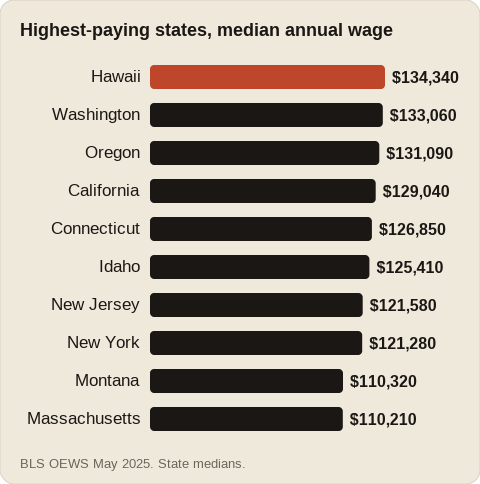
Top-paying states for linemen
| Rank | State | Median wage | vs US median |
|---|---|---|---|
| 1 | Hawaii | $134,340 | +$39,020 |
| 2 | Washington | $133,060 | +$37,740 |
| 3 | Oregon | $131,090 | +$35,770 |
| 4 | California | $129,040 | +$33,720 |
| 5 | Connecticut | $126,850 | +$31,530 |
| 6 | Idaho | $125,410 | +$30,090 |
| 7 | New Jersey | $121,580 | +$26,260 |
| 8 | New York | $121,280 | +$25,960 |
| 9 | Montana | $110,320 | +$15,000 |
| 10 | Massachusetts | $110,210 | +$14,890 |
Lineman salary in all 50 states
| State | Median annual wage |
|---|---|
| Hawaii | $134,340 |
| Washington | $133,060 |
| Oregon | $131,090 |
| California | $129,040 |
| Connecticut | $126,850 |
| Idaho | $125,410 |
| New Jersey | $121,580 |
| New York | $121,280 |
| Montana | $110,320 |
| Massachusetts | $110,210 |
| Vermont | $108,520 |
| Illinois | $108,120 |
| Michigan | $106,890 |
| Pennsylvania | $106,230 |
| Maryland | $106,090 |
| North Dakota | $105,870 |
| Wisconsin | $105,820 |
| Rhode Island | $104,620 |
| Minnesota | $104,180 |
| Colorado | $103,980 |
| New Hampshire | $102,170 |
| Indiana | $102,040 |
| Kansas | $101,620 |
| Utah | $101,220 |
| Iowa | $100,200 |
| South Dakota | $97,310 |
| Delaware | $97,180 |
| Nevada | $96,560 |
| Missouri | $96,360 |
| Wyoming | $93,860 |
| Ohio | $93,150 |
| Alaska | $92,470 |
| Nebraska | $92,150 |
| Alabama | $92,030 |
| Florida | $86,870 |
| West Virginia | $83,810 |
| Tennessee | $83,660 |
| Maine | $83,090 |
| Arkansas | $81,450 |
| Georgia | $80,080 |
| Texas | $78,940 |
| North Carolina | $77,270 |
| Kentucky | $77,020 |
| South Carolina | $76,870 |
| Virginia | $76,590 |
| New Mexico | $76,470 |
| Louisiana | $76,410 |
| Oklahoma | $76,010 |
| Mississippi | $75,890 |
| Arizona | $75,420 |
Top-paying metro areas for linemen
| Metro area | Median wage | Employed |
|---|---|---|
| San Jose-Sunnyvale-Santa Clara, CA | $157,620 | 300 |
| Eugene-Springfield, OR | $140,270 | 120 |
| San Francisco-Oakland-Fremont, CA | $137,180 | 770 |
| Olympia-Lacey-Tumwater, WA | $135,450 | 50 |
| Kiryas Joel-Poughkeepsie-Newburgh, NY | $135,400 | 240 |
| Portland-Vancouver-Hillsboro, OR-WA | $135,300 | 810 |
| Urban Honolulu, HI | $135,080 | 450 |
| El Centro, CA | $134,950 | 40 |
| Salem, OR | $134,500 | 180 |
| Fresno, CA | $134,150 | 230 |
BLS publishes the lineman median for 261 metro areas; the national median is $95,320. 2 of these ten count fewer than 100 linemen or have no published headcount, so treat them as rough. Source: U.S. Bureau of Labor Statistics, OEWS May 2025, metropolitan area estimates.
Compare lineman pay
Put two states side by side, or set linemen next to another job. Every figure is from BLS OEWS May 2025.
| Measure | Hawaii | Arizona |
|---|---|---|
| Median annual wage | $134,340 | $75,420 |
| Median hourly wage | $64.59 | $36.26 |
| 10th percentile | $81,120 | $48,760 |
| 25th percentile | $99,170 | $57,800 |
| 75th percentile | $135,510 | $100,330 |
| 90th percentile | $144,170 | $124,300 |
| Employed, May 2025 | 600 | 3,360 |
The Hawaii median is $58,920 a year higher. That difference is our subtraction of two BLS state medians. n/a means this page has only the BLS median for that state so far, or BLS released no figure for it. Source: BLS OEWS May 2025, Electrical Power-Line Installers and Repairers.
Starting pay for linemen
BLS does not publish pay by years of experience, so nobody can honestly quote an official entry-level lineman salary. What the data gives is the bottom of the market. One in ten linemen earns $51,470 or less, and one in four earns $67,270 or less. Read those as the low end of the national range, not as what a new graduate will be offered, because older workers sit in the bottom tenth too.
Utility or contractor
Who signs the paycheck matters a lot here. BLS industry medians are $111,900 in the federal government, $103,060 at utilities, $90,060 in local government, $76,980 at specialty trade contractors and $76,060 in utility system construction.
Utilities employ half of all linemen and pay well above the construction side, which holds another 29 percent of the jobs. BLS does not publish overtime pay, but it does say some linemen work more than 40 hours a week, and after storms or other disasters crews may travel and work long hours for several days in a row. That storm work is part of why two linemen with the same base can end the year far apart.
Hawaii and the West Coast lead
Hawaii has the top state median at $134,340, with Washington ($133,060), Oregon ($131,090) and California ($129,040) close behind. The lowest published state median is Arizona at $75,420.
The highest metro median is San Jose-Sunnyvale-Santa Clara, CA at $157,620. Among the top ten metros, the largest groups of linemen are in Portland-Vancouver-Hillsboro, OR-WA (about 810) and San Francisco-Oakland-Fremont, CA (about 770). Olympia-Lacey-Tumwater, WA and El Centro, CA count fewer than a hundred, and BLS metro medians for groups that small are estimates.
Lineman, electrician or electrical engineer
BLS lists both electricians and electrical engineers as similar occupations. Electricians, who install, maintain and repair electrical power, communications, lighting and control systems, have a national median of $63,190, which is $32,130 less than the lineman median of $95,320, by our subtraction. Both trades usually start with a high school diploma and an apprenticeship.
Electrical and electronics engineers need a bachelor's degree; the electrical engineer median is $120,630. The lineman hourly median is $45.83, and the road to it runs through on-the-job training and technical instruction instead of a 4-year degree. BLS does not say what apprentices are paid along the way.
Related jobs
- Electrician salary and career path: BLS lists it as similar: electricians handle power, lighting and control systems, and the median is lower.
- Electrical Engineer salary and career path: BLS lists it as similar: the engineers design the electrical systems, on a bachelor's degree.
What linemen do
Linemen install and repair the cables and wires of the power grid, the network that carries electricity from generating plants to homes and businesses, and they may erect the poles and transmission towers that hold it up. They routinely work with high-voltage electricity, which BLS says requires extreme caution.
Crews on the interstate grid travel across a region to service transmission lines and towers. Linemen at local utilities look after transformers, voltage regulators and switches, and may also work on traffic lights and street lights. Work starts from outage reports from remote monitoring, aerial inspections and customers, and a fix begins with diagnostic testing to find the cause.
Duties BLS lists
- Install, maintain and repair the power lines that move electricity
- String cable and wires between poles, towers and buildings
- Find defective devices, voltage regulators, transformers and switches
- Inspect and test power lines and auxiliary equipment
- Climb poles and towers, or use truck-mounted buckets to reach equipment
- Operate power equipment to install and repair poles, towers and lines
A typical day
A new job may start at ground level, digging trenches or setting poles with trucks fitted with augers and cranes. Repair work starts with an outage report and a diagnostic test. Then the crew goes up, usually in a bucket truck, sometimes by climbing the pole or tower in fall-protection gear, and works the line with insulated tools. It happens outdoors in rain and wind, and after a storm it can mean travel to the damaged area and long days several in a row.
Where they work
- Utilities employed 50 percent of electrical power-line installers and repairers, utility system construction 29 percent, local government 10 percent, specialty trade contractors 6 percent and the federal government 2 percent.
- The work is physically demanding, at great heights and in confined spaces, and calls for climbing and balancing on poles and towers.
- Contact with a live high-voltage cable can electrocute. Insulated protective devices and tools, fall-protection equipment and safety training reduce the danger.
- Most work full time and some work more than 40 hours a week. Crews on the interstate grid may travel long distances.
Source: U.S. Bureau of Labor Statistics, Occupational Outlook Handbook, Electrical Power-Line Installers and Repairers, read 25 November 2026. BLS counted about 131,900 jobs in 2025 and projects 10% growth from 2025 to 2035, much faster than the average for all occupations.
How to become a lineman: the career path
Typical entry-level education, according to BLS: high school diploma or equivalent. Apprenticeships and other employer training programs may last up to 3 years, and BLS says qualified apprentices reach the journey level after 3 or 4 years of working. Each step below comes from the BLS Occupational Outlook Handbook, and the last step is the pay.
- 1Requirements
High school diploma, algebra helps
A high school diploma or equivalent is the typical entry. Employers may prefer basic algebra and trigonometry, and technical knowledge of electricity from the military, vocational programs or community colleges may help.
- 2Or train
Community college lineworker program
Some community colleges offer a 1-year certificate or a 2-year associate's degree covering electrical distribution, line construction and pole top and bucket rescue, sometimes with an internship or fieldwork.
- 3Train
Apprenticeship
Apprenticeships or employer programs of up to 3 years combine on-the-job training with technical instruction, sometimes run jointly by the employer and the union. Entry may require a year of high school algebra, a qualifying aptitude test score, a substance abuse screening and a fitness test.
- 4License
Commercial driver's license
Workers who drive heavy vehicles usually need a state CDL, and crews crossing state lines need an interstate CDL. Line certification itself is available but not mandatory; other rules such as minimum age vary by state.
- 5Advance
Journey level, then supervisor or trainer
After 3 or 4 years of working, qualified apprentices reach the journey level and can do most tasks without supervision. Experienced linemen may become supervisors or trainers.
- 6Pay
Median $95,320 a year
BLS median annual wage for linemen. The lowest-paid tenth earn $51,470 or less and the highest-paid tenth earn $128,690 or more.
The next pay step
Line crew supervisor
$79,860 median a year
-$15,460 a year vs the lineman median
BLS says experienced electrical power-line installers and repairers may become supervisors or trainers.
Pay: U.S. Bureau of Labor Statistics, OEWS May 2025, First-Line Supervisors of Mechanics, Installers, and Repairers, set against Electrical Power-Line Installers and Repairers. Each difference is our subtraction of two BLS national medians, the next job's minus the lineman median.
Steps 1 to 5 for linemen: U.S. Bureau of Labor Statistics, Occupational Outlook Handbook, Electrical Power-Line Installers and Repairers, "How to Become One", read 25 November 2026. Pay step: U.S. Bureau of Labor Statistics, OEWS May 2025.
Lineman skills and certifications
These come from the CVBooster lineman resume guide, which lists what employers look for on a lineman CV. Put the ones you really have near the top of your CV, in the words the job ad uses.
Core skills
People skills
Licenses and certifications
- Certified Utility Safety Professional (CUSP), Utility Safety and Ops Leadership Network
- Power Line Worker Certification, NCCER
- Commercial Driver License Class A, State department of motor vehicles
- First Aid, CPR and AED, American Red Cross
Lineman salary questions
How much do linemen make a year?
Electrical power-line installers and repairers had a median of $95,320 in May 2025 and a mean of $91,970. The lowest tenth earned under $51,470, the highest tenth over $128,690. The federal government and utilities are the best-paying employers BLS lists.
How much does a lineman make an hour?
The BLS hourly median is $45.83. Half of linemen earn more than that and half less. Storm restoration and other emergency work can mean long hours several days in a row, but BLS does not publish what those extra hours pay.
How long is a lineman apprenticeship?
BLS says apprenticeships and other employer-sponsored programs may last up to 3 years, mixing on-the-job training with technical instruction. Qualified apprentices reach the journey level after 3 or 4 years of working, at which point they can do most tasks without supervision.
Do you need a degree to be a lineman?
No. The typical entry is a high school diploma or equivalent, followed by an apprenticeship. Some community colleges offer a 1-year certificate or 2-year associate's degree in line work, and employers may prefer applicants who know basic algebra and trigonometry.
Which state pays linemen the most?
Hawaii leads with a median of $134,340, followed by Washington at $133,060 and Oregon at $131,090. The lowest published figure is Arizona at $75,420, so the spread between states is wide.
Is being a lineman dangerous?
BLS says linemen face serious hazards. Touching a live high-voltage cable can electrocute, and the work is done at great heights. Insulated tools and protective devices, fall-protection equipment, safety procedures and training have reduced the danger, but the job still demands extreme caution.
Sources and method
- Pay: U.S. Bureau of Labor Statistics, Occupational Employment and Wage Statistics (OEWS), May 2025, Electrical Power-Line Installers and Repairers (SOC 49-9051), national, state and metro area estimates, retrieved 23 to 25 November 2026 from the BLS OEWS May 2025 national, state and metropolitan area files. Wages are before tax. BLS defines what its wage figure includes and leaves out in the OEWS technical notes.
- The job, the route in and the outlook: U.S. Bureau of Labor Statistics, Occupational Outlook Handbook, Electrical Power-Line Installers and Repairers, read 25 November 2026.
- Skills and certifications: the CVBooster lineman resume guide.
- Where we subtract or divide two BLS figures on this lineman page, the page says so. The pay check is an estimate between the published BLS percentiles for linemen and says so. Nothing else here is estimated.
Lineman CV example

The CVBooster lineman resume guide has a finished example, three written summaries, before and after bullets and answers to the questions people ask.
Build your lineman CV
Create my CV